Musk Posted a Recruitment Ad for SpaceX, and After Reading the Comments Section, I Understood

marsbitPublié le 2026-05-21Dernière mise à jour le 2026-05-21

Résumé

On May 20th, SpaceX filed for a landmark IPO with a $1.75 trillion valuation. Shortly after, Elon Musk posted a recruitment call on X, seeking "world-class engineers and physicists" for SpaceX. The application process was starkly simple: email with three bullet points proving "exceptional ability," with real, complex projects as a plus. Musk promised to review qualifying emails himself. The post garnered millions of views and thousands of replies, revealing a spectrum of responses. Most comments, including a highly-upvoted humorous one listing absurd "skills," merely listed credentials or experiences in a conventional, non-differentiating way. This highlighted a key insight: a traditional resume listing degrees and skills often fails to demonstrate true exceptionalism. Effective self-presentation requires "performance efficiency." A standout reply came from an OpenAI engineering lead, who simply stated "codex." This demonstrated that for those who have built significant, recognized products, the product itself becomes the ultimate resume. The article argues that in the AI era, any tangible, shareable output—a tool, research, or online project—serves as a living, self-evident credential more powerful than a list of attributes. However, a twist emerged when applicants found the provided email address non-functional, leading to speculation that the post might also serve as an IPO publicity stunt, projecting an image of aggressive talent acquisition to investors. Ultimately, t...

Author: Curry, Deep Chao TechFlow

On May 20th after US market close, SpaceX submitted its prospectus to the SEC with a valuation of $1.75 trillion, aiming to list on NASDAQ in June.

This is undoubtedly the largest IPO in history, likely surpassing Saudi Aramco's $29 billion fundraising record set six years ago.

Less than a day after the prospectus was submitted, on the afternoon of May 21st, Musk posted a recruitment message on X.

The gist was that SpaceX is hiring world-class engineers and physicists. Zero experience in AI is fine because smart people learn fast. The application method is incredibly simple:

Send an email listing three bullet points proving you have exceptional ability.
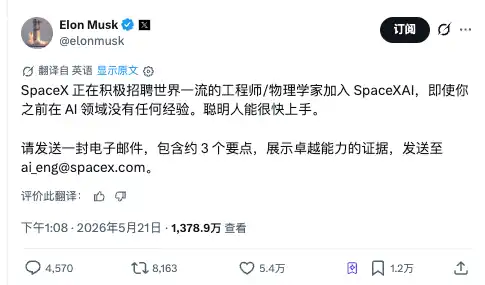
Additionally, Musk noted that having built "something very complex and actually functional" is a plus. Emails passing the basic screening will be reviewed by Musk personally. By the time I wrote this article, the post had over 13 million views and 4,500 replies.

Musk's recruitment stance seems very appealing. Degrees, companies, ten years of experience don't matter, only whether you have "exceptional ability." But upon closer thought, you realize this is actually a much harsher filter than conventional recruitment.

Do you think using 3 bullet points to explain your outstanding qualities is simple or difficult?

A conventionally formatted resume is at least one page long: positions and achievements from past jobs, alma mater, tools you know, awards won... piled together it looks full, but perhaps not a single line directly proves you are "exceptional."

Scrolling through the comments section, you'll also find the vast majority of people cannot do this.

Resumes Are Actually About "Performance Efficiency"

I scrolled through the comments section and roughly understood.

With 4,500 replies, you can probably guess the style—mostly witty one-liners. Currently, the top-rated reply is from a user named Greg who posted a so-called "resume," looking utterly absurd:
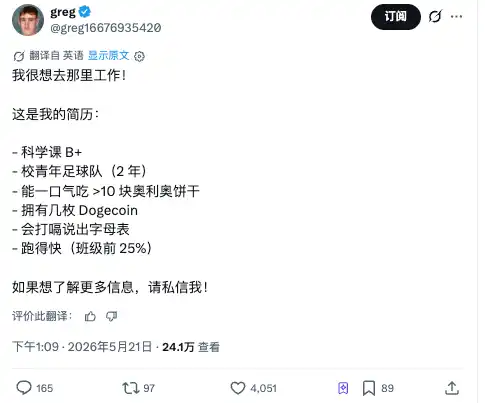
Pure self-deprecating meme is quite funny, and the answer is obviously just a joke, but it also acts as a mirror. Think carefully, the resumes I've submitted in the past seem essentially no different from this?

Replace the content of this resume: top university computer science major GPA 3.8, two years on the school basketball team, proficient in Python and Java, self-studied CFA Level 1, top fifty in school sports meet...

The format is identical, the logic is identical, only the content is less outrageous, but the essence remains listing everything you have point by point indiscriminately.

From Musk's perspective, your Python skill level versus your ability to burp the alphabet—the difference isn't actually that significant.

The comments section isn't just full of jokers. Some seriously posted their degree certificates, others threw in their child's Ivy League acceptance letter, some posted passport photos asking for work visas, and others listed paper publications and conference talks...

Compared to the jokers, these people are surely sincere about applying.

But step back and look: what they are doing is the same as that absurd joke post: listing credentials, piling up experiences, indiscriminately listing any possible shining point, hoping to create an impression of "I am excellent."

Musk asked: what have you built that is complex and useful enough. A typical interviewer in our daily lives might not be that demanding, but similarly hopes for stronger relevance in a resume.

Simply put, a resume is a performance, and performance is about efficiency. What can efficiently impress the other party most of the time is not necessarily long-winded explanations.

Product, The Better Resume

There's actually another highly upvoted comment in the section that I think perfectly satisfies the request in Musk's post: "Please use 3 bullet points to prove your excellence."

And this person even used just 1 bullet point, typing just 1 word:

codex.

Clicking into his profile, I checked—Tibo (full name Thibault Sottiaux) is an Engineering Lead at OpenAI, currently leading the Codex team. Codex is one of the most powerful AI programming tools and something developers worldwide use daily.
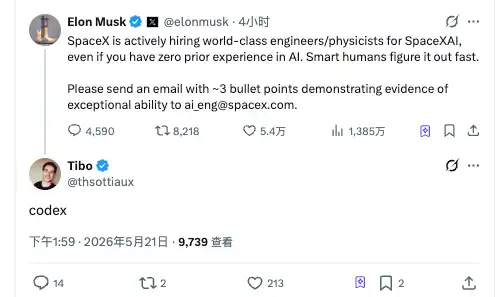
A product name is the entire resume.

The more you need to explain who you are, the less likely you are the person Musk is looking for. People who have truly built things, their name itself is evidence, the product itself is the bullet point. But you might say, he's a project lead at OpenAI, excellent enough to have the capital to reply with just one word. Ordinary people don't have that kind of confidence.

Think from another angle: Tibo can reply like that because he has something others have used, validated, that requires no self-explanation. That thing speaks for him.

Of course, elitism is not to be encouraged, but most of us aren't big shots. Yet sometimes we also just need to productize ourselves, to let the things we've done prove ourselves in a more efficient way.

Pushing this idea one layer down, it's actually unrelated to seniority.

You spent a weekend using vibe coding to build a small tool, consistently shared it and people use it—that's a kind of product; you wrote an industry research post on social media that got cited—that's also a kind of product.

These things are of course small compared to Codex, but they share a common trait: they are things you made, visible to others, requiring no explanation from you.

In the AI era, every work, every output, every tangible result you leave online that others can point to is, in a way, a living resume. It speaks for you.

You don't need to reach Codex's scale, but you should at least have something that can be pointed to.

So, the attachments in resumes today—they themselves might be the better resume.

But, Is the Recruitment Real?

The story actually has a tail end here.

In the comments section, someone, after reading Musk's post, seriously wrote an email and sent it to the address [email protected], only to find it bounced back. The system indicated the address doesn't exist...
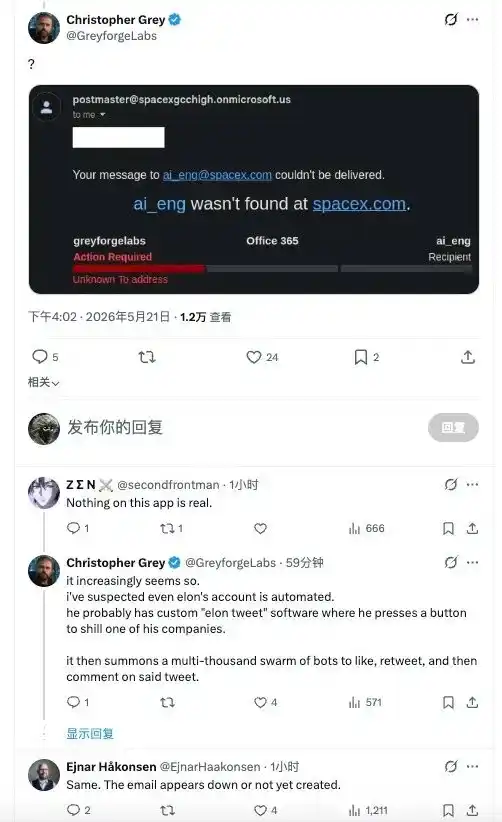
Some suspect Musk's account itself is automated, the recruitment email isn't set up yet, but the recruitment announcement went out first; others think recruiting around an IPO is part of the IPO roadshow, projecting an image of attracting top talent to strengthen the team.

Investors will certainly see Musk's post. So whether the recruitment itself is real can be set aside for now, but the posture the post conveys—"SpaceX is poaching talent"—is clear.

So, is this recruitment post actually hiring or doing a roadshow?

Perhaps the difference between the two isn't that big. In Musk's world, a single tweet can simultaneously be a job posting, an investor relations statement, and a brand advertisement. You see three bullet points; investors see "this company has the ability to attract the world's best talent."

Reading the post and the comments gives a sense of enlightenment. The witty one-liners, the one-word "Codex" self-proof, the bounced emails where applications fail—these are actually three types of roles on the same stage.

Some come to perform, some come to prove themselves, some discover the stage set seems to be made of cardboard...

In an era of scarce attention and cheap content output, finding one's own position and value remains the long-term homework we must do.


Questions liées

QAccording to the article, what was the most effective response to Elon Musk's SpaceX job posting on X, and why was it considered so powerful?

AThe most effective response was from Tibo (Thibault Sottiaux), the engineering lead of OpenAI's Codex team. He simply replied 'codex'. This was powerful because a single word referenced a globally used and complex product he led, which served as irrefutable, self-explanatory proof of his 'exceptional ability'. It demonstrated that a tangible, successful product is the ultimate resume.

QHow does the author describe the fundamental problem with most traditional resumes and the typical responses to Musk's post?

AThe author argues that traditional resumes and many responses to the post follow the same flawed logic: they provide an 'undifferentiated list' of qualifications, degrees, skills, and experiences. This is akin to the satirical resume listing skills like 'burping the alphabet'. The issue is this approach merely proves you have attributes but doesn't directly or efficiently demonstrate exceptional, practical ability to build complex things.

QWhat core piece of advice does the article offer for professionals in the AI era regarding personal branding?

AThe article advises individuals to 'productize' themselves. This means creating tangible, visible outputs—like a useful tool, a well-researched report, or any shareable project—that can act as a 'live resume'. These outputs are evidence of one's abilities that 'speak for themselves' without needing lengthy personal explanation, making them a more efficient form of proof in an attention-scarce world.

QWhat suspicion did some people have about the legitimacy of the SpaceX job posting mentioned at the end of the article?

ASome people suspected the posting might not be entirely genuine. Evidence cited includes that the provided email address ([email protected]) initially bounced back as non-existent. This led to theories that the post could be automated, that the hiring process wasn't fully set up, or that it was partly a publicity move to showcase SpaceX's talent-attraction prowess to investors during its IPO roadshow.

QWhat is the 'three-act play' the author sees in the comments section of Musk's post?

AThe author sees a three-act play: 1) People 'performing' by posting humorous or generic content (like the burping resume). 2) People attempting to genuinely 'prove themselves' by listing credentials and achievements. 3) People discovering the 'stage set might be made of paper' when they find practical issues like the non-functional email address. Together, these represent different engagements with the modern challenge of proving one's value.

Lectures associées

Comment interpréter la répression sévère des courtiers transfrontaliers par huit ministères ?

Une action réglementaire conjointe de huit ministères chinois, dirigée par la CSRC, vise à éliminer les activités illégales de courtage transfrontalier en valeurs mobilières. Le plan de mise en œuvre, publié le 22 mai 2026, impose des sanctions sévères à des sociétés comme Futu et Tiger Brokers pour leur exploitation sans licence sur le marché intérieur. Leurs actions ont chuté de plus de 40% en pré-marché. Le fondement juridique repose sur le principe selon que toute activité de courtage en Chine nécessite une licence locale. Ces plateformes ont illégalement recruté des clients, traité des transactions et géré des fonds pour des investisseurs résidents chinois sans autorisation. La réglementation vise à combler cette faille et à mettre fin à une ère d'exploitation "grise". Les principales motivations des autorités sont la protection de la stabilité financière et des investisseurs. Ces canaux non réglementés facilitaient des sorties de capitaux non surveillées, potentiellement risquées pour la stabilité des changes et la sécurité des réserves de change. De plus, les investisseurs étaient exposés à des risques (gel de comptes, litiges) sans protection juridique locale et à des risques pour la sécurité de leurs données. L'impact sur les entreprises concernées est immédiat et sévère : interdiction des activités en Chine, obligation de liquider les portefeuilles des clients existants (achats interdits, ventes seulement), confiscation des profits illégaux et lourdes amendes. Environ 90 000 à 95 000 clients détiendraient des actifs d'une valeur estimée entre 250 et 280 milliards de yuans via ces canaux. Cette liquidation forcée sur deux ans exercera une pression à la vente soutenue sur les actions chinoises cotées à Hong Kong (H-shares) et aux États-Unis (ADRs), en particulier dans les secteurs technologiques et de la nouvelle économie privilégiés par ces investisseurs. Cela pourrait déplacer le pouvoir de fixation des prix vers les institutions étrangères. Pour le marché intérieur, les canaux de placement transfrontaliers légaux pour les particuliers (comme Hong Kong Stock Connect, avec un seuil de 500 000 yuans, et les fonds QDII, aux quotas limités) vont connaître une demande accrue. Les fonds QDII populaires sur les actions américaines pourraient voir leurs primes sur le marché secondaire augmenter durablement en raison de la pénurie d'offre. Parallèlement, une partie des capitaux des investisseurs à forte appétence pour le risque pourrait revenir vers les actions A, potentiellement vers les secteurs technologiques de croissance comme l'IA et les semi-conducteurs, avec un risque de surévaluation. En conclusion, cette répression vise à normaliser le marché, à contrôler les risques financiers systémiques et à protéger les investisseurs, et non à fermer les canaux d'investissement transfrontaliers. Elle souligne la nécessité pour les entreprises de se conformer à la réglementation et pour les investisseurs d'utiliser les voies légales pour une protection adéquate.

链捕手Il y a 9 h

Comment interpréter la répression sévère des courtiers transfrontaliers par huit ministères ?

链捕手Il y a 9 h

Trading

Spot
Futures
活动图片