[dragon and tiger list] BTC investors made large profits, public chain EOS ranked first

Huobi ResearchPublié le 2022-03-28Dernière mise à jour le 2022-03-29

Résumé

Although the fluctuation space of BTC is small, it has continued to rise recently, and the trading day has increased significantly.

1. Market trend: standing on the 365 day moving average, profit taking increased

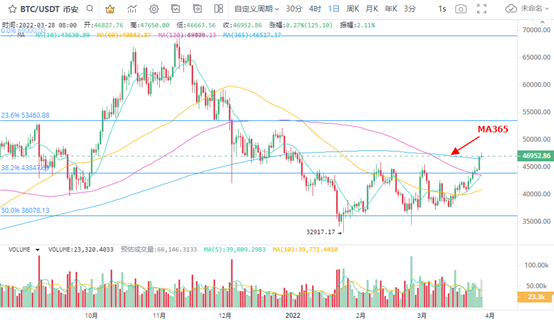
Although the fluctuation space of BTC is small, it has continued to rise recently, and the trading day has increased significantly. The price easily confirmed the breakthrough of 365 day moving average. This shows that the profitability of BTC investors has been significantly improved. At present, BTC has been in a relatively balanced state of profit within one year. Most investors make profits, but the profit space is very small. Even so, the market still better verified the reversal signal. Since 2022, BTC has confirmed the bottom pattern below the 365 day moving average, and then further strengthened the reversal pattern.
2. Message side interpretation:

Russian Presidential Assistant Dmitry medynski said that the positions of the two sides are approaching on some minor issues, but they are still "standing still" on major political issues. At the same time, the United States has cooperated with the European Union and the group of seven (G7) to impose sanctions on more than 400 Russian individuals and entities. This shows that the impact of the situation in Russia and Ukraine on the financial market has not been fundamentally improved.

For the Federal Reserve, the market bet that the probability of the Federal Reserve raising interest rates by 25 basis points in May is 28.9%, and the probability of raising interest rates by 50 basis points is 71.1%. This shows that the Fed's determination to control inflation is firm, and interest rates may rise rapidly. In the absence of new geopolitical concerns, this situation may not only put pressure on gold prices, but also affect the rising space of BTC. Especially at the capital level, the US dollar index is rising and the capital outflow from the financial market may remain high.

3. Dragon and tiger list:

Among the top currencies in the Dragon Tiger list, many currencies are related to the concept of defi. Xido led the rally significantly, so the currencies related to xido performed better. AAVE, SNx, maker, etc. are among the top ten. In terms of different ecological tokens, Boca test network represents KSM, and avalanche ecological avax ranks high. As a decentralized exchange, cake continued to rebound in technology in the short term, with a large increase.
Increase list

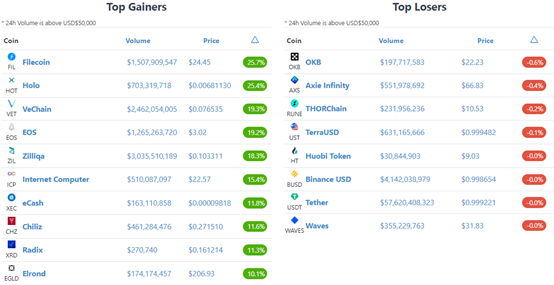
Among the top currencies, the public chain appears more frequently. The old public chains EOS, vet and ZIL performed well, and the price rise space was 19.2%, 19.3% and 18.3%. The ICP price of the new public chain also rebounded to 15.4%. From the disk trend, the current hot spots are concentrated in the undervalued plates. The price of the old public chain is low, especially in the past two years, the increase space is limited, and the make-up market is mainly reflected here.
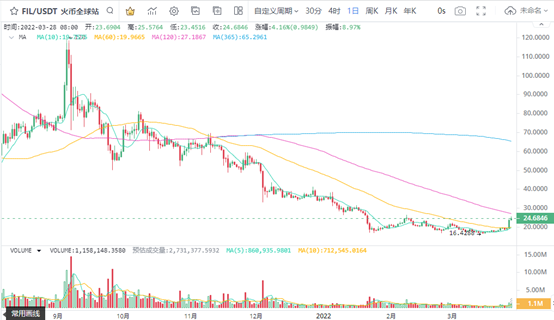
In the storage sector, fil and hot also performed well, with 24-hour price increases of 25.7% and 25.4% respectively. Fil is the leader in the storage sector, and the currency price has shown a technical rebound after hitting an all-time low of $16.4. At present, the rebound space from the bottom has reached 50%.
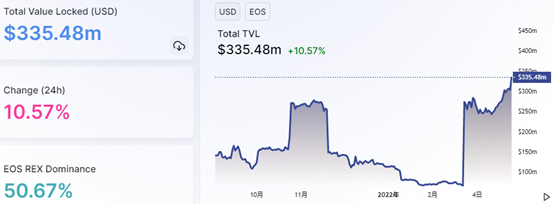
In terms of lock up data, EOS, as the lock up data of the public chain, bottomed out and rebounded, not as depressed as the price. Lock up data rose from $70 million to $335 million, up nearly 400%. From this point of view, the public chain does have lower valuation and better buying opportunities.

Decline list

Fewer currencies fell, with the top currencies platform currencies okb, HT and BNB. At the same time, gamefi concept currency AXS has a large decline, while stable currencies ust and usdt have the largest decline, and waves, which has a large increase, has also been adjusted.


Lectures associées

Securitize est entrée en bourse, le véritable « premier titre RWA » est arrivé

**Résumé : L’arrivée de la « première action RWA » sur le marché public** Le 2 juillet, Securitize a fait son entrée au NYSE sous le ticker SECZ et a simultanément émis une version tokenisée de ses actions sur les blockchains Solana et Avalanche. Ces « actions tokenisées », représentant environ 295 millions de dollars, visent à être l'équivalent numérique des actions ordinaires négociées en bourse, et non un produit synthétique. Ce cas est notable car l'émetteur lui-même pilote l'initiative, ce qui constitue un échantillon plus convaincant que les offres tierces précédentes. Cependant, l'accès est strictement régulémenté pour les investisseurs américains éligibles via la plateforme agréée de Securitize. La blockchain agit ici comme une couche d'exécution efficace pour l'enregistrement et le transfert, mais dans un cadre juridique et de conformité hybride. Cette démarche déplace le récit des « Real World Assets » (RWA) vers la classe d'actifs sensible des actions cotées, offrant un ancrage de confiance pour d'autres émetteurs. La valeur réelle de cet échantillon dépendra de la liquidité secondaire de la version tokenisée, de l'exécution effective des droits des actionnaires (dividendes, vote) et, surtout, de l'adoption future par des entreprises non natives du secteur crypto. Pour l'instant, il s'agit d'une démonstration importante testant une voie réglementée pour la représentation blockchain d'actions publiques.

marsbitIl y a 28 mins

Securitize est entrée en bourse, le véritable « premier titre RWA » est arrivé

marsbitIl y a 28 mins

Éthères à rabais : lequel choisir entre Bitmine et SharpLink ?

Dans un contexte de marché baissier pour l'ETH, les deux principales sociétés de trésorerie, SharpLink et Bitmine, enregistrent des pertes latentes supérieures à 50%. SharpLink a repris ses achats après huit mois, portant son portefeuille à 886 725 ETH, avec un coût moyen d'environ 3 609 $ et une perte latente de plus de 1,7 milliard de dollars. Bitmine détient 5,7 millions d'ETH (environ 4,7% de l'offre), avec un coût moyen d'environ 3 400 $ et une perte latente dépassant 11 milliards de dollars. Bien que leurs performances boursières et leurs coûts moyens soient similaires, leur décote par rapport à la valeur nette de l'actif (NAV) diffère fortement : environ 21% pour SharpLink contre seulement 6% pour Bitmine. Cette divergence s'explique par des capacités de financement et des liquidités distinctes. SharpLink a une histoire de levées de fonds plus modestes et progressives, tandis que Bitmine a levé de manière agressive 19,2 milliards de dollars en un an. Bitmine bénéficie également d'une liquidité boursière bien supérieure, facilitant les transactions. Les deux sociétés partagent des récits stratégiques (tokenisation RWA pour SharpLink, diversification et soutien à Ethlabs pour les deux), mais ces projets restent largement prospectifs sans impact financier immédiat. En résumé, pour une exposition indirecte à l'ETH, Bitmine offre un accès plus liquide et une décote plus faible, mais sa structure capitalistique complexe (actions prioritaires) et les survalorisations passées constituent des risques. SharpLink, avec une décote plus importante et une structure plus simple, pourrait offrir un potentiel de rebond plus fort si l'ETH se redresse, mais sa liquidité est moindre. Le choix dépend donc de la tolérance au risque et de l'horizon d'investissement.

marsbitIl y a 42 mins

Éthères à rabais : lequel choisir entre Bitmine et SharpLink ?

marsbitIl y a 42 mins

Acheter de l'ETH à prix réduit : Bitmine ou SharpLink, que choisir ?

Dans un contexte de baisse des prix de l'ETH, les deux principaux trésors institutionnels, SharpLink et Bitmine, affichent des pertes latentes supérieures à 50%. SharpLink a récemment repris ses achats après huit mois, portant son portefeuille à 886 725 ETH, avec un coût moyen d'environ 3 609 USD et une perte latente de plus de 1,7 milliard USD. Bitmine détient 5,7 millions d'ETH (environ 4,7% de l'offre), avec un coût moyen estimé à 3 400 USD et une perte latente dépassant 11 milliards USD. Bien que leurs performances boursières et leurs coûts moyens soient similaires, leur décote par rapport à la valeur nette de l'actif (NAV) diffère significativement : environ 21% pour SharpLink contre seulement 6% pour Bitmine. Cette divergence s'explique par plusieurs facteurs clés : la capacité de financement (Bitmine a levé des sommes bien plus importantes de manière agressive), la liquidité boursière (bien supérieure pour Bitmine), et la structure du capital. SharpLink mise sur un récit institutionnel incluant la tokenisation RWA, tandis que Bitmine bénéficie de son échelle et de son inclusion dans l'indice Russell 1000. Pour un investisseur, le choix dépend du profil de risque et de l'horizon temporel. Bitmine offre une liquidité et une décote réduite avantageuses pour des transactions à court terme. Cependant, sa structure financière est plus complexe (avec des actions privilégiées perpétuentes) et son cours a historiquement intégré une prime, ajoutant un risque supplémentaire. SharpLink, avec une décote plus importante et une structure capitalistique plus simple, pourrait présenter un potentiel de révaluation plus fort en cas de reprise, mais sa liquidité est moindre.

链捕手Il y a 49 mins

Acheter de l'ETH à prix réduit : Bitmine ou SharpLink, que choisir ?

链捕手Il y a 49 mins

Trading

Spot
活动图片