[Key interpretation] The expectation of the Federal Reserve's interest rate increase weakened, which was good for BTC, and LTC led the mainstream currency up

JinsPublié le 2022-12-05Dernière mise à jour le 2022-12-06

Résumé

The BTC rebound is expected to strengthen.

1. Short term rebound of BTC price

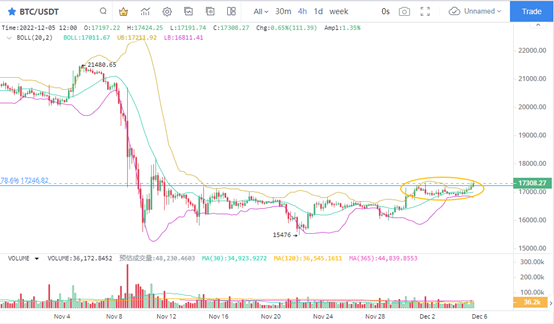
During BTC's short-term small rebound, the price reached 78.6% of the pressure level in Fibonacci, corresponding to more than $17246. This shows that in the process of continuous rebound, the price performance in the 4-hour K line chart is good, and the market is already in the process of rebound. In the absence of negative news, BTC is expected to continue this slight recovery until the price reaches the short-term pressure level. The typical daily K line level pressure is at a high of $25000, which is the reversal point prompted on August 15. In the case of regional shocks, 61.8% of the key Fibonacci accounts for US $28308, which is a pressure level that cannot be ignored.
2. Weak expectation of the Federal Reserve to raise interest rates

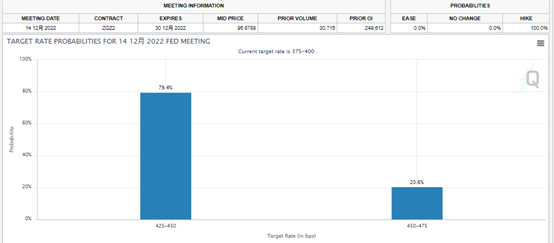
After the Federal Reserve raised interest rates by 0.75 percentage points again in November, the expectation that the Federal Reserve would continue to raise interest rates by a large margin has weakened. According to the "Fed Watch" tool of the Chicago Mercantile Exchange Group (CME), 79.4% of investors bet that they would raise interest rates by 50 basis points in December, while 20.6% of investors bet that the Fed would raise interest rates by 75 basis points in December. Judging from this, the expectation of the Federal Reserve to raise interest rates has begun to weaken. The intensity of interest rate increase was reduced, the expectation of depressing the financial market and BTC prices was reduced, and the stimulus to the rebound expectation was enhanced.

For positions, BTC and other mainstream currencies can be actively configured. Considering that it is still a long time before the Federal Reserve raises interest rates, we should not add too much money in our positions.
3. Strong ETH price performance

With the continuation of the rebound, ETH hit the pressure level of $1300, further away from the bottom area. From the current point of view, ETH is at a critical stage of bottoming success. From the perspective of growth, ETH has little short-term volatility, but the price is expected to recover. Therefore, we can pay attention to the duration and growth space of this rebound.
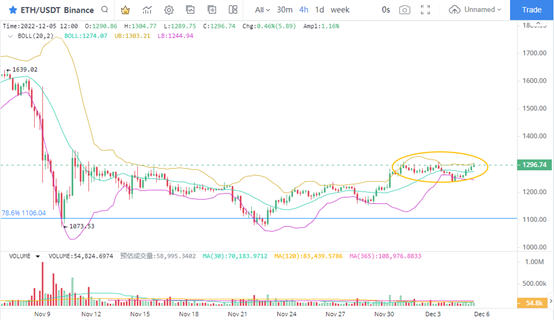
4. ETH financing interest rate rebounded

The financing interest rate of ETH rose slightly, which is different from the performance of the large drop of the financing interest rate in the early stage. In terms of value, the ETH financing interest rate remained positive for eight consecutive trading days from November 28 to December 5. Judging from the continuous rebound of financing interest rates, ETH may be on the way to rebound. The financing interest rate of ETH in September and November was as low as -0.199 and -0.06, but the price only experienced a short-term decline and then began to recover. Therefore, it is still the stage of buying ETH at a low price.
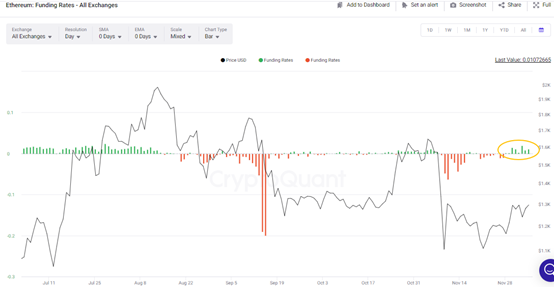
5. LTC's short-term strong recovery

With the continuous strengthening of the mainstream currency, LTC, as the leading currency, has been close to the Bollinger online track in the context of a price rise of more than 8%. From the current point of view, LTC has risen for three times. This is the third time that LTC has rebounded since it rebounded in November, and it is clear that it leads the rise. In terms of trading volume, LTC's current volume performance is the highest level since June, so the market will continue in the rising trend.
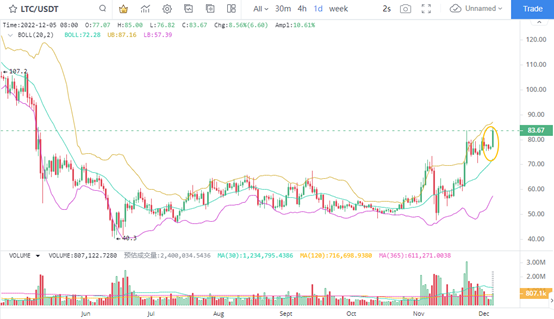

Lectures associées

La Fondation recule, Ethlabs avance : L'Ethereum connaît sa plus grande réorganisation de l'histoire

**Résumé en français :** Le 23 juin, l'écosystème Ethereum a été marqué par deux annonces majeures. D'une part, d'anciens chercheurs de l'Ethereum Foundation (EF) ont fondé Ethlabs, une organisation à but non lucratif indépendante axée sur les besoins pratiques de l'adoption institutionnelle (vitesse de règlement, émissions d'actifs, interopérabilité, scalabilité). Elle bénéficie du soutien financier de gros détenteurs d'ETH comme Bitmine et Sharplink, mais le cofondateur Vitalik Buterin n'apparaît pas parmi ses soutiens publics. D'autre part, l'Ethereum Foundation a annoncé une restructuration majeure, réduisant ses effectifs d'environ 20% (54 personnes) et se repositionnant comme un organe de gouvernance et de maintenance du protocole plus léger, cédant délibérément du terrain en tant que principal moteur de développement. Ces mouvements simultanés – l'avancée d'Ethlabs et le recul de l'EF – signalent une correction de gouvernance historique pour Ethereum. L'objectif est de passer d'un écosystème perçu comme trop centralisé autour de la Fondation et de la vision de Vitalik, et parfois lent à exécuter, vers un modèle plus décentralisé et efficace, avec des organisations spécialisées comme Ethlabs prenant en charge des fonctions d'exécution plus "terrain" et orientées marché. En somme, l'EF se concentrerait désormais à maintenir Ethereum "correct" sur le plan de la décentralisation et de la neutralité, tandis que des entités comme Ethlabs auraient pour mission de le rendre plus "efficace" en répondant aux demandes du marché et des institutions, afin de renforcer la compétitivité et l'adoption du réseau.

链捕手Il y a 6 h

La Fondation recule, Ethlabs avance : L'Ethereum connaît sa plus grande réorganisation de l'histoire

链捕手Il y a 6 h

Seconde mi-temps de la politique cryptographique américaine : La loi CLARITY tente d'obtenir 60 voix, le CFTC "comité d'une seule personne" est la plus grande inconnue

L'industrie de la cryptographie aux États-Unis attend un moment décisif avec l'avancée du projet de loi CLARITY au Sénat, qui nécessite 60 voix pour être adopté. Les républicains doivent négocier avec la Maison Blanche et rallier des sénateurs indécis. Dans un calendrier législatif chargé (seulement 40 jours de travail restants), d'autres propositions fiscales et réglementaires liées aux crypto-monnaies cherchent également à être intégrées dans des textes législatifs plus larges cette année. Un obstacle majeur est la composition incomplète de la CFTC, avec quatre postes de commissaires vacants, ce qui crée de l'incertitude. La question de la juridiction sur les marchés prédictifs (États, CFTC, SEC ou Cour suprême) reste également en suspens. Le secteur subira par ailleurs la perte de deux figures clés : la commissaire de la SEC, Hester M. Peirce, et la sénatrice Cynthia Lummis, qui ont joué un rôle central dans l'élaboration des politiques. Des experts soulignent que l'adoption de CLARITY durant cette session du Congrès est peu probable en raison des contraintes de temps et des élections. Ils estiment que des mesures fiscales ciblées sur les cryptos pourraient passer en étant intégrées à des projets de loi plus vastes. La CFTC travaille à un cadre pour les marchés prédictifs, dont le statut (infrastructure financière ou jeu) est crucial pour leur avenir. La fenêtre d'opportunité pour des progrès législatifs concrets en 2025 est étroite, exigeant une collaboration bipartite soutenue.

marsbitIl y a 8 h

Seconde mi-temps de la politique cryptographique américaine : La loi CLARITY tente d'obtenir 60 voix, le CFTC "comité d'une seule personne" est la plus grande inconnue

marsbitIl y a 8 h

Trading

Spot
Futures
活动图片