WLFI Banking License Sparks Concerns Among Trump Critics

cryptonews.ruPublié le 2026-08-24Dernière mise à jour le 2026-08-24

Résumé

The U.S. Office of the Comptroller of the Currency (OCC) has granted conditional approval to World Liberty Financial ($WLFI), a company linked to former President Donald Trump's family, to launch a trust bank. Final approval requires the firm to hire an external auditor and maintain required capital levels. Three $WLFI investors, including a son of the former president, have agreed to limit their influence over the bank's management. Under the Trump administration, the OCC approved 22 new bank charters in 19 months, a significant increase, with many going to fintech and digital asset firms like Circle and Coinbase. The company claims the federal charter will enhance regulatory oversight and help expand use of its $USD1 stablecoin, which the bank would custody. However, the Trump family connection has drawn criticism from Democrats, with concerns the stablecoin could be used to curry favor with the White House amid perceived lighter regulation. Critics, including a Brookings Institution scholar, warn of risks if the public mistakenly believes the stablecoin is government-backed. A company representative defended the move, stating it subjects the project to continuous OCC supervision, with independent audits of reserves and compliance with anti-money laundering rules.

The Trump family-linked company World Liberty Financial ($WLFI) received conditional approval from the OCC to launch a trust bank in the United States. Bloomberg reports.

The application review took seven months. For final approval, the firm must hire an external auditor and maintain an established capital level. Three investors in $WLFI, including one of the president's sons, have agreed to limit their influence on the future bank's management.

Journalists noted that during the first 19 months of President Donald Trump's second term, the regulator approved 22 applications for banking licenses—more than in the previous five years combined.
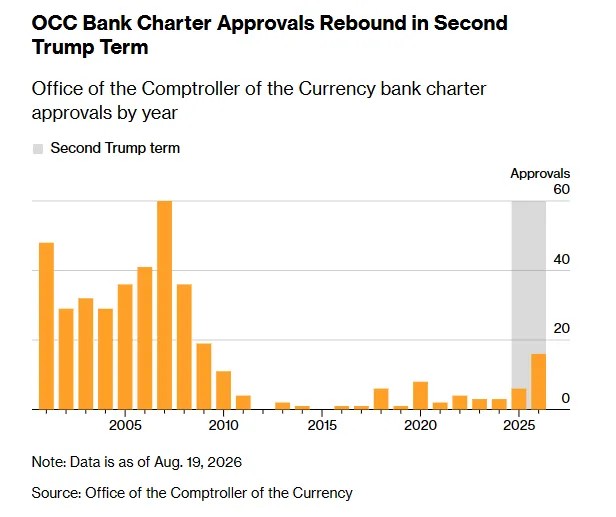
Source: Bloomberg.

Moreover, the majority of new permits went to fintech companies and firms working with digital assets, including Circle and Coinbase.

US Banks to Grant Clients Direct Access to Bitcoin

Earlier in August, representatives of $WLFI stated that a federal charter would strengthen regulatory oversight of the project and help expand the use of the stablecoin $USD1. According to the company, the future bank is intended to hold the assets backing the stablecoin.

The project's connection to the family of US President Donald Trump has raised questions among Democrats. Sources familiar with the matter told Bloomberg that the 'stable coin' could become a tool for gaining favor with the White House amid a more lenient regulatory approach.

According to Aaron Klein, a senior fellow at the Brookings Institution, 'creating the illusion among people that stablecoins are backed by the state raises real concerns.'

In response to the criticism, company representative David Waxman emphasized that the firm is not evading oversight but is transitioning to ongoing OCC supervision. The project must still comply with anti-money laundering and consumer protection requirements, and weekly reports on reserves and operations with $USD1 will undergo independent verification.

Recall that a Reuters poll showed that 63% of Americans found Trump's income from cryptocurrency inappropriate.

Trump Received Over $1.4 Billion from Crypto Projects
end-content

Questions liées

QWhat type of approval did World Liberty Financial ($WLFI) receive from the OCC, and what conditions were attached to it?

AWorld Liberty Financial ($WLFI) received conditional approval from the OCC to launch a trust bank in the United States. To receive final approval, the company must hire an external auditor and maintain a specific level of capital.

QWhat concerns did the article raise regarding the connection between World Liberty Financial ($WLFI) and the Trump family?

AThe article raised concerns that the project's connection to US President Donald Trump's family, including an investor who is one of the president's sons, led to questions from Democrats. Critics suggested the stablecoin $USD1 could be used as a tool to gain favor with the White House, given a perceived softer regulatory approach.

QAccording to the article, how did the number of banking license approvals under Trump's second term compare to the previous period?

AAccording to Bloomberg journalists, in the first 19 months of President Donald Trump's second term, the regulator approved 22 applications for banking licenses. This number is greater than the total approvals granted over the five preceding years combined.

QWhat point did Brookings Institution senior fellow Aaron Klein make about stablecoins in relation to this news?

AAaron Klein, a senior fellow at the Brookings Institution, expressed concern that 'creating the illusion for people that stablecoins are backed by the government raises real concerns.'

QHow did a representative from World Liberty Financial ($WLFI) respond to the criticism about the project's oversight?

ADavid Waxman, a representative of the company, responded by emphasizing that the firm is not avoiding oversight but is transitioning under the permanent supervision of the OCC. He stated that the project must still comply with anti-money laundering and consumer protection requirements, with weekly reports on reserves and $USD1 transactions undergoing independent review.

Lectures associées

PeaqOS et World ID intègrent des preuves ZK dans les robots autonomes

L'intégration de PeaqOS et de World ID permet désormais aux machines autonomes de vérifier qu'elles interagissent avec des personnes réelles et uniques, sans collecter de noms, de photos ou d'autres données personnelles. Grâce à la technologie de preuve à divulgation nulle de connaissance (ZK), un individu peut prouver son humanité tout en préservant la confidentialité de son identité. Cette solution répond au défi des opérateurs de robots de livraison, de machines en libre-service et de systèmes autonomes : comment authentifier un utilisateur sans recourir à des codes PIN, des mots de passe ou des documents d'identité traditionnels, souvent vulnérables ou intrusifs. À la place, un appareil reçoit une preuve cryptographique attestant que l'utilisateur est un humain. PeaqOS sert de couche de coordination, permettant aux appareils de solliciter, recevoir et vérifier ces preuves via des identifiants décentralisés. Le système inclut également une vérification d'unicité, permettant par exemple d'appliquer la règle "un article par personne" sans créer de bases de données d'identités. Un cas d'usage démontré est la livraison autonome de médicaments, où le patient est vérifié à plusieurs étapes (commande, préparation, réception) sans divulguer ses informations personnelles. D'autres applications possibles incluent la distribution publicitaire ciblée ou l'accès à des équipements partagés, le tout sans nécessiter de création de compte. Cette intégration, disponible via robotic.sh, permet aux systèmes autonomes d'assurer des interactions sécurisées et vérifiables tout en minimisant radicalement la collecte de données.

cryptonews.ruIl y a 3 h

PeaqOS et World ID intègrent des preuves ZK dans les robots autonomes

cryptonews.ruIl y a 3 h

Trading

Spot
活动图片