Unlocking $100 Million in Liquidity? Pump.fun's New Policy Tests the 5-Minute Pump Technique

marsbitPublié le 2026-07-22Dernière mise à jour le 2026-07-22

Résumé

Pump.fun, a popular meme coin launchpad, has introduced a new standard mechanism called BOOST. It aims to address a significant capital efficiency issue: when a newly launched token graduates from its initial bonding curve to a liquidity pool (LP), roughly 20% of its liquidity becomes permanently locked as "dead liquidity," estimated to waste over $100 million annually. Instead of locking these funds permanently, BOOST repurposes them. Upon a token's migration, approximately 20% of the settlement funds (e.g., 17.6 SOL or ~$2516 USDC) are used to buy back the token on the open market over a 5-minute period via a Time-Weighted Average Price (TWAP) mechanism. All purchased tokens are immediately burned. This creates a brief, systematic buy pressure immediately after migration, potentially generating a short-term price surge ("pump") while permanently reducing the token's circulating supply. The goal is to enhance the immediate post-launch trading experience, potentially increasing trader retention and sustainable protocol revenue, which funds ongoing token buybacks. However, concerns exist that this artificial 5-minute boost could lower the barrier for launching low-quality tokens and lead to steeper price crashes once the buy pressure stops, if followed by large sell-offs. The feature automatically applies to tokens migrating after July 21, 2024, but not to previously migrated tokens or those launched via the Mayhem AI Agent lab.

Original author: Ma He, Foresight News

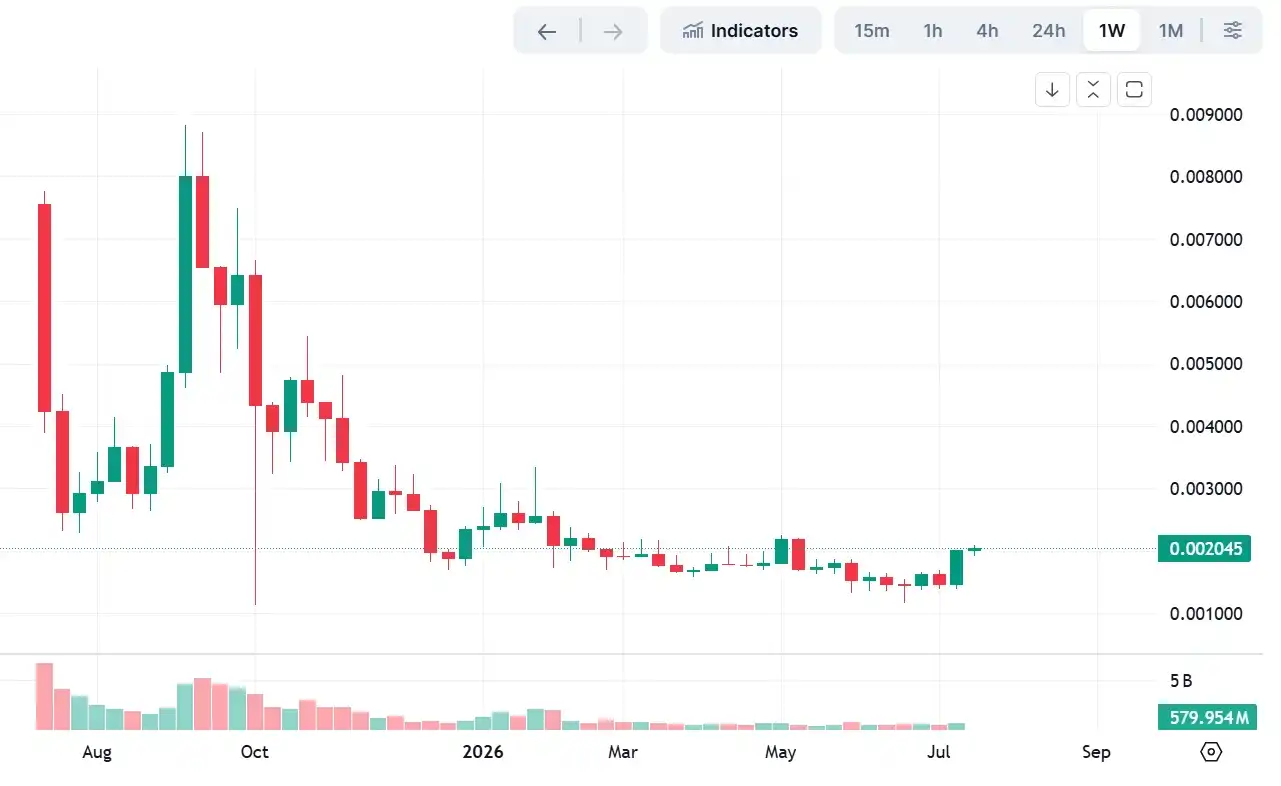
On July 21st, Pump.fun officially announced the launch of the BOOST mode, designating it as the new standard default token launch mechanism. Following the announcement, the price of PUMP continued to fluctuate around $0.002.

According to the official explanation, historical data shows that whenever a token graduates from the bonding curve and migrates to a liquidity pool, approximately 20% of the liquidity becomes "dead liquidity." Even if all holders sell, this portion of funds remains permanently locked in the LP, never to be effectively utilized again. The platform estimates that this mechanism leads to over $100 million in liquidity being permanently lost each year.
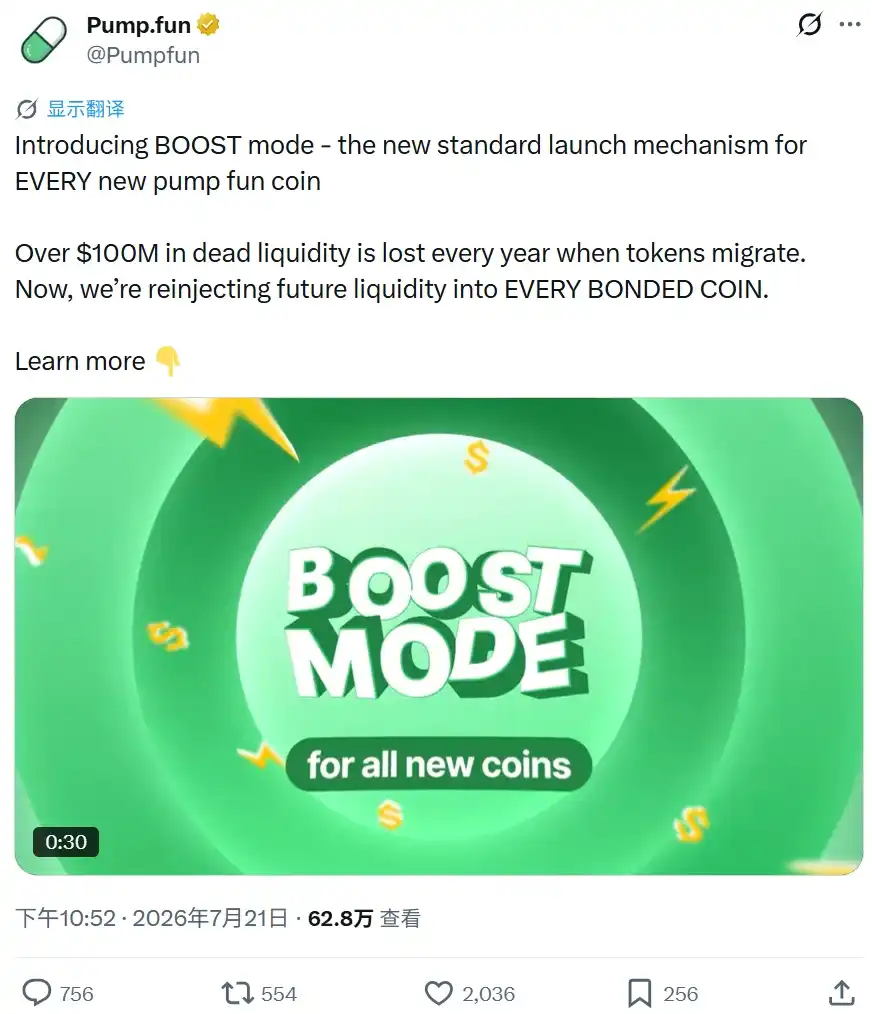
The core action of BOOST mode is straightforward: it takes this portion of funds that would have been wasted and, within the first 5 minutes after token migration, continuously buys the token via TWAP (Time-Weighted Average Price) and immediately burns all purchased tokens. When a token graduates, Pump.fun forcibly withholds roughly 20% of the funds. Calculated based on fixed migration rules, the SOL pair withholds 17.6 SOL, and the USDC pair withholds approximately $2516.

These funds entirely come from the liquidity "sacrificed" during previous migrations, not from new platform subsidies. After the buy order is completed, the corresponding tokens are directly burned, creating short-term buying pressure while permanently reducing the circulating supply.

Using Reserves to Provide 5 Minutes of Buying Pressure for Tokens

Pump.fun's classic process is: users create a token with one click, trade on the bonding curve, and when the token reaches a certain market cap threshold, it automatically migrates to the PumpSwap liquidity pool. Upon migration, the platform locks a portion of the liquidity into the LP at a set ratio to ensure subsequent trading depth.

The issue lies in the high proportion of these locked funds. Even if the token's price later goes to zero and everyone sells, a sum of "dead money" remains in the LP. This money can neither be withdrawn nor reallocated to other active assets, resulting in systemic capital waste. The official estimate is "over $100 million per year."

BOOST mode does not change the trading experience on the bonding curve, nor does it adjust the graduation threshold itself. BOOST mode does not arbitrarily add or release any external liquidity. Its essence is to extract the 20% of settlement funds that were originally destined for the LP and use them to buy and immediately burn tokens on the secondary market via TWAP within 5 minutes.

The official statement clarifies that Pump.fun tokens migrating after 22:23 Beijing Time on July 21st will automatically have the BOOST configuration enabled. Tokens that have already migrated before this time, as well as tokens launched via the Mayhem (AI Agent Lab) mode, do not benefit from this mechanism.

5-Minute Fireworks

As of July 22nd, Pump.fun's current annualized revenue is approximately $342.54 million, with total token buyback value around $411.27 million. However, its token price remains far from its high of $0.008. Relying solely on large-scale buybacks can no longer effectively boost price expectations.
The essence of BOOST is not to add another round of buybacks for PUMP, but to attempt to solve the product issue of the launchpad itself.

The logic behind this might be: if meme tokens, after graduation, could have slightly thicker order books and slightly better short-term performance, trader retention and repurchase willingness would be higher. Most PVP players don't care about whether a Meme coin lives or dies three days later; they care about whether it can "pump" at the moment of graduation. Pump.fun's official team likely sees through this. Rather than defensively locking 20% of funds in the LP pool, it's better to turn that money into "fireworks" for the first 5 minutes.

The platform's real moat is not "large token issuance volume," but rather "a certain proportion of issued tokens can sustain trading volume." Only when the latter is stable can protocol revenue be truly sustainable. Stable or growing revenue provides continuous ammunition for buybacks, rather than making buybacks look like "propping up the price with existing revenue."

Of course, many traders are concerned that the additional buying pressure could lower the actual difficulty of launching a project, potentially making more low-quality tokens appear "successful" and thereby encouraging more aggressive launch behaviors. Others point out that the 5-minute TWAP buying window is still short. Once buying stops after 5 minutes and faces large sell orders, the token price could crash with more exaggerated slippage than before. This essentially trades extremely high post-sell-off risk for the illusion of a pump in the first 5 minutes.


Cryptos en tendance

Questions liées

QWhat is the core mechanism of Pump.fun's new BOOST mode, and what problem is it designed to solve?

AThe core mechanism of the BOOST mode is to take approximately 20% of the liquidity that would normally be permanently locked as 'dead liquidity' when a token graduates from the bonding curve to a liquidity pool. Instead of locking it, this capital is used within the first 5 minutes after migration to buy the token itself via a TWAP (Time-Weighted Average Price) mechanism and then immediately burn all purchased tokens. It is designed to solve the problem of systemic capital waste, where over $100 million annually becomes unusable 'dead' funds locked in LPs even after tokens fail.

QAccording to the article, what is the intended effect of the BOOST mode's 5-minute buy-and-burn operation on new meme tokens?

AThe intended effect is twofold: 1) It creates short-term buying pressure (a 'fireworks' show) in the first 5 minutes after a token's migration, potentially making the token appear to 'pump' at launch. 2) By burning the purchased tokens, it permanently reduces the token's circulating supply. The goal is to improve short-term token performance to boost trader retention and re-engagement on the platform.

QWhat potential risk does the article mention regarding the BOOST mode's 5-minute buy window?

AThe article mentions the risk that once the 5-minute automated buy pressure stops, if the token then faces large sell orders, its price could crash with even more exaggerated slippage than before. This essentially trades the risk of a severe post-pump crash for the short-lived illusion of a price pump in the first 5 minutes.

QWhich tokens are eligible for the new BOOST mechanism, and which are not?

ATokens that graduate (migrate from bonding curve) after 22:23 Beijing Time on July 21st automatically have the BOOST mechanism enabled. Tokens that migrated before this time, as well as tokens launched through the Mayhem (AI Agent Lab) mode, do not receive this mechanism.

QBeyond just boosting PUMP token price, what does the article suggest is Pump.fun's deeper strategic goal with the BOOST update?

AThe deeper strategic goal is to strengthen the platform's core product and sustainable revenue. By making launched meme tokens perform better initially, the platform aims to increase the proportion of tokens that continue to generate trading volume. This sustains and grows protocol revenue, which in turn provides continuous ammunition for PUMP token buybacks, moving away from a model of merely using existing revenue to prop up the price.

Lectures associées

L'affaire de divorce de Chey Tae-won finalisée : Révélations sur les lignes cachées de succession derrière le conglomérat de mille milliards de SK Hynix

L'affaire de divorce de Chey Tae-won, président du groupe SK, s'est conclue par un jugement historique, mettant en lumière les complexités successorales derrière le géant SK Hynix, dont la valorisation a dépassé 1 000 billions de wons. Contrairement aux scénarios traditionnels de succession des chaebols sud-coréens, qui privilégient l'aîné masculin, les trois enfants de Chey Tae-won suivent des trajectoires distinctes et modernes. L'aînée, Chey Yun-jeong, considérée comme la successeure la plus probable, occupe un poste de direction au sein de SK Inc. et dirige des projets stratégiques dans la biopharmacie, alliant formation scientifique et compétences en consulting. La seconde fille, Chey Min-jeong, ancienne officière de marine et ex-employée de SK Hynix aux États-Unis, a fondé une startup dans la santé numérique et épousé un ancien officier du Corps des Marines américain, incarnant les dimensions géopolitiques de l'industrie des semi-conducteurs. Le fils cadet, Chey In-geon, bien que suivant un parcours académique et professionnel classique (Brown University, McKinsey), reste discret et ne détient aucun rôle opérationnel visible au sein du groupe. Leur héritage est marqué par le divorce très médiatisé et coûteux de leurs parents, mais aussi par la transformation de SK Hynix en un acteur mondial de l'ère de l'IA. La succession ne se résume plus à une simple transmission d'actions ou de titre ; elle exige des héritiers qu'ils prouvent leurs compétences dans un paysage où la technologie, la politique internationale et l'innovation disruptive redéfinissent les règles du pouvoir.

marsbitIl y a 2 jours 09:14

L'affaire de divorce de Chey Tae-won finalisée : Révélations sur les lignes cachées de succession derrière le conglomérat de mille milliards de SK Hynix

marsbitIl y a 2 jours 09:14

2 mois pour passer de 8,8 à 68 milliards d'euros d'évaluation ! La plus grande plateforme de transit d'IA, OpenRouter, sur le point d'être rachetée

**Résumé en français :** Stripe, le géant du paiement en ligne, négocierait l'acquisition d'OpenRouter, une place de marché et couche d'IA de type "routeur" ou "agrégateur", pour près de 100 milliards de dollars. Cette valorisation représente une multiplication par près de sept par rapport à l'évaluation d'OpenRouter il y a deux mois (13 milliards de dollars). Fondée en 2023 par Alex Atallah (cofondateur d'OpenSea), OpenRouter agit comme un intermédiaire crucial pour les développeurs d'applications d'IA. Sa plateforme permet d'accéder via une seule API à plus de 400 grands modèles de langage (comme GPT, Claude, et de nombreux modèles open source) et choisit automatiquement le modèle le plus adapté à chaque tâche en fonction du coût, des performances et de la vitesse. Cela permet aux applications en aval de réduire leurs factures de "réflexion" (inference) sans que l'utilisateur final ne voie la différence. Pour Stripe, cette acquisition stratégique s'inscrit dans une volonté de devenir l'infrastructure de paiement et de gestion de la consommation pour l'économie de l'IA. Fin 2025, Stripe avait déjà acquis Metronome, une plateforme de facturation à l'usage pour l'IA. En combinant OpenRouter (choix du modèle) et Metronome (facturation précise), Stripe cherche à offrir une solution intégrée pour le routage, la mesure et le paiement de la consommation d'IA, consolidant ainsi son rôle de "caisse" et de "centre de régulation" de cette nouvelle économie.

链捕手Il y a 2 jours 09:04

2 mois pour passer de 8,8 à 68 milliards d'euros d'évaluation ! La plus grande plateforme de transit d'IA, OpenRouter, sur le point d'être rachetée

链捕手Il y a 2 jours 09:04

D'OpenSea à OpenRouter : le scénario de la « sortie en haut de cycle » d'Alex Atallah se répète ?

**OpenRouter, la plateforme d'agrégation de modèles d'IA fondée par Alex Atallah, pourrait être rachetée par Stripe pour près de 100 milliards de dollars**, selon le Wall Street Journal. Cette transaction potentielle, si elle se concrétise, marquerait le deuxième succès d'Atallah à construire une entreprise valorisée à des dizaines de milliards, après avoir cofondé la place de marché NFT OpenSea. OpenRouter, décrit comme le "Stripe de l'IA", sert de point d'accès unifié à plus de 400 modèles d'IA pour environ 10 millions d'utilisateurs. Sa croissance a été fulgurante, passant d'une valorisation de 1,3 milliard de dollars en mars 2026 à une évaluation potentielle de 100 milliards aujourd'hui. L'article souligne un parallèle avec le parcours d'Atallah chez OpenSea, qu'il a quittée avant le refroidissement du marché NFT. Aujourd'hui, face à une concurrence croissante dans l'agrégation de modèles d'IA et à une activité essentiellement basée sur des frais de plateforme (5-5,5%), la vente à un géant comme Stripe pourrait apparaître comme un choix stratégique pour "sortir au sommet". La valeur réelle d'OpenRouter pour un acquéreur résiderait moins dans ses revenus actuels que dans les vastes quantités de données d'utilisation réelle de l'IA qu'elle a accumulées. Ces informations sur les performances, les préférences des développeurs et la dynamique du marché sont un atout unique. La transaction, si elle aboutit, pose la question : s'agit-il d'une juste reconnaissance de la valeur des infrastructures d'IA ou d'un possible signal de sommet pour le secteur ?

链捕手Il y a 2 jours 08:47

D'OpenSea à OpenRouter : le scénario de la « sortie en haut de cycle » d'Alex Atallah se répète ?

链捕手Il y a 2 jours 08:47

Trading

Spot

Articles tendance

Comment acheter PUMP

Bienvenue sur HTX.com ! Nous vous permettons d'acheter Pump.fun (PUMP) de manière simple et pratique. Suivez notre guide étape par étape pour commencer votre parcours crypto.Étape 1 : Création de votre compte HTXUtilisez votre adresse e-mail ou votre numéro de téléphone pour ouvrir un compte sur HTX gratuitement. L'inscription se fait en toute simplicité et débloque toutes les fonctionnalités.Créer mon compteÉtape 2 : Choix du mode de paiement (rubrique Acheter des cryptosCarte de crédit/débit : utilisez votre carte Visa ou Mastercard pour acheter instantanément Pump.fun (PUMP).Solde :utilisez les fonds du solde de votre compte HTX pour trader en toute simplicité.Prestataire tiers :pour accroître la commodité d'utilisation, nous avons ajouté des modes de paiement populaires tels que Google Pay et Apple Pay.P2P :tradez directement avec d'autres utilisateurs sur HTX.OTC (de gré à gré) : nous offrons des services personnalisés et des taux de change compétitifs aux traders.Étape 3 : stockage de vos Pump.fun (PUMP)Après avoir acheté vos Pump.fun (PUMP), stockez-les sur votre compte HTX. Vous pouvez également les envoyer ailleurs via un transfert sur la blockchain ou les utiliser pour trader d'autres cryptos.Étape 4 : tradez des Pump.fun (PUMP)Tradez facilement Pump.fun (PUMP) sur le marché Spot de HTX. Il vous suffit d'accéder à votre compte, de sélectionner la paire de trading, d'exécuter vos trades et de les suivre en temps réel. Nous offrons une expérience conviviale aux débutants comme aux traders chevronnés.

592 vues totalesPublié le 2024.12.12Mis à jour le 2026.07.09

Comment acheter PUMP

Discussions

Bienvenue dans la Communauté HTX. Ici, vous pouvez vous tenir informé(e) des derniers développements de la plateforme et accéder à des analyses de marché professionnelles. Les opinions des utilisateurs sur le prix de PUMP (PUMP) sont présentées ci-dessous.

活动图片