Author: Claude, Deep Tide TechFlow
Deep Tide's Guide: Telegram founder Pavel Durov announced that this summer, a native non-custodial Gram wallet will be built into all Telegram apps, offering zero-fee instant transfers to over 1 billion users. GRAM subsequently rose about 8% to $1.53. This wallet differs from the existing third-party-operated @wallet bot; it is developed by Telegram itself, with users directly controlling their private keys. Amid a competitive window where super apps like X Money and Meta's stablecoin payments are entering the fray, Durov is betting on a crypto-native route. However, the promise of the "largest deployment in human history" still lacks technical details and a definitive timeline.
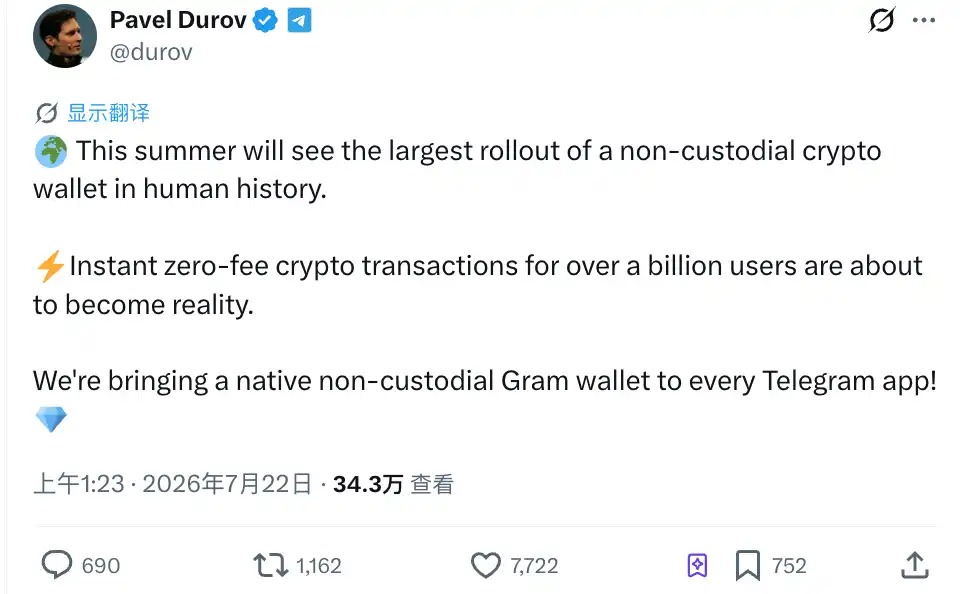
Telegram founder Pavel Durov announced in his Telegram channel on July 21 that this summer, a native non-custodial Gram wallet will be built into every Telegram application, providing instant, zero-fee cryptocurrency transfer services to over 1 billion monthly active users.
Durov characterized this launch as "the largest non-custodial crypto wallet deployment in human history." For comparison, the most widely used self-custody wallet in the crypto space, MetaMask, has tens of millions of users; no crypto wallet has ever started with a base of 1 billion users.
Completely Different from the Existing @wallet, Telegram Steps In Directly
This new wallet is fundamentally different from the existing @wallet bot within Telegram.
According to Decrypt, the existing @wallet is a mini-app developed and operated by the independent third-party company The Open Platform (TOP), and is not an official Telegram product. The service already boasts over 150 million registered users, with a default custodial model (meaning a third party holds user private keys), requiring users to actively switch to use its self-custody layer.
The new wallet announced by Durov is a feature natively embedded into the Telegram app, designed from the ground up as non-custodial, with users controlling their own private keys and assets. Non-custodial means there is no intermediary that can freeze, seize, or block transactions.
According to BeInCrypto, TOP founder Andrew Rogozov confirmed that the existing custodial @wallet service will continue to operate independently. However, key questions remain unanswered: whether the old and new wallets will ultimately coexist, which assets besides GRAM the new wallet will support, and how private key management will be handled for ordinary users who have never interacted with cryptocurrency.
GRAM Rises About 8%, But Still 88% Away from Previous High
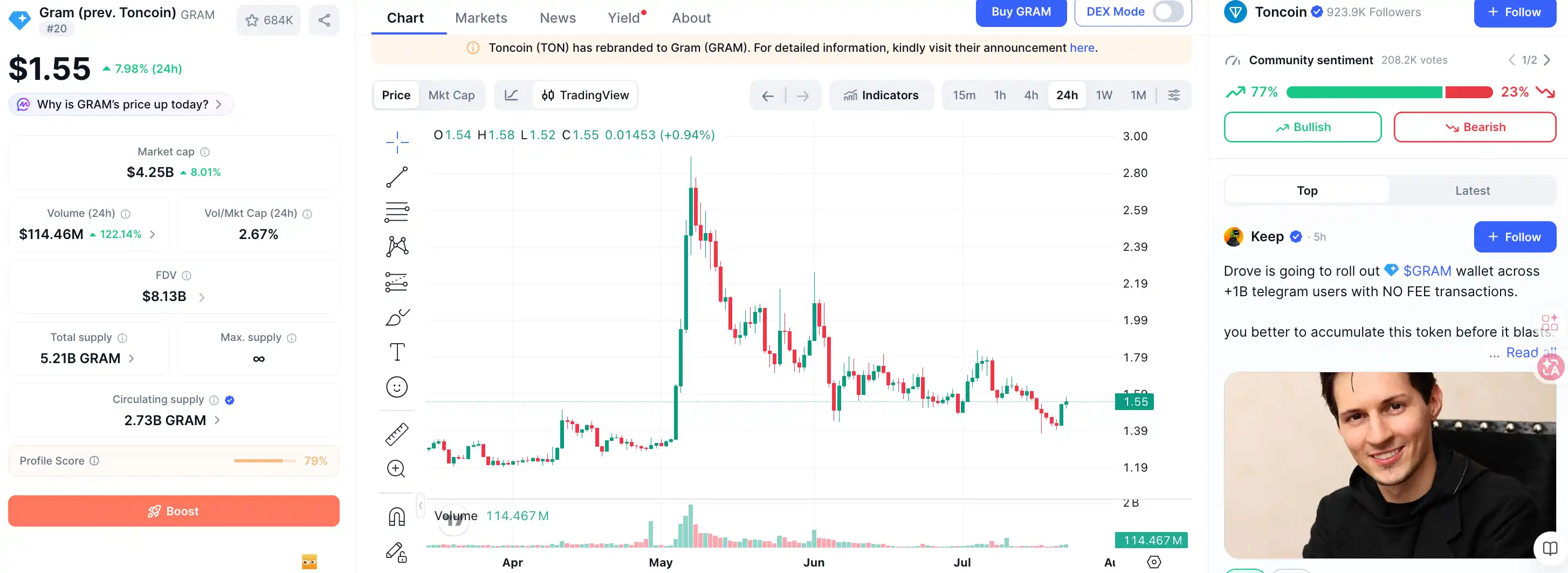
Following the announcement, GRAM (originally Toncoin, the native token of the TON blockchain) rose approximately 8.5% in 24 hours to around $1.53, with a market cap of about $4.18 billion. According to CoinMarketCap data, this partially offset a cumulative decline of about 25% since July, but significant reversal remains distant.
GRAM's 200-day exponential moving average is far above its current price, indicating a still bearish long-term trend. The token's all-time high was $8.25 (during the Telegram 'Tap-to-Earn' gaming frenzy in June 2024). It reached its yearly high of $2.89 in May 2026 when Telegram announced it was taking over the TON network. A return from the current price to the May high would require an increase of approximately 88%.
From SEC Lawsuit to 'Make TON Great Again', Durov's Seven-Year Comeback Battle
This wallet deployment is the latest chapter in a narrative that began in 2018.
In 2018, Telegram raised $1.7 billion for the TON blockchain project, planning to issue a token called Gram. The SEC subsequently sued, determining the token was an unregistered security. In 2020, Telegram settled with the SEC, refunding investors $1.2 billion and paying an $18.5 million fine, completely withdrawing from the project. Community developers took over, independently operating the token renamed as Toncoin for several years.
In 2026, Durov regained control of the TON network and launched a seven-step roadmap named "Make TON Great Again" (MTONGA). Publicly completed steps so far include: the Catchain 2.0 upgrade achieving a 10x speed increase and sub-second transaction confirmation; a 6x reduction in base transaction fees; Telegram becoming the network's largest validator; and the token name change (from Toncoin back to Gram) passed by 81% community vote on June 15. The built-in wallet is likely step five, with three remaining steps yet to be disclosed.
Super App Payments War Heats Up, Telegram Chooses Crypto-Native Route
Durov's wallet announcement comes during a dense window where multiple super apps are simultaneously deploying payment functions.
According to Glitchwire, Musk's X Money launched on June 26 for US Premium subscribers, offering 6% APY, Visa Direct peer-to-peer transfers, and 3% cashback, but currently only supports fiat currency. Crypto and stock trading features are on the roadmap but not yet live. Meta is also re-strategizing digital payments, reportedly sending partnership invitations to third-party stablecoin providers, planning to integrate stablecoin payments into WhatsApp, Instagram, and Facebook in the second half of 2026.
The route choices of the three super apps present a stark contrast: X Money takes a compliant fiat route (holding money transmitter licenses in over 40 states), Meta explores a stablecoin middle path, while Telegram directly bets on a crypto-native non-custodial wallet. Telegram's advantages lie in its user base (over 1 billion monthly active users) and natural affinity for the crypto community. The risks involve the user education costs associated with non-custodial models and regulatory uncertainty.
Zero-Fee Promise Still Lacks Key Details
Durov's promised "zero fees" is another issue requiring attention. Most crypto wallets still charge network fees, even if minimal. Telegram might bypass gas fees through internal subsidies or by using methods like off-chain settlement, but the specific technical solution has not been announced.
According to CryptoBriefing, in July 2025, Telegram launched a non-custodial TON Wallet to 87 million US users as a proof-of-concept. That deployment demonstrated that a messaging app could distribute wallet infrastructure at scale without the traditional friction of crypto onboarding, but a significant gap remained between the number of on-chain active wallets and the user base.
Beyond "this summer," Durov has not provided a more specific launch date.







