1inch Co-founder Anton Bukov Leaves, Launches New Project Second Tier

Foresight NewsPublié le 2026-07-17Dernière mise à jour le 2026-07-17

Résumé

Anton Bukov, co-founder of the decentralized exchange aggregator protocol 1inch, has announced his departure from the company's daily operations. Bukov, who was instrumental in designing core 1inch architectures like the Router, Fusion, and cross-chain Swap, ceased involvement in November 2025 due to strategic and leadership disagreements, though he retains his co-founder title and 50% equity stake. Concurrently, Bukov unveiled his new venture, Second Tier (tier.xyz), describing it as infrastructure to "shorten the distance between economic intent and on-chain execution." He explicitly stated it is not a DEX or aggregator. The project's public-facing material is currently a manifesto criticizing systemic financial friction and advocating for building new architectural categories rather than competing within existing ones. No product details, team, or funding have been disclosed. The split highlights a strategic divergence within 1inch. While CEO Sergej Kunz has steered the company toward traditional finance integration—evidenced by a 2025 brand refresh and a major Coinbase partnership—Bukov emphasized a commitment to decentralized, permissionless DeFi principles. Bukov's exit coincides with a challenging period for 1inch. Q1 2026 data shows a 60.3% quarterly drop in its daily average trading volume to $97.1 million, underperforming the broader DEX aggregator market decline. Its market share fell from 25.2% to 17.0%, dropping it to fourth place among competitors. Key quest...


Written by: ChandlerZ, Foresight News


On July 16th, Anton Bukov, co-founder of the decentralized exchange aggregation protocol 1inch, published an open statement confirming his departure from the day-to-day operations of 1inch. Anton Bukov, who was responsible for designing core architectures such as the 1inch Router, Fusion, and cross-chain Swap, ceased his involvement in company operations at the end of November 2025 due to disagreements over strategic direction and leadership. However, he retains his co-founder status and 50% of the shares.


The statement also announced the launch of a new project, Second Tier (tier.xyz). Anton Bukov positions Second Tier as an infrastructure company aimed at "shortening the distance between economic intent and on-chain execution," explicitly stating that the new project is neither a DEX nor an aggregator.


A Manifesto Mentioning No Products


All the content currently presented by Second Tier to the public is a manifesto published on tier.xyz.



The manifesto does not mention any specific product forms, technical architectures, or launch timelines. Its core argument is that friction in the current financial system (middlemen, settlement delays, permission barriers) is artificially designed. Optimizing within the existing framework is merely a "trade-off." The truly effective approach is to jump to the next level (the second tier) and work at the layer where the constraints themselves can be redesigned. This is the origin of the name Second Tier.


The manifesto states that its goal is not to create a single product but to build multiple architectures, creating categories that previously did not exist rather than competing within existing ones. It also mentions that the systems the team builds will enter the market in an open manner.


In an interview with The Defiant, Anton Bukov confirmed that Second Tier currently has no public financing, has not announced its team members, and will not reveal product details before having usable systems. When asked if the new project is another DEX or aggregator, his response was straightforward: "No, and it's not targeted at 1inch."


Strategic Disagreements and the Split


In his statement, Anton Bukov stated that he was fired from 1inch at the end of November 2025. He mentioned that he had spent months prior pushing for changes in the company's leadership approach and communication mechanisms, ultimately leading to his removal.


1inch contested the term "fired," officially stating that Anton Bukov was not a direct employee and therefore could not legally be fired. They added that his work on architecture and security was a team effort, with other individuals responsible.


Anton Bukov characterized this split as a mature founder breakup, with disagreements over strategic direction, communication methods, and leadership style. He still holds 50% of 1inch's equity, retains the co-founder title, but no longer plays any role in the protocol's product architecture or security matters. 1inch officially confirmed that Anton Bukov has not participated in any work of affiliated organizations since December 2025, and protocol operations are unaffected.


The background of the split is essentially 1inch's accelerated shift towards traditional finance in the second half of 2025.


In October 2025, 1inch completed a brand overhaul. CEO Sergej Kunz described the company's vision as extending to all financial markets. In the same month, 1inch integrated its swap engine into the Coinbase App, becoming its largest client-side partnership in the US market. 1inch's target customers began shifting from DeFi-native users to institutional and traditional finance users.


However, Anton Bukov held the opposite stance. He emphasized in his statement, "I believe DeFi is the path to an open financial system, without friction, without intermediaries. I would rather build it myself than wait around." During his time at 1inch, he led the design of core modules such as the DEX aggregation router, the Fusion swapping mechanism, and cross-chain execution—tools whose design logic pointed towards decentralization and permissionless access. In mid-November 2025, he was still publicly supporting the developer version of the shared liquidity protocol Aqua, only to be told to leave a few weeks later.


The Current State of 1inch


Anton Bukov's public announcement of his departure comes at a time when 1inch is experiencing a significant business contraction.


According to the "State of 1inch Q1 2026" report released by Messari on May 22nd, 1inch's average daily trading volume fell from $244.9 million in Q4 2025 to $97.1 million in Q1 2026, a sequential decline of 60.3%. During the same period, the average daily trading volume for the entire DEX aggregator sector dropped from $4.6 billion to $2.7 billion, a decrease of about 40%, indicating that 1inch's decline significantly exceeded the industry average.
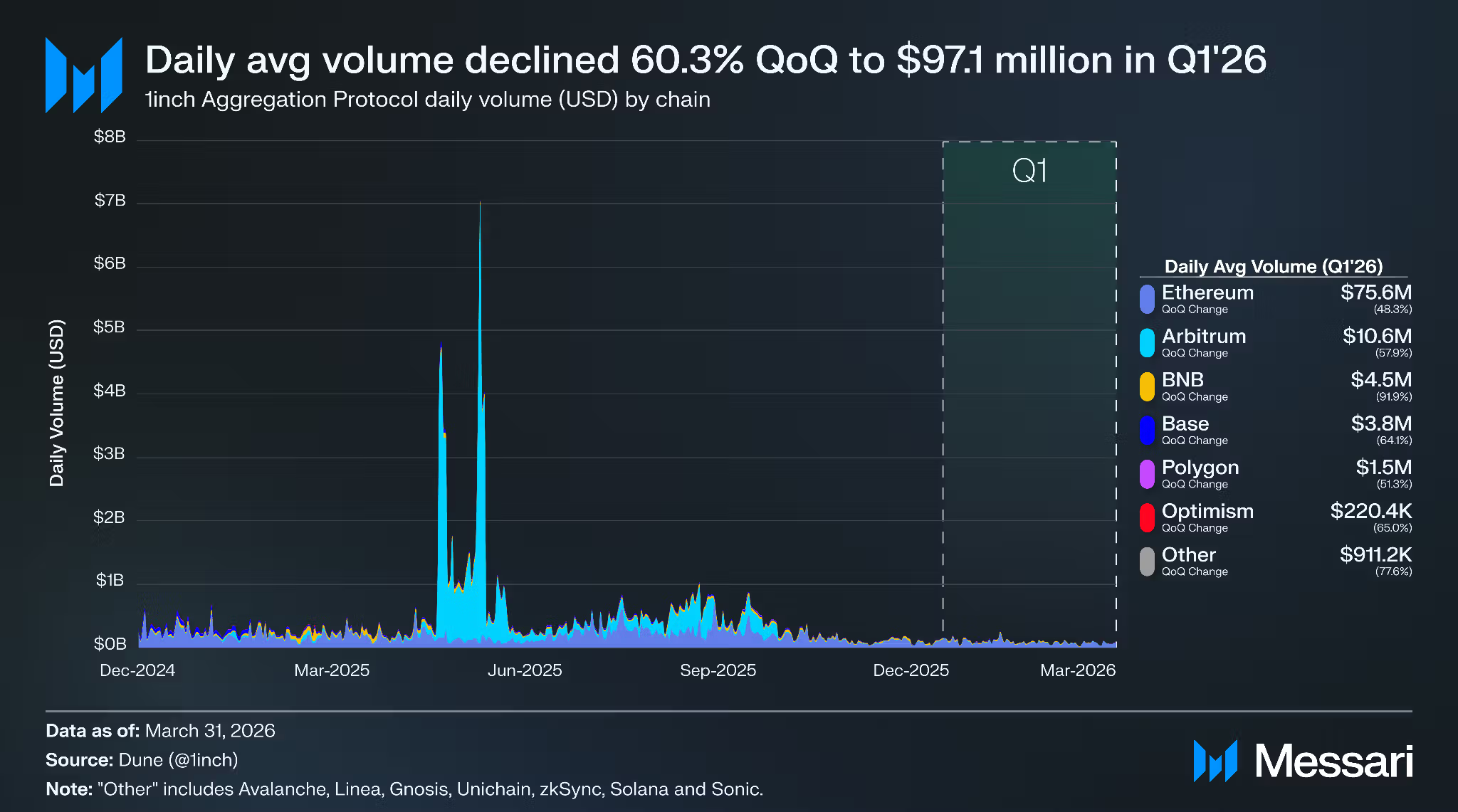


Regarding market share, 1inch's share on the networks it deployed on decreased from 25.2% in Q4 to 17.0% in Q1, its ranking falling from first to fourth, behind Kyber (23.9%), CoWSwap (18.0%), and ZeroEx (17.9%).


Additionally, 1inch's partnership with Ondo Finance routed over $2.5 billion in cumulative trading volume of tokenized stocks and ETFs on BNB Chain. The Limit Order Protocol's average daily trading volume on BNB Chain grew against the trend by 52.7%, making it the only chain showing growth. The Fusion protocol's average daily trading volume declined by only 26.5%, significantly better than the 60.3% drop for the aggregation protocol. The number of daily average Fusion orders actually increased by 31.3%, rising from 13,200 to 17,300, suggesting a shift among users towards smaller, higher-frequency trading patterns.


Sergej Kunz, in response to Anton Bukov's departure, emphasized that it does not affect the infrastructure and system operations of the 1inch network. Market reaction was muted, with the 1INCH token dropping only about 1% within 24 hours of the news announcement.


Pending Questions


Anton Bukov currently holds 50% of 1inch's equity and retains the co-founder title but has no say in the protocol's operations. He has not indicated plans to sell his shares or take any shareholder action. Second Tier remains in a purely conceptual stage—no product, no financing, and no publicly announced team.


It remains to be seen how Anton Bukov will handle his 1inch equity, when Second Tier will transform from a manifesto into a usable product, and whether 1inch's institutionalization path can reverse the trend of declining trading volume.


Cryptos en tendance

Questions liées

QWhy did Anton Bukov leave 1inch, and what is the core reason for the disagreement?

AAnton Bukov left the daily operations of 1inch due to disagreements on strategic direction, communication methods, and leadership style. He was focused on building a decentralized, permissionless DeFi system, while 1inch's leadership, led by CEO Sergej Kunz, was accelerating a strategic shift towards courting traditional financial institutions and users. Bukov stopped participating in company operations in November 2025 after failing to push for changes in the company's leadership approach.

QWhat is the main concept or goal of Anton Bukov's new project, Second Tier (tier.xyz)?

AThe main goal of Second Tier is to shorten the distance between economic intent and on-chain execution. It is positioned as an infrastructure company that aims to work at a higher level ('the second tier') where the constraints and frictions (like intermediaries, settlement delays, permissioned access) inherent in the current financial system can be redesigned, rather than making trade-offs within the existing framework. Bukov explicitly states it is not a DEX or an aggregator.

QWhat was the state of 1inch's business performance in Q1 2026 according to the article?

AIn Q1 2026, 1inch experienced significant business contraction. Its daily average trading volume fell 60.3% to $97.1 million from $244.9 million in Q4 2025. Its market share across deployed networks dropped from 25.2% to 17.0%, causing it to fall from first to fourth place among DEX aggregators. The overall DEX aggregator sector saw a smaller decline of about 40% in daily volume during the same period.

QHow did 1inch officially respond to Anton Bukov's claim that he was 'fired'?

A1inch contested Anton Bukov's claim of being 'fired.' The company's official statement argued that Bukov was not a direct employee and therefore could not be legally terminated. They also noted that the architectural and security work he was involved in was a team effort with other responsible personnel. The company confirmed he ceased all work for associated organizations in December 2025.

QDespite the overall decline, which specific 1inch protocol features showed relatively positive performance in Q1 2026?

ADespite the sharp decline in the core aggregation protocol, 1inch's Fusion protocol showed relatively better performance. Its daily average trading volume fell by only 26.5%, much less than the 60.3% drop for the aggregator. Furthermore, the number of daily Fusion orders actually increased by 31.3%, from 13,200 to 17,300, indicating a shift towards smaller, more frequent trades.

Lectures associées

Après trois trimestres consécutifs de baisse, le marché des cryptomonnaies pourra-t-il connaître une fenêtre de stabilisation au troisième trimestre ?

Le marché des cryptomonnaies a enregistré son pire trimestre depuis 2022, avec une capitalisation totale chutant de 12,6% à 2 100 milliards de dollars. Tous les indicateurs clés (volume des échanges, valeur des stablecoins) montrent une sortie nette de capitaux. Le Bitcoin a perdu 14,2% et l'Ethereum 25,4% sur le trimestre, rompant sa corrélation antérieure avec les actions technologiques. Les ETF spot américains sur le Bitcoin ont subi des rachats massifs, avec une sortie nette de 4,67 milliards de dollars au Q2, indiquant une pression de vente continue. Le resserrement de la politique de la Fed et les ventes d'entreprises comme Strategy ont accentué la déleveragisation du secteur. L'attention du marché se porte désormais presque exclusivement sur la réunion de la Fed fin juillet. Une position accommodante pourrait stabiliser le Bitcoin entre 68 000 et 84 000 dollars, tandis qu'un ton hawkish pourrait le faire osciller autour de 50 000-56 000 dollars. Parallèlement, la progression du *CLARITY Act*, une loi cruciale pour la clarté réglementaire, est au point mort au Sénat, réduisant les chances d'adoption en 2026 et maintenant une prime de risque élevée sur l'ensemble du secteur. Malgré ce contexte difficile, quelques secteurs résistent : les marchés de prédiction ont vu leur volume nominal augmenter de 48,7% et les biens collectionnables tokenisés ont progressé d'environ 143%. La tokenisation d'actifs du monde réel (RWA) continue également sa croissance régulière, portée par des fondamentaux indépendants du cycle crypto. Les bases d'un effondrement extrême semblent absentes, mais le marché est désormais guidé par les politiques monétaires, les prix et les attentes de taux, plutôt que par le simple récit haussier. La fin des sorties massives des ETF et le retour des achats des détenteurs à long terme pourraient indiquer une phase de stabilisation potentielle.

marsbitIl y a 33 mins

Après trois trimestres consécutifs de baisse, le marché des cryptomonnaies pourra-t-il connaître une fenêtre de stabilisation au troisième trimestre ?

marsbitIl y a 33 mins

The SpaceX Trade, Unlocked: SPCXON Débarque sur WEEX

En juin 2026, SpaceX a réalisé la plus grande introduction en bourse de l'histoire, mais l'accès à l'action a été limité pour de nombreux investisseurs en raison de restrictions régionales et de frictions liées aux courtiers. La plateforme WEEX propose désormais une solution via SPCXON/USDT, un instrument tokenisé sur le marché au comptant qui permet d'obtenir une exposition au cours de SpaceX en utilisant l'USDT, sans nécessiter de compte de courtage américain. SPCXON est un produit tokenisé construit sur l'infrastructure d'Ondo, conçu pour refléter l'économie de la détention d'actions SpaceX pour les traders éligibles en dehors des États-Unis, avec des dividendes réinvestis. Le cas d'investissement repose sur la croissance des revenus de Starlink et les progrès de Starship, malgré un valorisation déjà élevée et des risques liés à un flottant public réduit et à des déblocages d'actions internes à venir. Il est important de noter que SPCXON offre une exposition, et non la propriété directe d'actions ou de droits de vote. Son prix peut évoluer avec une prime ou une décote par rapport à la valeur liquidative. WEEX propose également d'autres produits tokenisés comme MSTRON et MUON dans un compte unifié, permettant une rotation entre crypto-monnaies et actions traditionnelles sans transfert de fonds. La plateforme souligne ainsi comment les barrières entre la finance traditionnelle et les actifs numériques s'estompent.

TheNewsCryptoIl y a 41 mins

The SpaceX Trade, Unlocked: SPCXON Débarque sur WEEX

TheNewsCryptoIl y a 41 mins

BIT Trading Moment : Le BTC reste sous la pression de l'EMA 200 hebdomadaire, un rejet pourrait relancer la baisse, les actions de stockage et de semi-conducteurs qui ont bondi cette nuit ont baissé en séance de nuit

**Résumé des marchés : Bitcoin sous pression, actions technologiques en réajustement** Le marché crypto poursuit son rebond, avec Bitcoin évoluant autour de 66 000 $. Il fait face à une résistance clé vers 68 000 $, niveau correspondant au coût moyen des investisseurs sur cinq mois. Les traders surveillent les moyennes mobiles clés (200 MA à ~63 333 $ et 200 EMA à ~68 328 $ en hebdomadaire). Une rupture au-dessus de 68 000 $ ouvrirait la voie à une hausse, tandis qu'un échec pourrait entraîner un retest des 63 000 $. L'analyse suggère que la dynamique actuelle ressemble à un rebond estival à faible liquidité plutôt qu'au début d'un véritable marché haussier. Sur le marché actions américain, après une forte séance mardi portée par les semi-conducteurs et les titres du stockage (Micron, AMD, Intel...), les contrats à terme indiquent une ouverture en baisse. Les secteurs ayant récemment bondi, comme les semi-conducteurs et le stockage, reculent en séance de nuit. Certaines valeurs se démarquent néanmoins, comme Super Micro Computer (SMCI), en hausse après des résultats et des perspectives robustes liées à la demande de serveurs IA. Des vents contraires persistent : les prix du pétrole (Brent >91$) et les rendements des obligations d'État américaines grimpent, ravivant les craintes inflationnistes. En Asie, les marchés ont suivi le rebond technologique américain, mais de manière hésitante. La tension reste forte sur le yen japonais, qui atteint son plus bas niveau depuis des décennies. **Points clés à surveiller :** * **Crypto :** Niveaux techniques de Bitcoin (68k$/63k$), flux des ETF spot. * **Actions :** Saison des résultats (Tesla, Alphabet, Intel...), activité d'AMD sur l'IA. * **Économie :** Données américaines sur l'emploi, décision de la BCE, tensions géopolitiques et prix de l'énergie.

marsbitIl y a 42 mins

BIT Trading Moment : Le BTC reste sous la pression de l'EMA 200 hebdomadaire, un rejet pourrait relancer la baisse, les actions de stockage et de semi-conducteurs qui ont bondi cette nuit ont baissé en séance de nuit

marsbitIl y a 42 mins

Gate Research Institute : La vague de « Wall Streetisation » des produits financiers cryptographiques, concurrence ou fusion ?

Le titre de l'article est : "Gate Institute : La vague de 'Wall Street-isation' des produits financiers cryptos, est-ce une compétition ou une fusion ?" Résumé en français (environ 1400 caractères) : Il y a dix-sept ans, Bitcoin fut créé avec une vision décentralisée et anti-establishment financier. Aujourd'hui, paradoxalement, son adoption massive passe souvent par des ETF émis par des géants comme BlackRock. Cet article analyse cette "Wall Street-isation" apparente des actifs cryptos : les institutions traditionnelles s'emparent-elles du pouvoir d'émission, de tarification, de garde et de distribution ? La réalité est plus nuancée. C'est une convergence à double sens. D'un côté, les plateformes cryptos comme Gate.io étendent leurs services aux actions traditionnelles (états-uniennes, hongkongaises, sud-coréennes), aux CFD et aux produits tokenisés, offrant un compte unifié. De l'autre, des courtiers traditionnels comme Robinhood intègrent les cryptomonnaies et explorent la tokenisation d'actions sur blockchain. Cette fusion vise à créer le "super-compte" financier de demain, où actions, cryptos, ETF et obligations tokenisées (RWA) coexistent dans une même interface, comblant les faiblesses de chaque écosystème. Les RWA, notamment les obligations d'État tokenisées, agissent comme une couche intermédiaire unificatrice. En conclusion, Wall Street n'a pas conquis la crypto, et la crypto n'a pas contourné Wall Street. Ils construisent ensemble une nouvelle forme de marché des capitaux, plus efficace et mondial, où l'idéal décentralisé persiste dans les protocoles, tandis qu'une expérience utilisateur unifiée émerge à l'interface.

marsbitIl y a 1 h

Gate Research Institute : La vague de « Wall Streetisation » des produits financiers cryptographiques, concurrence ou fusion ?

marsbitIl y a 1 h

Trading

Spot

Articles tendance

Comment acheter 1INCH

Bienvenue sur HTX.com ! Nous vous permettons d'acheter 1inch (1INCH) de manière simple et pratique. Suivez notre guide étape par étape pour commencer votre parcours crypto.Étape 1 : Création de votre compte HTXUtilisez votre adresse e-mail ou votre numéro de téléphone pour ouvrir un compte sur HTX gratuitement. L'inscription se fait en toute simplicité et débloque toutes les fonctionnalités.Créer mon compteÉtape 2 : Choix du mode de paiement (rubrique Acheter des cryptosCarte de crédit/débit : utilisez votre carte Visa ou Mastercard pour acheter instantanément 1inch (1INCH).Solde :utilisez les fonds du solde de votre compte HTX pour trader en toute simplicité.Prestataire tiers :pour accroître la commodité d'utilisation, nous avons ajouté des modes de paiement populaires tels que Google Pay et Apple Pay.P2P :tradez directement avec d'autres utilisateurs sur HTX.OTC (de gré à gré) : nous offrons des services personnalisés et des taux de change compétitifs aux traders.Étape 3 : stockage de vos 1inch (1INCH)Après avoir acheté vos 1inch (1INCH), stockez-les sur votre compte HTX. Vous pouvez également les envoyer ailleurs via un transfert sur la blockchain ou les utiliser pour trader d'autres cryptos.Étape 4 : tradez des 1inch (1INCH)Tradez facilement 1inch (1INCH) sur le marché Spot de HTX. Il vous suffit d'accéder à votre compte, de sélectionner la paire de trading, d'exécuter vos trades et de les suivre en temps réel. Nous offrons une expérience conviviale aux débutants comme aux traders chevronnés.

231 vues totalesPublié le 2024.12.10Mis à jour le 2026.06.02

Comment acheter 1INCH

Discussions

Bienvenue dans la Communauté HTX. Ici, vous pouvez vous tenir informé(e) des derniers développements de la plateforme et accéder à des analyses de marché professionnelles. Les opinions des utilisateurs sur le prix de 1INCH (1INCH) sont présentées ci-dessous.

活动图片












