Token FOLD Auction Imminent, What is The Interfold, Supported by Vitalik?

Foresight NewsPublié le 2026-07-08Dernière mise à jour le 2026-07-08

Résumé

**Title:** FOLD Token Auction Approaches: What is The Interfold, Supported by Vitalik? **Summary:** The Interfold, a "confidential coordination infrastructure" previously known as Enclave, is launching its functional token FOLD via a Uniswap Continuous Clearing Auction (CCA) starting July 8th. Endorsed by Ethereum co-founder Vitalik Buterin in May, the protocol tackles the core problem of governance bribery in decentralized voting (e.g., on platforms like Votium) by enabling multiple parties to compute a verifiable result without exposing their private input data. Its core technology, the Encrypted Execution Environment (E3), uses a distributed network of "Ciphernodes" that perform computations on fully encrypted data using Fully Homomorphic Encryption (FHE), with process integrity verified by Zero-Knowledge (ZK) proofs and decryption keys managed via Decentralized Threshold Cryptography (DTC) to eliminate a single point of trust. The primary application is CRISP (Coercion-Resistant Impartial Selection Protocol) for DAO governance, which ensures encrypted voting, "receipt-free" votes to prevent bribery, and verifiable tallying. The Interfold, developed by the Gnosis Guild team (creators of the Zodiac DAO tooling), positions itself as a focused solution to make on-chain voting truly un-buyable, realizing the vision of Vitalik's earlier MACI (Minimal Anti-Collusion Infrastructure) framework without its reliance on a single trusted coordinator. FOLD tokens will be used for C...


Author:angelilu,Foresight News

Originally Published on June 2nd


Vitalik wrote an article in May this year supporting The Interfold, a confidential coordination infrastructure. Its token FOLD will officially start auctioning today (July 8th) at 22:00 via the Uniswap CCA (Continuous Commitment Auction) mechanism, lasting for 48 hours until July 10th.


FOLD is the functional token of The Interfold: Ciphernodes can use it to stake and join the network and receive rewards, applications can use it to pay for encrypted computation requests, and holders can participate in protocol governance.


This auction adopts a uniform clearing price mechanism, where all successful bidders transact at the same price. Portions of bids exceeding the clearing price can be withdrawn for rebidding. Participation in the auction requires KYC verification via Predicate, and the pre-registration window closed yesterday. After the auction, there is a 40-day cooling period, during which FOLD can only be used for Ciphernode staking and cannot be freely transferred. The official TGE is expected on August 19th.


Below is the original article:


On-chain voting is one of the most attractive aspects of decentralized protocols—transparent, open, and accessible to anyone. But openness does not guarantee it fully represents community consensus. The existence of 'governance bribery markets' like Votium allows anyone with sufficient funds to directly bid to voters before the voting deadline. The result is: the direction of a protocol is often not decided by community consensus, but by the highest bidder.


A protocol called The Interfold has chosen to tackle this problem at its root.


Confidential Coordination Infrastructure


The Interfold (formerly known as Enclave) positions itself as a 'confidential coordination infrastructure,' aiming to allow multiple independent participants to jointly produce a verifiable result without exposing their respective input data.
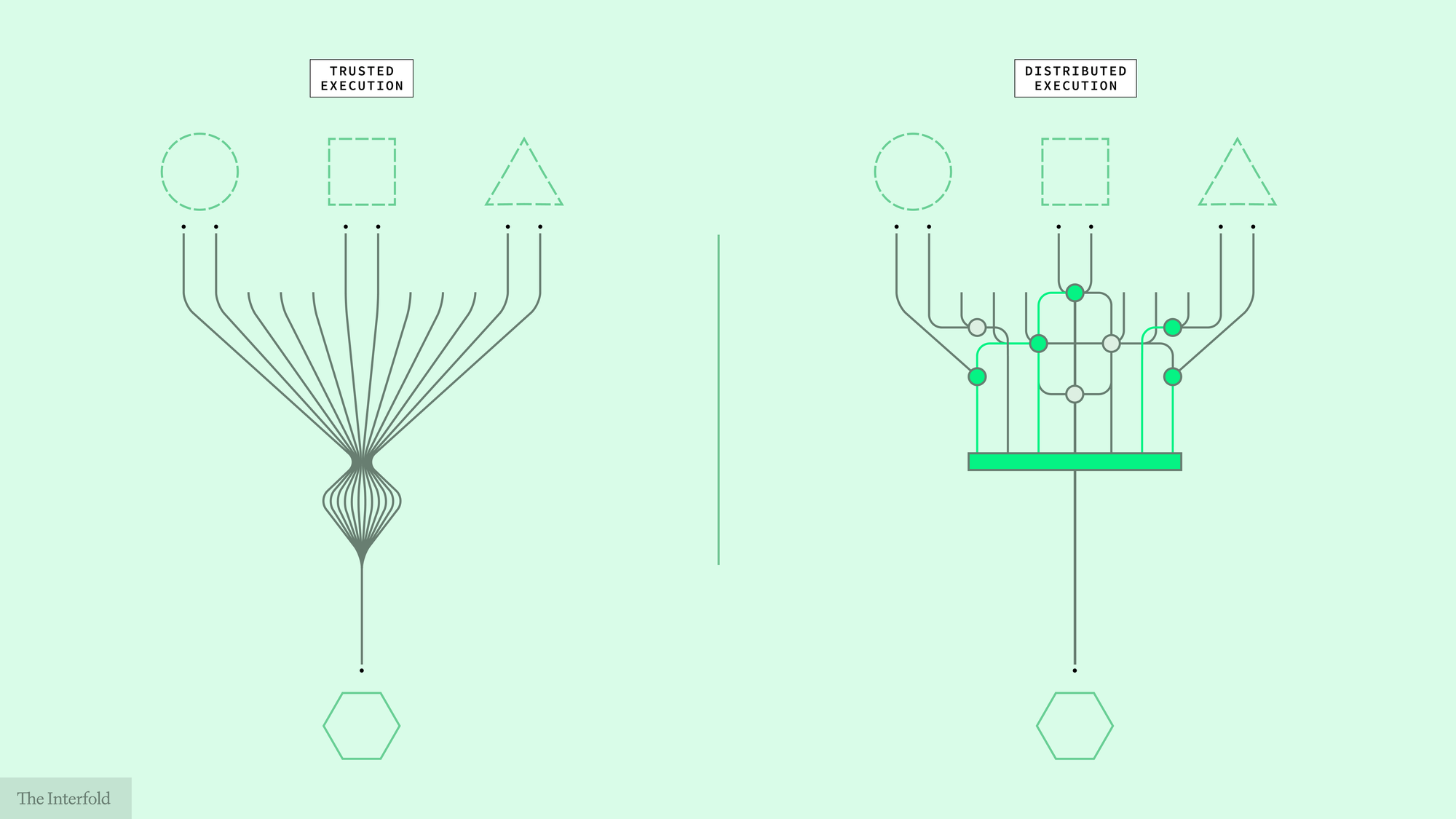


The core concept of The Interfold is E3 (Encrypted Execution Environment). Its principle is: computation tasks are assigned to a distributed network of 'Ciphernodes': user input always remains encrypted, computations are performed directly on ciphertext, and finally, only the aggregated result is decrypted and made public. No party can see anyone else's original data throughout the entire process.
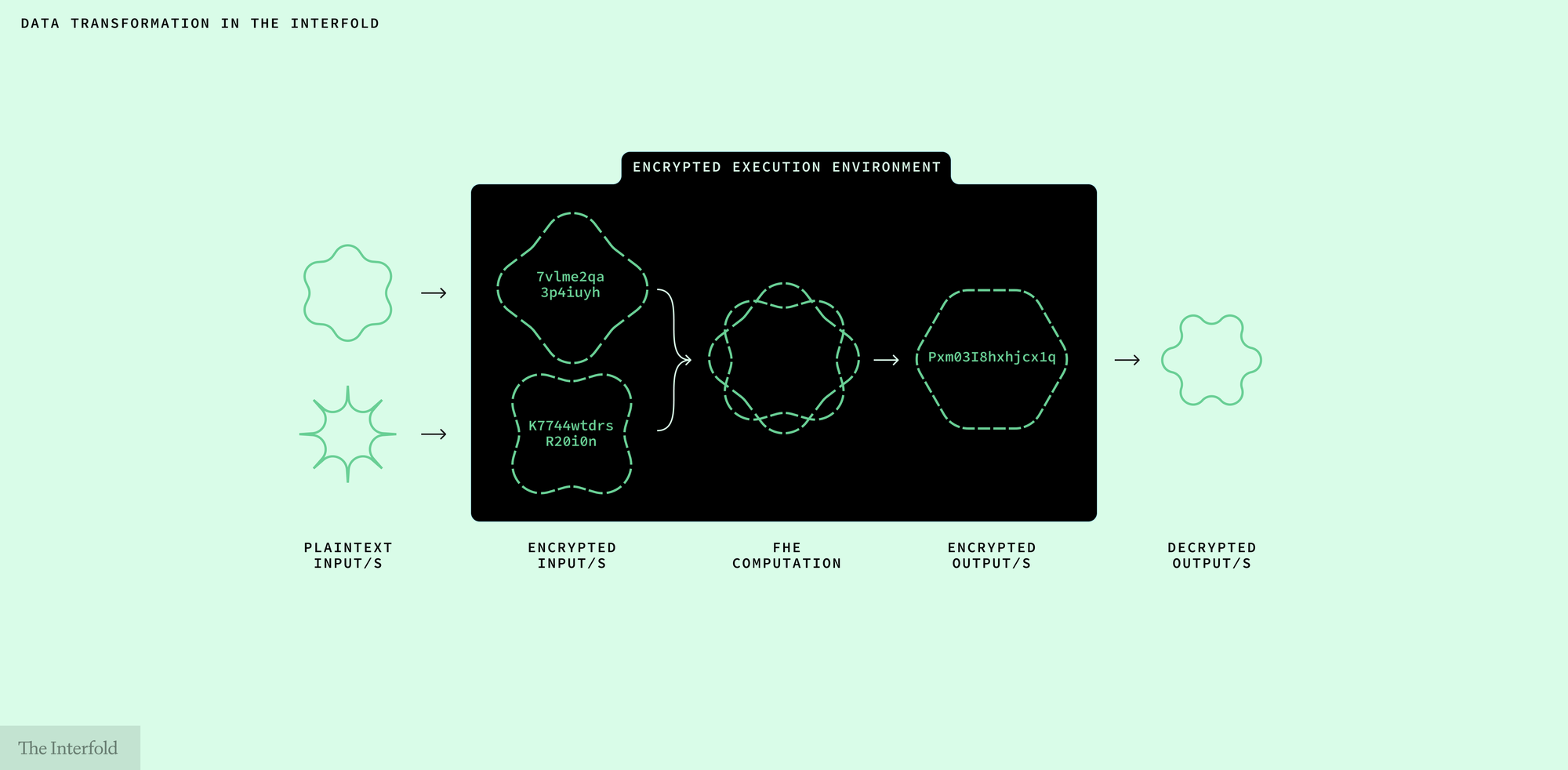


The technology stack supporting this mechanism consists of three layers: FHE (Fully Homomorphic Encryption) allows computations directly on encrypted data; ZK proofs (Zero-Knowledge proofs) verify whether the computation process itself was executed honestly; and DTC (Decentralized Threshold Cryptography) distributes decryption authority across multiple nodes, eliminating single points of trust.


The Interfold's currently promoted application scenario is CRISP (Coercion-Resistant Impartial Selection Protocol), designed for voting scenarios within DAO governance. CRISP achieves three things: the entire voting process is encrypted, and no one can view individual votes before the tally; 'receipt-free voting,' where users cannot prove to a third party how they voted, fundamentally cutting off bribery paths; and ZK proofs ensure the verifiability of tally results.


Two demo versions of CRISP are already live, with the team currently in the system integration and internal testnet validation phase. Confirmed ecosystem partnerships include: Zcash community's private governance tool Zecret Ballots, mobile DAO governance application Goverland, and joint integrations with Aragon and Status App.


Vitalik's Public Endorsement


On-chain governance bribery is not a new problem, but its measurable scale has rapidly expanded since 2024. Within the Curve ecosystem alone, the total value of bribes flowing through platforms like Votium exceeded $120 million in 2024; meanwhile, the median voter participation rate for various DAO proposals remains in the single digits.


The Ethereum community has not been unaware of this issue. In 2019, Vitalik posted a research note on ethresear.ch, proposing the conceptual framework of MACI (Minimal Anti-Collusion Infrastructure), envisioning the use of cryptographic means to eliminate voting bribery. This post has since been frequently cited, but practical implementation progress has been limited—the MACI scheme relies on a trusted 'Coordinator' role, who can see all votes. Once data is leaked, privacy guarantees immediately fail.


On May 28th, 2026, Vitalik publicly endorsed The Interfold on the X platform, stating: 'It basically is the thing I've been yelling for almost a decade for someone to build, and it's now built in a generalized way.'


The Interfold's core bet is: a single trusted coordinator is the fundamental bottleneck of MACI, and distributed threshold decryption is the correct path.


Team Background


The Interfold is developed by Gnosis Guild, a team with long-term expertise in Ethereum DAO infrastructure, previously well-known for its modular DAO toolset Zodiac. Zodiac is one of the most widely used permission and execution frameworks in the Ethereum DAO ecosystem, with partners covering several leading protocols. Specific core member names have not been publicly disclosed through official channels. The project also has no publicly disclosed institutional funding records.


Compared to larger-scale general-purpose privacy protocols like Aztec and Zama, The Interfold is a 'small but beautiful' project. It does not attempt to become a general-purpose privacy infrastructure; instead, it focuses on a specific, long-unresolved problem—making on-chain votes truly un-purchasable. The ambition may not be vast, but the target is precise.


From MACI to The Interfold


The conceptual framework of MACI (Minimal Anti-Collusion Infrastructure), proposed by Vitalik in 2019, has seen deployment in scenarios like Gitcoin but always had a structural flaw: it required a trusted coordinator, and if its private key were leaked, the entire privacy guarantee would fail. The Interfold is a generalized implementation of this framework—replacing a single coordinator with a distributed network of Ciphernodes, turning 'trust in a person' into 'trust in cryptography.'


Cryptos en tendance

Questions liées

QWhat is the main problem in DAO governance that The Interfold aims to solve?

AThe Interfold aims to solve the problem of governance bribery in DAO voting, where individuals or entities with sufficient funds can directly 'bribe' voters to sway decisions, undermining true community consensus.

QWhat is the core technological concept of The Interfold, and what does it stand for?

AThe core technological concept of The Interfold is the E3, or Encrypted Execution Environment. It enables a distributed network of 'Ciphernodes' to perform computations directly on encrypted user data, with only the final aggregated result being decrypted and revealed.

QAccording to the article, what is the key difference between The Interfold's approach and the earlier MACI framework proposed by Vitalik Buterin?

AThe key difference is that the original MACI framework relied on a single trusted 'coordinator' who could see all votes, creating a privacy vulnerability. The Interfold replaces this single point of trust with a distributed network of nodes using threshold cryptography.

QWhat are the primary uses of the FOLD token within The Interfold ecosystem?

AThe FOLD token has three primary uses: 1) For Ciphernodes to stake and join the network to earn rewards. 2) For applications to pay for encrypted computation requests. 3) For holders to participate in protocol governance.

QWhat major public endorsement did The Interfold receive, and who gave it?

AVitalik Buterin publicly endorsed The Interfold on the X platform on May 28, 2026, stating, 'It's basically the thing I've been shouting for almost a decade that someone should build, and it's now implemented in a general form.'

Lectures associées

Libérer 100 millions de dollars de liquidités ? La nouvelle politique de Pump.fun teste la technique du « pump » en 5 minutes

Pump.fun a lancé le mode BOOST, son nouveau mécanisme standard de lancement de jetons. Il vise à récupérer environ 20 % des liquidités qui étaient auparavant bloquées de façon permanente ("liquidités mortes") dans les pools de liquidité (LP) lors de la migration d'un jeton depuis la courbe de liaison (bonding curve). Cette pratique entraînait une perte de liquidités estimée à plus de 100 millions de dollars par an. Le fonctionnement du mode BOOST est le suivant : lors de la migration d'un jeton, environ 20 % des fonds de règlement (soit 17,6 SOL ou 2516 USDC selon la paire) sont désormais utilisés pour acheter ce même jeton sur le marché secondaire pendant les 5 premières minutes suivant la migration, via un ordre TWAP (prix moyen pondéré dans le temps). Les jetons achetés sont immédiatement brûlés, créant ainsi une pression d'achat temporaire et réduisant l'offre en circulation de manière permanente. L'objectif déclaré est d'améliorer l'expérience des traders en offrant un "feu d'artifice" de prix pendant les premiers instants critiques après la migration, dans l'espoir de renforcer la rétention des utilisateurs et l'activité commerciale sur la plateforme. Cependant, des inquiétudes ont été soulevées : ce mécanisme pourrait faciliter artificiellement le succès initial de jetons de mauvaise qualité et, une fois les achats terminés au bout de 5 minutes, exposer les jetons à des risques de chute de prix encore plus brutaux en cas de forte vente.

marsbitIl y a 51 mins

Libérer 100 millions de dollars de liquidités ? La nouvelle politique de Pump.fun teste la technique du « pump » en 5 minutes

marsbitIl y a 51 mins

Vendre de l'espace de bloc est mort : les chaînes publiques doivent trouver de nouvelles façons de survivre

L'article soutient que le modèle économique traditionnel des blockchains publiques, basé sur la vente d'espace de bloc, est obsolète. Il cite l'exemple frappant d'Hyperliquid, qui génère environ 100 fois plus de revenus mensuels qu'Arbitrum, et souligne que parmi les entreprises de crypto ayant dépassé 2 milliards de dollars de revenus, une seule est une blockchain publique. Face à ce constat, les blockchains doivent se réinventer. Les nouvelles voies émergentes sont : devenir des studios de produits, des distributeurs d'applications, des rails de paiement ou des piles SaaS verticalisées, abandonnant ainsi le rôle d'infrastructure neutre pour s'ancrer dans des niches spécifiques. L'article aborde ensuite deux autres sujets clés : 1. L'exploit du protocole Ostium, qui a perdu plus de 40% de sa TVL, illustre les risques critiques pour les protocoles qui importent des données hors-chaîne (comme les prix) et la nécessité de contrôles de sécurité stricts intégrés au produit. 2. L'avenir des options sur chaîne réside dans l'abstraction. Plutôt que de les commercialiser comme des produits complexes, il faut présenter leurs avantages (rendement, levier, protection) via des produits plus accessibles comme des coffres à rendement, des options binaires ou des produits structurés, masquant ainsi leur nature technique aux utilisateurs finaux. En conclusion, l'ère des infrastructures généralistes cède la place à une approche orientée produit et client, où la création de valeur tangible et capturable est primordiale pour la survie et la croissance.

marsbitIl y a 1 h

Vendre de l'espace de bloc est mort : les chaînes publiques doivent trouver de nouvelles façons de survivre

marsbitIl y a 1 h

Trading

Spot

Articles tendance

Comment acheter AUCTION

Bienvenue sur HTX.com ! Nous vous permettons d'acheter Auction (AUCTION) de manière simple et pratique. Suivez notre guide étape par étape pour commencer votre parcours crypto.Étape 1 : Création de votre compte HTXUtilisez votre adresse e-mail ou votre numéro de téléphone pour ouvrir un compte sur HTX gratuitement. L'inscription se fait en toute simplicité et débloque toutes les fonctionnalités.Créer mon compteÉtape 2 : Choix du mode de paiement (rubrique Acheter des cryptosCarte de crédit/débit : utilisez votre carte Visa ou Mastercard pour acheter instantanément Auction (AUCTION).Solde :utilisez les fonds du solde de votre compte HTX pour trader en toute simplicité.Prestataire tiers :pour accroître la commodité d'utilisation, nous avons ajouté des modes de paiement populaires tels que Google Pay et Apple Pay.P2P :tradez directement avec d'autres utilisateurs sur HTX.OTC (de gré à gré) : nous offrons des services personnalisés et des taux de change compétitifs aux traders.Étape 3 : stockage de vos Auction (AUCTION)Après avoir acheté vos Auction (AUCTION), stockez-les sur votre compte HTX. Vous pouvez également les envoyer ailleurs via un transfert sur la blockchain ou les utiliser pour trader d'autres cryptos.Étape 4 : tradez des Auction (AUCTION)Tradez facilement Auction (AUCTION) sur le marché Spot de HTX. Il vous suffit d'accéder à votre compte, de sélectionner la paire de trading, d'exécuter vos trades et de les suivre en temps réel. Nous offrons une expérience conviviale aux débutants comme aux traders chevronnés.

185 vues totalesPublié le 2024.12.12Mis à jour le 2026.06.02

Comment acheter AUCTION

Discussions

Bienvenue dans la Communauté HTX. Ici, vous pouvez vous tenir informé(e) des derniers développements de la plateforme et accéder à des analyses de marché professionnelles. Les opinions des utilisateurs sur le prix de AUCTION (AUCTION) sont présentées ci-dessous.

活动图片












