Chain Gaming Giant YGG Capitulates, Losing $15 Billion in Value Over 5 Years

Foresight NewsPublié le 2026-07-07Dernière mise à jour le 2026-07-07

Résumé

The leading blockchain gaming guild Yield Guild Games (YGG) is shutting down its publishing arm, YGG Play, announced on July 6th by its official account and co-founder Gabby Dizon. The platform and its supported games will be phased out by July 31st. While YGG Play successfully validated a market for casual, crypto-native mobile games—generating over $9M in total revenue, including $876,000 in Q1 2026—Dizon stated the closure was a market-driven decision. He cited insufficient liquidity and declining user confidence in the macroeconomic environment, making the business commercially unsustainable. Founded in 2020, YGG rose to prominence during the Play-to-Earn (P2E) boom, particularly with Axie Infinity, organizing players and managing assets. Its token price soared above $10 during the 2021 bull market. However, the 2022 crypto downturn exposed the fragility of P2E economic models. YGG attempted to pivot in 2025 with the YGG Play publishing initiative, focusing on short-session casual games. The shutdown reflects broader struggles in the Web3 gaming sector. An April 2026 report highlighted a "structural mismatch" between speculative financial designs and genuine player entertainment needs, leading to an estimated $15 billion in destroyed capital. The report noted that 93% of roughly 3,200 tracked blockchain game projects are now "functionally dead," with token prices down an average of 95% from 2022 peaks. YGG itself is now pivoting its strategy entirely towards the AI Data...


By Ma He, Foresight News


On July 6th, both the official account of Yield Guild Games (YGG) and its co-founder Gabby Dizon simultaneously announced the decision to shut down its game publishing division, YGG Play. The team will gradually phase out the platform and certain games by July 31st according to plan, with 35 employees receiving an additional 8 weeks of salary compensation. Some games, like GIGACHADBAT, will be transferred to the developer Delabs for continued operation. Others, such as LOL Land and Waifu Sweeper, will be officially retired. Games published by YGG Play have generated cumulative revenue exceeding $9 million, with a single quarter in Q1 2026 contributing $876,000.
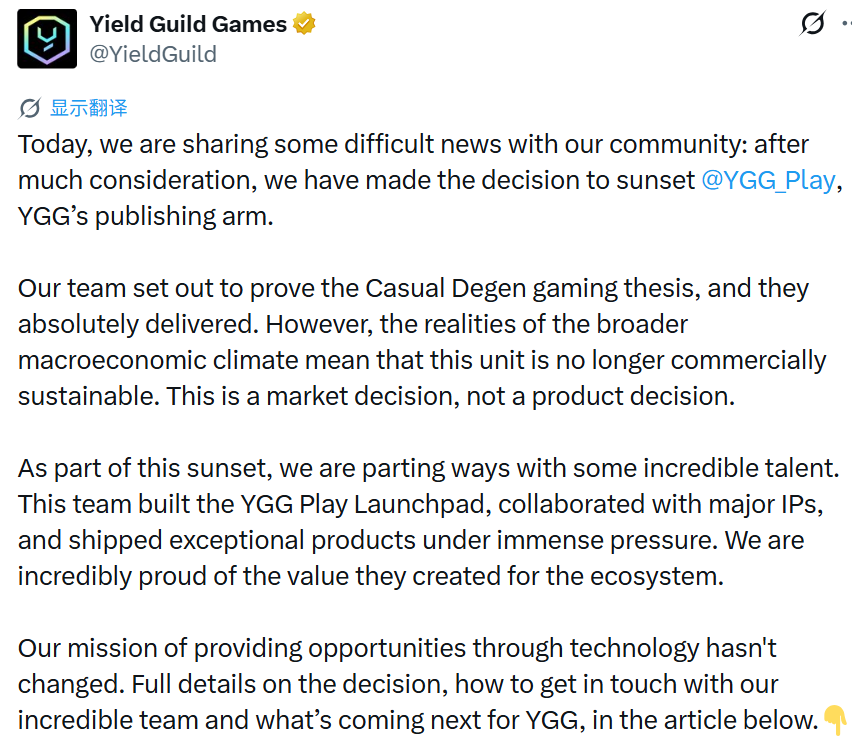


In the statement, Gabby Dizon stated: This is a market decision, not a product decision. Although the team successfully validated the casual gaming segment—short sessions, high engagement, and rapid feedback loops for crypto-native users—the lack of liquidity and declining user confidence in the macroeconomic environment have rendered this business commercially unsustainable.


Alongside shutting down YGG Play, YGG also announced a full pivot to the AI Data Economy, aiming to capture the multibillion-dollar market for AI training datasets, initially focusing on building B2B pipelines around gaming datasets.


The Chain Game Publishing Platform YGG Play


Launched by YGG in 2025, YGG Play was its Web3 game publishing arm, dedicated to serving the casual player community in the crypto space. It targeted short, quick, mobile-friendly games with a touch of social interaction and rewards, helping independent studios quickly go on-chain for distribution and acquire and operate users through YGG's community network. These games accumulated significant revenue during 2025-2026, proving that specific vertical segments could still generate genuine revenue even at the tail end of a bear market.


However, revenue peaked around October 2025. The large-scale liquidation event in October's crypto market further dampened the payment willingness and retention of target users. The closure of YGG Play marks a strategic contraction for YGG, moving away from the dual-engine drive of "guild operations + publishing."


To understand the weight of this closure, one must trace YGG's complete trajectory.


In 2020, veteran Philippine gaming industry figures Gabby Dizon, Beryl Li, and anonymous partner Owl of Moistness co-founded YGG. This was during the peak of the COVID-19 pandemic when many service industry workers in the Philippines were unemployed. Axie Infinity, the hottest Play-to-Earn (P2E) game at the time, was enabling players to borrow Axie NFTs for free to battle and share earnings through its "scholarship" model.


YGG seized this window, starting as a small guild, raising funds to purchase Axie assets, organizing and training players, and rapidly becoming one of the largest and most scalable guilds within the Axie ecosystem.
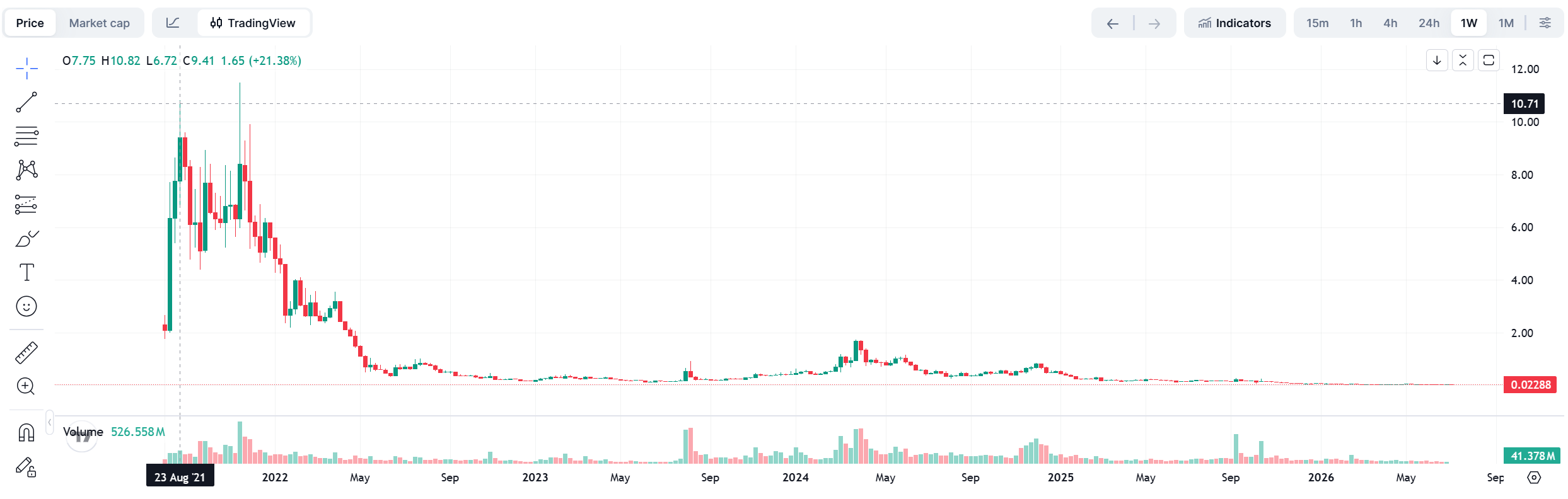


2021 was YGG's peak year. Driven by both the bull market and the P2E narrative, its token price soared, exceeding $10 at its highest. YGG expanded from a single Axie guild into a global network covering dozens of regional sub-guilds and partnered with over 80 blockchain games and infrastructure projects. It moved beyond mere asset lending, helping players maximize earnings through quests, events, and community operations. In places like the Philippines, the real economic phenomenon of "playing games as work" emerged, and YGG became a benchmark for the P2E model.


At its peak, YGG's model was widely replicated: guilds became crucial intermediaries connecting players, assets, and games, with DAO governance and token incentives allowing participants to share in growth benefits. YGG evolved from a simple "asset manager" into an investment, content, and community platform.


When the crypto bear market arrived in 2022, the fragility of Axie Infinity's economic model was laid bare—new user inflow slowed, token prices crashed, and player churn was severe. Many guilds and P2E projects vanished outright, and the entire industry entered a deep trough. YGG did not collapse but began a long adaptation. In 2025, YGG bet on a new direction: launching YGG Play and formally entering the game publishing arena, as heavy P2E was no longer viable, while crypto users naturally gravitated towards high-frequency, instant-feedback casual experiences.


This shutdown comes barely a year after that last pivot.


A Microcosm of the Chain Gaming Industry


The closure of YGG Play can be seen as a concentrated reflection of the chain gaming industry's development trajectory over the past five years.


In April this year, the crypto quantitative trading and market-making firm Caladan reviewed the five-year journey of the Web3 gaming sector from frenzied explosion to comprehensive collapse. Its core conclusion was that the decline of Web3 games is not a normal cyclical downturn but stems from a fundamental "structural misalignment" between the underlying speculative financial design and the genuine entertainment needs of players, leading to a staggering $15 billion in capital being obliterated.


Examples abound: Pixelmon, which raised $70 million but failed to launch public beta in 4 years; Ember Sword, which burned through $18 million and was liquidated; and Hamster Kombat, which lost 96% of its users within 6 months.


As of April 2026, in the roughly 3,200 chain gaming projects tracked by the report, 93% have been categorized as "practically dead" or have completely lost activity. The average decline in the crypto token prices for the entire gaming sector compared to the 2022 all-time highs reached 95%.


The prosperity of chain gaming was entirely built upon the Ponzi-like dividend logic of "Play-to-Earn." This model is inherently an unsustainable speculative financial closed loop: the earnings of early players and token prices entirely depend on a constant influx of new players buying tokens or NFTs to sustain the system. Once new user growth slows and external capital inflow decreases, the token's severe inflation rapidly breaches economic equilibrium, triggering a "death spiral" of token crashes, shrinking earnings, and a mass exodus of users.


YGG Play was not a failure in terms of product delivery or revenue figures but was defeated by "market timing."


The story of chain gaming may be nearing its end.

Cryptos en tendance

Questions liées

QWhy did YGG decide to shut down its YGG Play division?

AYGG decided to shut down its YGG Play division due to market conditions, specifically insufficient market liquidity and declining user confidence in the macroeconomic environment, which made the business commercially unsustainable, despite having validated the casual gaming niche.

QWhat was the original core business model of Yield Guild Games (YGG) at its peak?

AAt its peak during the 2021 bull market, YGG's core model was operating as a major guild within the Play-to-Earn (P2E) ecosystem, most notably for Axie Infinity. It provided asset lending (scholarships), player training, and community management to help players maximize earnings, evolving into a global network and a platform for investment, content, and community.

QWhat new strategic direction has YGG announced alongside the closure of YGG Play?

AAlongside the closure of YGG Play, YGG announced a full-scale pivot into the AI Data Economy, aiming to capture a share of the multi-billion dollar AI training dataset market, with an initial focus on building B2B pipelines around gaming datasets.

QAccording to the article, what is the fundamental structural flaw of most Web3/blockchain games as identified by Caladan's report?

AAccording to Caladan's report cited in the article, the fundamental structural flaw of most Web3 games is a 'structural misalignment' between their underlying speculative financial design and genuine player entertainment needs. Their models rely on an unsustainable Ponzi-like financial loop where early player returns depend on constant new user inflow to buy tokens/NFTs, leading to a 'death spiral' when growth slows.

QWhat statistics does the article provide to illustrate the scale of failure in the blockchain gaming sector over the past five years?

AThe article provides several statistics illustrating the sector's failure: a collective loss of $150 billion in capital, 93% of tracked projects (~3200) being 'effectively dead' or inactive by April 2026, and an average token price decline of 95% from the 2022 highs for the gaming sector. It also cites specific failed projects like Pixelmon and Ember Sword.

Lectures associées

Tiger Research : Trois stratégies clés pour que les institutions financières rattrapent la vague de la tokenisation

Tiger Research souligne que le marché de la tokenisation des actifs du monde réel est en forte croissance (estimé entre 250 et 360 milliards de dollars d'ici mi-2026), mais son développement est freiné par des cadres réglementaires encore incomplets. Face à cette incertitude, les institutions financières doivent choisir une stratégie : attendre une législation locale, expérimenter via des bac à sable réglementaires ou prendre de l'avance en se développant sur des marchés étrangers déjà matures. Avant de se lancer, une préparation rigoureuse dans six domaines clés est essentielle : choix de la juridiction, obtention des licences, définition de l'actif tokenisé, ciblage des investisseurs, mécanismes de règlement et exigences opérationnelles. Deux voies principales s'offrent ensuite. La première est une approche « par juridiction », en établissant une présence dans des places comme Hong Kong, Singapour ou les États-Unis, qui disposent de cadres réglementaires avancés et de plateformes opérationnelles. La seconde est une voie « native chaîne », utilisant des plateformes construites pour l'environnement blockchain (comme Ondo Global ou Plume Nest), permettant un déploiement plus rapide et une plus grande interopérabilité avec la finance décentralisée (DeFi), bien qu'avec une complexité structurelle accrue. Un exemple concret détaille les étapes pour une institution souhaitant tokeniser une obligation, en utilisant une entité existante à Hong Kong et en s'appuyant sur une plateforme agréée comme DigiFT pour accélérer le processus. Le rapport conclut que l'attente d'un cadre réglementaire parfait n'est pas une option. Les grands acteurs américains avancent déjà. L'essentiel pour les autres institutions est de choisir une voie adaptée, de surmonter les défis juridiques et opérationnels, et d'accumuler de l'expérience pratique rapidement, car le marché n'attendra pas. L'objectif final n'est pas la conception technique, mais la réussite complète du processus de vente et de distribution.

Foresight NewsIl y a 58 mins

Tiger Research : Trois stratégies clés pour que les institutions financières rattrapent la vague de la tokenisation

Foresight NewsIl y a 58 mins

Récapitulatif de Zoomex X Space avec David James et le panel de trading de la Coupe du Monde

Zoomex a organisé le troisième épisode de son X Space Édition Coupe du Monde, dans le cadre de son engagement caritatif, réunissant le gardien anglais David James et un panel de traders. La discussion a exploré les parallèles entre le gardien de but et le trader, en se concentrant sur la préparation, la psychologie et l'exécution. David James a partagé sa philosophie : la vraie pression pour un gardien survient lors des moments d'inactivité, nécessitant une concentration maximale. Il a comparé cela au trader préparé qui n'a pas peur du prochain mouvement de marché. Sur les penalties, il a distingué deux modes : la préparation pure (analyse des tendances) et l'instinct, affirmant que le premier affine le second. Ce principe a été directement relié au trading par le panel. James a souligné l'importance de transformer les erreurs en données apprenables plutôt qu'en fantômes mentaux. Évoquant l'évolution du poste, il a noté que les changements de règles, plus que la tactique, ont révolutionné le rôle, exigeant désormais une distribution précise. Concernant les équipes, il a pointé la menace statistique de la France, avec huit joueurs dépassant les 35 km/h, et la "fragilité" potentielle des équipes invaincues comme le Mexique et l'Espagne, qui n'ont pas encore appris à réagir après avoir encaissé. Interrogé sur l'Angleterre, James a maintenu sa conviction qu'elle peut tout gagner, chaque argument pour les autres favoris s'appliquant aussi à son équipe. La session s'est conclue sur le fil conducteur unissant le gardien et le trader : une préparation approfondie réduit l'inconnu et les nerfs, remplaçant l'anxiété par un plan, que le résultat soit favorable ou non. L'engagement caritatif de Zoomex se poursuit, avec 1000 USDT promis à la fondation UEFA choisie par James si l'Angleterre l'emporte.

TheNewsCryptoIl y a 2 h

Récapitulatif de Zoomex X Space avec David James et le panel de trading de la Coupe du Monde

TheNewsCryptoIl y a 2 h

La folle course en Bourse d'Unitree : le véritable enjeu, c'est comment elle va dépenser les 4,2 milliards qu'elle a levés

Le constructeur chinois de robots humanoïdes Unitree a vu sa demande d'introduction en Bourse approuvée par la Chine, visant à lever environ 4,2 milliards de yuans. Fondée par Wang Xingxing en 2016, l'entreprise s'est d'abord fait connaître avec des robots quadrupèdes avant de lancer en 2023 son premier robot humanoïde grandeur nature, le H1, suivie d'une gamme de produits à prix agressifs. Ses revenus sont passés de 159 millions de yuans en 2023 à 1,71 milliard en 2025, avec une part de marché mondiale dépassant 60% pour ses quadrupèdes. Environ 40% de son chiffre d'affaires provient de l'étranger, notamment d'un projet pilote avec Japan Airlines à l'aéroport de Tokyo Haneda. Les fonds levés serviront à renforcer la R&D, le développement de produits et la construction de nouvelles usines. Unitree fait face à une concurrence intense, avec des acteurs comme Ubtech (axé sur l'accompagnement émotionnel), Tesla Optimus, ou Fourier. Ses défis seront de consolider sa position au-delà des quadrupèdes, de maintenir son avantage de prix tout en améliorant la fiabilité, et de faire progresser l'intelligence incarnée, comme avec son modèle H2 Plus développé avec Nvidia. Sa stratégie semble privilégier la vente en volume de modèles d'entrée de gamme pour les développeurs, couplée à des projets phares dans des secteurs industriels, misant sur l'expansion future du marché des robots humanoïdes.

marsbitIl y a 2 h

La folle course en Bourse d'Unitree : le véritable enjeu, c'est comment elle va dépenser les 4,2 milliards qu'elle a levés

marsbitIl y a 2 h

Trading

Spot

Articles tendance

Comment acheter YGG

Bienvenue sur HTX.com ! Nous vous permettons d'acheter Yield Guild Games (YGG) de manière simple et pratique. Suivez notre guide étape par étape pour commencer votre parcours crypto.Étape 1 : Création de votre compte HTXUtilisez votre adresse e-mail ou votre numéro de téléphone pour ouvrir un compte sur HTX gratuitement. L'inscription se fait en toute simplicité et débloque toutes les fonctionnalités.Créer mon compteÉtape 2 : Choix du mode de paiement (rubrique Acheter des cryptosCarte de crédit/débit : utilisez votre carte Visa ou Mastercard pour acheter instantanément Yield Guild Games (YGG).Solde :utilisez les fonds du solde de votre compte HTX pour trader en toute simplicité.Prestataire tiers :pour accroître la commodité d'utilisation, nous avons ajouté des modes de paiement populaires tels que Google Pay et Apple Pay.P2P :tradez directement avec d'autres utilisateurs sur HTX.OTC (de gré à gré) : nous offrons des services personnalisés et des taux de change compétitifs aux traders.Étape 3 : stockage de vos Yield Guild Games (YGG)Après avoir acheté vos Yield Guild Games (YGG), stockez-les sur votre compte HTX. Vous pouvez également les envoyer ailleurs via un transfert sur la blockchain ou les utiliser pour trader d'autres cryptos.Étape 4 : tradez des Yield Guild Games (YGG)Tradez facilement Yield Guild Games (YGG) sur le marché Spot de HTX. Il vous suffit d'accéder à votre compte, de sélectionner la paire de trading, d'exécuter vos trades et de les suivre en temps réel. Nous offrons une expérience conviviale aux débutants comme aux traders chevronnés.

117 vues totalesPublié le 2024.12.11Mis à jour le 2026.06.02

Comment acheter YGG

Discussions

Bienvenue dans la Communauté HTX. Ici, vous pouvez vous tenir informé(e) des derniers développements de la plateforme et accéder à des analyses de marché professionnelles. Les opinions des utilisateurs sur le prix de YGG (YGG) sont présentées ci-dessous.

活动图片