SpaceX, AI, and XRP: Why the Next Wealth Transfer Might Be Different?

marsbitPublié le 2026-06-21Dernière mise à jour le 2026-06-21

Résumé

The article posits that the global economy is transitioning into a new phase of infrastructure investment. Capital, facing slowing traditional growth engines, is flowing towards emerging foundational systems. This includes space infrastructure (exemplified by SpaceX), AI computing power, satellite networks, data centers, and global payment systems. A key driver is a potential new commodity supercycle fueled by industrial demand from these sectors. Concurrently, the role of blockchain is evolving from speculative assets to a critical settlement layer for the future economy. Digital assets like XRP and XLM, focused on payments and interoperability, are highlighted as potential rails for cross-border settlement, tokenized assets, and machine-to-machine (AI Agent) transactions. The narrative connects figures like Ripple's Jed McCaleb to space ventures, suggesting convergence. The argument emphasizes a shift from speculative narratives to utility-driven value. As AI and space commerce generate new economic activity, and regulatory clarity improves, blockchain networks may underpin real-time value transfer. The conclusion urges investors to consider which networks will form the backbone of this integrated next-generation economic infrastructure.

Editor's Note: This article attempts to understand SpaceX's IPO expectations, AI Agents, blockchain settlement networks, commodity demand, and digital asset regulation within the same overarching narrative: global capital may be shifting from purely chasing speculative growth to betting on the next generation of economic infrastructure.

The author's core argument is that as traditional growth engines slow, capital requires new vessels. Space infrastructure, AI computing power, satellite networks, data centers, and cross-border payment systems may collectively constitute the next cycle of infrastructure investment. Within this framework, commodities are no longer just cyclical goods but become the foundational inputs for AI, communications, orbital manufacturing, and energy systems; blockchain is not merely about trading assets but could become the financial rails for tokenized assets, AI Agent payments, and global real-time settlement.

The article particularly emphasizes the potential role of payment-oriented digital assets like XRP and XLM in cross-border settlement, interoperability, and machine-to-machine payments. It connects threads such as Ripple, Jed McCaleb, Vast, and SpaceX to paint a picture of a converging landscape of "space commerce + AI + blockchain settlement layer".

It is important to note that such narratives still carry a strong speculative element, especially when tying specific digital assets to future infrastructure cycles. The distance between long-term trends, commercial implementation, and market pricing must still be distinguished. However, the question it raises is worth attention: If AI is creating new economic actors, and space and data centers are creating new capital expenditure cycles, who will handle value transfer, identity management, and instant settlement between these systems? This may be the key for digital assets to move from a speculative narrative to an infrastructure narrative.

Below is the original article:

The financial world may be entering a new phase. This phase is not merely a continuation of traditional market cycles but a progression towards the construction of a completely new set of economic infrastructure. Recent developments around SpaceX, artificial intelligence, blockchain technology, and the clarification of digital asset regulations suggest that capital is starting to flow towards systems that could define the next generation of global commerce.

Behind the SpaceX IPO Expectations: Capital is Searching for New Infrastructure

The highly anticipated IPO of SpaceX has garnered immense attention, not just because of SpaceX itself, but because it represents a broader trend. As debt markets tighten and economic growth slows, governments and financial institutions are seeking new frontiers that can both absorb capital and justify sustained investment.

Space infrastructure, orbital manufacturing, satellite networks, data centers, and advanced communications systems are increasingly being viewed as trillion-dollar opportunities. These fields require massive physical capital, commodities, financing support, and technological synergy.

The logic is simple: when traditional growth engines mature, capital seeks new domains to support further expansion. Space might become one such frontier, even if the narrative itself is built on lies and deception.

A New Commodity Cycle: Both AI and Space Depend on Raw Materials

Large-scale infrastructure projects are inseparable from raw materials.

The expansion of data centers, satellite networks, AI computing facilities, and future space infrastructure will generate enormous demand for key commodities. Metals like gold, silver, platinum, copper, and rare earths will become indispensable inputs in the next generation of technological systems.

The world may be in the early stages of a structural commodity supercycle. This means demand will rise consistently over a longer period, driven by infrastructure investment and technological change.

Unlike previous cycles centered primarily on consumer demand, this one will be driven by industrial and technological needs.

Blockchain's New Role: Not Just Tokens, But a Real-Time Settlement Layer

As new industries emerge, capital must be able to flow efficiently within global markets.

The traditional banking system was designed for a slower world. The infrastructure of the future will involve tokenized assets, AI-driven transactions, international payments, and even potential space commerce, all requiring settlement systems that operate continuously and process at high speed.

This is where blockchain technology enters the conversation.

As highlighted in our podcast yesterday, as financial infrastructure evolves, digital assets focused on payments and interoperability may become increasingly important. Networks capable of settling transactions quickly and efficiently will benefit from the growing need for real-time value transfer.

Digital assets like XRP and XLM are notable in this context, as they focus on payments, interoperability, and cross-border settlement.

It is worth noting the existing connections between Ripple co-founder and XRP Ledger architect Jed McCaleb and commercial space projects. His company, Vast, has partnership connections to SpaceX and Starlink-related plans.
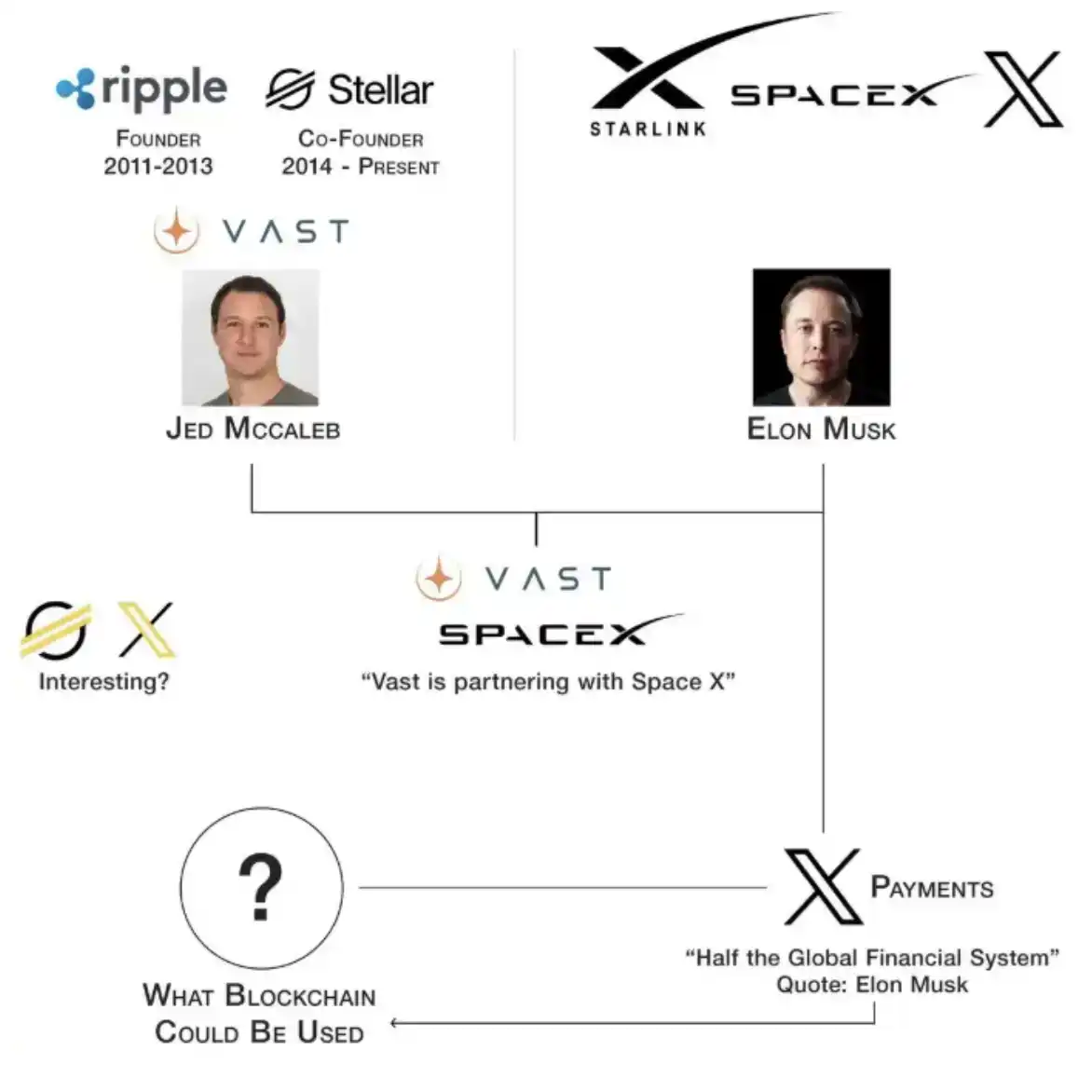
This suggests that blockchain and emerging infrastructure industries may see increasing intersections in the future.

The Convergence of Artificial Intelligence and Blockchain

One of the most overlooked points in current technological innovation might be the convergence of artificial intelligence and blockchain technology.

Ripple CEO Brad Garlinghouse recently mentioned that the company is advancing AI-related initiatives and developing tools to allow AI Agents to interact with the XRP Ledger. This reflects a broader trend taking shape across the tech industry.

AI systems are rapidly evolving from information-processing tools into autonomous agents capable of making decisions, executing transactions, and interacting with digital services.

For these agents to operate meaningfully in an economic sense, they require infrastructure that can support functions such as: sending payments; settling transactions instantly; managing digital identity; executing agreements; transferring value across different networks.

Blockchain technology provides many of these capabilities. As AI adoption accelerates, demand for payment rails capable of supporting large-scale machine-to-machine transactions may grow. This creates a potential fusion: AI generates economic activity, and blockchain networks provide the settlement layer that supports it.

Regulatory Clarity and Institutional Adoption

Another crucial topic is the increasing momentum towards digital asset regulation in the United States. Ripple's management has consistently argued that regulatory clarity is the single most important factor holding back broader institutional adoption. Banks, payment providers, corporate treasuries, and financial institutions typically require clear legal frameworks before committing significant capital to new technologies.

As regulatory certainty improves, institutions may become more willing to integrate blockchain-based systems into their existing business processes.

According to Garlinghouse, Ripple is expected to reach a revenue run-rate in the billions of dollars annually while continuing its global expansion. This indicates that demand for enterprise blockchain solutions continues to grow.

The importance of regulation is not merely legal. It reduces uncertainty and allows businesses and financial institutions to plan long-term.

From Speculative Narrative to Infrastructure Narrative

One of the strongest conclusions this month is that markets might be shifting from a speculative cycle to an infrastructure cycle. Historically, the crypto market has been largely driven by retail speculation and narrative-fueled investment. The next phase could be different.

If AI, tokenization, digital payments, commodity infrastructure, and global settlement systems continue to mature, the value of digital assets may increasingly come from actual utility, not just speculation.

This would represent a significant shift in how investors evaluate blockchain networks.

Market focus will shift away from being solely concentrated on price action, moving increasingly towards metrics like transaction volume, settlement activity, institutional adoption, growth in tokenization, and integration with emerging technologies.

Conclusion

The convergence of SpaceX, artificial intelligence, blockchain infrastructure, commodities, and regulatory clarity paints a picture of an economy undergoing structural transformation.

Space infrastructure is attracting capital, artificial intelligence is rapidly accelerating, and regulators are moving towards clearer digital asset frameworks.

Simultaneously, blockchain networks are increasingly being positioned as the settlement layer connecting these emerging systems.

For investors, the question may no longer be whether these technologies will converge, but how quickly this convergence will happen, and which networks will ultimately become the foundational backbone of the global economy's next phase.

Those who truly accumulate wealth have never been the late adopters. You must position yourself as an early investor in tomorrow's economic infrastructure, before mass adoption arrives.

Cryptos en tendance

Questions liées

QAccording to the article, what is the core shift in the global capital investment trend?

AThe core shift is from chasing speculative growth to investing in the next generation of economic infrastructure, including space infrastructure, AI computing power, satellite networks, data centers, and cross-border payment systems.

QWhat role does the article suggest for specific digital assets like XRP and XLM in the emerging economic framework?

AThe article suggests they could play a crucial role as payment-focused digital assets for facilitating cross-border settlement, interoperability, and machine-to-machine payments, potentially forming the settlement layer for new economic activities driven by AI and space commerce.

QHow does the article connect the rise of AI Agents to blockchain technology?

AIt connects them by stating that as AI Agents evolve to make decisions and execute transactions, they will need an infrastructure for payments, instant settlement, and value transfer. Blockchain technology is positioned to provide this essential settlement layer for large-scale machine-to-machine economic activity.

QWhat is identified as a key factor for broader institutional adoption of blockchain-based systems?

ARegulatory clarity is identified as the most important factor. Clear legal frameworks reduce uncertainty and allow institutions like banks and payment providers to confidently integrate blockchain solutions into their long-term business planning.

QWhat major transition in market narrative does the article predict for the digital asset space?

AThe article predicts a transition from a speculative narrative, driven by retail investment and hype, to an infrastructure narrative, where the value of digital assets is increasingly derived from practical utility, transaction volume, institutional adoption, and integration with other emerging technologies like AI.

Lectures associées

Les ours d'Ethereum gardent le contrôle alors que l'ETH rejette la résistance de la ligne de tendance

Le rebond récent d'Ethereum n'a pas convaincu les analystes que la tendance baissière est terminée. Le 20 juin, TheSignalyst sur TradingView a souligné qu'ETH reste orienté à la baisse, évoluant toujours sous une ligne de tendance résistante rouge et formant une série de plus hauts et de plus bas décroissants. Le graphique montre qu'ETH a rejeté une zone de confluence constituée de cette ligne de tendance descendante et d'une zone de résistance structurelle horizontale. Un tel rejet confirme souvent que les vendeurs maintiennent le contrôle. La zone de support clé à surveiller se situe entre 1 350 et 1 500 dollars. Un retrait contrôlé dans cette fourchette pourrait susciter une réaction, mais une rupture nette en dessous affaiblirait considérablement la structure globale d'ETH. Actuellement, ETH est pris entre ce support important et la ligne de tendance baissière qui limite les rebonds. Tant que l'un de ces niveaux ne cède pas, le marché reste techniquement comprimé. Cette configuration d'Ethereum est également importante pour l'ensemble du marché des altcoins. Lorsque ETH peine face au dollar, l'appétit pour le risque s'affaiblit souvent dans tout l'écosystème DeFi et les actifs cryptographiques de petite capitalisation. Le scénario de TheSignalyst sert donc d'avertissement : le rebond récent doit encore prouver sa solidité. Les haussiers ont besoin d'une cassure nette au-dessus de la résistance pour envisager un renversement de tendance plus durable.

bitcoinistIl y a 3 h

Les ours d'Ethereum gardent le contrôle alors que l'ETH rejette la résistance de la ligne de tendance

bitcoinistIl y a 3 h

Trading

Spot
Futures

Articles tendance

Qu'est ce que XRP 2.0

XRP 2.0 : Une Nouvelle Frontière dans le Paysage des Cryptomonnaies Introduction à XRP 2.0 Dans le domaine en constante évolution des cryptomonnaies, de nouveaux projets émergent en continu, cherchant à attirer l'attention et l'adoption. L'un de ces projets prometteurs est XRP 2.0, une nouvelle initiative cryptographique conçue pour tirer parti des technologies de blockchain avancées et des méthodologies de cryptage robustes. Bien que le nom fasse des parallèles avec le XRP de Ripple, il est crucial de noter que XRP 2.0 fonctionne de manière indépendante, se concentrant sur l'amélioration de la sécurité des transactions, de la confidentialité et de l'évolutivité. À mesure que le paysage financier numérique adopte de plus en plus des solutions décentralisées, XRP 2.0 vise à contribuer de manière significative au web3 et à l'expansion globale des projets crypto. Qu'est-ce que XRP 2.0 ? Au cœur de XRP 2.0 se trouve un projet de cryptomonnaie qui vise à créer un écosystème de monnaie numérique sécurisé et décentralisé. Sa technologie de base intègre des principes de blockchain sophistiqués avec des techniques de cryptage à la pointe. L'objectif global de XRP 2.0 est de s'établir comme une plateforme fiable et efficace, permettant une exécution rapide des transactions tout en accordant la priorité à une protection accrue de la vie privée pour ses utilisateurs. Le projet est promu comme une solution à de nombreuses limitations rencontrées par les cryptomonnaies existantes, proposant un système capable de gérer un volume de transactions plus élevé avec une vitesse et une confidentialité améliorées. Cette polyvalence positionne XRP 2.0 comme un concurrent significatif sur un marché parsemé de diverses monnaies numériques. Qui est le Créateur de XRP 2.0 ? L'identité du créateur derrière XRP 2.0 a été signalée comme étant ‘Wilbur’. Cependant, des détails complets concernant Wilbur ou son entité associée restent insaisissables. L'anonymat de nombreux créateurs de cryptomonnaies n'est pas un phénomène rare dans l'industrie, souvent conçu pour maintenir un degré de confidentialité et de sécurité. Qui sont les Investisseurs de XRP 2.0 ? À l'heure actuelle, des informations spécifiques concernant les fondations ou organisations d'investissement soutenant XRP 2.0 ne sont pas publiquement disponibles. Dans le secteur des cryptomonnaies, le soutien d'investisseurs réputés peut influencer considérablement la crédibilité et le succès d'un projet, mais la transparence concernant les soutiens financiers de XRP 2.0 n'a pas été établie. Comment Fonctionne XRP 2.0 ? XRP 2.0 se distingue en employant une combinaison de technologie blockchain et d'algorithmes de cryptage avancés qui garantissent des transactions sécurisées et décentralisées. Sa structure innovante comprend des caractéristiques uniques conçues pour favoriser l'engagement des utilisateurs et élargir les fonctionnalités au-delà des transactions traditionnelles en cryptomonnaie. Parmi ces fonctionnalités, XRP 2.0 intègre des capacités alimentées par l'IA, telles que des fonctionnalités de texte à image et de texte à parole. Ces ajouts sont conçus pour améliorer l'expérience interactive des utilisateurs, favorisant une applicabilité plus large à travers divers secteurs. En reliant les avancées technologiques à un design centré sur l'utilisateur, XRP 2.0 vise à capter l'attention d'un large éventail d'individus et d'entreprises cherchant à intégrer des solutions de cryptomonnaie dans leurs cadres opérationnels. Chronologie de XRP 2.0 Comprendre XRP 2.0 nécessite d'examiner les jalons qui ont défini son parcours jusqu'à présent : 23 juillet 2023 : XRP 2.0 est introduit comme un nouveau projet de cryptomonnaie, visant à révolutionner les capacités de transaction sécurisées et décentralisées dans le domaine de la blockchain. 8 septembre 2023 : Le lancement d'un autre projet, XRP20, a lieu, marquant l'émergence d'un jeton ERC-20 sur la blockchain Ethereum qui n'est pas lié à XRP 2.0. 13 novembre 2023 : Le XRP Ledger subit une mise à jour significative avec la sortie de la version 2.0.0 du logiciel serveur rippled. Il est essentiel de noter que ce développement est déconnecté du projet de cryptomonnaie XRP 2.0. Ponts Clés Concernant XRP 2.0 Pour distiller l'essence de XRP 2.0, plusieurs facteurs critiques émergent : Fonctionnalités Uniques : L'inclusion de fonctionnalités telles que le texte à image et le texte à parole alimentés par l'IA diversifie encore les applications potentielles de XRP 2.0. Technologie Blockchain : Le cadre utilise des mécanismes de blockchain avancés et des protocoles de cryptage, assurant un environnement sécurisé et décentralisé pour les transactions. Evolutivité et Confidentialité : XRP 2.0 privilégie une protection accrue de la vie privée dans les processus de transaction et l'évolutivité nécessaire pour accueillir une base d'utilisateurs croissante. Aucune Affiliation avec Ripple : Il est important de noter qu'en dépit de son nom, XRP 2.0 n'a aucune allégeance ou collaboration avec le XRP de Ripple, distinguant son cadre opérationnel et ses objectifs au sein de l'écosystème des cryptomonnaies. Conclusion XRP 2.0 représente une entreprise ambitieuse dans la sphère des cryptomonnaies, visant à offrir une combinaison de sécurité, de confidentialité et d'efficacité dans les transactions numériques. En intégrant des technologies sophistiquées et des fonctionnalités conviviales, le projet se donne pour objectif d'élargir les horizons de ce que la cryptomonnaie peut réaliser dans l'économie numérique d'aujourd'hui. Bien que l'anonymat de son créateur et le manque d'investisseurs divulgués puissent soulever des questions pour certains, l'accent mis par XRP 2.0 sur des fonctionnalités avancées et la décentralisation renforce son attrait dans un marché crypto de plus en plus encombré. À mesure que le paysage des cryptomonnaies continue d'évoluer, XRP 2.0 pourrait devenir un acteur clé dans l'expansion des solutions blockchain sécurisées et évolutives.

200 vues totalesPublié le 2024.04.05Mis à jour le 2024.12.03

Qu'est ce que XRP 2.0

Comment acheter XRP

Bienvenue sur HTX.com ! Nous vous permettons d'acheter XRP (XRP) de manière simple et pratique. Suivez notre guide étape par étape pour commencer votre parcours crypto.Étape 1 : Création de votre compte HTXUtilisez votre adresse e-mail ou votre numéro de téléphone pour ouvrir un compte sur HTX gratuitement. L'inscription se fait en toute simplicité et débloque toutes les fonctionnalités.Créer mon compteÉtape 2 : Choix du mode de paiement (rubrique Acheter des cryptosCarte de crédit/débit : utilisez votre carte Visa ou Mastercard pour acheter instantanément XRP (XRP).Solde :utilisez les fonds du solde de votre compte HTX pour trader en toute simplicité.Prestataire tiers :pour accroître la commodité d'utilisation, nous avons ajouté des modes de paiement populaires tels que Google Pay et Apple Pay.P2P :tradez directement avec d'autres utilisateurs sur HTX.OTC (de gré à gré) : nous offrons des services personnalisés et des taux de change compétitifs aux traders.Étape 3 : stockage de vos XRP (XRP)Après avoir acheté vos XRP (XRP), stockez-les sur votre compte HTX. Vous pouvez également les envoyer ailleurs via un transfert sur la blockchain ou les utiliser pour trader d'autres cryptos.Étape 4 : tradez des XRP (XRP)Tradez facilement XRP (XRP) sur le marché Spot de HTX. Il vous suffit d'accéder à votre compte, de sélectionner la paire de trading, d'exécuter vos trades et de les suivre en temps réel. Nous offrons une expérience conviviale aux débutants comme aux traders chevronnés.

1.7k vues totalesPublié le 2024.12.10Mis à jour le 2026.06.02

Comment acheter XRP

Discussions

Bienvenue dans la Communauté HTX. Ici, vous pouvez vous tenir informé(e) des derniers développements de la plateforme et accéder à des analyses de marché professionnelles. Les opinions des utilisateurs sur le prix de XRP (XRP) sont présentées ci-dessous.

活动图片