Can SK Hynix's Stock Double Again in This Rally?

marsbitPublié le 2026-06-16Dernière mise à jour le 2026-06-16

Résumé

The article discusses the highly optimistic price target of approximately $3,500 for SK Hynix stock, set by Aletheia Capital. This target is significantly above the consensus range of $2,000-$2,520 from major brokerages. The core debate is whether SK Hynix deserves a fundamental re-rating beyond its traditional cyclical discount, based on the long-term impact of AI-driven demand. The $3,500 target hinges on three key assumptions holding simultaneously until at least 2027: 1) Continued shortage and high pricing for HBM (High Bandwidth Memory), a critical component for AI chips; 2) Sustained high prices for standard DRAM, as HBM production consumes capacity and constrains general supply; and 3) Strong AI server demand generating substantial, above-expectation free cash flow. SK Hynix's leading ~58% market share in HBM and its early certification with key clients like Nvidia provide a competitive advantage, allowing it to capture significant supply chain premiums. The HBM shortage is seen not just as a niche growth driver but as a catalyst that amplifies profitability across the entire memory business by tightening overall DRAM supply. However, the article cautions that this target represents an optimistic "tail scenario." Key risks include potential supply increases from competitors (Samsung, Micron) by 2027, a possible slowdown in HBM price growth, and high capital expenditures that could erode the projected free cash flow. The divergence in analyst targets reflects the mar...

TL;DR

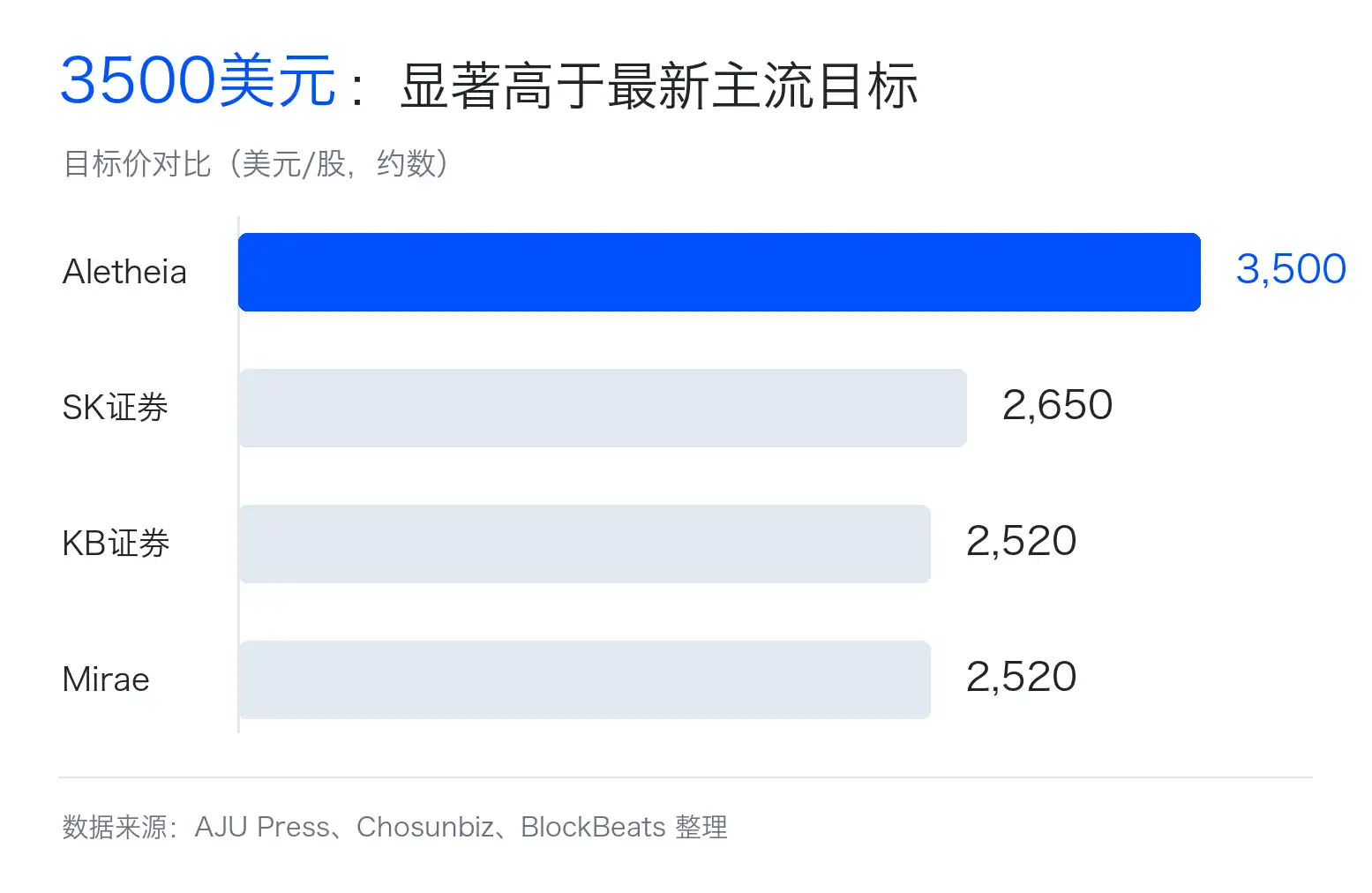
Aletheia Capital raised its target price for SK Hynix to approximately $3,500 in a report released today, pushing it far above the target range of mainstream institutions.

Aletheia Capital is an independent research and investment advisory firm headquartered in Hong Kong, serving institutional investors and covering sectors such as Asian tech hardware. In contrast, publicly reported target prices from SK Securities are around $2,000, while Mirae Asset and KB Securities target around $2,520.

The truly aggressive aspect of the $3,500 target price is not just being more optimistic than mainstream institutions. It requires the market to believe three things will happen simultaneously: continued shortages of HBM (high-bandwidth memory for AI chips), continued price increases for standard DRAM, and AI server demand sustaining both the memory upcycle and free cash flow until 2027.

The market has already acknowledged that SK Hynix deserves a re-rating; the divergence lies in how far this re-rating can go. Most mainstream institutions still apply a cyclical industry discount, while the $3,500 price implies pulling out an optimistic tail scenario even after the re-rating.
The Divergence Lies in the 2027 Profit Base

The $3,500 figure is most easily misread as a simple valuation question: if you just apply a 10x multiple to SK Hynix's 2027 profits or free cash flow, the stock price can continue rising. The difficulty lies not in the multiple itself, but in how much money the company will actually earn and how much cash it will retain in 2027.

Memory company profits are highly volatile. During an upturn, prices rise, inventory clears, and margins expand rapidly. During a downturn, new capacity comes online, customers cancel orders, prices fall, and profits can quickly reverse. This is why the market has long assigned lower valuation multiples to memory companies.

Even with SK Hynix's current strong profitability, its 12-month forward P/E ratio, as mentioned in public reports, remains in the single digits. The market isn't blind to AI; it's concerned that this rally will ultimately still be priced as a cyclical peak.

The aggressive target price circulating from Aletheia challenges this cyclical discount. Based on public descriptions, it bets that sustained AI hardware demand will keep pushing HBM and DRAM prices higher, and SK Hynix's 2027 free cash flow will significantly exceed most current expectations, thus allowing for repricing based on this higher base.

The issue is that $3,500 requires multiple variables to align favorably simultaneously: HBM prices remaining strong, standard DRAM prices not being undercut by new capacity, SK Hynix maintaining its leading market share, capital expenditures not consuming too much cash, and the market still willing to assign a non-low multiple to a cyclical stock. If any link underperforms expectations, the target price would shift from a structural re-rating to a high-cycle extrapolation.

HBM Shortages Spill Over to Standard Memory

HBM can change SK Hynix's pricing logic because it's not a minor upgrade to standard memory; it's a core component next to AI accelerator cards. No matter how fast an AI chip computes, its overall performance can be bottlenecked if data can't be fed in fast enough. HBM's role is to provide a higher-bandwidth data channel for GPUs or AI accelerators.

General investors can think of it this way: the GPU is the engine, and HBM is the high-speed fuel delivery system. The stronger the engine, the higher the demand on the fuel system. In the past, when trading AI hardware, the market looked first at NVIDIA GPUs. Now, the market is increasingly realizing that GPU shipments and the ability to build up AI servers also depend on HBM supply.

Increasing HBM supply isn't as simple as slightly tweaking a standard DRAM production line for immediate volume. It requires more complex stacking, packaging, customer qualification, and consumes more wafer area and advanced packaging resources. Producing an equivalent capacity of HBM typically occupies more production capacity resources than standard DRAM.

This spreads the impact to standard memory. As manufacturers shift more resources to HBM, supply of DRAM for standard servers, PCs, and mobile devices tightens, potentially pushing up the average selling price of DRAM.

This is precisely the core mechanism that makes the ~$3,500 target price plausible. If HBM were just a fast-growing niche product, it could only boost part of SK Hynix's revenue. If HBM simultaneously constrains standard DRAM supply and lifts the entire memory price curve, it becomes an amplifier for the entire company's margins and cash flow.
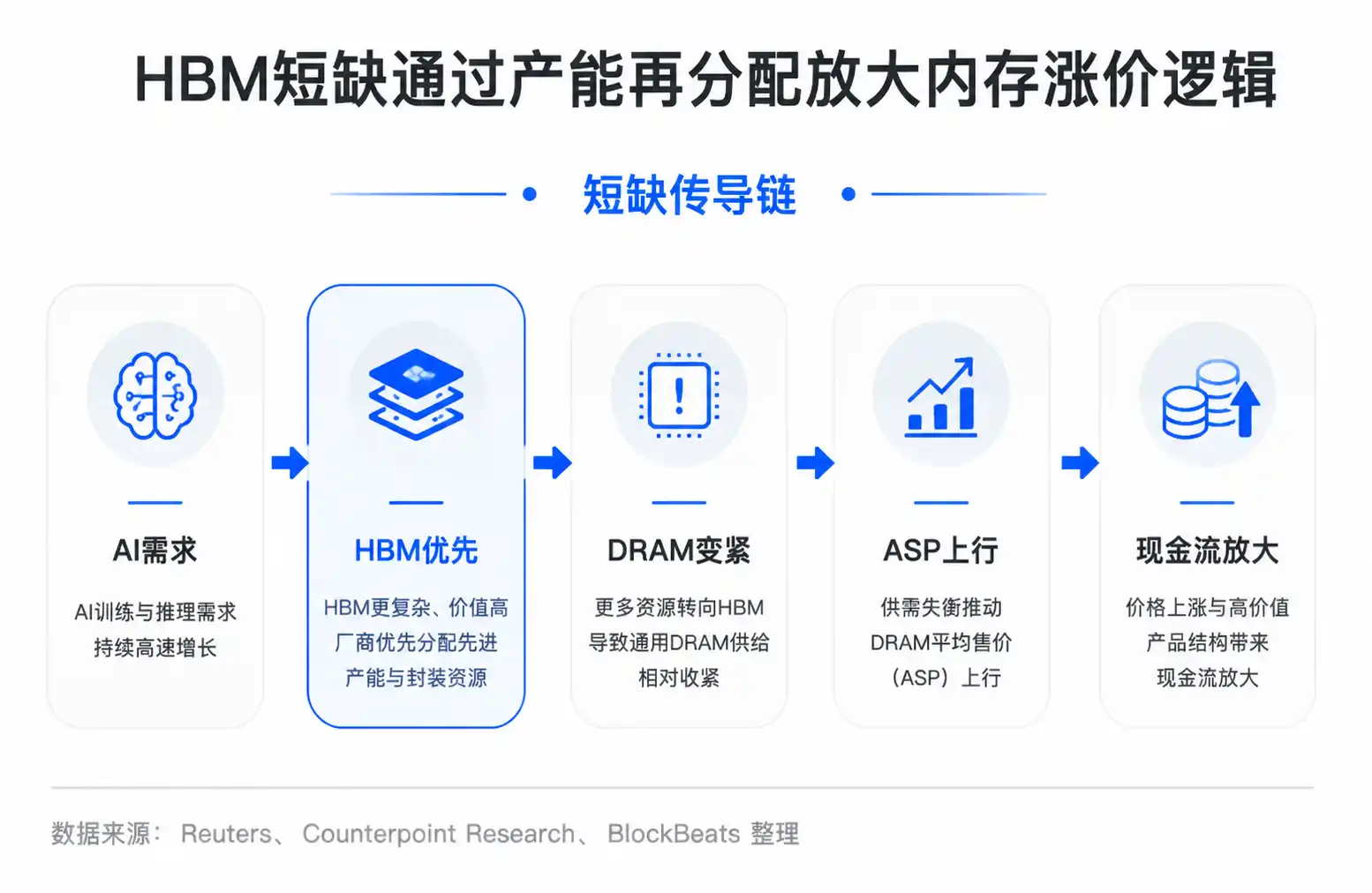
However, HBM shortages can only extend the cycle, not eliminate it. Samsung and Micron are catching up, SK Hynix itself will also expand production, and new wafer fabs and packaging capabilities will eventually be reflected in the supply side. The core of the debate is not whether shortages exist, but how long they will last and how long prices can remain strong.

SK Hynix Reaps the Most Direct Supply Chain Premium

SK Hynix is at the center of this re-rating not just because it's a memory company, but because it's the fastest runner in HBM. According to Reuters citing Counterpoint data, SK Hynix held about 58% of the global HBM market share in Q1 2026, with Samsung and Micron each around 21%. Reuters has also referred to it as a key supplier in NVIDIA's HBM supply chain.
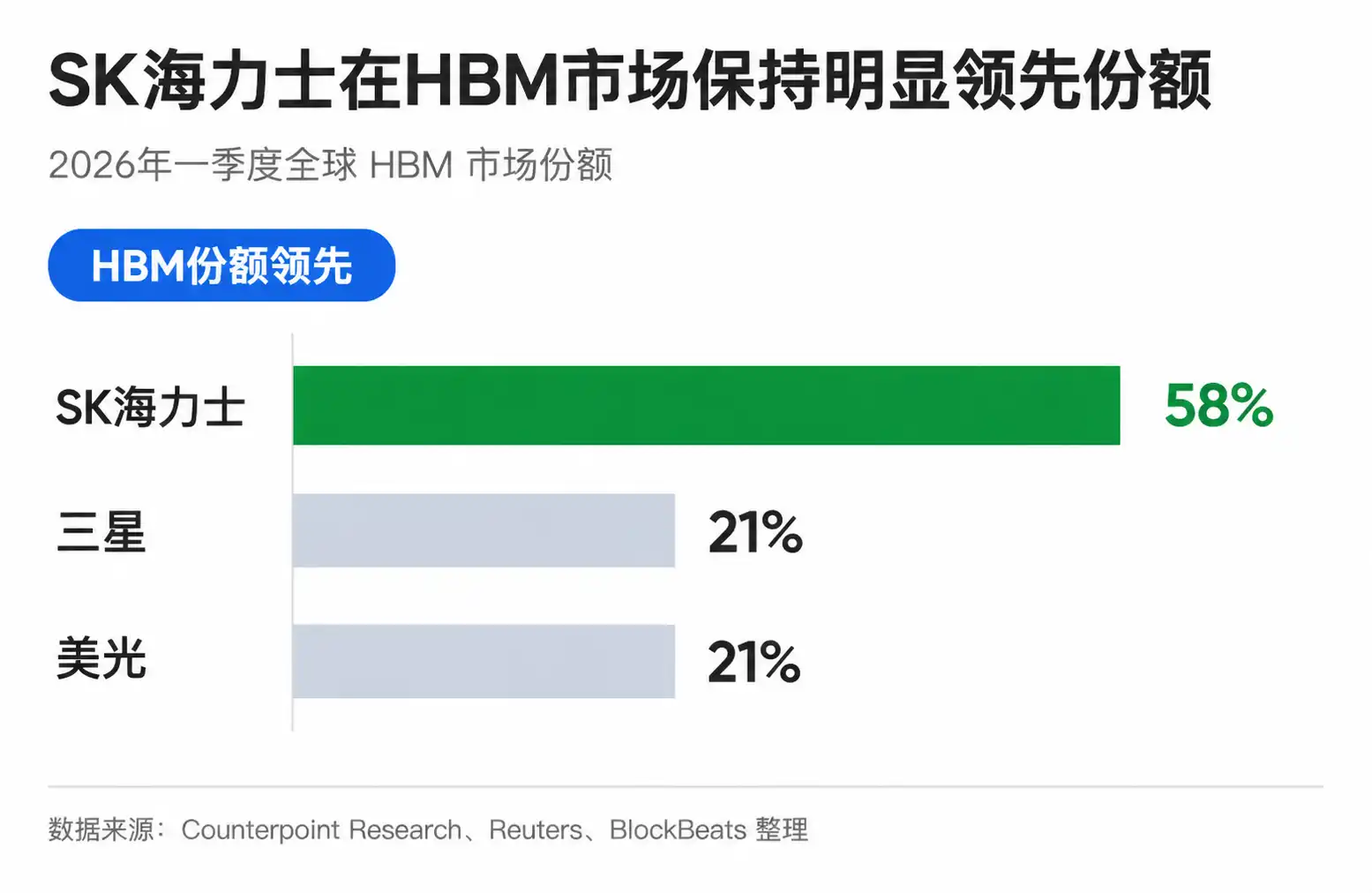
Such a lead is valuable in the semiconductor supply chain. AI chipmakers selecting HBM suppliers consider not just price, but also performance, yield, stability, and qualification progress. Being first to pass customer qualification makes it easier to enter the collaboration window for the next-generation products. Locking in orders earlier provides more initiative in capacity planning and price negotiations.

This is also why 2026 supply-demand visibility is drawing attention. According to a 2025 Reuters report, SK Hynix had completed 2026 HBM supply discussions with key customers. Multiple industry reports also suggest HBM shortages may extend into 2027. For investors, 2026 performance is at least not entirely story-driven.

SK Hynix's benefits aren't limited to HBM revenue itself. Because HBM occupies more capacity, squeezing standard DRAM supply, the traditional memory business may also benefit from price increases. AI demand first enters the financials through HBM, then influences the entire DRAM price through capacity reallocation.

This explains why institutional target prices keep being revised upward. Even without accepting an extreme scenario like $3,500, target prices in the ~$2,000 to $2,520 range indicate that mainstream institutions are already recalculating SK Hynix's profit elasticity for 2026-2027. The difference is that most still retain the discount appropriate for a cyclical industry, not extrapolating post-2027 tightness directly into a new normal.

Doubling the Stock Price Awaits Three Conditions

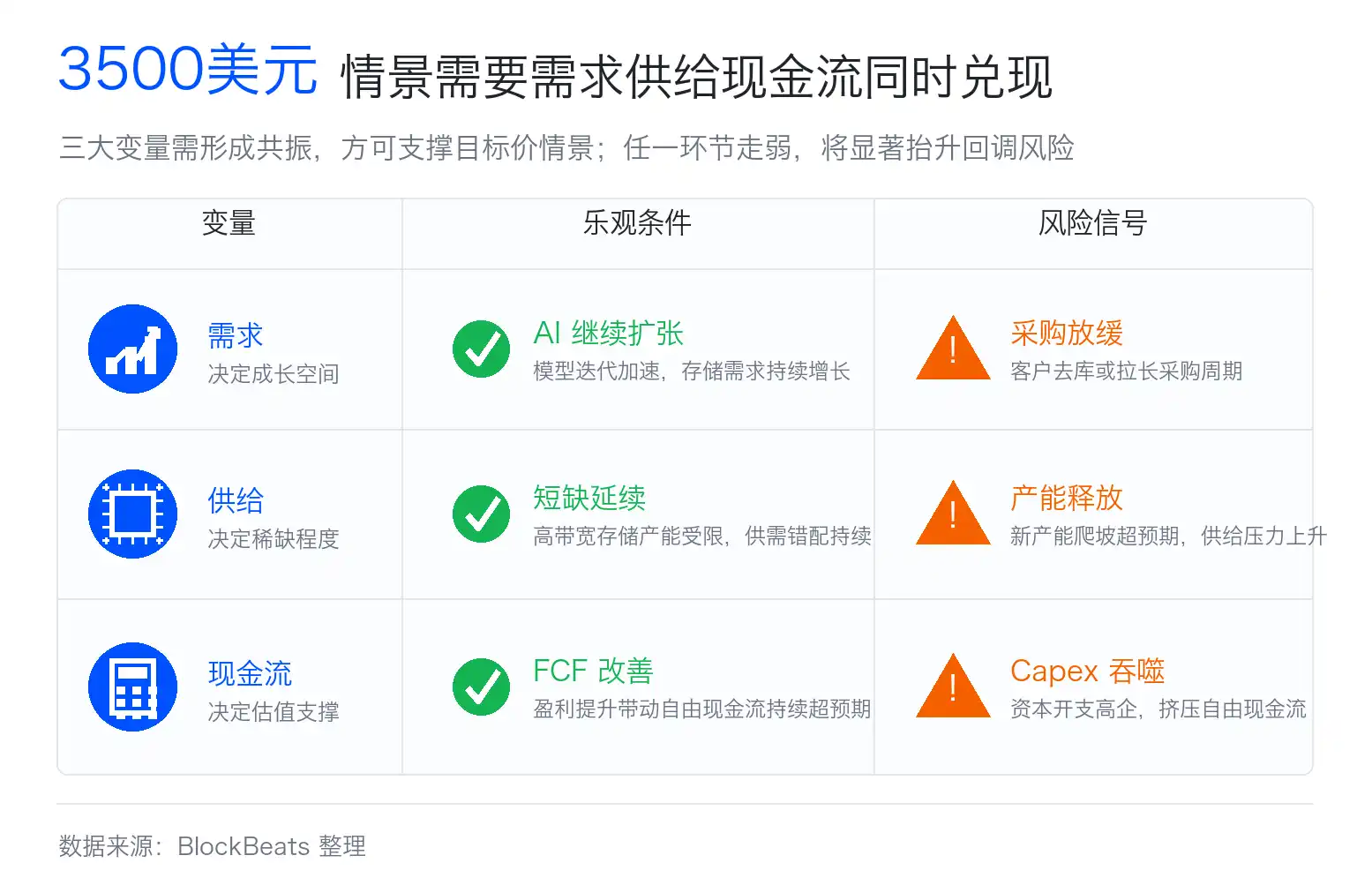
The $3,500 target price circulating from Aletheia essentially bets on continued strong demand, continued tight supply, and continued cash flow exceeding expectations. Over the past two years, massive GPU purchases by cloud providers and AI companies drove the HBM demand explosion. Next, the market needs to see if inference, enterprise AI, and custom ASICs can continue expanding memory consumption, ensuring demand isn't confined to training clusters.

The supply side also can't loosen too quickly. 2026 tightness is relatively easier to understand due to lags in capacity, packaging, and qualification; by 2027, new capacity and products from Samsung, SK Hynix, and Micron will gradually enter the market. If new supply arrives faster than expected, HBM price increases may narrow, and standard DRAM will face renewed pressure.

Ultimately, it comes down to cash flow. During an upturn, memory companies often increase capital expenditures for expansion, process upgrades, and advanced packaging. Profit growth doesn't necessarily all stay on the balance sheet. If SK Hynix needs significant investment to maintain its lead, the free cash flow base underpinning the $3,500 target price would be eroded.

Therefore, this target price is better viewed as an optimistic scenario, not a validated market consensus. 2027 is the real observation window: if HBM prices, DRAM ASPs, supply timing, and free cash flow continue to align favorably, the market will believe AI is raising the memory industry's profit center. If prices soften first, supply arrives first, or cash flow is consumed by capex, then ~$3,500 would shift from a re-rating anchor to an emotional peak.
Questions liées

QWhat are the three key conditions that Aletheia Capital's highly optimistic $3,500 price target for SK Hynix relies on?

AAletheia Capital's $3,500 price target for SK Hynix relies on three key conditions simultaneously occurring: 1) Sustained shortage and high prices for HBM (High Bandwidth Memory). 2) Continued price increases for regular DRAM. 3) AI server demand supporting strong market conditions and high free cash flow for the company through 2027.

QAccording to the article, what is the primary challenge in achieving the $3,500 target price, aside from the valuation multiple?

AThe primary challenge is not the valuation multiple itself, but accurately forecasting how much profit (or free cash flow) SK Hynix will actually generate in 2027. This requires multiple favorable variables to align, including HBM and DRAM pricing, market share, manageable capital expenditures, and market willingness to apply a higher multiple to a traditionally cyclical stock.

QHow does HBM shortage theoretically benefit SK Hynix's overall memory business beyond just HBM sales?

AHBM production is more complex and consumes more manufacturing resources (like wafer area and advanced packaging capacity) than regular DRAM. As manufacturers allocate more resources to produce HBM, the supply of regular DRAM for servers, PCs, and phones becomes tighter. This supply constraint can drive up the average selling price (ASP) of all DRAM, thereby boosting the profitability and cash flow of SK Hynix's entire memory division, not just the HBM segment.

QWhy is SK Hynix considered a core beneficiary in the current AI-driven memory revaluation?

ASK Hynix is a core beneficiary not just because it is a memory company, but because it holds a significant technological and supply chain lead in HBM. With reported market share around 58% in Q1 2026 and status as a key HBM supplier to NVIDIA, its early mover advantage in performance, yield, and customer certification allows it to secure orders, plan capacity proactively, and command pricing power more effectively than its competitors.

QWhat does the article suggest the $3,500 price target should be viewed as, rather than a market consensus?

AThe article suggests that the $3,500 price target should be viewed as an optimistic scenario or tail-end outcome, not an established market consensus. It represents a bet on a highly favorable alignment of demand, supply, and cash flow conditions extending through 2027. If any of these factors underperform, the target price would revert from being a structural revaluation anchor to merely reflecting peak-cycle optimism.

Lectures associées

Une foi louée : Quelle est la part de vrai argent dans les flux des ETF Bitcoin

L'article analyse les flux hebdomadaires des ETF Bitcoin, souvent interprétés comme un indicateur de confiance institutionnelle. Il démontre que ces flux sont en grande partie pilotés par une transaction d'arbitrage cachée (cash-and-carry) plutôt que par une conviction directionnelle sur le prix. Les arbitragistes achètent l'ETF tout en vendant à découvert des contrats à terme sur le CME, générant un profit basé sur l'écart (basis) tout en étant neutres au prix du Bitcoin. Cette activité se reflète dans une forte corrélation (0,70) entre les entrées dans les ETF et les nouvelles positions vendeuses des fonds à effet de levier sur le CME. Cependant, cette transaction d'arbitrage explique principalement la volatilité hebdomadaire des flux, et non leur montant cumulé. Sur environ 55 milliards de dollars d'entrées nettes totales depuis le lancement, l'exposition nette actuelle de cet arbitrage ne représente qu'environ 1 milliard. Le reste, soit un achat directionnel stable d'environ 400 millions de dollars par semaine, constitue l'essentiel des actifs sous gestion. Cette part d'arbitrage est en déclin constant depuis deux ans, diminuant d'environ 14% des actifs des ETF à leur pic à environ 4-5% actuellement. Ainsi, les flux des ETF surestiment la volatilité de la "foi" des investisseurs, pas son niveau. Les sorties récentes coïncident avec la compression de l'écart de base, rendant l'arbitrage moins rentable, et ne doivent pas être interprétées comme un rejet du Bitcoin. Pour interpréter correctement les flux, il faut surveiller l'écart de base annualisé par rapport aux taux des T-bills américains et les positions vendeuses nettes des fonds à effet de levier sur le CME.

marsbitIl y a 21 mins

Une foi louée : Quelle est la part de vrai argent dans les flux des ETF Bitcoin

marsbitIl y a 21 mins

Alan Greenspan décédé : les règles du marché qu'il a écrites, Warsh est en train de les réécrire

L'ancien président de la Fed, Alan Greenspan, est décédé le 22 juin 2026 à l'âge de 100 ans. Sa carrière de 19 ans a profondément marqué les marchés financiers. Il est célèbre pour avoir instauré le "Greenspan Put" – la conviction que la Fed interviendrait pour soutenir les marchés en cas de chute importante, comme après le "Lundi noir" de 1987. Son langage délibérément opaque, illustré par sa mise en garde contre "l'exubérance irrationnelle" en 1996, démontrait son pouvoir d'influencer les marchés par la seule communication. Son héritage est cependant ambivalent. Sa réponse agressive à la bulle Internet et aux attentats du 11 septembre, en abaissant les taux à 1% pendant un an, est souvent citée comme ayant contribué à la bulle immobilière et à la crise financière de 2008. Quelques jours avant sa mort, le nouveau président de la Fed, Kevin Warsh, a lancé une révision complète des opérations de la banque centrale. Il remet notamment en cause le "forward guidance" (orientation prospective), un outil de communication devenu central. En cherchant à brouiller les signaux sur les futures interventions, Warsh pourrait démanteler l'une des bases du "Greenspan Put". La disparition de Greenspan symbolise ainsi la fin possible d'une ère où les marchés pouvaient compter sur des interventions prévisibles de la Fed, ouvrant un chapitre plus incertain.

marsbitIl y a 39 mins

Alan Greenspan décédé : les règles du marché qu'il a écrites, Warsh est en train de les réécrire

marsbitIl y a 39 mins

Encore 75 millions de dollars levés, pourquoi le FOMO séduit-il à nouveau les VC de premier plan ?

Le projet fomo, une application mobile de trading cryptographique social, a annoncé le 22 juin 2026 une levée de fonds de série B de 75 millions de dollars, portant sa valorisation à 550 millions de dollars. Ce tour de table est mené par Index Ventures et voit la participation d'Union Square Ventures (USV) ainsi que le réinvestissement de Benchmark. Fondé par d'anciens employés de dYdX, fomo vise à démocratiser l'accès aux actifs cryptographiques en éliminant les frictions techniques pour les utilisateurs. Son application permet des transactions simplifiées sur plusieurs blockchains (Bitcoin, Ethereum, Solana, etc.) sans frais de gas pour l'utilisateur, avec une connexion via Apple/Google ID et un paiement direct par Apple Pay. Elle intègre également des fonctionnalités sociales permettant de suivre les trades d'autres utilisateurs. Depuis son lancement en version bêta en mai 2025, fomo affiche une croissance rapide avec plus de 625 000 utilisateurs, un volume de transactions dépassant 40 milliards de dollars et plus de 110 millions d'interactions sociales. La plateforme a récemment étendu ses services en lançant des contrats perpétuels sur diverses classes d'actifs. Cette nouvelle levée et la feuille de route du projet, qui prévoit de couvrir presque tous les actifs blockchain et de s'étendre aux titres traditionnels, positionnent fomo comme un acteur aspirant à devenir un pont entre le monde cryptographique et la finance traditionnelle.

Foresight NewsIl y a 1 h

Encore 75 millions de dollars levés, pourquoi le FOMO séduit-il à nouveau les VC de premier plan ?

Foresight NewsIl y a 1 h

Une hausse fulgurante de plus de dix fois sur l'année, l'effet de levier fou sur SK Hynix

Source : Shanghai Securities News En 2026, l'ETF à double effet de levier (2x) « Southern Fund 2x Long SK H力士 ETF » a enregistré une hausse de plus de 1 000 % depuis le début de l'année, tandis que la taille de ses actifs a été multipliée par plus de vingt. Cette performance spectaculaire reflète l'engouement des investisseurs pour le secteur des puces mémoire, porté par la demande liée à l'intelligence artificielle. SK海力士, le géant sud-coréen de la mémoire, a notamment présenté des échantillons de sa nouvelle DRAM HBM4E, conçue pour l'IA, avec des gains en performance et en efficacité énergétique. Cependant, les experts mettent en garde contre les risques inhérents à ces produits à effet de levier. En période de forte volatilité, ils amplifient à la fois les gains et les pertes. Par exemple, lors de récentes corrections, les ETF à double levier sur SK海力士 et Samsung Electronics ont subi des replis presque deux fois plus importants que les actions sous-jacentes. De plus, des anomalies de liquidité peuvent entraîner des écarts de prix brutaux, comme observé début juin où un ETF a chuté de 40 % alors que l'action progressait. Enfin, la structure de ces produits, avec un levier recalculé quotidiennement, peut générer une érosion de la valeur sur le long terme, même si le titre sous-jacent retrouve son niveau antérieur. La majorité des investisseurs sont des particuliers, les institutions évitant généralement ces instruments en raison de leur risque élevé. Dans un contexte d'évaluations sectorielles historiquement élevées et d'incertitudes géopolitiques, une prudence extrême est recommandée.

marsbitIl y a 1 h

Une hausse fulgurante de plus de dix fois sur l'année, l'effet de levier fou sur SK Hynix

marsbitIl y a 1 h

KIOXIA a vu sa valeur augmenter de plus de 50 fois en 18 mois, un retournement de situation épique

En seulement 18 mois après son introduction en bourse fin 2024, le fabricant de mémoire flash japonais Kioxia a connu une métamorphose spectaculaire, sa valeur boursière ayant été multipliée par plus de 50. Porté par la demande explosive de stockage liée à l'IA, l'action a bondi de 800 % en 2026, propulsant sa capitalisation au-delà de 51 000 milliards de yens et lui permettant de dépasser Toyota comme première entreprise japonaise par la valeur marchande. Cette résurrection s'appuie sur le succès de sa technologie phare, la mémoire 3D NAND BiCS FLASH, dont Kioxia est l'inventeur historique. La 8e génération, à 218 couches, intègre des innovations clés comme la liaison directe CMOS/matrice (CBA) et une structure de grille optimisée (OPS), améliorant densité et performance. La 10e génération vise 332 couches. Financièrement, le premier trimestre 2026 affiche un bénéfice d'exploitation prévisionnel de 1 300 milliards de yens, en hausse de près de 30 fois sur un an. Sa capacité de production NAND pour 2026 est déjà entièrement vendue. Les investisseurs initiaux, comme Bain Capital et SK Hynix, réalisent des profits considérables. Parallèlement, Kioxia mise sur l'avenir avec le développement du 3D DRAM (OCTRAM), une technologie utilisant des transistors à oxyde-semiconducteur pour réduire la consommation d'énergie, bien qu'elle soit encore en phase de R&D et distincte du HBM. Cette trajectoire fulgurante démontre qu'une entreprise peut se réinventer dans les cycles volatils des semi-conducteurs. L'enjeu pour Kioxia sera désormais de pérenniser cette réussite au-delà du super-cycle actuel de l'IA.

marsbitIl y a 1 h

KIOXIA a vu sa valeur augmenter de plus de 50 fois en 18 mois, un retournement de situation épique

marsbitIl y a 1 h

Trading

Spot
Futures
活动图片