TON Revives the Gram Brand, a Name That Disappeared Six Years Ago Returns

marsbitPublié le 2026-06-10Dernière mise à jour le 2026-06-10

Résumé

After a community vote with over 81% support, The Open Network (TON) is officially renaming its native token from Toncoin back to Gram (with ticker GRAM), effective June 15. This move reclaims the original name from the project's 2018 inception under Telegram, before regulatory issues forced its halt. The rebrand to Gram is part of the "Make TON Great Again" strategy and is seen as more than a simple logo change. It aims to leverage the historical brand recognition and narrative associated with Telegram’s initial vision of a global blockchain network. Gram evokes the original story of bringing crypto to Telegram's massive user base. This shift comes as TON is experiencing significant growth, driven by Telegram's over 1 billion monthly active users and viral mini-apps like Notcoin. The ecosystem is expanding in wallets, active addresses, and payment use cases. Analysts suggest the name change could strengthen TON's unique identity in a crowded Layer 1 market by deepening its association with Telegram's vast distribution channel. While potentially boosting short-term market attention, the long-term focus remains on Gram's utility within Telegram's evolving ecosystem, particularly for payments, transfers, and mini-app transactions. The ultimate goal is for Gram to become a widely used digital currency within one of the world's largest social platforms.

Author: Winnie, CryptoPulse Labs

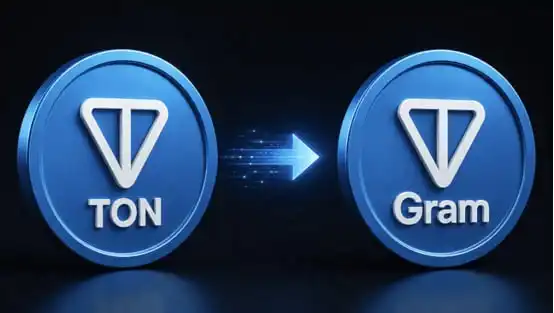
On June 9th, the results of the TON Vote community governance were announced. Over 81% of voters supported changing the native token name from Toncoin to Gram, and the token code will also change from TON to GRAM, with the changes scheduled to take effect officially on June 15th.

On the surface, this seems like just a brand upgrade, but for old players who experienced the Telegram token issuance saga, the name "Gram" carries the initial ideals and story of TON.

More importantly, against the backdrop of Telegram's monthly active users exceeding 1 billion, the TON ecosystem re-entering a growth cycle, and the rapid expansion of its on-chain payment and Mini App ecosystem, this renaming may be far more significant than just a logo change.

I. Behind TON's Brand Upgrade: Gram Officially Returns to the Crypto Market

Let's go back to 2018. At that time, Telegram founder Pavel Durov launched the TON (Telegram Open Network) plan, aiming to build a blockchain network covering hundreds of millions of users worldwide.

The project's whitepaper explicitly stated that the name of the network's native currency would be "Gram."
During the fervent ICO era, TON once set a fundraising record of $1.7 billion and was seen as one of the blockchain projects with the greatest potential for mass adoption.

However, in 2020, the U.S. SEC sued Telegram for allegedly conducting an unregistered securities offering. Ultimately, Telegram was forced to halt project development and refund investors.

Many thought TON was over, but the story didn't end there.

Subsequently, the open-source community took over the code and continued development. The project gradually evolved into today's The Open Network. To distinguish it from the original project, the community renamed the token to Toncoin, while keeping the token code as TON.

After several years of development, TON has re-emerged as a mainstream public chain. And now, with the token officially renamed to Gram, this name that had been dormant for years finally returns to the market's view.

An important step in the "Make TON Great Again" plan. Officials stated that this renaming is the fourth step in the "Make TON Great Again (MTGA)" seven-step strategy.

Based on public information, the TON team is driving a comprehensive brand overhaul. This upgrade mainly includes changing Toncoin to Gram, changing the TON code to GRAM, launching a new logo and visual system, synchronizing updates to wallets and ecosystem applications, and gradual adaptation by trading platforms.

It's noteworthy that only the token brand is changing; the blockchain network will maintain the name "The Open Network." In other words, the TON chain remains the TON chain, but the currency on the chain is once again called Gram.

This is similar to the Ethereum network keeping its name while ETH suddenly changes. Therefore, this is not a technical upgrade but a brand strategy adjustment.

In the crypto market, narrative is often more important than technology. For many veteran players, Gram represents TON's original dream. It is the story from 2018 that attempted to bring blockchain to hundreds of millions of global users; it is also a significant symbol of Telegram's challenge to the traditional financial system.

II. From Public Chain Competition to Brand Competition, TON is Seeking Differentiation

If we rewind two years, TON might not have had the conditions to rename, but the situation today is completely different.

Over the past year, Telegram has become one of the fastest-growing Web3 traffic portals globally. Especially after the explosion of hit applications like Notcoin and Hamster Kombat, a large number of users were exposed to on-chain assets for the first time.
The TON ecosystem's user base has rapidly expanded, with continuous growth in wallet numbers, on-chain active addresses, payment scenarios, and developer numbers.

For TON, it is no longer an experimental project; it has begun to become a large-scale ecosystem with a real user base. Against this backdrop, the timing for a brand upgrade has matured. Reviving "Gram" may be about strengthening the Telegram DNA.

In fact, "Toncoin" has always had a problem. Although it is highly aligned with the TON network name, it lacks a sufficiently distinct brand memory point.

Gram is different. This name is deeply tied to Telegram's history. Just mentioning Gram will remind veteran users of a series of keywords: Telegram, Pavel Durov, the $1.7 billion fundraising, the vision for global payments, Web3 super apps, etc. This brand equity is something Toncoin cannot provide.

For TON, re-adopting Gram is equivalent to reactivating brand value that has been dormant for years. This can help TON establish a more unique cognitive label in the fiercely competitive public chain market.

Currently, competition in the Layer1 track is intensifying. Besides Ethereum, new public chains like Solana, Sui, and Aptos are all vying for users and developers.

The technological gap is gradually narrowing, and what can truly create a difference is starting to become brand and traffic.

From this perspective, TON's biggest advantage is not TPS or gas fees, but the Telegram behind it. A global user base exceeding 1 billion is a moat difficult for other public chains to replicate. And the name Gram can further strengthen this association.

In the future, when users mention Gram, they will think not just of a token, but of the entire Telegram ecosystem. This is precisely the effect TON hopes to achieve.

III. From Token Upgrade to Ecosystem Expansion, Can Gram Open Up New Space?

Looking at historical experience, the crypto community often reacts positively to brand upgrades. Whether it's a project name change, token split, or visual upgrade, it can become a focus of short-term capital attention.

The reason is simple: a brand upgrade means a new story. And the market loves stories the most. Gram's return also possesses this attribute.
For a period of time in the future, "Gram's Revival" is likely to become a new communication theme for the TON ecosystem. For the trading market, this narrative has the potential to increase attention and capital inflows.

Of course, a name change alone cannot support prices long-term. What truly determines value remains ecosystem development. The Telegram payment system may be further improved

Compared to short-term price fluctuations, TON's future payment layout is more worthy of attention. From its inception, Gram was positioned as a digital payment currency. Its goal is not merely as an investment asset, but to become a medium of value exchange within the Telegram ecosystem.

Now, with the development of the Telegram Stars system, the expansion of the Mini App ecosystem, and the increase in on-chain payment scenarios, Gram's application space is gradually opening up.

If Telegram further integrates its payment system in the future, Gram may take on an even more central role, which is also one of the long-term logics the market is most concerned about.

Over the past few years, most public chains have been competing for developers. TON seems to have chosen a different path; it attempts to embed blockchain directly into the social platform users are already accustomed to using.

This model is somewhat similar to the development path of WeChat Pay. Users don't need to understand the underlying technology; they just need to complete payments, transfers, tipping, or game operations, with the blockchain hidden in the background.

If this model ultimately proves successful, TON could become the first Web3 network to truly achieve mass adoption by hundreds of millions of users. And Gram would be the core value carrier within this ecosystem.

Therefore, the significance of this renaming may far exceed market imagination. It is not just a brand return, but could be the beginning of TON redefining its own positioning.

Conclusion

For the market, Gram is not just a token name; it represents the dream Telegram once had of building a global digital economic network.

And now, against the backdrop of Telegram's traffic, on-chain payments, the Mini App ecosystem, and the continuous integration of AI applications, this dream may be getting a second chance.

In the coming years, what's truly worth watching may not be that TON changed its name. It is whether Gram can leverage Telegram's vast user network to grow into the crypto industry's first genuinely global internet currency.

Questions liées

QWhat was the result of the TON Vote community governance on June 9th regarding the native token's name?

AThe result of the TON Vote community governance on June 9th showed that over 81% of voters supported changing the native token name from Toncoin to Gram, with the token code changing from TON to GRAM. This change was planned to take effect officially on June 15th.

QWhat is the historical significance of the name 'Gram' for the TON project?

AThe name 'Gram' holds historical significance as it was the original name for the native currency in the 2018 whitepaper of the TON (Telegram Open Network) project launched by Telegram founder Pavel Durov. It represents the initial vision and story of TON, which was later halted due to a lawsuit from the U.S. SEC in 2020, before being revived by the open-source community.

QAccording to the article, what is the 'Make TON Great Again (MTGA)' plan and where does the token rename fit into it?

AThe 'Make TON Great Again (MTGA)' plan is a seven-step strategic initiative by the TON team. The token rename from Toncoin to Gram is the fourth step in this plan, which is part of a broader brand reshuffling effort that also includes a new logo, visual identity, and updates across wallets, ecosystem applications, and trading platforms.

QHow does the article describe the current competitive advantage of TON compared to other Layer1 blockchains?

AThe article states that TON's biggest competitive advantage is not its TPS or gas fees, but its association with Telegram and its user base of over 1 billion monthly active users. This provides a massive, unique traffic moat that other Layer1 blockchains like Solana, Sui, and Aptos cannot easily replicate. The rebranding to 'Gram' is seen as a way to further strengthen this association.

QWhat potential long-term role does the article suggest for Gram within the Telegram ecosystem?

AThe article suggests that Gram has the potential to become a core medium of value exchange within the Telegram ecosystem, similar to how WeChat Pay functions. As Telegram expands its payment systems (like Telegram Stars), Mini App ecosystem, and on-chain payment scenarios, Gram could evolve into the first truly global internet currency for the crypto industry, facilitated by Telegram's vast user network.

Lectures associées

Le parti colombe de la Fed se tourne collectivement vers la fauconnerie, la première performance de Warsh entre deux feux

Des responsables de la Réserve fédérale, autrefois favorables à une baisse des taux (colombes), y compris Christopher Waller, ont récemment indiqué qu’une hausse n’était pas exclue, laissant presque plus aucun membre du comité en faveur d’un assouplissement. La première réunion présidée par le nouveau président Kevin Warsh pourrait ainsi envoyer un signal : la prochaine étape de la Fed pourrait être un relèvement des taux. Warsh, nommé par le président Trump pour ses positions accommodantes, arrive à un moment délicat. L’inflation américaine dépasse désormais 3 %, le marché du travail se renforce et des tensions sur les prix persistent. Les raisons qui justifiaient une baisse des taux s’effacent une à une. Le changement d’orientation est net. Christopher Waller, qui plaidait pour une baisse début 2024, déclare désormais ne plus pouvoir exclure une future hausse. Même des membres modérés comme Lisa Cook se disent prêts à relever les taux si la baisse de l’inflation tarde trop. Les faucons, tels que Beth Hammack et Lorie Logan, estiment depuis longtemps que les conditions justifient un resserrement et mettent en garde contre le risque d’une inflation ancrée. Lors de sa première réunion, la Fed devrait maintenir son taux directeur mais supprimer toute mention d’une orientation accommodante dans son communiqué, indiquant ainsi que hausse et baisse sont désormais des options équivalentes. Les projections des membres (« point plot ») devraient refléter moins de baisses de taux attendues cette année, voire quelques hausses. Warsh, critique des outils de communication de la Fed comme le « point plot », se trouve dans une position difficile : il doit gérer un comité qu’il n’a pas formé, utiliser des méthodes qu’il a longtemps contestées, et possiblement conduire la politique vers une direction contraire aux souhaits du président qui l’a nommé. Son entrée en fonction marque un tournant net vers un possible resserrement monétaire.

marsbitIl y a 8 mins

Le parti colombe de la Fed se tourne collectivement vers la fauconnerie, la première performance de Warsh entre deux feux

marsbitIl y a 8 mins

« Yi Zhong Tian » à un billion de dollars de capitalisation boursière, qui est le vrai champion du rapport qualité-prix ?

L'article analyse les trois leaders chinois du secteur des modules optiques, surnommés "Yi Zhong Tian" (d'après les noms Xinyisheng, Zhongji Innolight et TFC Optical Communication), qui ont connu une hausse spectaculaire de leur valorisation, dépassant 1 000 milliards de yuans. L'accent est mis sur la comparaison de leur "rapport qualité-prix" en termes d'investissement. Xinyisheng présente le ratio PEG le plus bas (environ 0,30) et une bonne qualité de bénéfices, mais sa décote reflète des risques : forte dépendance à quelques clients, exposition aux tensions commerciales et incertitudes sur sa croissance durable. Zhongji Innolight, le leader du marché, bénéficie de la plus forte prime pour sa position dominante (plus de 50% des parts de marché sur les modules 800G de NVIDIA) et son avance technologique. Son principal risque est géopolitique, après son inscription sur une liste du département américain de la Défense. TFC Optical Communication, fournisseur de composants en amont, a la marge brute la plus élevée et parie sur la future architecture CPO/NPO. Cependant, sa valorisation est très élevée (PER élevé) et sa croissance est plus stable, moins sensible aux cycles d'investissement AI que les assembleurs de modules. Enfin, l'article souligne un défi sous-jacent : la vraie valeur et les profits durables se situent en amont de la chaîne, dans les puces laser et les semi-conducteurs, dominés par des entreprises comme Coherent et Lumentum. La pérennité à long terme des "Yi Zhong Tian" dépendra de la capacité de l'industrie chinoise à monter en gamme et à capturer cette partie de la valeur ajoutée.

marsbitIl y a 15 mins

« Yi Zhong Tian » à un billion de dollars de capitalisation boursière, qui est le vrai champion du rapport qualité-prix ?

marsbitIl y a 15 mins

Le marché de la cryptographie a-t-il touché le fond ? Voici ce qu'en pensent les institutions

Le marché des cryptomonnaies a-t-il atteint son point bas ? Trois institutions financières présentent des analyses divergentes. Galaxy Digital estime que le fond n'est pas encore atteint. Sur la base de 13 indicateurs historiques (tels que la moyenne mobile sur 200 semaines et l'indice de peur et de cupidité), seuls 4 signaux sont pleinement activés. Leur analyse suggère un creux potentiel entre 30 000 et 54 000 dollars, avec un scénario neutre entre 40 000 et 46 000 dollars. NYDIG adopte une position plus nuancée. Bien que de nombreux indicateurs soient proches des niveaux de creux historiques, l'absence d'une vente de panique généralisée typique des marchés baissiers majeurs persiste. L'institution note que l'entrée des investisseurs institutionnels pourrait avoir modifié la dynamique des cycles, permettant un creux moins prononcé que par le passé. À l'inverse, la Standard Chartered affirme que le fond a été touché à environ 59 000 dollars. La banque s'appuie sur deux facteurs : une éventuelle détente diplomatique entre les États-Unis et l'Iran, et l'hypothèse que les ventes récentes dans les ETF Bitcoin étaient liées à la préparation de l'introduction en bourse anticipée de SpaceX. Elle prévoit désormais que le Bitcoin pourrait atteindre 100 000 dollars d'ici la fin de l'année. Malgré ces divergences sur le niveau exact du creux, les trois rapports s'accordent sur des points essentiels pour les investisseurs à long terme : 1. Le fond du marché devrait être atteint au cours de l'année 2024. 2. Le prix actuel est plus proche du creux que des sommets précédents. 3. Une nouvelle phase haussière (bull market) pour le Bitcoin reste attendue à l'avenir. L'article conclut que, quelle que soit la fourchette exacte du creux (entre 40 000 et 60 000 dollars), la perspective d'une remontée vers 100 000 dollars ou plus offre un potentiel de rendement significatif pour les investisseurs patients. Les fondamentaux à long terme du Bitcoin, comme l'endettement public mondial, l'inflation et l'adoption numérique, restent solides, rendant le contexte actuel plus favorable que lors des hivers cryptographiques précédents.

marsbitIl y a 28 mins

Le marché de la cryptographie a-t-il touché le fond ? Voici ce qu'en pensent les institutions

marsbitIl y a 28 mins

La "Douleur du Cœur" et la Percée de la Chaîne Industrielle Photonique Chinoise

Dans la course mondiale à l'IA, les modules optiques, qui assurent la conversion et la transmission des données entre les GPU, sont des éléments clés. Leur composant essentiel, la puce DSP haute performance, est dominé par les entreprises américaines Marvell et Broadcom, détenant plus de 90% du marché des hauts débits (800G/1.6T). Les fabricants chinois de modules optiques, leaders mondiaux de l'assemblage (comme Zhongji Innolight et Eoptolink), dépendent de ces fournisseurs pour leurs exportations vers les géants de l'IA nord-américains. Cette dépendance crée une vulnérabilité, mais une interdiction totale est improbable à court terme. Marvell et Broadcom dépendent fortement du marché chinois (environ 56% des revenus pour la région) et de la chaîne d'approvisionnement locale pour l'assemblage et les composants optiques. De plus, les puces à semi-conducteurs comme les EML laser (domaine de Lumentum) présentent un risque moindre grâce à une concurrence plus diversifiée et des progrès plus rapides dans les substituts chinois. Pour atténuer les risques, l'industrie chinoise peut : à court terme, diversifier ses fournisseurs et ses marchés ; à moyen terme, promouvoir l'adoption à grande échelle de puces DSP et optiques nationales (Huawei Hisilicon, Innochips, etc.) sur le marché intérieur ; et à long terme, accélérer la R&D sur les DSP hauts débits et les nouvelles technologies comme la photonique sur silicium et l'OPC. La solution durable réside dans l'autonomisation de la chaîne d'approvisionnement en puces de haute technologie, en s'appuyant sur la force du marché intérieur et des capacités de fabrication.

marsbitIl y a 38 mins

La "Douleur du Cœur" et la Percée de la Chaîne Industrielle Photonique Chinoise

marsbitIl y a 38 mins

Derrière les 2 000 milliards de dollars de valorisation de SpaceX : Pourquoi Musk anticipe-t-il toujours le coup suivant ?

Le 12 juin, SpaceX a fait ses débuts en bourse au NASDAQ, atteignant une capitalisation boursière de 2 000 milliards de dollars. Fondée en 2002 après qu'Elon Musk n'ait pas trouvé de fusée abordable, l'entreprise a connu trois échecs de lancement consécutifs avant sa première réussite en 2008, marquant le début de l'ère du vol spatial commercial. SpaceX a révolutionné le secteur grâce à des contrats à prix fixe de la NASA, qui l'ont incitée à réduire les coûts. L'entreprise a développé la technologie de récupération des fusées, prouvée en 2015 avec l'atterrissage du Falcon 9. Aujourd'hui, le succès financier repose sur Starlink, qui génère des bénéfices, tandis que le développement du Starship et les activités spatiales restent déficitaires. Starlink a été conçu comme un débouché majeur pour les lancements à bas coût. De même, le Starship vise désormais un nouveau marché : les centres de données spatiaux, un concept soutenu par des géants comme Google et Blue Origin. Cependant, cette "informatique spatiale" reste à un stade conceptuel, avec des défis techniques et de coûts importants, nécessitant une réduction drastique du prix de mise en orbite. En résumé, SpaceX est passé d'un client frustré à un constructeur de fusées, puis a créé sa propre demande avec Starlink, et parie maintenant sur l'informatique spatiale pour justifier son évolution et sa valorisation astronomique.

marsbitIl y a 42 mins

Derrière les 2 000 milliards de dollars de valorisation de SpaceX : Pourquoi Musk anticipe-t-il toujours le coup suivant ?

marsbitIl y a 42 mins

Trading

Spot
Futures
活动图片