When Hyperliquid Steals Solana's 'Internet Capital Markets' Playbook

链捕手Publié le 2026-05-19Dernière mise à jour le 2026-05-19

Résumé

The article discusses how Solana's grand vision of becoming an "Internet Capital Markets" platform is facing significant challenges in 2026, primarily from the unexpected rise of Hyperliquid. Solana's performance has weakened, with its token SOL experiencing the largest price decline among major cryptocurrencies. Its core narrative of building a global, chain-based marketplace for all assets is under pressure both internally and externally. Hyperliquid, originally a perpetual futures exchange, has evolved into a dedicated Layer 1 financial infrastructure network. Its focused, trading-centric approach is attracting capital and challenging the assumption that a "general-purpose" ecosystem like Solana is necessary for a capital market. Hyperliquid's success suggests that for high-frequency trading, superior performance, liquidity, and user experience may be more critical than a broad application ecosystem. Internally, Solana's strategy suffered a blow from a major hack on the Drift Protocol in April, resulting in over $200 million in losses. In response, Solana founder Anatoly Yakovenko has heavily promoted Phoenix as a new decentralized perpetual futures platform on Solana. While this boosted Phoenix's visibility, its trading volume remains far behind leading platforms. Solana's community has launched a rhetorical attack against Hyperliquid, questioning its decentralization due to its limited validator set and closed-source code. Critics, however, point out Solana's own dec...

Author: Hu Tao

In the cyclical waves of the cryptocurrency market, Solana once returned to its peak with the "Ethereum killer" narrative and extreme performance. However, as we enter 2026, this once high-performance machine is facing unprecedented deceleration pressure, first evident in its price.

In the past year, SOL's price has fallen by up to 73.5% from its high, the largest decline among all mainstream cryptocurrencies. In the recent month's market pullback, SOL's gains have also been very weak, significantly lagging behind other major cryptocurrencies like BTC and ETH.

Furthermore, Solana's core vision of "Internet Capital Markets" has suffered a major blow amidst internal and external challenges, forcing the Solana Foundation's senior team to speak out frequently recently, promoting their ecosystem on the public opinion front.

Solana's Core Narrative Hits a Wall

Over the past few years, Solana has been trying to tell a story far grander than just a "high-performance public chain."

In the definition of the Solana Foundation, Solana's endgame has transformed into "Internet Capital Markets"—a global trading network that brings stocks, commodities, futures, perpetual contracts, and all real-world assets on-chain.

Now, upon opening the official Solana website homepage, the most prominent slogan immediately greeting you is still: "Capital markets for every asset on Earth."
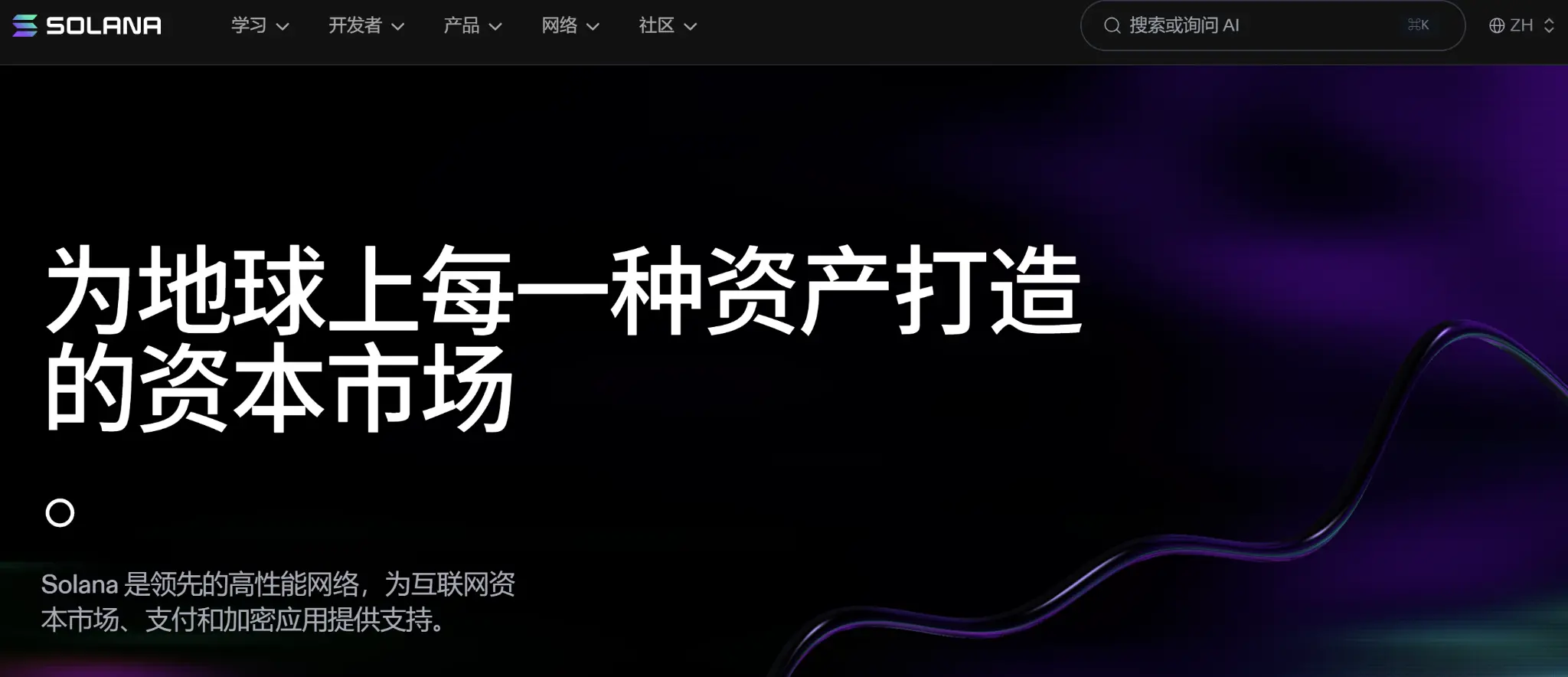
This means Solana aims not only to challenge Ethereum but also to replace traditional exchanges, brokers, and clearing systems, becoming the on-chain version of Nasdaq. High speed, low fees, high throughput, relatively mature user experience, and the strong backing of Wall Street capital once positioned Solana as the public chain closest to achieving this goal.

However, the problem is that as the "Internet Capital Markets" truly begin to take shape, the market is finding that Solana may not necessarily be at its core.

The Unexpected Impact of Hyperliquid

One of the biggest structural changes in the crypto industry over the past year has been the migration of the perpetual futures market away from traditional CEXs to on-chain platforms.

The biggest beneficiary of this trend is not Solana, nor Ethereum, Sui, or other networks, but Hyperliquid.

Initially, Hyperliquid was just an on-chain perpetual futures trading platform, but with the advancement of its Layer1 strategy, it has gradually evolved into a complete financial infrastructure network. Compared to Solana's broad and abstract "capital markets" vision, Hyperliquid has chosen a more focused, transaction-driven path.

For a long time, although the Solana ecosystem has hosted numerous DeFi projects, its core liquidity has always leaned more towards spot trading, Meme Coins, and on-chain speculation. The infrastructure truly capable of supporting institutional-grade trading depth, risk management, and high-frequency trading needs has never matured.

More critically, Hyperliquid has gradually proven something many previously overlooked: an "Internet Capital Markets" may not necessarily require a general-purpose ecosystem.

For high-frequency financial transactions, performance, matching, liquidity, and trading experience are far more important than "richness of on-chain applications." This means a vertical Layer1 specifically designed for financial transactions might be more suitable as the core of on-chain capital markets than a general-purpose public chain like Solana.

This is also why an increasing amount of capital, traders, and attention is converging on Hyperliquid.

After the Drift Incident, Solana Forced to Adjust Perpetual Futures Market Strategy

If Hyperliquid's rise externally squeezes the strategic space for Solana's "capital markets," then the Drift Protocol exploit incident tore open a massive gap from within.

In early April of this year, the Solana DeFi protocol Drift suffered a governance and oracle attack, resulting in over $200 million in losses.

As one of the most important perpetual futures protocols on Solana, Drift had been playing a central liquidity role in Solana DeFi. After the hack, the protocol's functions were directly paralyzed, a large number of assets, vaults, and associated protocols within the Solana ecosystem were affected, and market confidence rapidly deteriorated.

Perpetual futures are a fiercely contested territory in the DeFi space. Faced with the market vacuum left by Drift and the strategic gap in Solana's on-chain derivatives field, the Solana official team must vigorously promote a new alternative product to capture users and market share in this frontline battle for the "Internet Capital Markets" strategy.

At this point, the choices before Solana officials included a series of products like Pacifica, Phoenix, Jupiter, GMTrade, Bullet, and Blink. However, Solana founder Anatoly Yakovenko firmly chose Phoenix.

Over the past five days, Toly has posted at least twenty tweets or retweets related to Phoenix, either forwarding other industry figures' test experiences with Phoenix, directly recommending its use, or discussing his views on Phoenix.

Regarding such "favoritism," Toly has also explained multiple times that Pacifica does not execute trades on the Solana chain; its compatibility with Solana is as good as Hyperliquid's, while Jup is already mature, and he is more focused on early-stage teams building from 0 to 1. Meanwhile, Phoenix is decentralized and can be atomically composable with all other applications on Solana.

Driven by Toly's promotion, Phoenix's popularity has ranked among the top three on RootData's trending projects list for consecutive days, reaching its historical peak in the heat index.

However, in terms of trading volume, Phoenix still lags far behind other established perpetual futures platforms. According to DeFillama data, Phoenix's daily trading volume had long been less than $4 million, and recently, riding the market hype, it surpassed $80 million for the first time. Yet, it still ranks outside the top 20 among all perpetual platforms, with at least a 20-fold gap from the top 5 platforms (minimum $1.6 billion).

Solana's Public Relations Offensive and Internal Rifts

Faced with Hyperliquid's strong rise and the wounds within its own ecosystem, Solana supporters have chosen a seemingly "using the opponent's own spear as a shield" path—wielding decentralization as a weapon to launch a public opinion attack against Hyperliquid.

Solana Foundation member @harkl_ tweeted that Hyperliquid markets itself as a decentralized exchange, but the reality is 24 validator nodes, closed-source node code, a single bridge handling tens of billions of dollars, and a record of forced settlements during market volatility.

"Can you participate in any part of the protocol stack with your own resources without approval from a trusted third party? If not, then it's not permissionless. No matter what you do, you cannot run a Hyperliquid sequencer," Toly further stated.

This argument sparked heated debate in the crypto community. Supporters believe Toly hit Hyperliquid's core weakness—if there are fewer than 30 validator nodes, node code is not open-source, and the bridge is highly centralized, what is the fundamental difference between this so-called "on-chain capital market" and the custodial model of CEXs?

Opponents point out that Solana's own validator count has sharply dropped from 2560 to about 756, its Nakamoto Coefficient has fallen from 31 to 20, and the top twenty validators control over one-third of the staked share—in this context, discussing "decentralization" seems somewhat like "the pot calling the kettle black."

An even thornier issue comes from within the Solana ecosystem. The consistent "favoritism" shown by many Solana Foundation executives has caused discontent among developers of other protocols.

"They will promote what they think is best for themselves. Pushing others away just because a team meets a certain criterion is turning friends into enemies," said kdotcrypto, co-founder of Bulk.

The comment from Pacifica founder Constance was more restrained yet equally damaging: "We chose Solana in 2025, didn't take any funding from the Foundation, didn't raise from investors, just wanted to build the product first and let the market decide." This phrase "let the market decide" carries a veiled protest against the Solana Foundation's role as both "referee and player."

The most brutal truth of the crypto market is this: users don't care about grand narratives; they only care about depth, liquidity, and safety. Hyperliquid's rise is not just a technical victory but a dimensional strike against the "general-purpose public chain" narrative—it proves that the core of building capital markets may not be a sprawling ecosystem, but an ultimate matching engine.

Now, Solana is mired in a quagmire of competing with rivals over "decentralization metrics," and its championed Phoenix still faces a 20-fold trading volume chasm compared to mainstream derivatives platforms.

In this battle for the endgame of "Internet Capital Markets," if Solana cannot regain its dominance in the derivatives field in the second half of 2026, it may remain an excellent Meme playground, but its dream of "hosting global assets" will only drift further away.


Questions liées

QWhat is the core narrative that Solana has been trying to build, and how is it currently being challenged according to the article?

ASolana's core narrative has evolved from being a 'high-performance blockchain' to becoming an 'Internet Capital Markets'—a global trading network for all assets. However, this vision is being challenged externally by Hyperliquid's rise as a vertical Layer1 for financial trading, and internally by the fallout from the Drift Protocol hack and strategic friction within its ecosystem.

QHow does Hyperliquid's approach to becoming a 'capital market' differ from Solana's, and why is it considered a threat?

AHyperliquid takes a more focused, transaction-driven path as a vertical Layer1 specifically designed for high-frequency financial trading, prioritizing performance, matching, liquidity, and trading experience. It is considered a threat because it proves that a specialized financial infrastructure may be more suitable for a capital market core than a general-purpose ecosystem like Solana, drawing away funds, traders, and attention.

QWhat internal event significantly damaged Solana's position in the perpetual futures market, and what was Solana's strategic response?

AThe significant internal event was the governance and oracle attack on the Drift Protocol in April, causing over $200 million in losses and paralyzing a core Solana DeFi protocol. In response, Solana founder Anatoly Yakovenko strongly endorsed and promoted Phoenix as a new decentralized perpetual futures platform to fill the strategic gap and regain market share.

QWhat criticism did Solana's leadership level against Hyperliquid, and what was the counter-argument from critics?

ASolana's leadership criticized Hyperliquid's decentralization, pointing to its limited number of validators (24), closed-source node code, and a single centralized bridge. Critics countered that Solana itself has seen a sharp decline in validators and an increase in stake concentration among top validators, making its focus on Hyperliquid's decentralization seem hypocritical, like 'the pot calling the kettle black.'

QWhat key challenge does the article suggest Solana must overcome to achieve its 'Internet Capital Markets' vision?

AThe article suggests that to achieve its 'Internet Capital Markets' vision, Solana must overcome its significant gap in the derivatives market. It needs to regain dominance in perpetual futures, as its promoted platform, Phoenix, still lags far behind leading platforms in trading volume. Without this, Solana risks remaining just a 'Meme paradise' rather than the global asset network it aims to be.

Lectures associées

Kalshi, MTS et l'ambition de a16z

Le marché des prédictions, illustré par des plateformes comme Kalshi, connaît un regain d'intérêt en 2025, suscitant l'enthousiasme des investisseurs, des acteurs de la cryptomonnaie et des médias. Cet engouement dépasse les simples opportunités de régulation ou de revenus, touchant à une dimension philosophique plus profonde. L'article retrace l'évolution intellectuelle du concept, depuis les théories de Hayek sur la connaissance dispersée dans la société, jusqu'aux mécanismes incitatifs comme le LMSR de Robin Hanson, conçus pour révéler l'information. Cependant, c'est l'entrée en jeu du géant du capital-risque a16z, avec son investissement massif dans Kalshi, qui marque un tournant. a16z voit dans le marché des prédictions bien plus qu'un produit financier : un nouvel outil médiatique fondamental. Il répondrait au désir contemporain de "présence" et d'action face à un monde de plus en plus médiatisé et déterministe. En pariant de l'argent réel sur des événements mondiaux, l'utilisateur passerait du statut de spectateur passif à celui d'observateur actif et impliqué, recouvrant un sentiment d'agency. Cette capacité à générer de l'engagement et à définir la réalité par les prix du marché (établissant la véracité et l'importance des événements) en ferait une pièce maîtresse de l'empire des "nouveaux médias" qu'a16z cherche à construire. Cet empire, illustré par des acteurs comme MTS, se caractérise par une production et une diffusion d'information extrêmement rapides et intenses, visant à "s'approprier la timeline". La valeur ultime de Kalshi résiderait ainsi dans son puissant "champ de distorsion de la réalité" : sa capacité, via le poids de l'argent engagé par la foule, à influencer la perception collective du futur et à s'imposer comme un arbitre de la vérité, conférant à une entreprise privée une influence historique rare.

marsbitIl y a 48 mins

Kalshi, MTS et l'ambition de a16z

marsbitIl y a 48 mins

Changement de cap mondial chez a16z : Le capital-risque devient le « moteur » de l'alliance technologique américaine

L’annonce de Ben Horowitz marque un virage stratégique majeur dans la globalisation d’a16z. Le fonds ne se contente plus de rechercher des projets à l’étranger, mais s’inscrit dans un cadre plus large de compétition technologique et de coopération entre alliés, explicitement lié au leadership technologique des États-Unis et de leurs partenaires. Dans un contexte où l’IA, la robotique, la cybersécurité et les chaînes d’approvisionnement deviennent des enjeux de compétition nationale, le rôle des VC évolue. A16z renforce ses capacités pour aider ses startups à naviguer dans des environnements complexes, mêlant marchés, régulations et géopolitique. Les initiatives clés incluent : l’ouverture d’un bureau à Tokyo, la nomination d’Anne Neuberger (ancienne responsable gouvernementale) comme associée chargée des affaires mondiales pour conseiller sur la politique et la géopolitique, et la transformation de l’équipe relations investisseurs en une équipe « Partenaires Mondiaux » pour faciliter les connexions et le déploiement international des entreprises. L’objectif reste de soutenir les meilleures entreprises technologiques partout dans le monde (plus de 100 investissements internationaux à ce jour), mais avec une mission élargie : être un organisateur reliant les startups aux capacités nationales, aux ressources industrielles et au réseau des alliés, contribuant ainsi à la compétitivité technologique des États-Unis et de leurs alliés.

marsbitIl y a 1 h

Changement de cap mondial chez a16z : Le capital-risque devient le « moteur » de l'alliance technologique américaine

marsbitIl y a 1 h

Kalshi, MTS et les ambitions d'a16z

Les marchés prédictifs, représentés par Kalshi, émergent comme un domaine clé en 2025, attirant fonds d'investissement, acteurs de la cryptomonnaie et médias. Leur importance dépasse la simple spéculation. Leur évolution conceptuelle remonte à Hayek (l'utilisation de la connaissance dans la société) et à Robin Hanson (mécanisme LMSR pour inciter à la révélation d'informations), avec l'idée utopique d'une « futarchie ». L'intérêt de a16z, qui a investi dans Kalshi (évalué à 220 milliards de dollars), va au-delà du modèle économique. Leur thèse centrale est que les marchés prédictifs offrent un « sentiment de présence » et une forme d'« anti-cynisme » dans un monde moderne où les individus se sentent déconnectés. En pariant sur des événements mondiaux, l'utilisateur devient un « observateur superlatif », investi et influençant la perception collective. Cela s'inscrit dans la vision de « nouveaux médias » de a16z : un écosystème médiatique complet et rapide qui « s'approprie la timeline », comme le démontre MTS (Monitoring The Situation), un média en continu sur Twitter. Kalshi ajoute à ce dispositif une autorité unique car ses prix reflètent des paris en argent réel, lui conférant un pouvoir de « distorsion de la réalité » pour définir la vérité et l'importance des événements. C'est ce pouvoir, rarement détenu par une entreprise privée, qui justifierait sa valorisation faramineuse et en ferait une pièce maîtresse de l'empire médiatique de a16z.

链捕手Il y a 1 h

Kalshi, MTS et les ambitions d'a16z

链捕手Il y a 1 h

Comprendre la réalité du commerce, des paiements et des infrastructures des Agents

**Interprétation de la réalité des agents, des paiements et des infrastructures commerciales** Au cours de l'année passée, l'auteur a travaillé sur l'infrastructure de l'économie des agents, interagissant avec Stripe, Visa, Coinbase, Google et des dizaines de startups. La conclusion est claire : il n'existe pas encore de demande réelle, et les startups font face à des problèmes structurels. Stripe a enregistré peu de transactions d'agents malgré un fort intérêt. Visa impose des seuils de revenus et des processus KYC extrêmement restrictifs, accessibles uniquement aux géants comme Amazon. Les chiffres d'utilisation des agents sur la blockchain (comme via le protocole x402) sont largement gonflés par des transactions de test. **Agent vs Commerçant** : L'expérience d'achat par agent (IA) est souvent inférieure au commerce électronique traditionnel pour les achats visuels (vêtements, électronique). L'interface conversationnelle est un recul par rapport aux interfaces riches. La demande actuelle des marchands est défensive : ils veulent être "trouvables" par les agents par crainte de rater une future tendance. Les cas d'usage convaincants sont limités (commande de nourriture, navigation dans des interfaces complexes), mais nécessitent une distribution de masse détenue par les géants. **Agent vs API** : Les développeurs utilisent déjà massivement des API (calcul, données). Le problème du coût des micro-transactions est souvent résolu par du prépaiement. Le véritable obstacle est que les grands fournisseurs SaaS privilégient les contrats enterprise. Les opportunités pour les nouveaux systèmes de paiement (comme les stablecoins) se situent dans la longue traîne des services, un marché plus restreint. **Agent vs Agent** : Ce modèle est encore théorique, sans volume significatif. Il impliquerait des transactions ultra-rapides entre entités non humaines, avec des montants variables et des règlements multipartites. C'est un pari à long terme sur une infrastructure dédiée, mais ce n'est pas le marché actuel. **Agent vs Finance** : C'est la seule catégorie avec une demande existante et une volonté de payer. Intégrer l'IA dans les workflows financiers existants (gestion de portefeuille, DeFi) est une évolution naturelle et crée de nouvelles capacités. Cependant, la concurrence est rude face aux institutions établies, régulées et bien connectées. **Le véritable enjeu** : Les grandes entreprises construisent par stratégie défensive et ont les moyens d'attendre. Pour les startups, il est crucial de se concentrer sur le marché actuel. Le problème fondamental n'est pas le paiement, mais la **coordination** entre agents et humains : vérifier le travail, s'accorder sur les résultats, puis régler. Le paiement n'est qu'une partie de la solution de coordination. Ce sont les entreprises qui résoudront le problème de la coordination à grande échelle qui domineront, en intégrant le paiement, et non l'inverse. L'expérience de l'auteur l'a conduit vers un autre segment de marché, actif, en croissance et encore mal desservi, en dehors de ces quatre catégories.

marsbitIl y a 1 h

Comprendre la réalité du commerce, des paiements et des infrastructures des Agents

marsbitIl y a 1 h

Trading

Spot
Futures

Articles tendance

Comment acheter WAVES

Bienvenue sur HTX.com ! Nous vous permettons d'acheter Waves (WAVES) de manière simple et pratique. Suivez notre guide étape par étape pour commencer votre parcours crypto.Étape 1 : Création de votre compte HTXUtilisez votre adresse e-mail ou votre numéro de téléphone pour ouvrir un compte sur HTX gratuitement. L'inscription se fait en toute simplicité et débloque toutes les fonctionnalités.Créer mon compteÉtape 2 : Choix du mode de paiement (rubrique Acheter des cryptosCarte de crédit/débit : utilisez votre carte Visa ou Mastercard pour acheter instantanément Waves (WAVES).Solde :utilisez les fonds du solde de votre compte HTX pour trader en toute simplicité.Prestataire tiers :pour accroître la commodité d'utilisation, nous avons ajouté des modes de paiement populaires tels que Google Pay et Apple Pay.P2P :tradez directement avec d'autres utilisateurs sur HTX.OTC (de gré à gré) : nous offrons des services personnalisés et des taux de change compétitifs aux traders.Étape 3 : stockage de vos Waves (WAVES)Après avoir acheté vos Waves (WAVES), stockez-les sur votre compte HTX. Vous pouvez également les envoyer ailleurs via un transfert sur la blockchain ou les utiliser pour trader d'autres cryptos.Étape 4 : tradez des Waves (WAVES)Tradez facilement Waves (WAVES) sur le marché Spot de HTX. Il vous suffit d'accéder à votre compte, de sélectionner la paire de trading, d'exécuter vos trades et de les suivre en temps réel. Nous offrons une expérience conviviale aux débutants comme aux traders chevronnés.

323 vues totalesPublié le 2024.12.11Mis à jour le 2026.06.02

Comment acheter WAVES

Discussions

Bienvenue dans la Communauté HTX. Ici, vous pouvez vous tenir informé(e) des derniers développements de la plateforme et accéder à des analyses de marché professionnelles. Les opinions des utilisateurs sur le prix de WAVES (WAVES) sont présentées ci-dessous.

活动图片












