Trump Executed 3,600 Stock Trades in Q1, Bought Nvidia, Dell, Then Made a 'Stock Tip,' Sparking Conflict-of-Interest Controversy

marsbitPublié le 2026-05-15Dernière mise à jour le 2026-05-15

Résumé

Former President Donald Trump executed 3,642 individual stock trades in Q1 2026, averaging about 60 trades per day, according to a recent OGE 278-T disclosure. This breaks from the modern presidential tradition of using blind trusts. The filings reveal Trump sold large positions in Amazon, Meta, and Microsoft while making significant new purchases in AI and semiconductor firms like NVIDIA, Broadcom, and Intel. Notably, he bought $1-5 million worth of Dell stock on February 10. Three months later, on May 8, he publicly urged Americans to "buy Dell" at a White House event; the stock has since risen 96%. His Intel purchases began in early March, after which the stock surged 150%. The U.S. government had taken a 9.9% stake in Intel in August 2025. These transactions, occurring close to related policy actions or public endorsements, have ignited significant controversy over potential conflicts of interest. While the White House maintains full compliance with the STOCK Act, critics highlight the unprecedented scale of trading and the timing coinciding with his official duties and donors' interests.

Author: Claude, Deep Chao TechFlow

Deep Chao Introduction: Trump's newly disclosed OGE 278-T form shows he executed 3,642 stock trades in Q1 2026, averaging about 60 trades per day, breaking the precedent of using a "blind trust" set by presidents since Lyndon Johnson.

The disclosure reveals that after buying $1 million to $5 million worth of Dell stock on February 10th, Trump publicly urged people on May 8th at the White House to "go buy Dell," following which the stock surged 96%. Multiple trades, including those in Nvidia and Intel, occurred ahead of related policy moves, rapidly fueling a conflict-of-interest controversy.

Trump's personal stock trading record is becoming one of the most contentious documents in Washington.

According to Benzinga, documents released this week by the Office of Government Ethics (OGE) show Trump executed 3,642 securities transactions in Q1 2026, averaging about 58 per day. The 113-page OGE 278-T form was signed by Trump on May 8th, delivered to the OGE on May 12th, and had "Filer paid late fee" handwritten on the cover page, indicating it exceeded the 30- to 45-day filing window stipulated by federal regulations.

This trading frequency breaks the nearly continuous blind trust arrangement precedent since Lyndon Johnson. Most former U.S. presidents placed personal assets in qualified blind trusts to limit conflicts of interest; Carter even liquidated his peanut farm, Obama held Treasury bonds and index funds, and Biden also employed a blind trust arrangement during his term.

Massively Sold Tech Giants, Heavily Bet on AI Chip Supply Chain

Disclosure documents show Trump significantly reduced holdings in Amazon, Meta, and Microsoft in Q1, all falling within the highest valuation bracket of $5 million to $25 million. However, while selling heavily, Trump maintained exposure to these three companies through smaller purchases.

More notably are the new positions. Trump established new positions in the $1 million to $5 million range in Nvidia (NVDA), Broadcom (AVGO), Synopsys (SNPS), Cadence Design Systems (CDNS), and Texas Instruments (TXN), covering almost every core segment of the U.S. AI chip supply chain. Large buys also appeared in Apple, Oracle, ServiceNow, Adobe, and Workday within the same range.
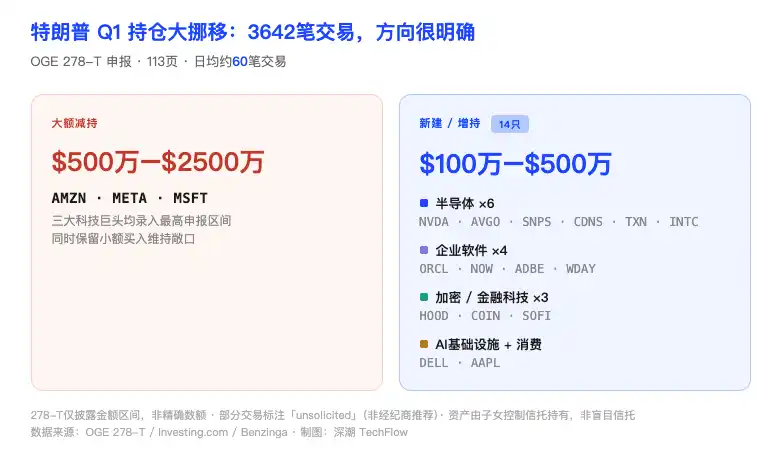
The semiconductor holdings closely align with the White House's policy direction of boosting domestic chip production capacity. According to Quiver Quantitative analysis, the purchase of Nvidia occurred before CEO Jensen Huang accompanied Trump on a visit to China, a trip expected to involve discussions on AI chip exports and semiconductor policy.

White House "Stock Tip" Three Months After Buying Dell, Stock Up 96%

The focus of the conflict-of-interest controversy centers on Dell.

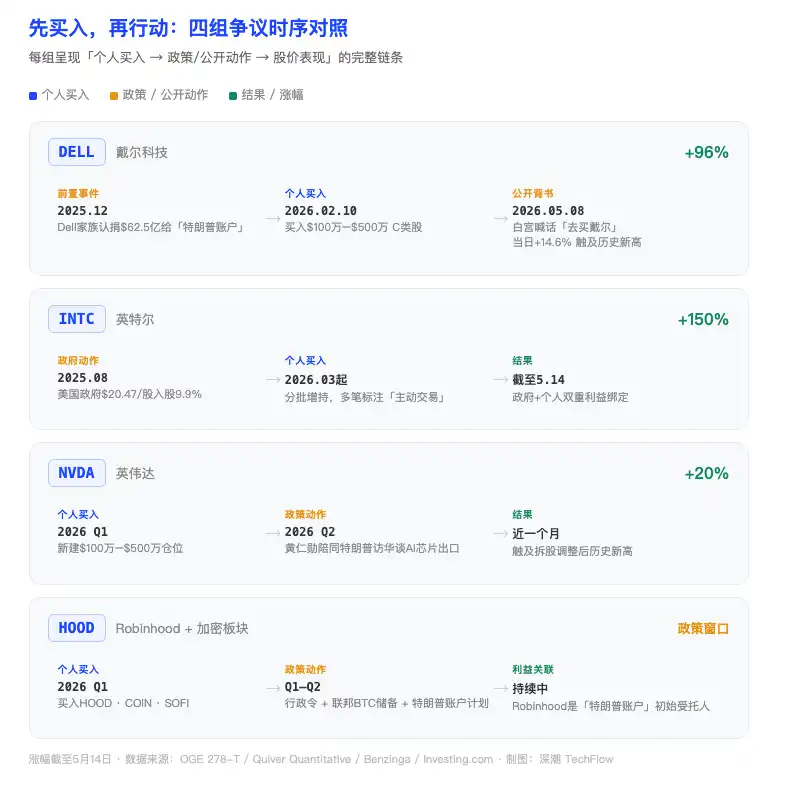
Documents show Trump bought $1 million to $5 million worth of Dell Technologies Class C stock on February 10, 2026. Three months later, at a Mother's Day event on May 8th, Trump thanked Michael Dell and Susan Dell by name at the White House and made the remark that sparked an uproar to those present—telling Americans to "go buy Dell."

That day, Dell's stock price surged as much as 14.6%, hitting a record high of $263.99. From Trump's purchase to the present, Dell's stock price has risen 96% cumulatively.

Another detail in the timeline intensified the controversy. On December 2, 2025, Michael Dell and Susan Dell pledged $6.25 billion to the "Trump Accounts," one of the largest private donations in recent years to a signature project of a sitting president. The White House has not responded to whether there was coordination between the President's public endorsement and the Dell family's donation.

Intel Shares Soar 150% After Purchase, Government Holds 9.9% Stake

Intel's trades are also worth examining.

Trump began buying Intel in batches starting in early March 2026, with several trades marked as "unsolicited," meaning not broker-recommended. Since the initial purchase on March 2nd, Intel's stock price has risen 150%.

Prior to this, the U.S. government purchased 433.3 million shares of Intel in August 2025 at $20.47 per share, giving it a 9.9% stake. In other words, Trump was buying Intel stock in the open market in his personal capacity while, in his presidential role, promoting government investment in Intel.

Additionally, purchases of Coinbase, Robinhood, and SoFi occurred during a period of active government promotion of crypto-friendly policies, including executive orders, a federal bitcoin reserve, and the "Trump Accounts" retirement plan. Robinhood is the initial trustee for that plan.
Non-Blind Trust Sparks Constitutional Debate, White House Claims Compliance

Critics view the alignment of these trading timelines as posing a conflict-of-interest risk. The White House argues that the filings fully comply with the STOCK Act's requirements.

Trump's assets are held in trusts controlled by his children, but the latest documents show numerous trades were executed by brokers acting as agents. The documents do not specify exactly which accounts hold the trading positions nor who gave the trading instructions.

An OGE spokesperson declined to comment on whether the trades reflect Trump's direct trading activity or operations through managed accounts, stating only that "the OGE is committed to transparency and citizen oversight of government."

According to Quiver Quantitative analysis, to their knowledge, this is the first time Trump has actively traded individual stocks while in office. The conservative, bond-heavy portfolio seen in previous 278-T filings has been completely overturned.


Questions liées

QWhat is the primary controversy surrounding Donald Trump's stock trades in Q1 2026 as detailed in the article?

AThe primary controversy is the potential conflict of interest, as Trump conducted numerous personal stock trades (3642 in total) while in office, a break from the tradition of modern presidents using blind trusts. Specific concerns include his purchase of Dell stock followed by a public endorsement to "buy Dell" from the White House, and trades in companies like Nvidia and Intel that coincided with or preceded related government policy actions.

QHow did Donald Trump's investment activity in Dell become a focal point of the conflict-of-interest allegations?

ATrump purchased between $1 million and $5 million worth of Dell stock on February 10, 2026. Three months later, on May 8, he publicly told attendees at a White House event to "go buy Dell." Following this endorsement, Dell's stock price surged, having already risen 96% from his purchase date. This sequence created the appearance of using his presidential platform to influence a stock in which he held a significant personal financial stake.

QWhat significant change does the article note in Trump's investment strategy during his presidency compared to his previous disclosures?

AThe article notes a dramatic shift from a conservative, bond-heavy portfolio in his previous financial disclosures to an active trading strategy focused on individual stocks, particularly within the AI chip and technology sectors. This represents his first known period of active individual stock trading while in office.

QAccording to the article, what action did the US government take regarding Intel before Trump's personal stock purchases?

AIn August 2025, the US government purchased 433.3 million shares of Intel at $20.47 per share, acquiring a 9.9% stake in the company. Trump subsequently began personally buying Intel stock in March 2026.

QHow has the White House responded to criticism about the timing of Trump's stock trades?

AThe White House has defended the transactions, stating that the financial disclosures are fully compliant with the requirements of the STOCK Act. However, it has not commented on whether there was any coordination between the president's public endorsements and related stock trades or political donations.

Lectures associées

La loi CLARITY sous le feu des critiques alors qu'Hayes presse Trump de l'abroger

Le co-fondateur de BitMEX, Arthur Hayes, a vivement critiqué le projet de loi CLARITY Act et le rôle de Brian Armstrong, PDG de Coinbase, dans la poussée réglementaire. Lors d'un entretien, Hayes a accusé Armstrong d'agir dans l'intérêt de ses actionnaires plutôt que pour la communauté crypto au sens large. Il a mis en garde contre un décalage croissant entre les grandes entreprises du secteur et les utilisateurs ordinaires, affirmant que les institutions financières s'intéressent au Bitcoin principalement comme couverture contre l'inflation, et non par adhésion à ses principes fondamentaux. Hayes a explicitement appelé le président américain Donald Trump à opposer son veto au CLARITY Act s'il lui était présenté. Son argument central est que la réglementation n'est pas un moyen de survie pour la crypto-monnaie et que son intégration excessive dans la finance traditionnelle, via des produits dérivés et des bilans bancaires, lui ferait perdre son essence décentralisée. Pour lui, transformer le Bitcoin en un simple instrument financier conventionnel reviendrait à annuler sa raison d'être. Ce débat souligne une fracture au sein de l'industrie entre, d'une part, les partisans d'une réglementation claire pour attirer les capitaux institutionnels et, d'autre part, ceux qui, comme Hayes, y voient une menace pour l'idéal décentralisé originel. Le projet de loi poursuit son parcours législatif dans un climat de division persistante sur l'avenir de la crypto.

bitcoinistIl y a 29 mins

La loi CLARITY sous le feu des critiques alors qu'Hayes presse Trump de l'abroger

bitcoinistIl y a 29 mins

La veille de l'effondrement de l'empire GitHub : Fuite du code source, rupture avec un fan de 18 ans, Microsoft perd 1,5 million de développeurs

GitHub traverse une crise majeure. Récemment, Mitchell Hashimoto, développeur de Ghostty et utilisateur depuis 18 ans, a annoncé son départ, critiquant la fiabilité défaillante de la plateforme. Cet événement s’inscrit dans un contexte plus large d’incidents techniques répétés (pannes, corruptions de code) ayant mécontenté des clients majeurs comme Intel et OpenAI, obligeant Microsoft à octroyer des compensations. La situation s’est aggravée avec une fuite massive de code source interne en mai 2026 : plus de 3800 dépôts auraient été compromis suite à l’installation d’une extension VS Code malveillante par un employé, une faille humiliante pour une plateforme axée sur la sécurité. En interne, GitHub, désormais intégré à l’équipe CoreAI de Microsoft, a perdu son statut d’entité indépendante et son poste de CEO. Cette restructuration et une culture managériale impopulaire ont entraîné une fuite des cerveaux et une perte d’autonomie. Sur le plan commercial, GitHub Copilot, bien que comptant des millions d’utilisateurs payants, serait structurellement déficitaire en raison des coûts d’infrastructure IA, pénalisant la rentabilité de Microsoft. Le récent passage à une facturation à l’usage a suscité la colère des développeurs. Concurrencée par des outils comme Cursor (racheté par SpaceX) et Claude Code (adopté massivement en interne chez Microsoft), GitHub voit sa position érodée. La question centrale devient : dans l’ère de l’IA, les développeurs ont-ils encore besoin d’un dépôt central comme GitHub ? La confiance de la communauté open source, pilier historique de la plateforme, est gravement mise à l’épreuve.

marsbitIl y a 36 mins

La veille de l'effondrement de l'empire GitHub : Fuite du code source, rupture avec un fan de 18 ans, Microsoft perd 1,5 million de développeurs

marsbitIl y a 36 mins

La SEC pousse à la tokenisation des actions, l'industrie financière traditionnelle commence-t-elle à s'inquiéter ?

La Securities and Exchange Commission (SEC) américaine s'apprête à officialiser un cadre d'"exemption pour l'innovation". Ce cadre permettra à des tiers de tokeniser des actions comme celles d'Apple ou de Tesla sans l'accord des entreprises concernées. Cette initiative, portée par les commissaires pro-crypto Paul Atkins et Hester Peirce, pourrait accélérer la migration des marchés boursiers traditionnels vers la blockchain, tout en suscitant de vives inquiétudes parmi les places bourses existantes. Le rapport de Tiger Research identifie deux menaces principales : la fragmentation de la liquidité et des revenus. La tokenisation disperserait les volumes de transaction et les flux d'ordres, actuellement concentrés sur des bourses comme le NYSE ou le NASDAQ, vers de multiples plateformes blockchain décentralisées. Cela créerait des écarts de prix, augmenterait les slippages et réduirait l'efficacité du marché. Parallèlement, les frais de transaction et les revenus intermédiaires migreraient vers des plates-formes concurrentes, souvent offshore, érodant la compétitivité financière nationale. L'analogie utilisée est celle d'un "supermarché" monopolistique (la bourse traditionnelle) face à la prolifération de "stands en plein air" (les tokens). Les régulateurs et les institutions financières sont tiraillés entre adopter l'innovation pour construire une nouvelle infrastructure ou la freiner pour protéger les modèles existants. Les faits montrent que cette fragmentation est déjà en cours. Le 18 mai, le même jour où la SEC a signalé son projet, les intérêts ouverts sur les actifs du monde réel (RWA) sur la plateforme décentralisée Hyperliquid ont atteint un record historique de 2,6 milliards de dollars. Le débat futur portera sur la clarification des droits des actionnaires attachés à ces tokens et sur l'encadrement réglementaire des plateformes décentralisées émergentes. Le risque pour les acteurs traditionnels est de perdre définitivement leur position dominante et de voir les capitaux se disperser vers des juridictions plus agiles.

marsbitIl y a 54 mins

La SEC pousse à la tokenisation des actions, l'industrie financière traditionnelle commence-t-elle à s'inquiéter ?

marsbitIl y a 54 mins

Analyse Complète des Pre-IPO sur la Blockchain : Pourquoi le Pouvoir de Tarification de SpaceX et OpenAI Migre-t-il sur la Blockchain ?

Résumé : Les marchés de pré-introduction en bourse (pre-IPO) migrent vers la blockchain. Cet article, basé sur un podcast avec Dio Casares de Patagon, explore cette tendance, illustrée par les contrats perpétuels pre-IPO de SpaceX sur Hyperliquid et les transactions secondaires sur des sociétés comme OpenAI et Anthropic. Les principaux points incluent : - L'essor des *perpétuels pre-IPO* : assimilables à un « pré-marché » cryptographique, ils gagnent en volume à l'approche d'un IPO, offrant une découverte de prix. - La position des entreprises : des sociétés comme OpenAI et Anthropic invalident les transactions secondaires pour canaliser les capitaux vers leurs levées primaires et éviter des complexités légales liées aux nombreux véhicules d'investissement (SPV). - L'avantage de la blockchain : les produits dérivés (perpétuels) sont souvent préférés aux jetons représentant des actions réelles (tokenisation), car ils présentent un risque de marché plutôt qu'un risque de contrepartie ou de non-conformité réglementaire (ex : période de détention de 6 mois aux États-Unis). - L'écosystème : il comprend des plateformes comme Hyperliquid pour les dérivés, et des acteurs du secondaire privé traditionnel (Forge, Hiive) ou basés sur Solana pour la tokenisation, attirant un public retail. - Les risques : investir via des structures secondaires complexes (SPV en cascade) comporte des risques juridiques et de liquidité, notamment si les banques ou les émetteurs contestent la validité des transactions. En conclusion, ce mouvement est renforcé par un calendrier chargé d'IPO attendus (SpaceX, Anthropic) et par l'avantage des marchés 24/7 de la crypto, positionnant les contrats perpétuels pre-IPO comme un instrument potentiellement majeur pour la découverte de prix et la couverture avant les introductions en bourse.

marsbitIl y a 1 h

Analyse Complète des Pre-IPO sur la Blockchain : Pourquoi le Pouvoir de Tarification de SpaceX et OpenAI Migre-t-il sur la Blockchain ?

marsbitIl y a 1 h

Les forfaits token sont là, les opérateurs de télécom sont-ils inquiets ?

"Les opérateurs télécoms chinois (China Telecom, China Mobile, China Unicom) lancent à partir de mi-mai 2026 des forfaits de tokens (unités de calcul pour l'IA), suscitant débats et interrogations. Shanghai Telecom ouvre la marche avec une offre à 1 yuan pour 250 000 tokens. Ces forfaits permettent d'accéder via API à une trentaine de grands modèles d'IA (comme DeepSeek), agissant comme un « supermarché des modèles ». Cependant, leurs prix sont perçus comme élevés par rapport à ceux des géants du cloud (jusqu'à 40 fois plus cher que DeepSeek), et leur utilité pour le grand public reste limitée face aux modèles gratuits. Cette stratégie révèle l'inquiétude des opérateurs face au ralentissement de leurs activités traditionnelles (téléphonie, internet fixe). Ils cherchent une nouvelle source de croissance dans l'IA. Leur rôle pourrait être crucial dans la construction du « réseau national unifié de puissance de calcul », une infrastructure comparée au réseau électrique. Leur force réside dans leur vaste réseau de stations de base, capable d'acheminer la puissance de calcul avec une faible latence, notamment pour des applications comme la conduite autonome. Ils se positionnent ainsi non comme créateurs des meilleurs modèles, mais comme les indispensables « distributeurs » de la puissance de calcul, la rapprochant de l'utilisateur final."

marsbitIl y a 1 h

Les forfaits token sont là, les opérateurs de télécom sont-ils inquiets ?

marsbitIl y a 1 h

Trading

Spot
Futures
活动图片