$30 Billion DeFi Capital Exodus: LayerZero Stumbles, Chainlink Feasts

marsbitPublié le 2026-05-13Dernière mise à jour le 2026-05-13

Résumé

Following the major DeFi security incident involving Kelp DAO, a significant migration of funds is underway from the cross-chain protocol LayerZero to Chainlink's CCIP (Cross-Chain Interoperability Protocol). Over $30 billion in Total Value Locked (TVL) from protocols like Kelp DAO, Solv Protocol, Re, and Tydro has moved to Chainlink in the past week, driven by security concerns. LayerZero is facing a severe trust crisis after the attack. Initially denying responsibility, LayerZero Labs has now issued a public apology, acknowledging management oversights. These include a vulnerable "1/1" single-node configuration for its Decentralized Verification Network (DVN) and past misuse of a multi-signature wallet by a team member. The protocol's weekly bridge volume has slumped to near-historic lows of around $470 million. In contrast, Chainlink is experiencing a surge in adoption and activity. Its independent active addresses recently hit multi-month highs, and whales have been accumulating LINK tokens. Beyond DeFi, Chainlink is securing partnerships with traditional finance giants like DTCC, European stock exchange operator SIX Group, and asset manager Amundi. While LayerZero has announced security upgrades—such as migrating to stronger multi-signature configurations and developing a second DVN client—and contributed to a rescue fund, the event underscores that security is becoming a decisive competitive factor as DeFi matures.

Author: Nancy, PANews

With several leading protocols stepping in to inject capital, quickly covering the funding gap and advancing on-chain recovery, the rescue efforts for the Kelp DAO attack incident have recently seen substantial progress. However, compared to the financial repairs, the harder thing to restore remains market trust.

At the center of this vortex, cross-chain leader LayerZero is facing accelerating withdrawals from many protocols and was forced to make a dramatic shift in attitude within just a few weeks—from initially shifting blame and denying responsibility to now publicly apologizing and initiating rectifications. Meanwhile, Chainlink has unexpectedly become a beneficiary of this crisis, with its CCIP protocol absorbing a large portion of migrating liquidity, showing notable growth in on-chain data.

Securing $30 Billion in Migration in a Single Week, Chainlink Reaps Security Dividends

As the largest DeFi security incident to date in 2026, the Kelp DAO attack has accelerated the migration of on-chain liquidity.

As LayerZero's security controversy continues to ferment, an increasing number of DeFi protocols are reevaluating cross-chain risks and proactively seeking more reliable havens. Over the past week, Chainlink has intensively announced multiple migration cases.

On May 9, Chainlink officially disclosed that four protocols, including Kelp DAO, Solv Protocol, Re, and Tydro, had recently abandoned their original cross-chain bridge or oracle solutions and migrated to Chainlink CCIP. The combined TVL of these related protocols exceeds $30 billion. The official even specifically added the phrase "The Great Migration" to hype this ecosystem shift, revealing strong competitive undertones.

Behind this migration wave is a realignment centered on security.

And besides DeFi protocols realigning due to security concerns, Chainlink has also been continuously gaining favor from traditional financial institutions and crypto projects in recent months.

In March of this year, Coinbase directly put its exchange market data on-chain for the first time via Chainlink's newly launched DataLink service; Europe's largest asset management firm, Amundi, collaborated with Spiko to launch a tokenized public fund based on Chainlink.

In April, OpenAssets formed a strategic partnership with Chainlink, launching an asset tokenization infrastructure solution for institutions; major European stock exchange operator SIX Group partnered with Chainlink to push Swiss and Spanish stock market data on-chain; AWS Marketplace listed Chainlink data services, connecting traditional cloud and blockchain.

In May, the US Depository Trust & Clearing Corporation (DTCC) announced the introduction of Chainlink to build a blockchain collateral management platform, aiming to achieve near-real-time settlement around the clock; Huma Finance partnered with Chainlink to introduce institutional-grade yield products into the multi-chain ecosystem.

Accompanying the ongoing ecosystem expansion, Chainlink's on-chain activity has also noticeably heated up. According to Santiment monitoring, Chainlink's number of unique active addresses broke 282,000 and 264,000 on May 9 and 10, respectively, hitting the highest records since September 2025, and noted this was primarily influenced by the recent large-scale migration of DeFi protocol infrastructure.
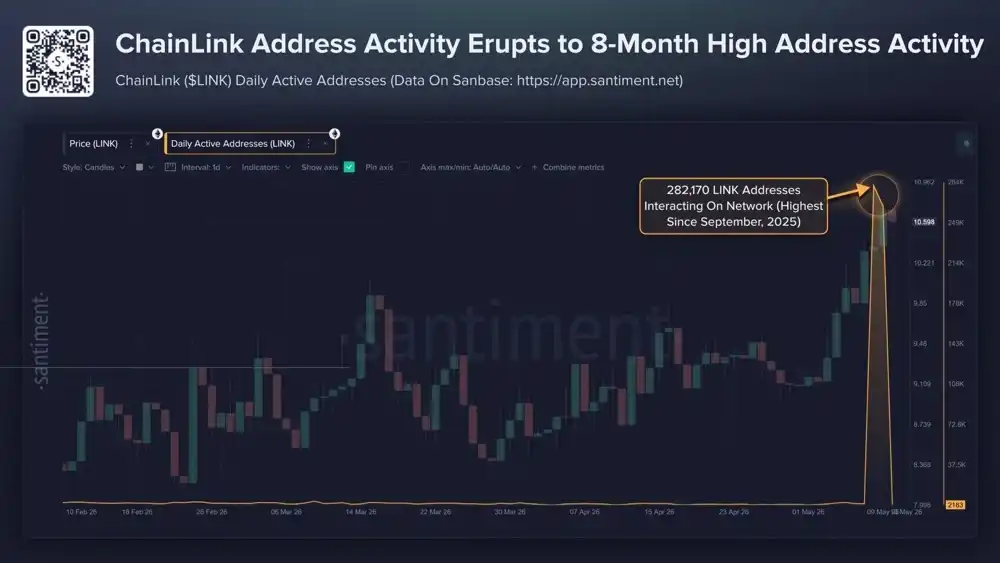
Meanwhile, official Chainlink data shows that the total value of its cross-chain tokens has exceeded $61.8 billion, with CCIP transaction volume reaching $19.5 billion.

Market confidence is also reflected in changes in LINK token holdings. According to Santiment monitoring earlier this month, over the past month, Chainlink whale and shark addresses holding between 100,000 and 10 million LINK cumulatively added 32.93 million LINK. Historically, this has often been a strong bullish signal. Over the past 30 days, LINK has risen approximately 19.7%.

LayerZero Faces Trust Crisis, Officials Issue Emergency Apology and Overhaul

Currently, LayerZero is mired in a trust crisis.

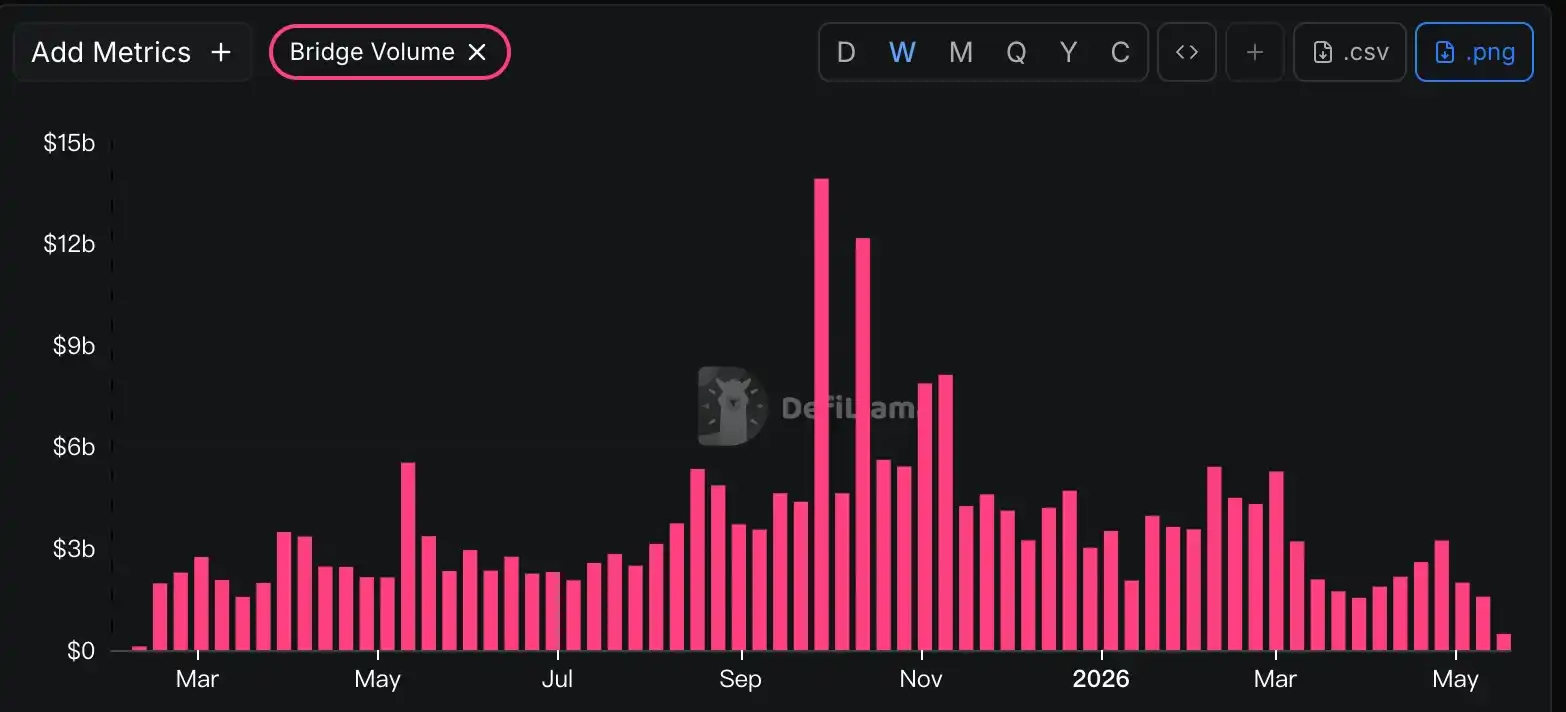
According to DefiLlama data, LayerZero's weekly Bridge transaction volume has now declined to about $470 million, approaching historical lows. This attack incident has plunged LayerZero into a trust crisis.
In the early stages of the hack, Kelp DAO attributed the vulnerability exploit to LayerZero's security issues. Subsequently, LayerZero quickly denied responsibility, stating that multiple accusations by Kelp DAO in the rsETH security incident were completely false.

But the controversy did not subside. Last week, LayerZero Labs co-founder and CEO Bryan Pellegrino engaged in heated debates with several security researchers in the ETHSecurity Community Telegram group.

The focal point of contention is that LayerZero Labs could immediately upgrade the default library contract without a timelock, theoretically allowing forged cross-chain messages. This exposed over $3 billion in LZ OFT assets to potential risk for a period. Security researcher Banteg pointed out that several mainstream projects, including Ethena and EtherFi, were still using this default library weeks ago, and about $178 million in assets remain exposed to risk.

Simultaneously, on-chain data also showed that LayerZero's multi-signature address had conducted Meme coin trading, DEX swaps, and cross-chain bridging operations unrelated to multi-signature duties, further raising community concerns about key security. In response, Bryan admitted that related operations were indeed performed by multi-signature team members but denied they constituted "Meme coin speculation trading," claiming the purpose was merely "testing PEPE OFT functionality," and stated that the involved members had been removed.

To mitigate risks, Bryan also publicly advised project teams to promptly adopt a "fixed configuration" to replace the default configuration. Subsequently, Banteg published a list of LayerZero projects still using the default library contract and called on related protocols to migrate as soon as possible.

These remarks quickly sparked industry discussion and skepticism. Chainlink Strategy Lead Zach Rynes had previously criticized LayerZero Labs, stating that its multi-signature keys had long suffered from serious OPSEC (operational security) failures, directly exposing tens of billions in OFT assets to security risks. He further stated that if LayerZero and the industry had truly heeded the persistent warnings from security researchers over the past few years, such attack incidents could have been entirely avoided.

Facing market舆论 and ongoing ecosystem bleeding, LayerZero's attitude shifted noticeably. On May 9, LayerZero officially released a public apology statement, addressing the security incidents and communication issues over the past three weeks.

LayerZero Labs stated that the internal RPC it used had been attacked by the Lazarus Group over the past three weeks, compromising the authenticity source of its DVN (Decentralized Verification Network), while external RPC providers suffered DDoS attacks. The incident affected only 0.14% of applications and approximately 0.36% of asset value, the LayerZero protocol itself was unaffected, and over $9 billion in assets continued normal cross-chain flow after the incident.

However, LayerZero Labs also acknowledged for the first time that it was responsible for management oversight in previously allowing DVNs to provide security for high-value transactions with a "1/1" single-node configuration, which posed a single point of failure risk. The official also disclosed that three and a half years ago, a multi-signature signer mistakenly used a multi-signature hardware wallet for personal transactions. That signer has been removed, and the relevant wallet has been rotated.

Regarding subsequent rectifications, LayerZero Labs announced a series of security upgrade measures, including: already ceasing services for the 1/1 DVN configuration, currently migrating all path default configurations to a 5/5 multi-signature setup with a minimum of 3/3; developing a second DVN client based on Rust to achieve client diversity; launching the dedicated multi-signature tool OneSig to enhance signature security; and launching the unified management platform Console for asset issuance configuration and abnormal behavior detection.

Additionally, LayerZero also contributed over 10,000 ETH to this DeFi United rescue effort, of which 5,000 ETH will be used for the fund, and the remaining 5,000 ETH will be reserved for Aave.

Despite the escalating controversy, LayerZero has not completely lost its market. Major assets, including Ethena's USDe product, EtherFi's weETH asset, and BitGo's WBTC, continue to use LayerZero's OFT standard.

Every major security crisis triggers a redistribution of liquidity and discourse power. As the crypto industry increasingly moves towards mainstream financial markets, the criteria for evaluating underlying infrastructure will become ever more stringent, with security capabilities becoming one of the core competitive advantages.


Questions liées

QWhat was the immediate consequence of the Kelp DAO hack on the cross-chain infrastructure landscape?

AIt triggered a rapid migration of DeFi liquidity away from LayerZero due to security concerns, with over $30 billion in TVL from protocols like Kelp DAO moving to Chainlink's CCIP within a week.

QAccording to the article, what were two key security issues highlighted by researchers regarding LayerZero?

AFirst, LayerZero's default library contract, which could be upgraded instantly without a timelock, potentially allowing forged cross-chain messages. Second, suspicious non-multisig-related activities from a multisig signer address, raising concerns about key security.

QHow did Chainlink's on-chain activity and LINK token react to the migration trend mentioned in the article?

AChainlink's daily active unique addresses surged to over 282,000 and 264,000, the highest since September 2025. Furthermore, whales and sharks holding 100k to 10M LINK accumulated over 32.9 million LINK in a month, while the LINK token price rose approximately 19.7% in 30 days.

QWhat specific corrective measures did LayerZero announce in its public apology on May 9th?

ALayerZero announced several measures: stopping service for 1/1 DVN configurations, migrating all paths to at least 3/3 or 5/5 multisig setups, developing a second DVN client in Rust for client diversity, launching a dedicated multisig tool called OneSig, and releasing a management platform called Console for configuration and anomaly detection.

QDespite the crisis, which major assets and protocols were mentioned as still continuing to use LayerZero's technology?

AMajor assets and protocols continuing to use LayerZero's OFT standard include Ethena's USDe, EtherFi's weETH, and BitGo's WBTC.

Lectures associées

Bulletin | xAI de Musk lance Skills ; Duan Yongping fait ses premiers achats de Circle au T1 2026 ; Polymarket s'associe à Nasdaq pour lancer un marché prédictif

**Résumé des actualités du jour** Les derniers développements dans les secteurs de l'IA et de la crypto se croisent. **IA et entreprises technologiques :** * **Anthropic** renforce son équipe avec l'arrivée d'**Andrej Karpathy**, cofondateur d'OpenAI. * **xAI** (Elon Musk) lance **"Skills"** pour son assistant Grok, lui conférant une mémoire persistante entre les conversations. * **Analog Devices** est en négociations avancées pour acquérir la startup de puces IA **Empower Semiconductor** pour environ 1,5 milliard de dollars. **Crypto-monnaies et investissements :** * **DeFi sous pression :** Le mois de mai compte déjà **14 incidents de piratage**. Un exploit récent sur Echo Protocol (réseau Monad) a entraîné des pertes significatives, portant à trois les attaques majeures en cinq jours. * L'investisseur renommé **段永平 (Duan Yongping)** a révélé via un dépôt SEC son **premier investissement dans Circle** (émetteur de l'USDC), d'une valeur de 19,1 millions de dollars, au premier trimestre 2026. * **Canaan (嘉楠科技)** a publié ses résultats Q1 2026 : un revenu total de 62,7 millions de dollars et des réserves record de crypto (1,807 BTC et 3,951 ETH). * **Polymarket**, plateforme de marchés prédictifs, s'associe au **Nasdaq** pour lancer un marché dédié aux entreprises non cotées. * **VanEck** prédit un marché du crédit numérique de 2,5 billions de dollars dans dix ans et un prix du **BTC à 1 million de dollars**. **Tendances et analyses :** * Le marché des **mèmes (meme coins)** reste actif sur ETH, Solana et Base. * Des articles approfondis analysent la pression réglementaire croissante sur les DEX comme **Hyperliquid**, les défis de **Solana** pour maintenir sa dynamique, et l'émergence potentielle d'un **marché des capitaux dédié aux "Agents" IA** autonomes.

链捕手Il y a 12 mins

Bulletin | xAI de Musk lance Skills ; Duan Yongping fait ses premiers achats de Circle au T1 2026 ; Polymarket s'associe à Nasdaq pour lancer un marché prédictif

链捕手Il y a 12 mins

HYPE continue-t-il de grimper en flèche ? A-t-il atteint un sommet ?

L’actif HYPE, le token de la plateforme de trading décentralisée Hyperliquid, connaît une forte hausse, surpassant même le BTC et le BNB. Cette performance s’explique par plusieurs catalyseurs fondamentaux récents. Premièrement, l’ouverture de canaux d’investissement traditionnels via les ETF (comme THYP de 21Shares et BHYP de Bitwise) apporte des flux de capitaux conformes et une visibilité accrue. Bitwise a annoncé qu’il utiliserait 10 % des frais de gestion de son ETF BHYP pour acheter et staker des HYPE, créant ainsi un acheteur institutionnel potentiellement récurrent. Deuxièmement, le retour de l’USDC sur Hyperliquid, via un nouveau mécanisme (AQAv2) en partenariat avec Coinbase et Circle, pourrait générer des revenus substantiels issus des réserves. Une estimation communautaire évalue un rachat potentiel de HYPE d’environ 440 000 dollars par jour grâce à ces revenus, ajoutant une source de demande plus stable aux rachats basés sur les frais de transaction. Troisièmement, Hyperliquid élargit son champ d’action au-delà des perpétuels. Le lancement de marchés de prédiction (HIP-4) a rencontré un succès immédiat, nécessitant un staking important de HYPE. Parallèlement, le segment RWA (Real World Assets) explose, avec des contrats ouverts atteignant 2,6 milliards de dollars, ouvrant la plateforme à des actifs comme les actions ou les matières premières. Une éventuelle assouplissement réglementaire américain sur les actions tokenisées pourrait encore amplifier cette tendance. En résumé, le marché revalorise HYPE car Hyperliquid se transforme d’un simple DEX à perpétuels en un écosystème de trading on-chain plus vaste, captant de nouveaux flux, de nouveaux actifs et de nouvelles sources de revenus. Cependant, à court terme, le prix est entré dans une zone de forte confrontation entre baleines haussières et baissières, rendant la dynamique immédiate plus volatile.

marsbitIl y a 26 mins

HYPE continue-t-il de grimper en flèche ? A-t-il atteint un sommet ?

marsbitIl y a 26 mins

Pourquoi HYPE continue-t-il d'exploser ? Est-ce le sommet ?

L'article analyse les raisons derrière la forte hausse du prix du token HYPE de la plateforme Hyperliquid. Le texte souligne plusieurs facteurs clés : 1. **Accès à des capitaux institutionnels** : Le lancement d'ETF sur HYPE (comme THYP et BHYP) ouvre une nouvelle voie d'entrée pour les capitaux traditionnels. Bitwise a annoncé qu'il utiliserait 10% des frais de gestion de son ETF BHYP pour acheter et staker du HYPE, créant un potentiel d'achat récurrent. 2. **Retour d'USDC et revenus stables** : Le retour du stablecoin USDC sur Hyperliquid, via un mécanisme impliquant Coinbase et Circle (AQAv2), pourrait générer des revenus annuels significatifs pour le protocole. Une partie de ces revenus serait utilisée pour racheter du HYPE, ajoutant une source d'achat potentiellement stable et quotidienne, indépendante du seul volume de transactions. 3. **Expansion dans de nouveaux marchés** : Hyperliquid élargit son offre au-delà des contrats perpétuels (Perps) : * **Marchés de prédiction (HIP-4)** : Le protocole a lancé des contrats à résultat binaire, attirant un volume important dès le premier jour. Cela crée une nouvelle demande de staking de HYPE et génère des frais. * **RWA (Actifs Réels)** : L'encours ouvert (OI) sur les actifs réels (actions, matières premières) a atteint un record, élargissant considérablement le champ d'action potentiel de la plateforme. * **Actions tokenisées** : Une potentielle assouplissement réglementaire de la SEC américaine pourrait offrir un énorme potentiel de croissance pour ce segment déjà actif sur Hyperliquid. **Conclusion** : Le marché reevalue HYPE car Hyperliquid se transforme d'un simple DEX de contrats perpétuels en un écosystème de trading plus large, captant de la valeur via plusieurs canaux (frais de trading, revenus de réserves stables, staking). Cependant, l'article note qu'à court terme, le prix est entré dans une zone de forte confrontation entre baleines baissières et haussières, ce qui pourrait entraîner une volatilité accrue malgré les fondamentaux positifs à long terme.

Odaily星球日报Il y a 50 mins

Pourquoi HYPE continue-t-il d'exploser ? Est-ce le sommet ?

Odaily星球日报Il y a 50 mins

Trading

Spot
Futures
活动图片