1inch Team Accused of Dumping, On-Chain Data Reveals Sophisticated Trading Strategies of Large Positions

Odaily星球日报Publié le 2026-01-29Dernière mise à jour le 2026-01-29

Résumé

1inch Team Accused of Dumping Tokens, But On-Chain Data Reveals Complex Trading Patterns Three wallets labeled as "1inch Team" sold 36.36 million 1INCH tokens (worth $5.04 million), causing the token’s price to drop 16.7% to $0.1155. The tokens were initially acquired in late November 2024 at around $0.42 each, meaning the sale resulted in an estimated loss of over $10 million for that batch. However, this selling behavior contradicts the team’s historical trading strategy. Earlier in the year, the 1inch investment fund demonstrated sophisticated market timing—accumulating 1INCH at lows near $0.20, buying more during a July rally that pushed prices to $0.206, and later taking partial profits at around $0.33. Similar strategies were applied to ETH and WBTC, yielding significant gains through disciplined entry and exit points. 1inch officially denied involvement, stating that the wallets in question were not controlled by the team, foundation, or treasury, and that the selling was likely from a third-party holder. The incident highlights the risks of misinterpreting on-chain labels and the impact of large sell-offs in low-liquidity markets. Despite the denial, the event further pressured 1INCH, which has declined significantly from its all-time high of $6.

Original | Odaily Planet Daily (@OdailyChina)

Author | Ethan (@ethanzhang_web3)
Large sales marked as "1inch team" have once again sparked criticism.

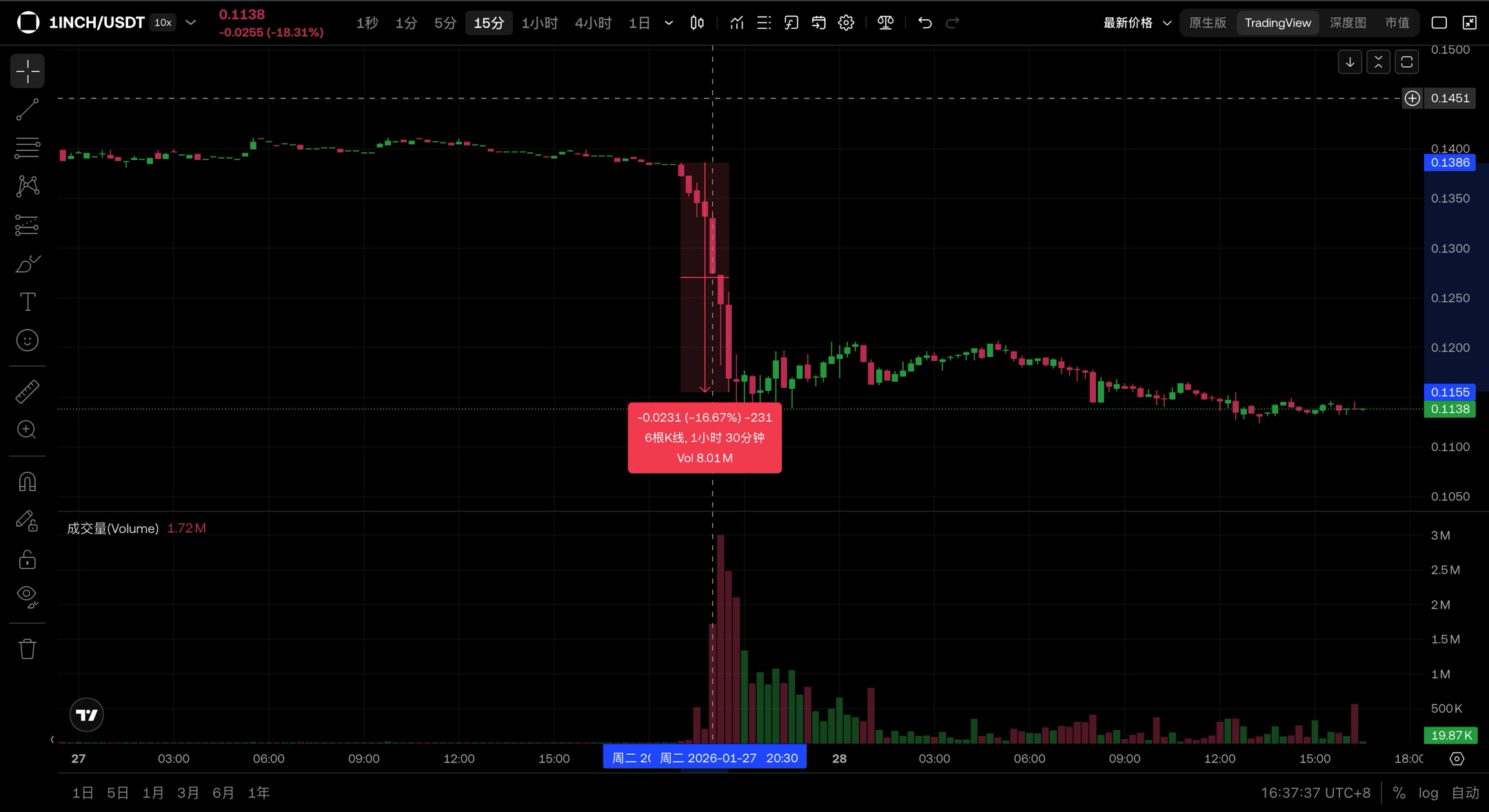
Recently, the on-chain data platform ARKHAM showed that three wallets marked as "1inch team" sold a total of 36.36 million 1INCH tokens, worth $5.04 million. According to OKX market data, affected by this, the price of 1INCH token fell 16.7% to $0.1155 in a short time, and is currently reported at $0.1164. Surrounding this sale, a question was quickly thrown to the market: Is this really the project team itself dumping?

Judging from this sale itself, the result was not ideal. On-chain data shows that the aforementioned 1INCH tokens were mainly transferred to the relevant addresses in late November 2024. Based on the price estimate at that time, the cost was around $0.42, corresponding to a value of approximately $15.27 million. Before this sale, the price of 1INCH had fallen back to around $0.14. Combined with the slippage impact due to the large volume during the selling process, the actual loss for this batch of positions alone may exceed $10 million.
Reference: The Trading Style of the 1inch Team in the Past

Previously, the on-chain operations of the 1inch team investment fund during multiple market fluctuations were once regarded by the market as the existence of a "professional trading team".

As early as the period from February to April, the 1inch team investment fund had begun to continuously accumulate 1INCH at low levels. At that time, market sentiment had not yet warmed up, and 1INCH hovered around $0.2 for a long time. During this stage, the team invested a total of approximately $6.648 million to buy 33.19 million 1INCH tokens, with an average building price of about $0.2.

However, this round of buying did not cause significant price fluctuations. What really caught the market's attention was the concentrated buying in early July. From July 6 to 9, the 1inch team investment fund made another move, adding an investment of approximately $4.4 million in just a few days to buy 22.99 million 1INCH tokens. As buying continued, the price of 1INCH rose from around $0.18 to $0.206, a阶段性涨幅 of about 14%. During this period, the team transferred 3 million USDC to Binance and withdrew 1INCH in batches back to its own addresses. The relevant funds were not used up at once, perhaps waiting for the right time, and were still being bought continuously.

After entering July 10, the pace of operations明显加快. On the afternoon of July 10, the team again bought about 4.12 million 1INCH tokens for approximately $880,000, while simultaneously补充 2 million USDT to Binance to prepare ammunition for subsequent transactions. On the evening of July 11, on-chain monitoring showed that the team疑似 bought another 11.81 million 1INCH tokens at a higher price range, with the transaction price already rising to around $0.28. By this point, the address's holdings had once increased to 83.97 million 1INCH tokens, with a book value exceeding $23 million. On July 13, the team continued to withdraw 6.334 million 1INCH tokens from Binance.

If we trace the timeline back to early February, the 1inch team investment fund has累计投入 approximately $13.64 million since the beginning of the year to buy 55.85 million 1INCH tokens, with a comprehensive cost of about $0.244. Against the backdrop of the 1INCH price soaring above $0.39 in mid-July, these positions had浮盈 millions of dollars.

It is worth noting that the team is not "only buying and not selling". On the evening of July 13, it began to小规模兑现收益, selling about 904,000 1INCH tokens at a price of $0.33, exchanging for $298,000; and at an earlier stage, it had already sold部分 1INCH tokens in batches at around $0.28.

At the same time, the team also同步对 another important position进行止盈: the ETH previously bought at an average price of $2577 in February had begun to be sold in batches above $4200, with the ETH position alone realizing profits of millions of dollars.

On August 11, according to on-chain analyst余烬监测, the 1inch team investment fund had begun to兑现部分前期仓位 on-chain. Data showed that it sold 5000 ETH at an average price of $4215, exchanging for 21.07 million USDC;同时 sold 6.45 million 1INCH tokens at an average price of $0.28, exchanging for about 1.8 million USDC.

Judging from the building costs, the aforementioned ETH was bought by the 1inch team in February this year at an average price of about $2577; the corresponding 1INCH was mainly built in July, with a comprehensive cost of about $0.253.仅就本次已卖出的 ETH and 1INCH positions计算, the 1inch team investment fund has realized approximately $8.36 million in账面收益.
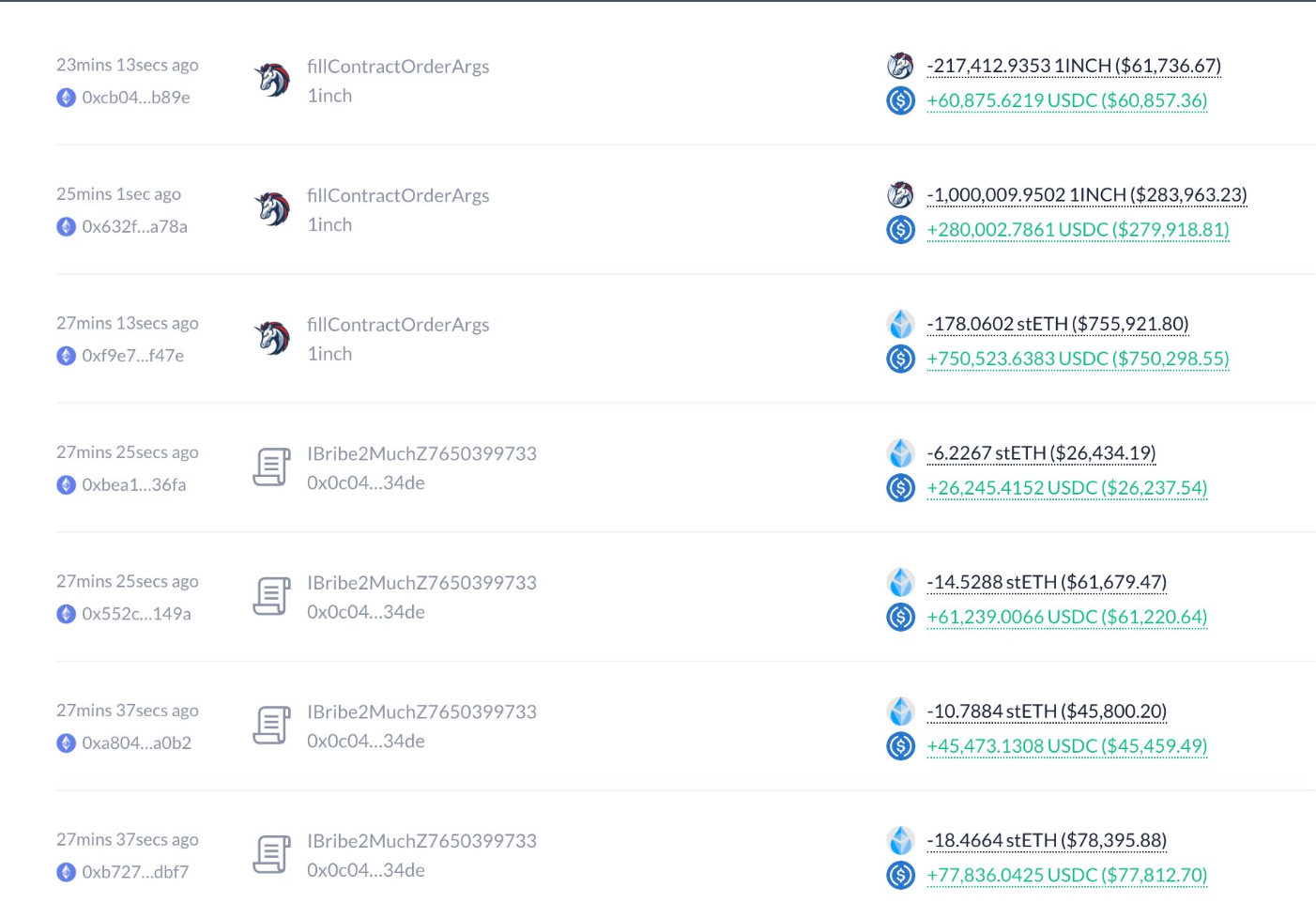
If we look further back, the 1inch team's operation path of "buying against the trend and selling with the trend" on BTC is同样清晰. During the period from February to March this year, it bought 160.8 WBTC at an average price of about $88,000 during the BTC回调阶段, and completed清仓 in May when BTC再次逼近 the $100,000 mark, realizing a total profit of nearly $1 million.

综合 BTC, ETH, and 1INCH asset线索来看, the on-chain operations of the 1inch team investment fund are more like a set of capital strategies that have been反复演练: Complete building during market adjustment stages, continuously add positions during the上涨过程, and分批兑现收益 after prices enter high ranges.

But This Time, Was It Really Them Operating?

It should be pointed out that if we compare this large sale that occurred around $0.14 with the past on-chain operations of the 1inch team investment fund, we find: If this sale was indeed directly led by the team, then its execution method itself明显背离 its past trading logic. Whether in the operations of BTC, ETH, or 1INCH history, the team's more common practice is to兑现收益 in batches after the price trend is confirmed, rather than集中抛售 in明显的低流动性区间.

Because of this, some market participants began to question: Was this selling behavior marked as "1inch team" really出自 the team or wallets directly controlled by it.

Subsequently, 1inch official also responded to the relevant controversy. In a statement, it clearly stated that this selling behavior did not occur in any wallet controlled by the 1inch team, entity, or treasury multi-signature, and the team could not interfere with the asset allocation and trading decisions of third-party holders.

In other words, the关联关系 pointed to by on-chain labels does not equate to actual control权. Judging from the execution rhythm and price range, this sale is more likely to come from a third-party holder who has脱离 project control, rather than a shift in the 1inch team's own trading logic.

In a stage with inherently limited liquidity, a single large sale being quickly equated to "team dumping" is itself an interpretation of information that is过度压缩. It ignores the天然断层 between address labels and real control权 after long-term circulation of tokens.

Back to 1inch itself. The official emphasized in the statement that this market fluctuation did not change its core business and long-term direction. Since 2019, 1inch has累计撮合交易量接近 $800 billion, and even during market downturns, it can maintain a daily trading volume of hundreds of millions of dollars. The team also stated that it plans to重新审视代币经济模型 this year to improve overall韧性 in low liquidity and下行周期. Against this background, the discussion surrounding "whether the 1inch team dumped" is more like a误读放大 by on-chain labels, liquidity environment, and emotional interpretation.

However, even if it is eventually proven to be a misreading, this sale still constituted a real secondary impact on the already持续走弱 price of 1INCH. Since the last cycle high of $6, 1INCH has experienced a long-term unilateral decline and is now hovering around $0.11.
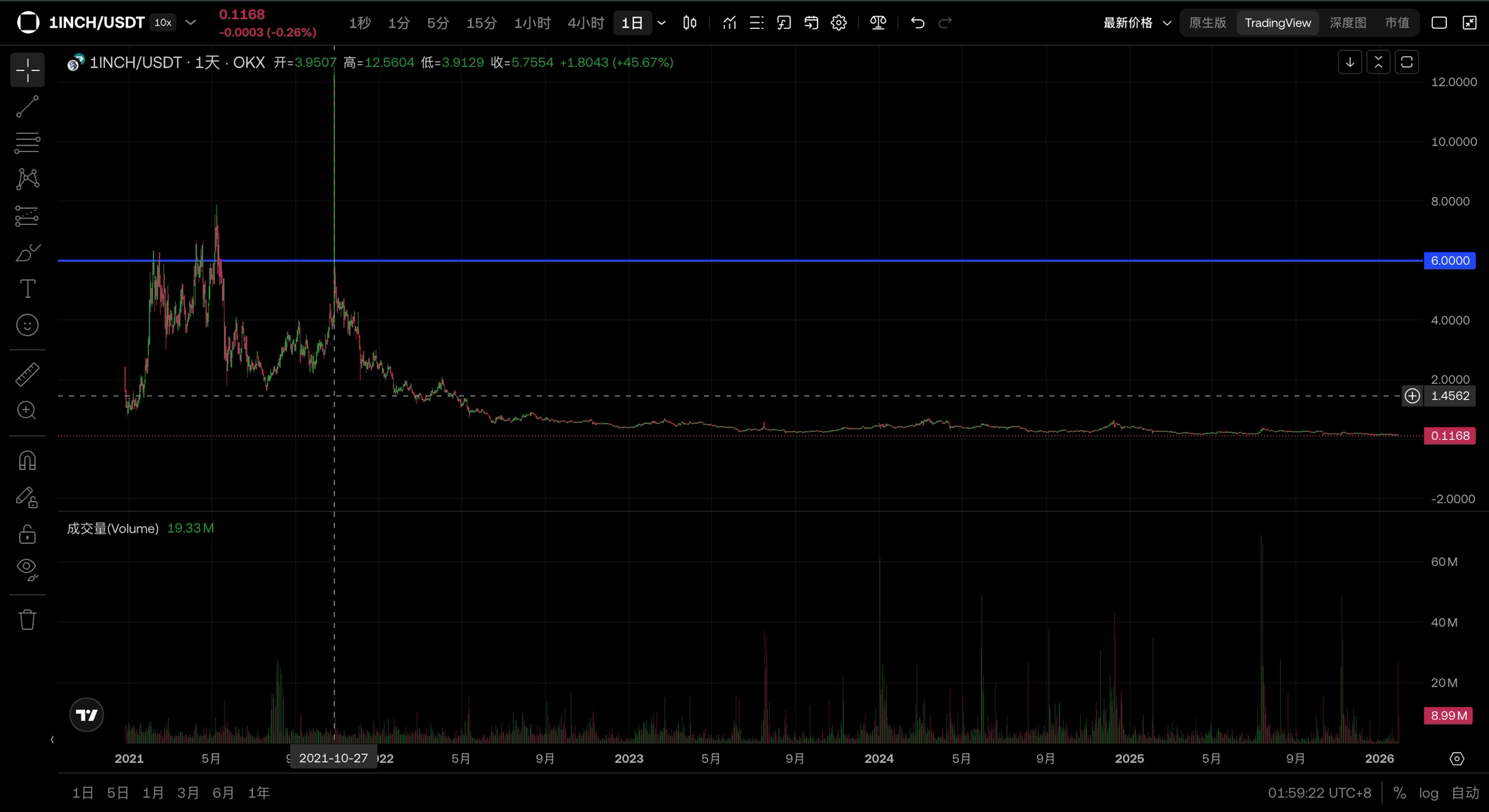
On such a trend, the market显然已没有足够的缓冲空间 to消化任何一次突发的卖出信号. This type of放大 selling event ultimately承受情绪冲击的, often falls on the end with the weakest risk tolerance—retail investors.


Questions liées

QWhat was accused of the 1inch team regarding their token sales, and what was the actual outcome according to the article?

AThe 1inch team was accused of conducting large sell-offs (dumping) of their tokens, causing a price drop. However, the article clarifies that the selling was not actually performed by the 1inch team or any wallets controlled by them, but rather by third-party holders, making it a misinterpretation amplified by on-chain labels and market sentiment.

QHow did the recent large sale of 1INCH tokens affect the token's price, and what was the estimated financial loss from this sale?

AThe recent sale of 36.36 million 1INCH tokens, worth $5.04 million, caused a short-term price drop of 16.7% to $0.1155. The estimated financial loss from this batch of tokens, considering the purchase cost of around $0.42 per token in late 2024, was over $10 million due to the lower selling price and slippage.

QDescribe the typical trading strategy of the 1inch team investment fund as highlighted in the article.

AThe 1inch team investment fund typically follows a strategy of accumulating tokens during market downturns, increasing positions during upward trends, and gradually taking profits when prices reach higher levels. This was demonstrated in their operations (e.g., buying BTC, ETH, and 1INCH at low points and selling at peaks), resulting in significant realized gains.

QWhat was 1inch's official response to the allegations of team-led token dumping?

A1inch officially stated that the sell-off did not occur in any wallets controlled by the 1inch team, entity, or treasury multisig. They emphasized that they cannot interfere with the asset allocation and trading decisions of third-party holders, indicating that the on-chain labels did not reflect actual control by the team.

QWhat long-term trend has the 1INCH token price experienced, and how does the recent event impact its market performance?

AThe 1INCH token has been in a long-term downward trend since its all-time high of around $6, currently trading near $0.11. The recent selling event, even if misinterpreted, further weakened the price and negatively impacted market sentiment, particularly affecting retail investors with lower risk tolerance.

Lectures associées

Kalshi, MTS et l'ambition de a16z

Le marché des prédictions, illustré par des plateformes comme Kalshi, connaît un regain d'intérêt en 2025, suscitant l'enthousiasme des investisseurs, des acteurs de la cryptomonnaie et des médias. Cet engouement dépasse les simples opportunités de régulation ou de revenus, touchant à une dimension philosophique plus profonde. L'article retrace l'évolution intellectuelle du concept, depuis les théories de Hayek sur la connaissance dispersée dans la société, jusqu'aux mécanismes incitatifs comme le LMSR de Robin Hanson, conçus pour révéler l'information. Cependant, c'est l'entrée en jeu du géant du capital-risque a16z, avec son investissement massif dans Kalshi, qui marque un tournant. a16z voit dans le marché des prédictions bien plus qu'un produit financier : un nouvel outil médiatique fondamental. Il répondrait au désir contemporain de "présence" et d'action face à un monde de plus en plus médiatisé et déterministe. En pariant de l'argent réel sur des événements mondiaux, l'utilisateur passerait du statut de spectateur passif à celui d'observateur actif et impliqué, recouvrant un sentiment d'agency. Cette capacité à générer de l'engagement et à définir la réalité par les prix du marché (établissant la véracité et l'importance des événements) en ferait une pièce maîtresse de l'empire des "nouveaux médias" qu'a16z cherche à construire. Cet empire, illustré par des acteurs comme MTS, se caractérise par une production et une diffusion d'information extrêmement rapides et intenses, visant à "s'approprier la timeline". La valeur ultime de Kalshi résiderait ainsi dans son puissant "champ de distorsion de la réalité" : sa capacité, via le poids de l'argent engagé par la foule, à influencer la perception collective du futur et à s'imposer comme un arbitre de la vérité, conférant à une entreprise privée une influence historique rare.

marsbitIl y a 49 mins

Kalshi, MTS et l'ambition de a16z

marsbitIl y a 49 mins

Changement de cap mondial chez a16z : Le capital-risque devient le « moteur » de l'alliance technologique américaine

L’annonce de Ben Horowitz marque un virage stratégique majeur dans la globalisation d’a16z. Le fonds ne se contente plus de rechercher des projets à l’étranger, mais s’inscrit dans un cadre plus large de compétition technologique et de coopération entre alliés, explicitement lié au leadership technologique des États-Unis et de leurs partenaires. Dans un contexte où l’IA, la robotique, la cybersécurité et les chaînes d’approvisionnement deviennent des enjeux de compétition nationale, le rôle des VC évolue. A16z renforce ses capacités pour aider ses startups à naviguer dans des environnements complexes, mêlant marchés, régulations et géopolitique. Les initiatives clés incluent : l’ouverture d’un bureau à Tokyo, la nomination d’Anne Neuberger (ancienne responsable gouvernementale) comme associée chargée des affaires mondiales pour conseiller sur la politique et la géopolitique, et la transformation de l’équipe relations investisseurs en une équipe « Partenaires Mondiaux » pour faciliter les connexions et le déploiement international des entreprises. L’objectif reste de soutenir les meilleures entreprises technologiques partout dans le monde (plus de 100 investissements internationaux à ce jour), mais avec une mission élargie : être un organisateur reliant les startups aux capacités nationales, aux ressources industrielles et au réseau des alliés, contribuant ainsi à la compétitivité technologique des États-Unis et de leurs alliés.

marsbitIl y a 1 h

Changement de cap mondial chez a16z : Le capital-risque devient le « moteur » de l'alliance technologique américaine

marsbitIl y a 1 h

Kalshi, MTS et les ambitions d'a16z

Les marchés prédictifs, représentés par Kalshi, émergent comme un domaine clé en 2025, attirant fonds d'investissement, acteurs de la cryptomonnaie et médias. Leur importance dépasse la simple spéculation. Leur évolution conceptuelle remonte à Hayek (l'utilisation de la connaissance dans la société) et à Robin Hanson (mécanisme LMSR pour inciter à la révélation d'informations), avec l'idée utopique d'une « futarchie ». L'intérêt de a16z, qui a investi dans Kalshi (évalué à 220 milliards de dollars), va au-delà du modèle économique. Leur thèse centrale est que les marchés prédictifs offrent un « sentiment de présence » et une forme d'« anti-cynisme » dans un monde moderne où les individus se sentent déconnectés. En pariant sur des événements mondiaux, l'utilisateur devient un « observateur superlatif », investi et influençant la perception collective. Cela s'inscrit dans la vision de « nouveaux médias » de a16z : un écosystème médiatique complet et rapide qui « s'approprie la timeline », comme le démontre MTS (Monitoring The Situation), un média en continu sur Twitter. Kalshi ajoute à ce dispositif une autorité unique car ses prix reflètent des paris en argent réel, lui conférant un pouvoir de « distorsion de la réalité » pour définir la vérité et l'importance des événements. C'est ce pouvoir, rarement détenu par une entreprise privée, qui justifierait sa valorisation faramineuse et en ferait une pièce maîtresse de l'empire médiatique de a16z.

链捕手Il y a 1 h

Kalshi, MTS et les ambitions d'a16z

链捕手Il y a 1 h

Comprendre la réalité du commerce, des paiements et des infrastructures des Agents

**Interprétation de la réalité des agents, des paiements et des infrastructures commerciales** Au cours de l'année passée, l'auteur a travaillé sur l'infrastructure de l'économie des agents, interagissant avec Stripe, Visa, Coinbase, Google et des dizaines de startups. La conclusion est claire : il n'existe pas encore de demande réelle, et les startups font face à des problèmes structurels. Stripe a enregistré peu de transactions d'agents malgré un fort intérêt. Visa impose des seuils de revenus et des processus KYC extrêmement restrictifs, accessibles uniquement aux géants comme Amazon. Les chiffres d'utilisation des agents sur la blockchain (comme via le protocole x402) sont largement gonflés par des transactions de test. **Agent vs Commerçant** : L'expérience d'achat par agent (IA) est souvent inférieure au commerce électronique traditionnel pour les achats visuels (vêtements, électronique). L'interface conversationnelle est un recul par rapport aux interfaces riches. La demande actuelle des marchands est défensive : ils veulent être "trouvables" par les agents par crainte de rater une future tendance. Les cas d'usage convaincants sont limités (commande de nourriture, navigation dans des interfaces complexes), mais nécessitent une distribution de masse détenue par les géants. **Agent vs API** : Les développeurs utilisent déjà massivement des API (calcul, données). Le problème du coût des micro-transactions est souvent résolu par du prépaiement. Le véritable obstacle est que les grands fournisseurs SaaS privilégient les contrats enterprise. Les opportunités pour les nouveaux systèmes de paiement (comme les stablecoins) se situent dans la longue traîne des services, un marché plus restreint. **Agent vs Agent** : Ce modèle est encore théorique, sans volume significatif. Il impliquerait des transactions ultra-rapides entre entités non humaines, avec des montants variables et des règlements multipartites. C'est un pari à long terme sur une infrastructure dédiée, mais ce n'est pas le marché actuel. **Agent vs Finance** : C'est la seule catégorie avec une demande existante et une volonté de payer. Intégrer l'IA dans les workflows financiers existants (gestion de portefeuille, DeFi) est une évolution naturelle et crée de nouvelles capacités. Cependant, la concurrence est rude face aux institutions établies, régulées et bien connectées. **Le véritable enjeu** : Les grandes entreprises construisent par stratégie défensive et ont les moyens d'attendre. Pour les startups, il est crucial de se concentrer sur le marché actuel. Le problème fondamental n'est pas le paiement, mais la **coordination** entre agents et humains : vérifier le travail, s'accorder sur les résultats, puis régler. Le paiement n'est qu'une partie de la solution de coordination. Ce sont les entreprises qui résoudront le problème de la coordination à grande échelle qui domineront, en intégrant le paiement, et non l'inverse. L'expérience de l'auteur l'a conduit vers un autre segment de marché, actif, en croissance et encore mal desservi, en dehors de ces quatre catégories.

marsbitIl y a 1 h

Comprendre la réalité du commerce, des paiements et des infrastructures des Agents

marsbitIl y a 1 h

Trading

Spot
Futures

Articles tendance

Comment acheter 1INCH

Bienvenue sur HTX.com ! Nous vous permettons d'acheter 1inch (1INCH) de manière simple et pratique. Suivez notre guide étape par étape pour commencer votre parcours crypto.Étape 1 : Création de votre compte HTXUtilisez votre adresse e-mail ou votre numéro de téléphone pour ouvrir un compte sur HTX gratuitement. L'inscription se fait en toute simplicité et débloque toutes les fonctionnalités.Créer mon compteÉtape 2 : Choix du mode de paiement (rubrique Acheter des cryptosCarte de crédit/débit : utilisez votre carte Visa ou Mastercard pour acheter instantanément 1inch (1INCH).Solde :utilisez les fonds du solde de votre compte HTX pour trader en toute simplicité.Prestataire tiers :pour accroître la commodité d'utilisation, nous avons ajouté des modes de paiement populaires tels que Google Pay et Apple Pay.P2P :tradez directement avec d'autres utilisateurs sur HTX.OTC (de gré à gré) : nous offrons des services personnalisés et des taux de change compétitifs aux traders.Étape 3 : stockage de vos 1inch (1INCH)Après avoir acheté vos 1inch (1INCH), stockez-les sur votre compte HTX. Vous pouvez également les envoyer ailleurs via un transfert sur la blockchain ou les utiliser pour trader d'autres cryptos.Étape 4 : tradez des 1inch (1INCH)Tradez facilement 1inch (1INCH) sur le marché Spot de HTX. Il vous suffit d'accéder à votre compte, de sélectionner la paire de trading, d'exécuter vos trades et de les suivre en temps réel. Nous offrons une expérience conviviale aux débutants comme aux traders chevronnés.

175 vues totalesPublié le 2024.12.10Mis à jour le 2026.06.02

Comment acheter 1INCH

Discussions

Bienvenue dans la Communauté HTX. Ici, vous pouvez vous tenir informé(e) des derniers développements de la plateforme et accéder à des analyses de marché professionnelles. Les opinions des utilisateurs sur le prix de 1INCH (1INCH) sont présentées ci-dessous.

活动图片












