[Key interpretation] BTC giant whale fled with a loss of 60%, and the decline may exceed expectations

Huobi ResearchPublié le 2022-07-12Dernière mise à jour le 2022-07-14

Résumé

BTC whale recently showed its first significant loss selling signal, and paid attention to the maximum possible decline.

1、 BTC volume fallback

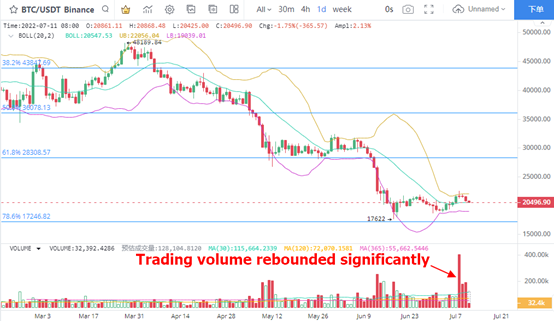
BTC's daily line operated in large volume for 3 trading days, and the cumulative trading volume rebounded significantly during the expansion of the decline. The trading volume in the recent three trading days has been running at a high level, and there is no sign that the contraction signal has continued. According to this judgment, bulls are continuously selling BTC, which makes the market have the possibility of a sharp decline.

Morphologically, the fluctuation space of BTC in the past month is relatively limited after it fell back from the rail position on the brin line. Considering the further strengthening of price decline in the short term, the possibility of a new low closing price cannot be ruled out. In terms of support, 78.6% of Fibonacci's corresponding $17246 is still valid. On June 19, during the BTC pullback period, the minimum reached $17622. Next, we can continue to pay attention to the rebound opportunity above $17000.
2. Main loss escape signal

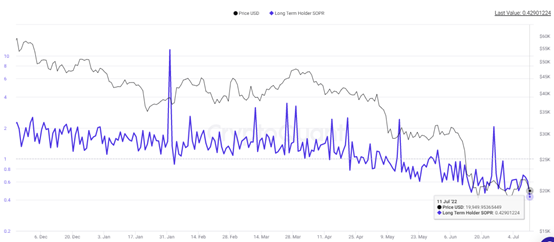
With the continuation of BTC adjustment trend, the trading trend of long-term investors deserves attention, especially the profit and loss performance of investors who have traded, indicating the main trading intention. The data shows that the SOPR proportion of long-term investors has been as low as 0.429 on July 11, the lowest performance in history. Judging from this, the average trading loss of long-term investors reached 57.1%. In other words, investors dumped BTC around $20000 to $21000 at the BTC point. After the completion of loss trading, it indicates that there is a large room for expected adjustment, and the possibility of falling below the recent low price of $17622 is enhanced.
3. The number of BTC coins destroyed per day rebounded

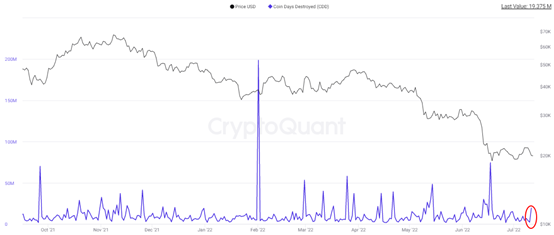
BTC is used to measure the trading trend of long-term investors. The rebound of this index means that long-term investors begin to adjust their positions, and BTC prices will also be affected. The number of BTC coins destroyed per day reached three times the recent average on July 11, indicating that long-term investors began to accelerate transactions, and the increase in transfers indicates that the selling pressure continues. At the point, BTC increased from 1170 to 1091 dollars on July 11
4. Eth continued to decline

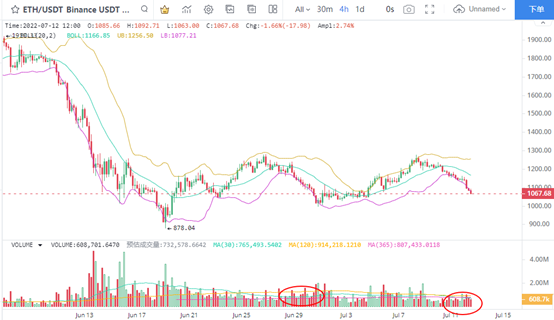
In the 4-hour K-line chart, the decline in eth prices has continued to expand, and has now reached below $1100. Compared with the price drop before and after June 29, this eth trading volume is smaller, and the unilateral downward trend shows an accelerated trend. Eth not only easily fell below the brin line, but also continued to expand its decline along the brin line. At present, the integer price support of $1000 is still valid, and we should pay attention to the further performance opportunities of eth at this point.

If the rebound around $1000 cannot be sustained, the recent trading volume is lower than the equivalent line, and the price has fallen below the previous expectations. In the early stage, ETH reached a minimum of $878. After a month of volatility, it basically digested the short-term long-term bottom hunting funds. Therefore, the signs of short-term eth seeking unilateral decline are strengthened.
5. Eth contract long short ratio pullback

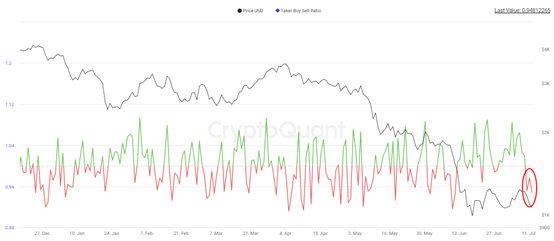
The long short ratio of eth has continued to fall significantly, falling to around 0.948 after falling below 0 in the short term, which means that bears have taken advantage. Since June 11, the contract long short ratio of eth has always maintained a strong position, with no less than 0 on most trading days. When the long short ratio of eth fell significantly below 0 for the first time, investors' bearish sentiment has increased. Eth recently traded sideways between $1000 and $1200. Next, once it falls below this range, its decline will soon expand.

Lectures associées

Les États-Unis autorisent pour la première fois les contrats perpétuels cryptographiques : qu'est-ce que cela signifie pour le marché ?

Le 29 mai, la CFTC américaine a publié une directive autorisant la négociation et la compensation 24h/24 et 7j/7 pour les produits dérivés liés aux actifs cryptographiques, ouvrant effectivement le marché américain jusque-là interdit aux contrats perpétuels cryptos. Cette décision historique permet aux plateformes et aux citoyens américains d'accéder à ce marché, qui représentait entre 60 et 90 billions de dollars de volume en 2025. Les principaux bénéficiaires immédiats sont Kalshi (dont le contrat perpétuel BTCPERP a été approuvé), Coinbase (devenue le premier FCM régulé par la CFTC pour offrir ces produits) et le CME (passant à une négociation 24/7 pour ses contrats Bitcoin). La directive de la CFTC est présentée comme une mesure spécifique aux actifs numériques, distinguant les cryptomonnaies des matières premières traditionnelles comme les produits agricoles. Les réactions de l'industrie sont majoritairement positives, saluant un accès élargi et une amélioration de l'efficacité du capital. Cependant, l'organisation de protection des consommateurs Better Markets critique vivement la décision, l'accusant de négliger la protection des investisseurs particuliers face aux risques complexes des contrats perpétuels et d'agir dans l'intérêt des entreprises qu'elle est censée réguler. D'autres acteurs comme Kraken ont annoncé leur intention de lancer des produits similaires sous peu, indiquant que le marché américain des dérivés cryptos est sur le point de connaître une phase de croissance significative.

marsbitIl y a 51 mins

Les États-Unis autorisent pour la première fois les contrats perpétuels cryptographiques : qu'est-ce que cela signifie pour le marché ?

marsbitIl y a 51 mins

Comment la loi CLARITY redéfinit l'économie de rendement des stablecoins

Le projet de loi CLARITY, adopté en commission sénatoriale le 14 mai 2026, redéfinit fondamentalement l'économie des rendements des stablecoins. Sa section 404 élargit l'interdiction de rémunération des détenteurs (instaurée par le GENIUS Act de 2025) à tous les prestataires de services d'actifs numériques (plateformes, custodians). Elle interdit les récompenses "passives" (équivalentes à des intérêts) mais autorise celles liées à une "activité réelle" (transactions, consommation, staking). Ce changement de paradigme, du "hold-to-earn" vers du "use-to-earn", pousse l'industrie à restructurer les modèles de distribution des rendements. Trois voies principales émergent : récompenses basées sur l'activité via les exchanges (A), rendements via les protocoles DeFi non-custodiaux (B), et le canal jugé le plus robuste : la rémunération via la couche des actifs de réserve (C). Anticipant cela, les grands gestionnaires d'actifs (Morgan Stanley, BlackRock, JPMorgan) ont lancé en avril-mai 2026 des fonds monétaires tokenisés (comme le BRSRV de BlackRock) conçus spécifiquement comme actifs de réserve pour les émetteurs de stablecoins. Ces produits deviennent l'infrastructure de base pour fournir un rendement conforme dans le nouveau paradigme. L'enjeu réglementaire final réside dans la proposition de l'OCC de limiter à 20% la part d'actifs tokenisés dans les réserves. La décision finale déterminera l'ampleur du succès de la voie (C). La victoire des fonds tokenisés, tout en consolidant leur rôle d'"autoroutes à péage" de l'économie crypto-dollar, soulève également des risques nouveaux de concentration systémique autour de fonds uniques comme le BUIDL.

marsbitIl y a 2 h

Comment la loi CLARITY redéfinit l'économie de rendement des stablecoins

marsbitIl y a 2 h

Kalshi et Coinbase approuvés par la CFTC : l'ère de la régulation la plus favorable pour l'industrie crypto ?

Le 29 mai, la CFTC américaine a approuvé deux initiatives majeures : le contrat perpétuel Bitcoin de Kalshi via la voie régulée DCM, et a émis une lettre de non-poursuite à Coinbase, permettant à sa filiale d’offrir des produits dérivés perpétuels aux clients américains via des contrats à l’étranger. Ces décisions, accompagnées d’une nouvelle déclaration de politique, marquent un tournant vers la conformité des produits perpétuels, auparavant dans un flou juridique. Le président de la CFTC, Mike Selig, a salué cette avancée comme une étape clé pour faire des États-Unis un centre mondial de la cryptographie, tout en soulignant que le cadre réglementaire actuel reste susceptible d’évolutions. Les contrats perpétuels dominent le marché mondial des dérivés cryptos, représentant environ 78% du volume. Cette approbation répond également à la concurrence croissante des plateformes décentralisées offshore comme Hyperliquid, qui ont déjà développé un vaste écosystème de produits synthétiques. Pour Kalshi, cela ouvre un nouveau champ dans les marchés de prédiction, tandis que Coinbase pourrait voir ses revenus augmenter. La décision pourrait attirer les investisseurs institutionnels et rapatrier une partie de l’activité offshore vers des canaux conformes, stimulant le développement d’autres produits comme les perpétuels sur Ethereum et renforçant la compétitivité des États-Unis dans la finance décentralisée.

marsbitIl y a 6 h

Kalshi et Coinbase approuvés par la CFTC : l'ère de la régulation la plus favorable pour l'industrie crypto ?

marsbitIl y a 6 h

Trading

Spot
Futures
活动图片




