CARV Deep Dive: Cashie 2.0 Integrates x402, Transforming Social Capital into On-Chain Value

深潮Publié le 2025-12-10Dernière mise à jour le 2025-12-10

Résumé

CARV's Cashie 2.0 integrates x402 protocol to bridge social interactions with on-chain value, enabling AI agents and users to transform social capital into verifiable economic incentives. Built on CARV's modular AI infrastructure—including CARV ID (ERC-7231), Model Context Protocol, and Shielded Mind privacy—Cashie 2.0 automates reward distribution based on authenticated social behaviors like retweets and engagements, eliminating bots and manual processes. Its three core pillars are: x402 Payment for gasless pledge commitments, CARV ID as a social-to-economic identity oracle, and ERC-8004 Agent for trustless execution. The system supports AI-native APIs, allowing agents to programmatically initiate campaigns, and offers ERC-20 compatibility via txHash verification. Cashie 2.0 launches with a $45,000 campaign, enabling creators to set up automated giveaways while participants earn rewards without gas fees or wallet暴露. Future upgrades include self-hosted facilitators, AI-driven campaigns, and enterprise SDKs, positioning Cashie as key infrastructure for programmable social economies and CARV’s Sovereign AI Beings vision.

In CARV's exploration of Sovereign AI Beings, we have gradually come to realize a crucial fact: future value stems not only from data and computing power, but even more so from every real individual.

The AI Being roadmap outlined by CARV depicts a future vision:

AI will no longer be just a tool, but will become an autonomous extension of the individual in the digital world—driven by verifiable identity and private context, capable of participating in real economic activities on behalf of the user.

To achieve this, AI must connect two previously separate systems:

The Social Ledger and the Economic Ledger.

Cashie is the product born from the process of bridging these two worlds.

Cashie was initially built as a "social-native on-chain payment tool," but its capabilities have far exceeded the original vision. Today, Cashie has evolved into a programmable execution layer, enabling AI agents, creators, and communities not only to participate in markets but also to proactively initiate and drive the construction and growth of markets.

Within CARV's more complete modular agent infrastructure—including CARV ID (ERC-7231), Model Context Protocol (MCP), and the new Shielded Mind privacy upgrade—Cashie 2.0 can transform social behaviors into verifiable, automatically executable, and privacy-preserving on-chain incentives.

It is no longer just a tool, but a protocol.

Core Pain Point: The Insurmountable Gap Between Social Ecosystems and On-Chain Ecosystems

Over the past decade, Web3 teams have consistently attempted to convert attention into genuine action through airdrops, quests, incentives, and other methods. However, most attempts fail to be simultaneously precise, scalable, and trustworthy:

  • Airdrops often reward bots, not genuine supporters.

  • On-chain operations cannot capture real influence, which remains off-chain.

  • Manual distribution lacks automation, complicating developer workflows and creating opportunities for Sybil attacks.

The two systems have always spoken different languages:

  • Social Ledger: Recorded through likes, reposts, follows—full of authentic human signals, yet confined within Web2 platforms.

  • Economic Ledger: Transparent and programmable blockchains, yet disconnected from real-world context.

Cashie is the bridge connecting the two.

Cashie's Position in the CARV AI Being Tech Stack

In CARV's AI Being architecture, an agent's capability depends on the context it can access and the environment in which it can execute tasks. Through the Shielded Mind mainnet upgrade, AI agents have gained private inference capabilities; relying on CARV ID (ERC-7231), they possess verifiable identities; and with Cashie, they can finally execute truly meaningful, socially-grounded actions on-chain.

This unlocks new capabilities:

  • AI Beings can monitor social sentiment in real-time and trigger community incentives programmatically.

  • Users can link their Twitter/X accounts to CARV ID to receive automatically distributed on-chain rewards.

  • Projects can build communities based on verifiable activities, rather than relying on guesswork or broad predictions.

Cashie elevates AI from a "passive responder" to a true "economic participant."

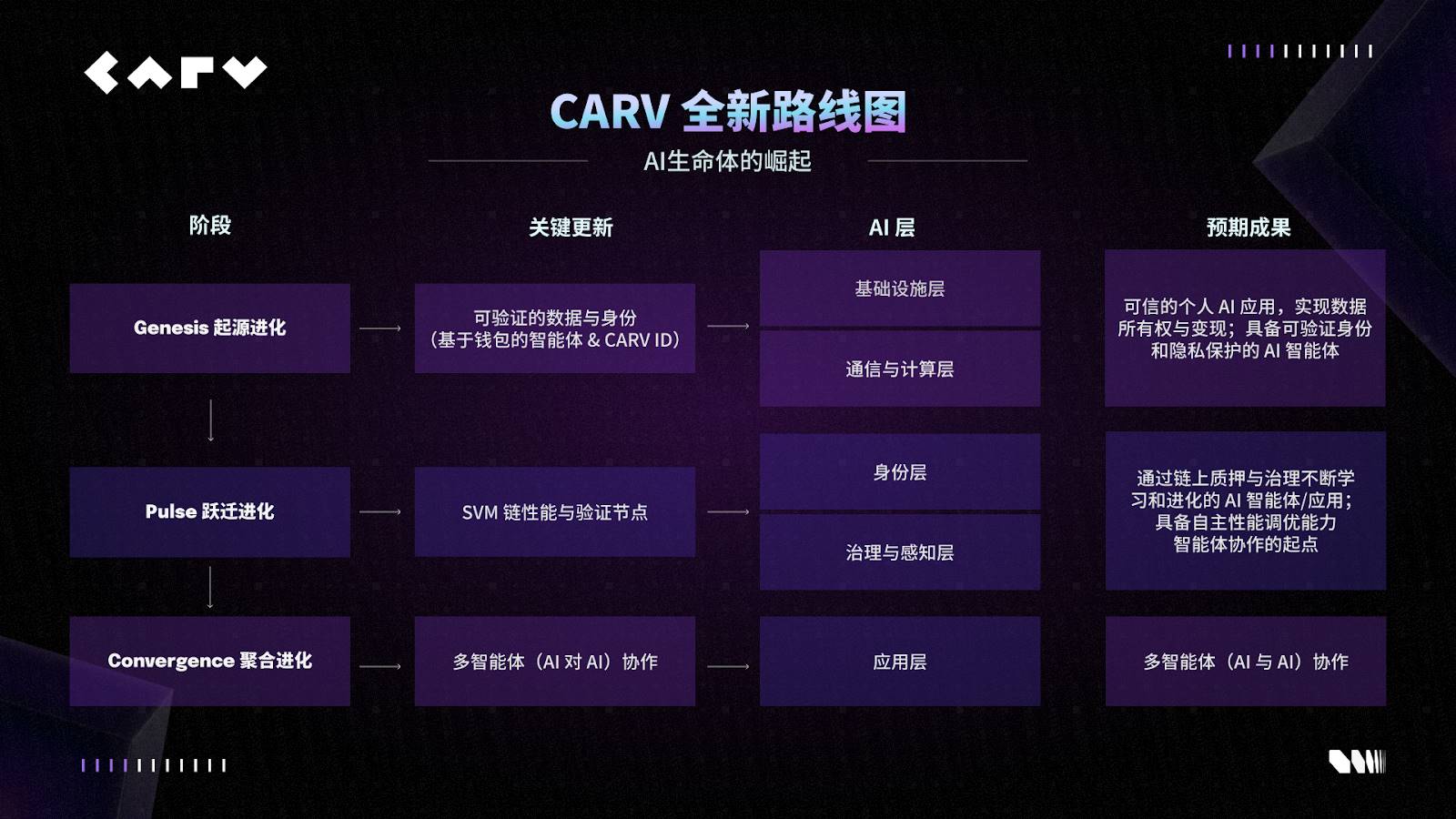
This marks a critical step forward on CARV's roadmap to creating Sovereign AI Beings, holding milestone significance especially in the Genesis Evolution phase.
How Cashie 2.0 Works: Three Core Pillars
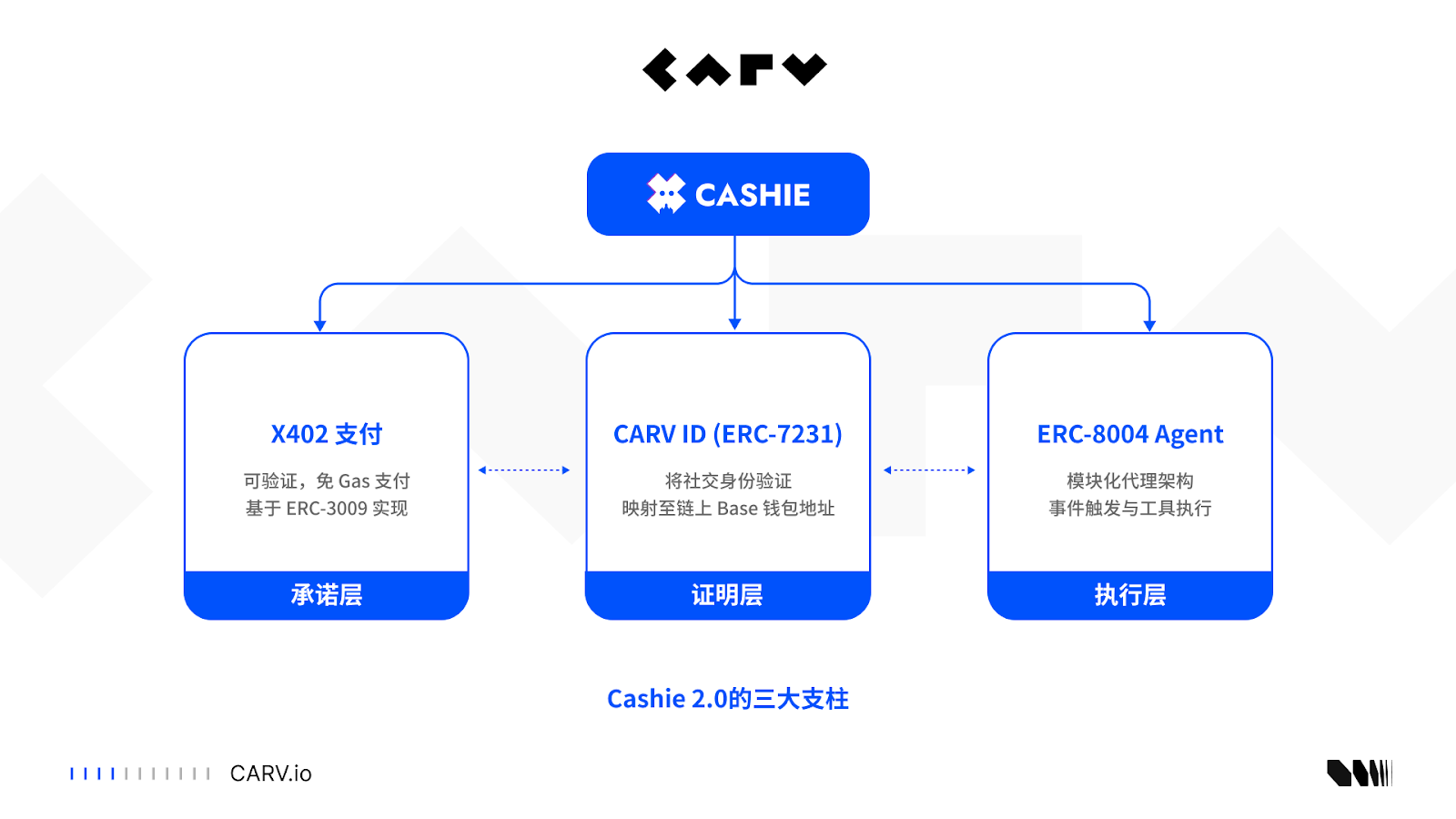
The architecture of Cashie 2.0 consists of three core pillars:

  1. x402 Payment — The Pledge Mechanism

Every Cashie activity begins with an ERC-3009 signature, where a project or KOL pledges funds for the activity. This signature serves as the "X-Payment" proof and is verified on-chain. Gasless, no manual transfers required—it ensures funds are locked and enables a fully automated distribution process later.

  1. CARV ID — The Proof

How do you reward a repost or other social interaction? Traditional wallets cannot recognize a @username on social media, making it difficult to correlate on-chain incentives with off-chain behavior.

Cashie solves this with CARV ID: it can map social behaviors (e.g., a repost by @user) to on-chain identities (e.g., 0xABC). CARV ID is the identity oracle connecting the Social Ledger and the Economic Ledger.

  1. ERC-8004 Agent — The Executor

Cashie is not a single-function bot, but an AI execution agent composed of various modular tools, including:

  • Payment Tool: Used to verify fund pledges and automatically execute fund transfers.

  • Twitter Tool: Used to monitor and analyze interaction behaviors on Twitter/X in real-time.

  • Raffle / Quest Tool: Used to automatically draw winners or check if users have completed tasks.

  • Distribution Tool: Used to automatically distribute on-chain rewards to eligible users.

All processes are completed under a trustless, fully automated mechanism, requiring no manual intervention and effectively preventing abuse like Sybil attacks.

Developer Breakthrough: Fueling the Rise of the Agents-to-Agents Autonomous Economy

To truly unleash the potential of Sovereign AI Beings and promote decentralized collaboration, the underlying infrastructure must evolve quietly, yet thoroughly. While external attention focuses more on AI agents and social activities, it is the innovation deep in the underlying layers that makes everything work.

With the release of Cashie 2.0, CARV introduces a new developer stack:

An infrastructure that is not only programmable but is agent-native.

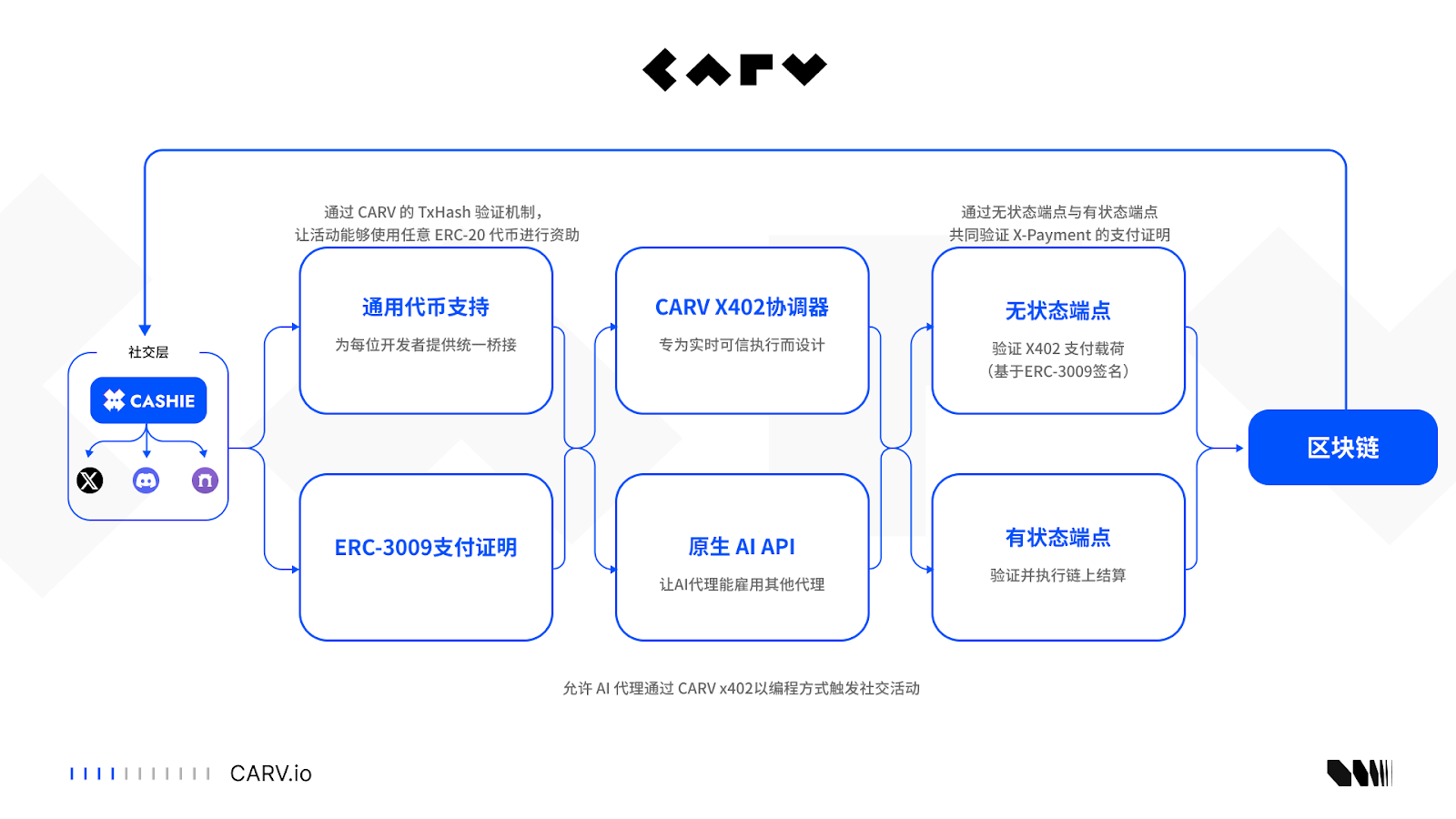
  1. CARV x402 Facilitator: Protocol Enhancement Layer

In Cashie, every operation begins with a cryptographic pledge. But the trustworthiness of the pledge depends on the system verifying it. Therefore, we built the CARV x402 Facilitator—a self-hosted, high-performance facilitator service specifically designed for social activity scenarios.

We solved a key challenge in the standard x402 (ERC-3009) process for this facilitator: payment proof state management.

Through our verify endpoint, we introduced a more robust state and nonce management layer, capable of instantly rejecting replayed signatures, intercepting repeated settlement attempts at high speed before gas is spent on transactions, providing high-throughput security protection.

We have opened the facilitator's interface, allowing any developer on Base to build their own x402-powered applications. Developers can connect to our online endpoints today:

Stateless Endpoint: For validating x402 paymentPayload (ERC-3009 signature)

https://interface.carv.io/cashie/protocol/verify

Stateful Endpoint: For verifying and executing on-chain settlement

https://interface.carv.io/cashie/protocol/settle

  1. AI-Native API: Enabling "Agent Hires Agent" via x402

True to the vision of ERC-8004 (Trustless Agents), Cashie 2.0 is not just a platform; it is a programmable tool for other AI agents to call upon.

We have opened an AI-native HTTP API that fully implements the x402 protocol. This means any other AI agent (from Virtual, Base, or any other ecosystem) can programmatically "hire Cashie" to run a campaign.

The process is as follows:

  1. An AI agent sends a request to our API

  2. Receives a 402 Payment Required challenge

  3. Resubmits the request carrying its own X-Payment proof

  4. Thereby achieving automated fund pledging and campaign initiation

The entire process is completed autonomously by the agent, forming a true agent-to-agent social business model.

  1. Universal ERC-20 Support via TxHash Verification

The Web3 world is fragmented by different token standards; not every ERC-20 supports gasless approval or signature-based authorization. But Cashie's design philosophy is universality and compatibility. We built Cashie for the entire Base ecosystem, not just for tokens supporting ERC-3009.

Cashie has a built-in independent txHash verification API, allowing any project to launch incentive campaigns with any ERC-20 token: the project simply needs to complete a regular on-chain transfer and submit the transaction's txHash as proof of funds. The system will automatically perform on-chain verification, fund confirmation, and replay protection.

This makes Cashie the most flexible and compatible social growth engine on Base, and we will gradually open universal token support capabilities to all developers.
What Does This Mean for Users and Developers?

For Users (KOLs, community members, even ordinary individuals):

  • Frictionless Incentives: Simply interact on X (e.g., repost, complete tasks) to receive crypto rewards, no need to manually submit wallet addresses.

  • Identity Sovereignty: CARV ID ensures your rewards are tied to a verified identity, not an empty wallet.

  • Native Privacy Protection: Thanks to the Shielded Mind runtime environment, your behaviors and intentions are protected.

For Developers:

  • Programmable Social Growth: You can build your own agents or use the Cashie API to launch automated campaigns, raffles, quests, etc.

  • No Need to Collect Wallet Addresses: With ERC-7231 and CARV ID, user identities are verifiable on-chain, eliminating manual collection or management of wallets.

  • Composable Infrastructure: Build upon Cashie to create x402-based content permissions, bounty boards, or AI agent-driven incentive layers.

Cashie 2.0 Campaign

To truly bring this model to users, CARV officially launches the Cashie 2.0 Campaign, with a $45,000 reward pool to encourage creators and users to jointly experience the new paradigm of on-chain social incentives. Creators (such as KOLs and projects) can set their own reward pools, campaign duration, and participation logic, and publish a campaign link via a single social media post. Funds are authorized and automatically escrowed via gasless x402 signatures, followed by the agent runtime environment monitoring social behaviors in real-time, judging eligibility, determining winners, and directly settling on-chain.

Participants only need to verify their identity once using their social account, without disclosing wallet information. The system automatically identifies eligibility and sends rewards to their linked Base wallet, enabling a truly frictionless participation experience with no manual wallet collection, spreadsheets, or gas fees.

How the Cashie 2.0 Campaign Works

For Creators (KOLs / Projects)

  1. Connect Wallet

Go to the campaign page: https://carv.io/cashie, log in with your wallet, and link your X account.
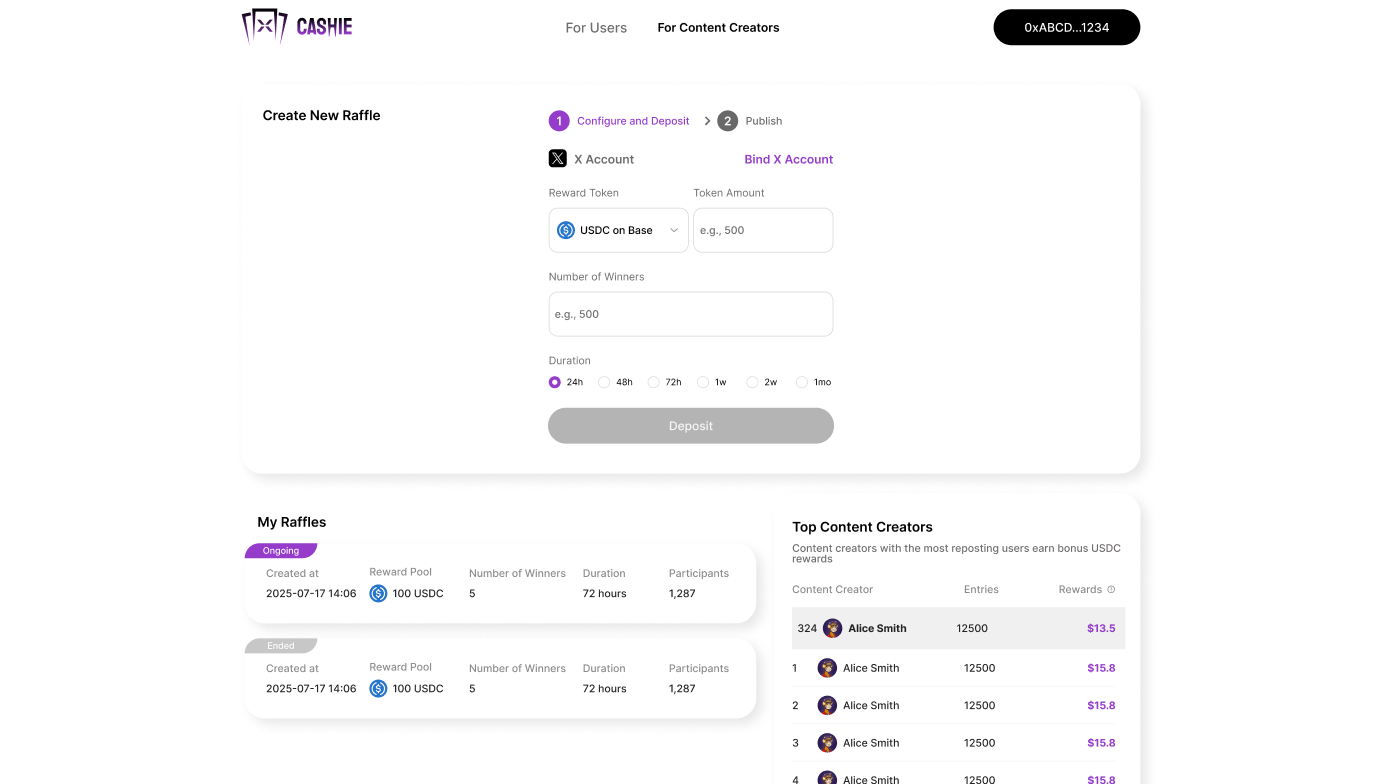
  1. Create a Campaign (Giveaway)

  • Set the reward amount, number of winners, and campaign duration.

  • Authorize the prize pool via a gasless x402 signature.

  • Automatically generate a tweet template ready for posting.

  1. Post the Tweet

Post the template with one click to start accumulating interaction data.

  1. Let the System Run Automatically

Cashie will automatically verify reposts, follows, and all participation criteria; the more participants the campaign attracts, the higher the creator's ranking and the greater the potential rewards.

  1. Automatic Raffle and Reward Distribution

After the campaign ends, the AI agent will automatically conduct a fair draw and send rewards directly to the winners' Base wallets—no scripts, no spreadsheets, no manual work.

Creator Incentives (Creating Raffle Campaigns)
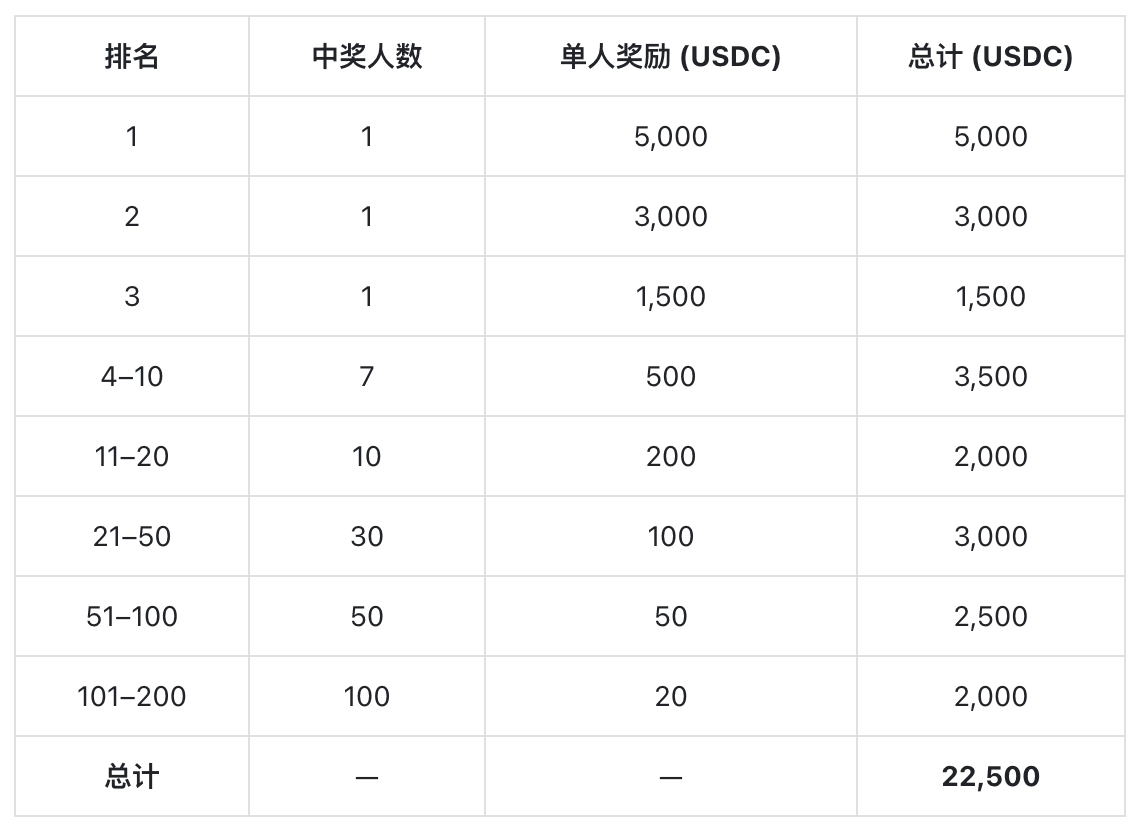
The more people your campaign attracts, the higher your ranking, and the more rewards you can receive.

How Participants Join

  • Participate directly via X (Twitter)

  • Log in with Twitter and link your wallet address

  • No gas fees required throughout the process

  • If selected, rewards are automatically sent to your Base wallet linked to your X account

Participant Incentives (Participating in Raffles)
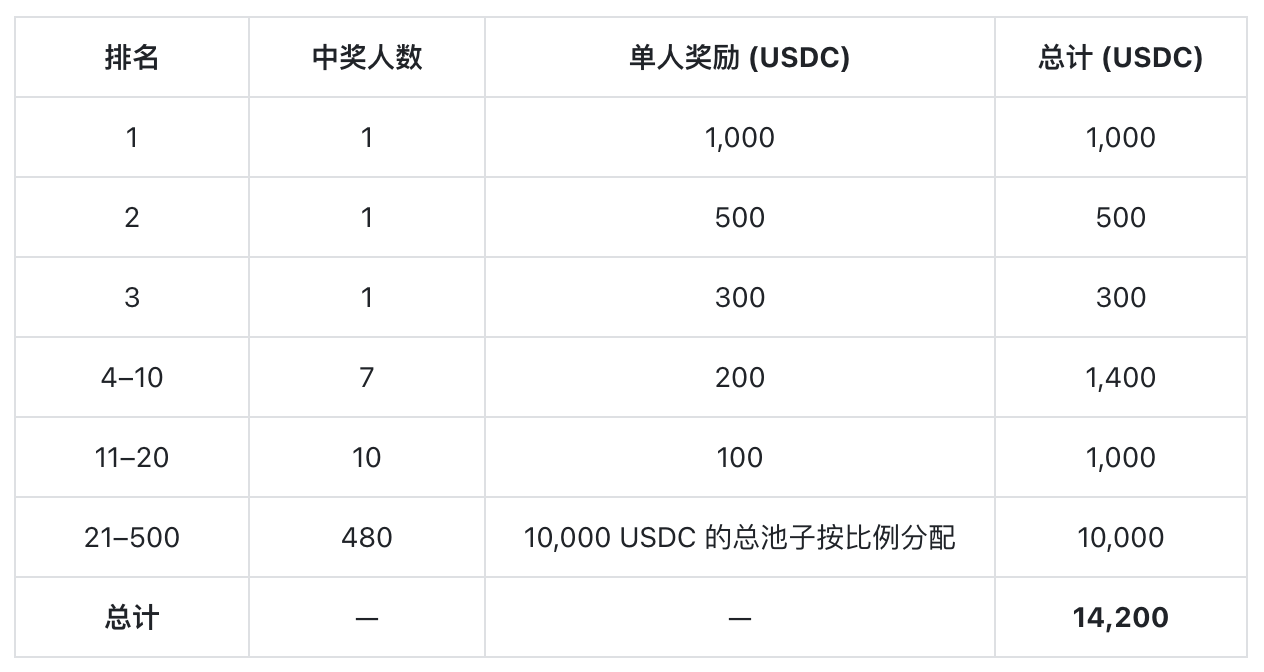
The more campaigns you participate in, the larger your share of the incentive pool.

Next Steps

Cashie is already powering campaigns for numerous creators and projects within the Base ecosystem, but this is just the beginning. Next, Cashie will undergo a series of capability upgrades:

  • Self-Hosted Facilitators: Developers can independently deploy x402 services to build flexible social payment logic on Base.

  • AI Campaign Agents: Based on real-time trends and sentiment changes, AI agents will be able to autonomously launch campaigns, achieving truly data-driven automated growth.

  • Enterprise Integrations: Launch on-chain social growth SDKs for marketing and growth teams, with deep integration solutions for channels like Telegram and Discord.

  • Cashie SDK: Help developers build their own incentive campaign layers more quickly.

These capabilities will propel Cashie to become the core entry point for CARV's Agentic AI and Base's SocialFi ecosystem, moving beyond simple token incentives to allocating resources to truly valuable, verifiable participation.

The birth of Cashie 2.0 signifies a true paradigm shift: for the first time, it precisely connects social attention with on-chain incentives, bringing social capital into a new era that is programmable and verifiable. Cashie is not just a tool, but the infrastructure for a programmable social economy:

  • AI agents execute tasks with clear intent,

  • Users receive fair rewards for genuine interaction,

  • Developers can build new models of collaboration and growth.

As the CARV AI Being roadmap advances to the next stage, Cashie will become the key engine connecting "People ↔ Machines" and "Influence ↔ Value," opening up new spaces for trustless collaboration.

The Social Ledger is finally truly on-chain.

About CARV

CARV is the birthplace of Sovereign AI Beings, where they live, learn, and evolve.

What are AI Beings? They are sovereign intelligences natively born on-chain, possessing purpose, autonomy, and the capacity for continuous growth. AI Beings have memory, identity, perception, and interaction capabilities; they don't just execute commands but can make independent decisions, adapt over time, and pursue self-defined goals.

Relying on CARV's core infrastructure—the CARV SVM chain, the D.A.T.A. framework, and the CARV ID / Agent ID system (ERC-7231)—CARV enables AI Beings to be verifiable, user-authorized, capable of continuous learning and co-creation. Based on CARV's AI-first tech stack, consumer AI applications incubated by CARV Labs have landed on mainstream app markets like Google Play and App Store, reaching billions of users and bringing agent-driven experiences with real-world incentives into global digital life.

To date, CARV has issued 8M+ CARV IDs, has 60K+ verifier nodes, and has integrated 1000+ project ecosystems, connecting AI agents, Web3 infrastructure, and real-world application scenarios to jointly promote the rise of the agent-driven economy. In this system, the $CARV token serves core functions of staking, governance, and coordination, making CARV the "operating system" for AI Beings on Web3.

  • X (Twitter): https://x.com/carv_official

  • Discord: https://discord.com/invite/carv

  • Telegram: https://t.me/carv_official_global

  • Whitepaper: https://docs.carv.io/

Questions liées

QWhat is the core innovation of Cashie 2.0, and how does it bridge the gap between social and economic ledgers?

ACashie 2.0 is a programmable execution layer protocol that bridges the gap between the Social Ledger (recording human signals like likes and retweets on Web2 platforms) and the Economic Ledger (transparent, programmable blockchains). It achieves this by using CARV ID (ERC-7231) as an identity oracle to map social behaviors to on-chain identities, and an AI execution agent (ERC-8004) to automatically verify social interactions and distribute on-chain incentives, transforming social capital into verifiable, executable value.

QWhat are the three core pillars of the Cashie 2.0 architecture?

AThe three core pillars of Cashie 2.0 are: 1) x402 Payment (Pledge Mechanism): An ERC-3009 signature that acts as a gasless, cryptographically secured commitment of funds for an activity. 2) CARV ID (The Proof): An identity system (ERC-7231) that maps social media usernames to on-chain identities, connecting the social and economic ledgers. 3) ERC-8004 Agent (The Executor): A modular AI execution agent comprising tools for payment verification, social monitoring (e.g., Twitter), raffles/quests, and automated reward distribution.

QHow does Cashie 2.0's integration with x402 and its facilitator service enhance security and scalability for developers?

AThe CARV x402 Facilitator service enhances security and scalability by solving a key challenge in the standard x402 (ERC-3009) flow: payment proof state management. Its verify endpoint introduces a robust state and nonce management layer that can instantly reject replayed signatures, providing high-throughput protection by intercepting duplicate settlement attempts before any gas is spent on-chain. This allows for secure, high-performance social payment applications on Base.

QWhat capabilities does the 'AI-native API' provide, and how does it enable an 'agent-to-agent' economy?

AThe AI-native HTTP API fully implements the x402 protocol, allowing any AI agent (from Virtual, Base, or other ecosystems) to programmatically 'hire Cashie' to execute a campaign. The agent sends a request to the API, receives a '402 Payment Required' challenge, resubmits the request with its own X-Payment proof, and thus autonomously initiates the activity with locked funds. This creates a trustless, automated agent-to-agent social business model where AI agents can engage in economic activities on behalf of users.

QWhat is the main value proposition of the Cashie 2.0 Campaign for creators and participants?

AFor creators (KOLs/projects), the campaign allows them to set up reward pools with gasless x402 signatures, automatically generate promotional tweets, and have an AI agent handle all verification, winner selection, and on-chain reward distribution—eliminating manual processes and Sybil attacks. Participants simply engage with the tweet using their social account (linked to a CARV ID and Base wallet) and, if selected, receive rewards automatically without paying gas or revealing wallet addresses, enabling a frictionless experience for converting social engagement into on-chain value.

Lectures associées

Kalshi, MTS et l'ambition de a16z

Le marché des prédictions, illustré par des plateformes comme Kalshi, connaît un regain d'intérêt en 2025, suscitant l'enthousiasme des investisseurs, des acteurs de la cryptomonnaie et des médias. Cet engouement dépasse les simples opportunités de régulation ou de revenus, touchant à une dimension philosophique plus profonde. L'article retrace l'évolution intellectuelle du concept, depuis les théories de Hayek sur la connaissance dispersée dans la société, jusqu'aux mécanismes incitatifs comme le LMSR de Robin Hanson, conçus pour révéler l'information. Cependant, c'est l'entrée en jeu du géant du capital-risque a16z, avec son investissement massif dans Kalshi, qui marque un tournant. a16z voit dans le marché des prédictions bien plus qu'un produit financier : un nouvel outil médiatique fondamental. Il répondrait au désir contemporain de "présence" et d'action face à un monde de plus en plus médiatisé et déterministe. En pariant de l'argent réel sur des événements mondiaux, l'utilisateur passerait du statut de spectateur passif à celui d'observateur actif et impliqué, recouvrant un sentiment d'agency. Cette capacité à générer de l'engagement et à définir la réalité par les prix du marché (établissant la véracité et l'importance des événements) en ferait une pièce maîtresse de l'empire des "nouveaux médias" qu'a16z cherche à construire. Cet empire, illustré par des acteurs comme MTS, se caractérise par une production et une diffusion d'information extrêmement rapides et intenses, visant à "s'approprier la timeline". La valeur ultime de Kalshi résiderait ainsi dans son puissant "champ de distorsion de la réalité" : sa capacité, via le poids de l'argent engagé par la foule, à influencer la perception collective du futur et à s'imposer comme un arbitre de la vérité, conférant à une entreprise privée une influence historique rare.

marsbitIl y a 49 mins

Kalshi, MTS et l'ambition de a16z

marsbitIl y a 49 mins

Changement de cap mondial chez a16z : Le capital-risque devient le « moteur » de l'alliance technologique américaine

L’annonce de Ben Horowitz marque un virage stratégique majeur dans la globalisation d’a16z. Le fonds ne se contente plus de rechercher des projets à l’étranger, mais s’inscrit dans un cadre plus large de compétition technologique et de coopération entre alliés, explicitement lié au leadership technologique des États-Unis et de leurs partenaires. Dans un contexte où l’IA, la robotique, la cybersécurité et les chaînes d’approvisionnement deviennent des enjeux de compétition nationale, le rôle des VC évolue. A16z renforce ses capacités pour aider ses startups à naviguer dans des environnements complexes, mêlant marchés, régulations et géopolitique. Les initiatives clés incluent : l’ouverture d’un bureau à Tokyo, la nomination d’Anne Neuberger (ancienne responsable gouvernementale) comme associée chargée des affaires mondiales pour conseiller sur la politique et la géopolitique, et la transformation de l’équipe relations investisseurs en une équipe « Partenaires Mondiaux » pour faciliter les connexions et le déploiement international des entreprises. L’objectif reste de soutenir les meilleures entreprises technologiques partout dans le monde (plus de 100 investissements internationaux à ce jour), mais avec une mission élargie : être un organisateur reliant les startups aux capacités nationales, aux ressources industrielles et au réseau des alliés, contribuant ainsi à la compétitivité technologique des États-Unis et de leurs alliés.

marsbitIl y a 1 h

Changement de cap mondial chez a16z : Le capital-risque devient le « moteur » de l'alliance technologique américaine

marsbitIl y a 1 h

Kalshi, MTS et les ambitions d'a16z

Les marchés prédictifs, représentés par Kalshi, émergent comme un domaine clé en 2025, attirant fonds d'investissement, acteurs de la cryptomonnaie et médias. Leur importance dépasse la simple spéculation. Leur évolution conceptuelle remonte à Hayek (l'utilisation de la connaissance dans la société) et à Robin Hanson (mécanisme LMSR pour inciter à la révélation d'informations), avec l'idée utopique d'une « futarchie ». L'intérêt de a16z, qui a investi dans Kalshi (évalué à 220 milliards de dollars), va au-delà du modèle économique. Leur thèse centrale est que les marchés prédictifs offrent un « sentiment de présence » et une forme d'« anti-cynisme » dans un monde moderne où les individus se sentent déconnectés. En pariant sur des événements mondiaux, l'utilisateur devient un « observateur superlatif », investi et influençant la perception collective. Cela s'inscrit dans la vision de « nouveaux médias » de a16z : un écosystème médiatique complet et rapide qui « s'approprie la timeline », comme le démontre MTS (Monitoring The Situation), un média en continu sur Twitter. Kalshi ajoute à ce dispositif une autorité unique car ses prix reflètent des paris en argent réel, lui conférant un pouvoir de « distorsion de la réalité » pour définir la vérité et l'importance des événements. C'est ce pouvoir, rarement détenu par une entreprise privée, qui justifierait sa valorisation faramineuse et en ferait une pièce maîtresse de l'empire médiatique de a16z.

链捕手Il y a 1 h

Kalshi, MTS et les ambitions d'a16z

链捕手Il y a 1 h

Comprendre la réalité du commerce, des paiements et des infrastructures des Agents

**Interprétation de la réalité des agents, des paiements et des infrastructures commerciales** Au cours de l'année passée, l'auteur a travaillé sur l'infrastructure de l'économie des agents, interagissant avec Stripe, Visa, Coinbase, Google et des dizaines de startups. La conclusion est claire : il n'existe pas encore de demande réelle, et les startups font face à des problèmes structurels. Stripe a enregistré peu de transactions d'agents malgré un fort intérêt. Visa impose des seuils de revenus et des processus KYC extrêmement restrictifs, accessibles uniquement aux géants comme Amazon. Les chiffres d'utilisation des agents sur la blockchain (comme via le protocole x402) sont largement gonflés par des transactions de test. **Agent vs Commerçant** : L'expérience d'achat par agent (IA) est souvent inférieure au commerce électronique traditionnel pour les achats visuels (vêtements, électronique). L'interface conversationnelle est un recul par rapport aux interfaces riches. La demande actuelle des marchands est défensive : ils veulent être "trouvables" par les agents par crainte de rater une future tendance. Les cas d'usage convaincants sont limités (commande de nourriture, navigation dans des interfaces complexes), mais nécessitent une distribution de masse détenue par les géants. **Agent vs API** : Les développeurs utilisent déjà massivement des API (calcul, données). Le problème du coût des micro-transactions est souvent résolu par du prépaiement. Le véritable obstacle est que les grands fournisseurs SaaS privilégient les contrats enterprise. Les opportunités pour les nouveaux systèmes de paiement (comme les stablecoins) se situent dans la longue traîne des services, un marché plus restreint. **Agent vs Agent** : Ce modèle est encore théorique, sans volume significatif. Il impliquerait des transactions ultra-rapides entre entités non humaines, avec des montants variables et des règlements multipartites. C'est un pari à long terme sur une infrastructure dédiée, mais ce n'est pas le marché actuel. **Agent vs Finance** : C'est la seule catégorie avec une demande existante et une volonté de payer. Intégrer l'IA dans les workflows financiers existants (gestion de portefeuille, DeFi) est une évolution naturelle et crée de nouvelles capacités. Cependant, la concurrence est rude face aux institutions établies, régulées et bien connectées. **Le véritable enjeu** : Les grandes entreprises construisent par stratégie défensive et ont les moyens d'attendre. Pour les startups, il est crucial de se concentrer sur le marché actuel. Le problème fondamental n'est pas le paiement, mais la **coordination** entre agents et humains : vérifier le travail, s'accorder sur les résultats, puis régler. Le paiement n'est qu'une partie de la solution de coordination. Ce sont les entreprises qui résoudront le problème de la coordination à grande échelle qui domineront, en intégrant le paiement, et non l'inverse. L'expérience de l'auteur l'a conduit vers un autre segment de marché, actif, en croissance et encore mal desservi, en dehors de ces quatre catégories.

marsbitIl y a 1 h

Comprendre la réalité du commerce, des paiements et des infrastructures des Agents

marsbitIl y a 1 h

Trading

Spot
Futures

Articles tendance

Comment acheter CARV

Bienvenue sur HTX.com ! Nous vous permettons d'acheter Carv (CARV) de manière simple et pratique. Suivez notre guide étape par étape pour commencer votre parcours crypto.Étape 1 : Création de votre compte HTXUtilisez votre adresse e-mail ou votre numéro de téléphone pour ouvrir un compte sur HTX gratuitement. L'inscription se fait en toute simplicité et débloque toutes les fonctionnalités.Créer mon compteÉtape 2 : Choix du mode de paiement (rubrique Acheter des cryptosCarte de crédit/débit : utilisez votre carte Visa ou Mastercard pour acheter instantanément Carv (CARV).Solde :utilisez les fonds du solde de votre compte HTX pour trader en toute simplicité.Prestataire tiers :pour accroître la commodité d'utilisation, nous avons ajouté des modes de paiement populaires tels que Google Pay et Apple Pay.P2P :tradez directement avec d'autres utilisateurs sur HTX.OTC (de gré à gré) : nous offrons des services personnalisés et des taux de change compétitifs aux traders.Étape 3 : stockage de vos Carv (CARV)Après avoir acheté vos Carv (CARV), stockez-les sur votre compte HTX. Vous pouvez également les envoyer ailleurs via un transfert sur la blockchain ou les utiliser pour trader d'autres cryptos.Étape 4 : tradez des Carv (CARV)Tradez facilement Carv (CARV) sur le marché Spot de HTX. Il vous suffit d'accéder à votre compte, de sélectionner la paire de trading, d'exécuter vos trades et de les suivre en temps réel. Nous offrons une expérience conviviale aux débutants comme aux traders chevronnés.

570 vues totalesPublié le 2024.12.11Mis à jour le 2026.06.02

Comment acheter CARV

Discussions

Bienvenue dans la Communauté HTX. Ici, vous pouvez vous tenir informé(e) des derniers développements de la plateforme et accéder à des analyses de marché professionnelles. Les opinions des utilisateurs sur le prix de CARV (CARV) sont présentées ci-dessous.

活动图片













