Is Zcash Quantum-Resistant Yet? Experts Weigh In

bitcoinistPublié le 2025-10-31Dernière mise à jour le 2025-11-01

Résumé

A debate on X this week exposed a core question for on-chain privacy: when quantum computers are able to break...

Trusted Editorial content, reviewed by leading industry experts and seasoned editors. Ad Disclosure

A debate on X this week exposed a core question for on-chain privacy: when quantum computers are able to break elliptic-curve cryptography (ECC), will they be able to retroactively deanonymize every transaction ever made of privacy coins like Zcash?

Nic Carter, co-founder of Coin Metrics and partner at Castle Island Ventures, argued that the answer is effectively yes for most privacy coins. “For privacy coins, even if they migrate to post-quantum cryptographic schemes, all historical transactions prior to that migration can be decrypted,” he said on October 30, 2025. “So all historical txns will be stripped of privacy in >~5y. Everything is built on ECC.”

Carter’s point is based on “harvest now, decrypt later.” Attackers don’t need to break you today. They just copy the data now and crack it once quantum is strong enough. On blockchains, that problem is worse because the data is already public and permanent. “Blockchains are uniquely bad for quantum because normally the quantum thing is ‘harvest now decrypt later’ so adversaries have to be preemptively harvesting traffic but blockchains just.. publish.. everything.. forever.”

He warned specifically that even if a privacy coin upgrades to quantum-resistant signatures in the future, old activity is still exposed once ECC falls. “While privacy coins can adopt post quantum sigs, understand that all previously hidden addresses, relationships between addresses, etc, will be revealed once ECC is broken,” Carter said. “And obviously everything is on chain so you don’t even need to harvest traffic today.”

Is Zcash Already Quantum-Resistant?

That claim triggered pushback from Zcash supporters, who argue Zcash is structurally different from something like Monero.

Mert Mumtaz (Helius) agreed that Carter’s warning applies to “many privacy coins like Monero,” but said it’s “not necessarily true for zcash’s privacy, given advanced opsec.” He acknowledged that “advanced opsec is not the norm,” but said that if it is followed, Zcash users “get you certain guarantees w.r.t information leakage.” He also said “some things are in the works to make this even stronger,” pointing to research by Zcash engineer Sean Bowe.

Bowe’s position is that Zcash’s fully shielded pool simply does not put critical sender/receiver information on the ledger in the first place. “There is no quantum computer or powerful AI that will be able to look back at the Zcash blockchain 1000 years from now and figure out who made every fully shielded transaction,” Bowe said in July this year. “That information, among other things, never even touches the ledger. It’s already gone.” His condition is clear: “To be certain about your privacy you must start by using shielded Zcash. You almost cannot even begin otherwise.”

Carter partially credits that. “Zec is definitely ahead of anyone when it comes to quantum preparedness, not denying that,” he said. But he called the “already quantum-proof” framing unrealistic in practice.

He argued that Zcash’s long-term privacy story depends on very strong assumptions that often break in the real world: “assumes pubkey never being known. assumes: no metadata collection, no exchange key leaks, perfect metadata privacy.”

He added that Zcash’s shielded pools — Sprout, Sapling, Orchard — still “rely on ECC for key exchange, viewkeys, proof verification, which are all broken” under a powerful quantum adversary. His conclusion: “unrealistic to say zec privacy is perfectly q resistant. linkages between addrs are forever encoded on the blockchain, you and Sean know that. store now decrypt later still applies.”

In other words: Zcash builders say that if you stay fully shielded, the chain itself won’t hand quantum attackers a clean map of who paid whom. Carter says that in the real world, users leak, exchanges leak, metadata leaks — and once ECC breaks, those leaks plus the permanent ledger are enough to unwind the privacy anyway.

One final note: when asked directly, Carter denied holding ZEC. “Nope.”

At press time, ZEC traded at $366.
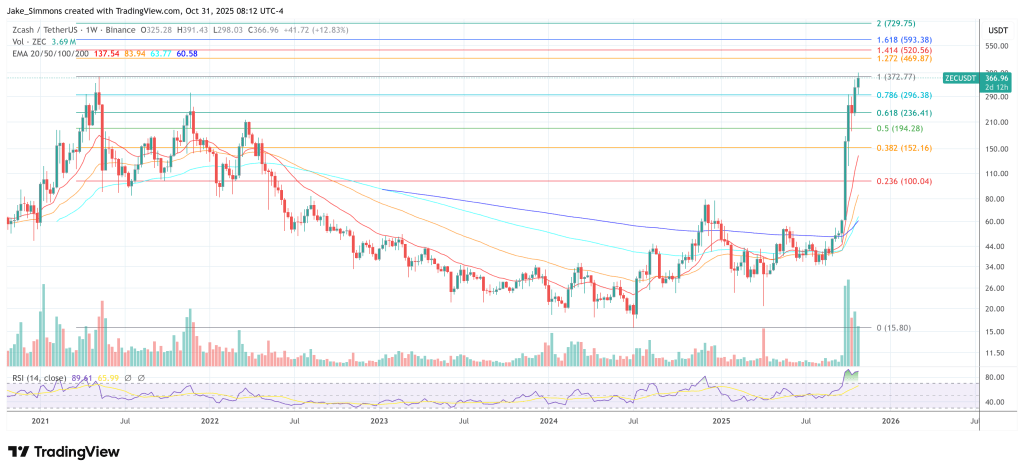
Zcash price
ZEC tries to break the 2021 high, 1-week chart | Source: ZECUSDT on TradingView.com
Featured image created with DALL.E, chart from TradingView.com
Editorial Process for bitcoinist is centered on delivering thoroughly researched, accurate, and unbiased content. We uphold strict sourcing standards, and each page undergoes diligent review by our team of top technology experts and seasoned editors. This process ensures the integrity, relevance, and value of our content for our readers.

Jake Simmons has been a Bitcoin enthusiast since 2016. Ever since he heard about Bitcoin, he has been studying the topic every day and trying to share his knowledge with others. His goal is to contribute to Bitcoin's financial revolution, which will replace the fiat money system. Besides BTC and crypto, Jake studied Business Informatics at a university. After graduation in 2017, he has been working in the blockchain and crypto sector. You can follow Jake on Twitter at @realJakeSimmons.

Lectures associées

Les baleines du Bitcoin ont cessé de vendre et accumulé plus de 2,7 milliards de dollars en 60 jours

Les baleines du Bitcoin (gros détenteurs) ont mis fin à leur phase de vente et sont revenues sur le marché en tant qu'acheteurs nets au cours des 60 derniers jours, accumulant environ 43 000 BTC pour une valeur d'environ 27,5 milliards de dollars. Cette accumulation a commencé lorsque le prix du Bitcoin s'est stabilisé autour de 60 000 dollars, marquant un changement de comportement après plusieurs mois de ventes soutenues. Les données montrent que cette tendance à l'achat est large, touchant à la fois les détenteurs moyens (100 à 1000 BTC) et les très gros détenteurs (plus de 10 000 BTC). Cette reprise des achats à travers toutes les catégories de détenteurs depuis fin juillet est interprétée par certains comme un signal potentiel de stabilisation du marché, d'autant plus qu'elle se produit dans un contexte de faiblesse des prix et de sentiment négatif. Cependant, le marché reste confronté à des vents contraires macroéconomiques. Les FNB thématiques crypto connaissent des sorties de fonds continues, les investisseurs particuliers se sont retirés et l'activité de trading est au plus bas. De plus, des acheteurs institutionnels traditionnels comme MicroStrategy sont désormais vendeurs nets. Si l'accumulation par les baleines est un signe structurel positif, les analystes restent prudents. Ils soulignent que pour qu'une reprise durable et généralisée du marché s'engage, une amélioration du contexte macroéconomique est nécessaire. Ainsi, bien que les gros investisseurs semblent préparer le terrain, le véritable renversement de tendance reste à confirmer.

华尔街日报Il y a 49 mins

Les baleines du Bitcoin ont cessé de vendre et accumulé plus de 2,7 milliards de dollars en 60 jours

华尔街日报Il y a 49 mins

Le cours du BTC atteint 65 000 dollars : un « short-squeeze » de 56 millions de dollars punit les traders qui misaient sur la baisse

Le cours du Bitcoin a brièvement atteint 65 000 dollars mardi, malgré une escalade des tensions géopolitiques au Moyen-Orient. Après avoir maintenu un niveau supérieur à 64 000 dollars, la cryptomonnaie a connu une volatilité avant de bondir d'environ 1 000 dollars en une heure pour toucher les 65 000 dollars. Elle a clôturé la journée avec une hausse de 0,5%. Ce mouvement a été particulièrement dévastateur pour les vendeurs à découvert (shorts) sur le marché des dérivés, entraînant la liquidation de positions courtes pour 56 millions de dollars, contre seulement 4 millions de dollars pour les positions longues. Alors que certains analystes mettent en garde contre une forte concentration d'ordres de vente autour des 65 000 dollars, signalant une résistance, d'autres observateurs comme Anthony Scaramucci voient des signes positifs. Il note que la baisse actuelle du Bitcoin est moins sévère (environ 55%) que lors des cycles baissiers précédents (75-80%), suggérant une accumulation par des investisseurs à long terme en prévision de la prochaine phase haussière. La plateforme d'analyse Glassnode abonde dans ce sens, indiquant que des investisseurs convaincus ("strong hands") achètent activement des bitcoins, un schéma similaire à celui observé en 2022. La capitalisation boursière du Bitcoin approchait quant à elle 1 300 milliards de dollars.

cryptonews.ruIl y a 53 mins

Le cours du BTC atteint 65 000 dollars : un « short-squeeze » de 56 millions de dollars punit les traders qui misaient sur la baisse

cryptonews.ruIl y a 53 mins

Trading

Spot
活动图片