PayPal Expands PYUSD Stablecoin To 9 More Blockchains With LayerZero

bitcoinistPublié le 2025-09-20Dernière mise à jour le 2025-09-20

Résumé

PayPal's stablecoin PYUSD is now available on nine more blockchains, thanks to integration with LayerZero's interoperability protocol. PayPal's Stablecoin Now...

Trusted Editorial content, reviewed by leading industry experts and seasoned editors. Ad Disclosure

PayPal’s stablecoin PYUSD is now available on nine more blockchains, thanks to integration with LayerZero’s interoperability protocol.

PayPal’s Stablecoin Now On Tron, Avalanche, & Seven Other Networks

As announced by LayerZero in a blog post, PayPal USD (PYUSD) is getting a major expansion through integration with its Stargate Hydra system, allowing users to move the stablecoin to blockchains on which it is natively unavailable. This is made possible with PYUSD0, a new permissionless token that’s fully fungible with the original PYUSD.

Currently, PayPal’s stablecoin is natively issued by Paxos on Abritrum, Solana, Ethereum, and Stellar. With PYUSD0, it will now also be transferable to Abstract, Aptos, Avalanche, Ink, Sei, Stable, and Tron. According to LayerZero, more networks beyond these are also set to come.

Previously, PYUSD was already bridged to two other networks, Berachain (BYUSD) and Flow (USDF), and both will now be receiving upgrades to PYUSD0. This makes a total of nine networks on which the new token will be accessible.

“As the stablecoin market continues its rapid growth beyond $270 billion, innovations like this are essential for creating the seamless, interoperable financial infrastructure that users and developers demand,” says David Weber, Head of Ecosystem, PayPal USD.

PayPal launched its stablecoin back in 2023, becoming one of the first payment processing giants to embrace fiat-tied tokens. Since then, the firm has been taking measures to increase the reach of its coin, most recently with the Stellar version launch on Thursday.

Now, with the LayerZero integration, the company has taken another step toward its goal. “By working together, we will enable PYUSD to reach new markets faster while maintaining compliance and composability from day one,” notes Weber.

The PYUSD0 system is built on three pieces of infrastructure: PayPal’s stablecoin itself, Stargate Hydra, and LayerZero. Stargate, which was acquired by LayerZero last month, acts as the transfer interface, while LayerZero handles minting, burning, and deployment of PYUSD0 to the new blockchains.

“With PYUSD0, PayPal USD expands its reach and flexibility to work across today’s networks and tomorrow’s,” says Bryan Pellegrino, Co-Founder and CEO at LayerZero Labs. “Launches like this make it obvious that we are at the start of a global financial market that breaks down borders and works around the clock.”

Besides its stablecoin, PayPal has also been making developments in its cryptocurrency payments ecosystem lately. In late July, the payments processor firm unveiled a “Pay with Crypto” service to help merchants receive digital asset payments, and earlier this week, it also announced cryptocurrency integration into its peer-to-peer (P2P) payments system.

Bitcoin Has Seen A Pullback During The Past Day

Bitcoin recovered to $117,900 on Thursday, but the asset has since gone down as its price is back at $116,400. The below chart shows how the coin’s recent trajectory has looked.

Bitcoin Price Chart

The price of the asset seems to have overall moved sideways over the last five days | Source: BTCUSDT on TradingView

The pullback in Bitcoin and other digital assets has induced $133 million in long liquidations over the last 24 hours, according to data from CoinGlass.
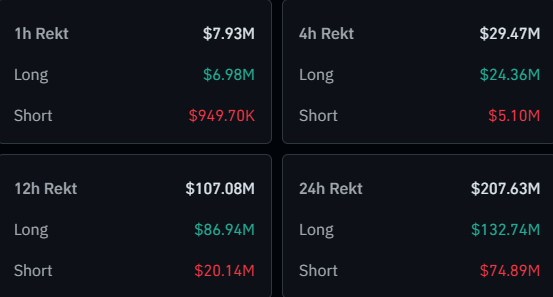
Bitcoin Liquidations

The data for the cryptocurrency liquidations during the past day | Source: CoinGlass
Featured image from Dall-E, CoinGlass.com, chart from TradingView.com
Editorial Process for bitcoinist is centered on delivering thoroughly researched, accurate, and unbiased content. We uphold strict sourcing standards, and each page undergoes diligent review by our team of top technology experts and seasoned editors. This process ensures the integrity, relevance, and value of our content for our readers.

Keshav is a Physics graduate who has been employed as a writer with Bitcoinist since June 2021. He is passionate about writing and through the years, he has gained experience working in a variety of niches. Keshav holds an active interest in the cryptocurrency market, with on-chain analysis being an area he particularly likes to research and write about.

Lectures associées

Vous serez surpris à quel point WeChat est différent de Telegram au niveau de l'architecture

L'audience mensuelle de WeChat et Weixin a atteint 1,428 milliard d'utilisateurs, confirmant son statut d'outil numérique central en Chine et au-delà. Cette analyse compare l'architecture de WeChat avec celle de Telegram, révélant des philosophies opposées en matière de stockage des données, de monétisation et d'ouverture aux développeurs. **Stockage des conversations :** Telegram utilise un stockage cloud illimité avec synchronisation sur tous les appareils. WeChat stocke les historiques localement sur l'appareil, nécessitant une fonction de migration spécifique pour les transférer et liant strictement la version desktop au téléphone. **Fonctionnalités sociales :** Dans Telegram, les commentaires sous les publications de chaînes sont intégrés. Dans WeChat, les commentaires sous les articles des comptes officiels sont modérés préalablement et ne disposent pas d'un système de discussion unifié. **Développement :** Telegram propose un Bot API ouvert et gratuit. L'écosystème des mini-programmes de WeChat est fermé, nécessitant souvent une vérification et une certification payante pour les développeurs. **Transfert de fichiers :** Telegram permet d'envoyer des fichiers jusqu'à 2 Go (4 Go pour Premium). WeChat limite généralement les envois à 200 Mo, proposant un "assistant de transfert" pour les volumes plus importants. **Paiements :** WeChat Pay est profondément intégré dans la vie économique chinoise, remplaçant souvent les applications bancaires. Telegram ne possède pas de système de paiement fiduciaire intégré comparable, s'appuyant sur des bots tiers et les cryptomonnaies. **Analyse de la sécurité (point de vue IA ajouté) :** L'article soulève indirectement la question de la sécurité. Telegram propose un chiffrement de bout en bout pour ses "chats secrets". WeChat, sans chiffrement de bout en bout standard, fusionne messages et paiements dans une même interface, ce qui pourrait élargir la surface d'attaque en cas de vulnérabilité, comme l'illustrent des cas de fraude signalés à Singapour. En conclusion, WeChat repose sur un modèle intégré et fermé, profondément ancré dans l'économie réelle, tandis que Telegram privilégie les protocoles ouverts, le stockage flexible et une faible barrière à l'entrée pour les développeurs. Ce choix architectural fondamental détermine leurs publics et leurs cas d'utilisation respectifs.

cryptonews.ruIl y a 3 h

Vous serez surpris à quel point WeChat est différent de Telegram au niveau de l'architecture

cryptonews.ruIl y a 3 h

Trading

Spot
活动图片