Police Confirms Largest Crypto Seizure In Canadian History

bitcoinistPublié le 2025-09-20Dernière mise à jour le 2025-09-20

Résumé

The Royal Canadian Mounted Police (RCMP) has confirmed a record-breaking seizure of cryptocurrency linked to the centralized exchange TradeOgre, taking...

Trusted Editorial content, reviewed by leading industry experts and seasoned editors. Ad Disclosure

The Royal Canadian Mounted Police (RCMP) has confirmed a record-breaking seizure of cryptocurrency linked to the centralized exchange TradeOgre, taking control of assets worth more than 56 million Canadian dollars—about 40 million US dollars—following a federal policing investigation in Quebec. The agency described the operation as “the largest cryptocurrency seizure in Canadian history,” and said it dismantled the platform’s Canadian infrastructure. The news was announced on September 18 from Montréal.

Canadian Police Confirms $40 Million Crypto Seizure

According to details released by Canadian media quoting the RCMP, investigators seized servers in Beauharnois in the Montérégie region, which supported TradeOgre’s operations. RCMP Sgt. Mathieu Lagarde said: “The servers that allowed this platform to conduct these transactions were located in Canada. So we seized these servers and then seized the crypto assets controlled by the exchange.” Authorities added that this marks the first time a cryptocurrency exchange has been dismantled by police in Canada.

The yearlong probe was run by the RCMP Federal Policing – Eastern Region’s Money Laundering Investigative Team and began in June 2024 after a tip from Europol, according to the accounts of the investigation provided by authorities and reported by national outlets. The RCMP alleges TradeOgre failed to register with the Financial Transactions and Reports Analysis Centre of Canada (FINTRAC) as a money services business and did not identify its customers, conditions that investigators say allowed criminal organizations to conceal the origins of funds.

Open-source blockchain intelligence platform Arkham said its tooling was used in the case. In a public post, Arkham wrote that “as per the RCMP’s website, Arkham was used as part of the investigation,” and in a research note the firm documented earlier on-chain indicators—specifically messages embedded in Bitcoin transactions—signaling that Canadian police had claimed ownership of funds. Arkham’s report also noted TradeOgre’s social and site activity had gone dark earlier this summer (X account inactive since May; website offline since July 30).

The RCMP said it is now analyzing transaction data from the platform and that enforcement actions may follow: “The transaction data obtained from the platform will be analyzed and charges may follow. The investigation is ongoing.” Authorities emphasized that no arrests had been announced as of the release and encouraged anyone with relevant information to contact investigators.

While the RCMP’s statement framed TradeOgre as an unregistered venue used to launder proceeds of crime, the seizure has already prompted a broader debate among some users who claim legitimate balances were swept up with illicit funds. What is clear, however, is that Canadian law enforcement has established a new high-water mark for domestic crypto enforcement and, for the first time, has taken down the Canadian infrastructure of a cryptocurrency exchange as part of a money-laundering investigation.

At press time, the total crypto market cap stood at $4 trillion.
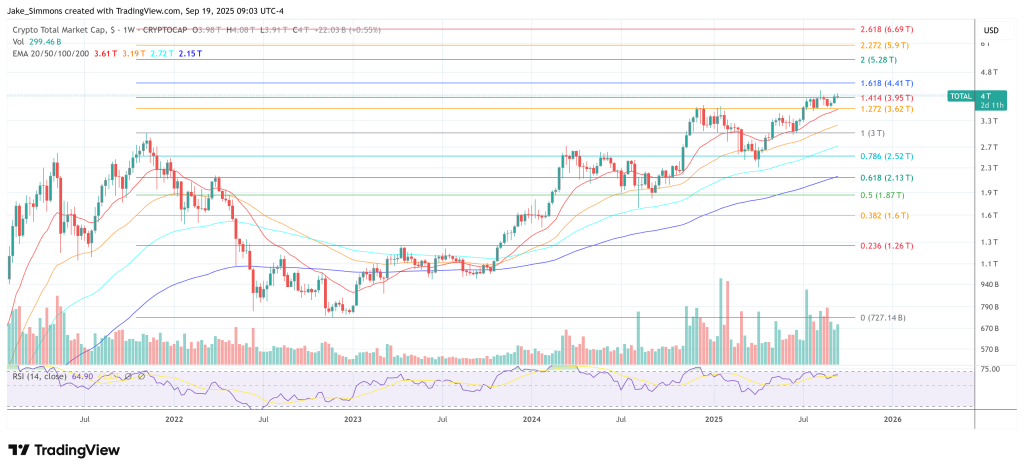
Total crypto market cap
Total crypto market cap breaks above $4 trillion, 1-week chart | Source: TOTAL on TradingView.com
Featured image created with DALL.E, chart from TradingView.com
Editorial Process for bitcoinist is centered on delivering thoroughly researched, accurate, and unbiased content. We uphold strict sourcing standards, and each page undergoes diligent review by our team of top technology experts and seasoned editors. This process ensures the integrity, relevance, and value of our content for our readers.

Jake Simmons has been a Bitcoin enthusiast since 2016. Ever since he heard about Bitcoin, he has been studying the topic every day and trying to share his knowledge with others. His goal is to contribute to Bitcoin's financial revolution, which will replace the fiat money system. Besides BTC and crypto, Jake studied Business Informatics at a university. After graduation in 2017, he has been working in the blockchain and crypto sector. You can follow Jake on Twitter at @realJakeSimmons.

Lectures associées

Vous serez surpris à quel point WeChat est différent de Telegram au niveau de l'architecture

L'audience mensuelle de WeChat et Weixin a atteint 1,428 milliard d'utilisateurs, confirmant son statut d'outil numérique central en Chine et au-delà. Cette analyse compare l'architecture de WeChat avec celle de Telegram, révélant des philosophies opposées en matière de stockage des données, de monétisation et d'ouverture aux développeurs. **Stockage des conversations :** Telegram utilise un stockage cloud illimité avec synchronisation sur tous les appareils. WeChat stocke les historiques localement sur l'appareil, nécessitant une fonction de migration spécifique pour les transférer et liant strictement la version desktop au téléphone. **Fonctionnalités sociales :** Dans Telegram, les commentaires sous les publications de chaînes sont intégrés. Dans WeChat, les commentaires sous les articles des comptes officiels sont modérés préalablement et ne disposent pas d'un système de discussion unifié. **Développement :** Telegram propose un Bot API ouvert et gratuit. L'écosystème des mini-programmes de WeChat est fermé, nécessitant souvent une vérification et une certification payante pour les développeurs. **Transfert de fichiers :** Telegram permet d'envoyer des fichiers jusqu'à 2 Go (4 Go pour Premium). WeChat limite généralement les envois à 200 Mo, proposant un "assistant de transfert" pour les volumes plus importants. **Paiements :** WeChat Pay est profondément intégré dans la vie économique chinoise, remplaçant souvent les applications bancaires. Telegram ne possède pas de système de paiement fiduciaire intégré comparable, s'appuyant sur des bots tiers et les cryptomonnaies. **Analyse de la sécurité (point de vue IA ajouté) :** L'article soulève indirectement la question de la sécurité. Telegram propose un chiffrement de bout en bout pour ses "chats secrets". WeChat, sans chiffrement de bout en bout standard, fusionne messages et paiements dans une même interface, ce qui pourrait élargir la surface d'attaque en cas de vulnérabilité, comme l'illustrent des cas de fraude signalés à Singapour. En conclusion, WeChat repose sur un modèle intégré et fermé, profondément ancré dans l'économie réelle, tandis que Telegram privilégie les protocoles ouverts, le stockage flexible et une faible barrière à l'entrée pour les développeurs. Ce choix architectural fondamental détermine leurs publics et leurs cas d'utilisation respectifs.

cryptonews.ruIl y a 3 h

Vous serez surpris à quel point WeChat est différent de Telegram au niveau de l'architecture

cryptonews.ruIl y a 3 h

Trading

Spot
活动图片