PayPal Stablecoin Goes Permissionless Across Nine Blockchains, Drives Attention to Best Wallet

bitcoinistPublié le 2025-09-19Dernière mise à jour le 2025-09-19

Résumé

PayPal is launching a permissionless version of its $PYUSD stablecoin across Tron, Avalanche, and seven other blockchains. All will be...

Trusted Editorial content, reviewed by leading industry experts and seasoned editors. Ad Disclosure

PayPal is launching a permissionless version of its $PYUSD stablecoin across Tron, Avalanche, and seven other blockchains.

All will be achieved through Stargate, a bridge service that connects over 80 blockchains. LayerZero, which acquired Stargate last month, used its Hydra model to expand $PYUSD to these nine networks.

With crypto adoption accelerating, now’s a prime time to buy $BEST. As the native token of Best Wallet, it’s a great way to stay ahead of this mainstream shift.

PayPal Debuts Permissionless Version of $PYUSD Stablecoin

Yesterday, LayerZero announced that $PYUSD will expand into a permissionless version dubbed $PYUSDO. It’ll be fully fungible with the original version and interoperable across multiple networks.

Beyond Tron and Avalanche, the rollout covers Aptos, Abstract, Ink, Sei, and Stable. Existing permissionless versions on Berachain ($BBYUSD) and Flow ($USDF) will upgrade to $PYUSD0.

‘As the stablecoin market continues its rapid growth beyond $270B, innovations like this are essential for creating the seamless, interoperable financial infrastructure that users and developers demand.’ — David Weber, Head of Ecosystem, PayPal USD.

In another update, PayPal also confirmed that $PYUSDY has launched on Stellar. This way, you can benefit from five-second transaction finality and easier dollar-denominated savings.
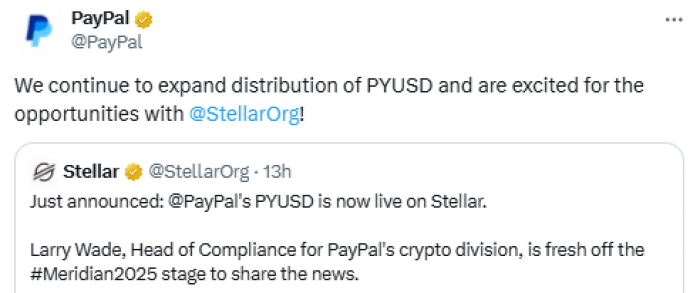
PayPal announced stablecoin is now on Stellar via Twitter.
Source: X (PayPal)

Following these developments, $PYUSD has surpassed $1.3B in market capitalization for the first ever time.
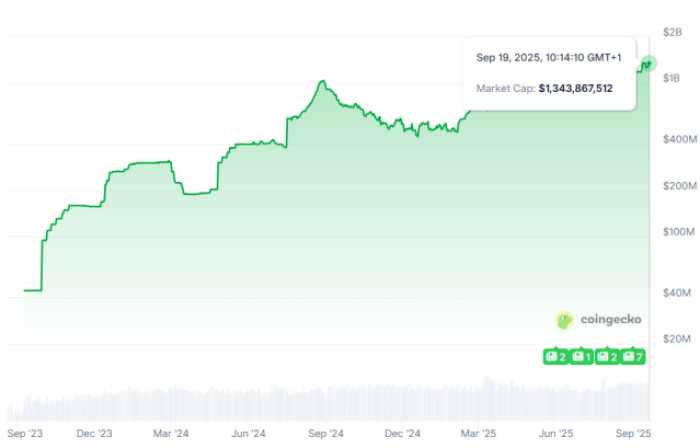
PYUSD market cap on CoinGecko.
Source: CoinGecko

As stablecoins like $PYUSD continue to attract mainstream attention, managing your digital assets securely becomes increasingly important.

And you’ll need a good solution that can take care of asset storage, trading, with top-notch security to boot.

This is where Best Wallet comes in.

Securely Manage 1K+ Digital Assets on Best Wallet

Available on Google Play and iOS, Best Wallet is a secure, non-custodial app that gives you complete control over your private keys to keep your digital assets safe.

Extra protection comes from 2FA, biometrics, local encryption, and encrypted cloud backups to guard against unauthorized access.

Beyond security, Best Wallet offers an easy way to manage, buy, sell, and swap over 1K+ digital assets while on the go – spanning stablecoins like $USDT and $USDC, top cryptos like $BTC and $ETH, and even the best meme coins.

At the moment, the mobile app supports major networks like Ethereum, Polygon, BNB Chain, Bitcoin, and Solana. It’s on track to expand across 60 networks soon, which will give you even more flexibility to manage your crypto activity in one place.

The wallet already has some notable features. This includes its built-in launchpad that gives you access to top crypto presales. Meanwhile, its swap engine scans 330+ DEXs and 30 bridges to ensure you benefit from the best rates on the market.
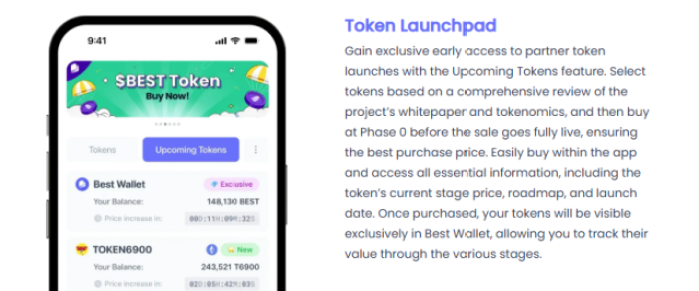
Information about the Best Wallet token launchpad.
Source: Best Wallet Token

Even more functions are on the way, including market intel analytics, an NFT gallery, and a rewards hub.

Each of these new enhancements is powered by $BEST, the official Best Wallet Token. That’s because 25% of its total token supply is set aside for product development.

$BEST also unlocks governance rights, reduces gas fees, and offers staking rewards at an 83% APY.

Given its perks, it’s no wonder $BEST has nearly raised $16M on presale, backed by whales investing significant amounts of capital (including eye-boggling amounts of $70.2K, $50.9K, and $49.5K).

This is even more impressive when considering that you can currently buy $BEST for just $0.025665. To join the presale at this ultra-low price, you’ll want to act fast. After the new app developments launch, the token’s anticipated to spike to $0.072 by the end of the year.

Check out our Best Wallet review for more information.

This article is for information only and not financial advice. Always do your own research before making any type of crypto investment. 

Authored by Leah Waters for Bitcoinist: https://bitcoinist.com/paypal-pyusd-goes-multichain-best-wallet-surges

Editorial Process for bitcoinist is centered on delivering thoroughly researched, accurate, and unbiased content. We uphold strict sourcing standards, and each page undergoes diligent review by our team of top technology experts and seasoned editors. This process ensures the integrity, relevance, and value of our content for our readers.

Leah is a British journalist with a BA in Journalism, Media, and Communications and nearly a decade of content writing experience. Over the last four years, her focus has primarily been on Web3 technologies, driven by her genuine enthusiasm for decentralization and the latest technological advancements. She has contributed to leading crypto and NFT publications – Cointelegraph, Coinbound, Crypto News, NFT Plazas, Bitcolumnist, Techreport, and NFT Lately – which has elevated her to a senior role in crypto journalism. Whether crafting breaking news or in-depth reviews, she strives to engage her readers with the latest insights and information. Her articles often span the hottest cryptos, exchanges, and evolving regulations. As part of her ploy to attract crypto newbies into Web3, she explains even the most complex topics in an easily understandable and engaging way. Further underscoring her dynamic journalism background, she has written for various sectors, including software testing (TEST Magazine), travel (Travel Off Path), and music (Mixmag). When she's not deep into a crypto rabbit hole, she's probably island-hopping (with the Galapagos and Hainan being her go-to's). Or perhaps sketching chalk pencil drawings while listening to the Pixies, her all-time favorite band.

Lectures associées

Vous serez surpris à quel point WeChat est différent de Telegram au niveau de l'architecture

L'audience mensuelle de WeChat et Weixin a atteint 1,428 milliard d'utilisateurs, confirmant son statut d'outil numérique central en Chine et au-delà. Cette analyse compare l'architecture de WeChat avec celle de Telegram, révélant des philosophies opposées en matière de stockage des données, de monétisation et d'ouverture aux développeurs. **Stockage des conversations :** Telegram utilise un stockage cloud illimité avec synchronisation sur tous les appareils. WeChat stocke les historiques localement sur l'appareil, nécessitant une fonction de migration spécifique pour les transférer et liant strictement la version desktop au téléphone. **Fonctionnalités sociales :** Dans Telegram, les commentaires sous les publications de chaînes sont intégrés. Dans WeChat, les commentaires sous les articles des comptes officiels sont modérés préalablement et ne disposent pas d'un système de discussion unifié. **Développement :** Telegram propose un Bot API ouvert et gratuit. L'écosystème des mini-programmes de WeChat est fermé, nécessitant souvent une vérification et une certification payante pour les développeurs. **Transfert de fichiers :** Telegram permet d'envoyer des fichiers jusqu'à 2 Go (4 Go pour Premium). WeChat limite généralement les envois à 200 Mo, proposant un "assistant de transfert" pour les volumes plus importants. **Paiements :** WeChat Pay est profondément intégré dans la vie économique chinoise, remplaçant souvent les applications bancaires. Telegram ne possède pas de système de paiement fiduciaire intégré comparable, s'appuyant sur des bots tiers et les cryptomonnaies. **Analyse de la sécurité (point de vue IA ajouté) :** L'article soulève indirectement la question de la sécurité. Telegram propose un chiffrement de bout en bout pour ses "chats secrets". WeChat, sans chiffrement de bout en bout standard, fusionne messages et paiements dans une même interface, ce qui pourrait élargir la surface d'attaque en cas de vulnérabilité, comme l'illustrent des cas de fraude signalés à Singapour. En conclusion, WeChat repose sur un modèle intégré et fermé, profondément ancré dans l'économie réelle, tandis que Telegram privilégie les protocoles ouverts, le stockage flexible et une faible barrière à l'entrée pour les développeurs. Ce choix architectural fondamental détermine leurs publics et leurs cas d'utilisation respectifs.

cryptonews.ruIl y a 5 h

Vous serez surpris à quel point WeChat est différent de Telegram au niveau de l'architecture

cryptonews.ruIl y a 5 h

Trading

Spot
活动图片