Solana Price Prediction for September: Analysts Target Breakout as Snorter Token Gains Buzz

bitcoinistPublié le 2025-09-15Dernière mise à jour le 2025-09-15

Résumé

Solana is experiencing a September to remember. In just two weeks, $SOL has surged 23.5%, leaving $BTC (+6.9%) and $ETH...

Trusted Editorial content, reviewed by leading industry experts and seasoned editors. Ad Disclosure

Solana is experiencing a September to remember. In just two weeks, $SOL has surged 23.5%, leaving $BTC (+6.9%) and $ETH (+6.4%) in the dust.

The surge occurs as Galaxy Digital acquires 6.5M $SOL, roughly $1.55B worth, fueling speculation that institutions are front-running the next big breakout. For traders, that’s a signal worth watching: when whales move in before retail, Q4 often follows with fireworks.

Sentiment on Crypto Twitter and CMC community threads remains bullish, but liquidations serve as a reminder that volatility is still present.

At the same time, Solana’s increasing liquidity is spilling over into Solana meme utility plays like Snorter Token ($SNORT), a Telegram trading bot project that leverages the network’s momentum.

Institutional Buying Drives the Solana Rally

Galaxy Digital’s aggressive buying is one of the biggest stories behind Solana’s September surge. The firm purchased $6.5M in $SOL in less than a week.

The size of these purchases is raising eyebrows, with analysts suggesting Galaxy may act on behalf of Forward Industries, which recently raised $1.65B to build a dedicated Solana treasury.
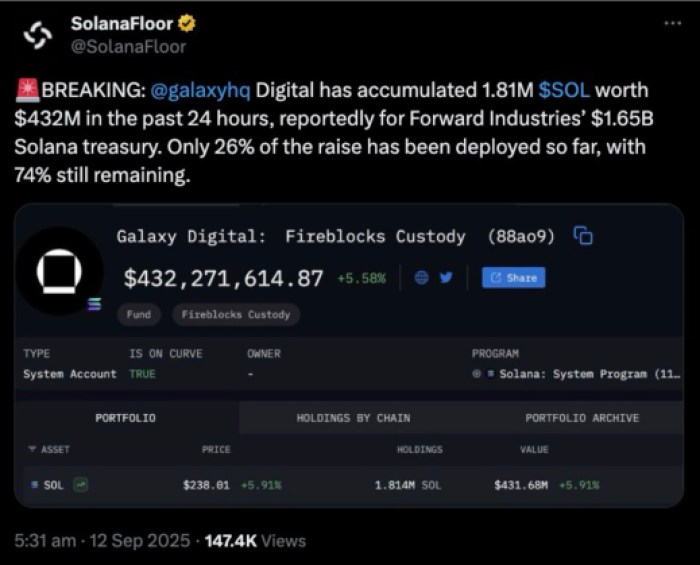
Galaxy Digital accumulations reportedly being tied to Foward Industries’ $1.65B Solana treasury
Source: SolanaFloor via X

Why does this matter? Institutions don’t usually commit that kind of capital without conviction. Solana has faced criticism in the past for network outages and scaling glitches. Yet, billion-dollar inflows show that major players see it as a viable bet heading into the next market cycle phase.

The move reflects what happened with Bitcoin earlier this year, when ETFs directed billions into $BTC. If Solana follows the same strategy, institutional rotation could speed up price discovery well before retail investors fully re-enter the market.

Analyst & Community Price Predictions

Chart watchers are lining up bullish scenarios for $SOL.

TEKT0NIC highlighted a textbook cup-and-handle pattern, indicating a possible breakout toward the $330-$350 range if momentum continues.
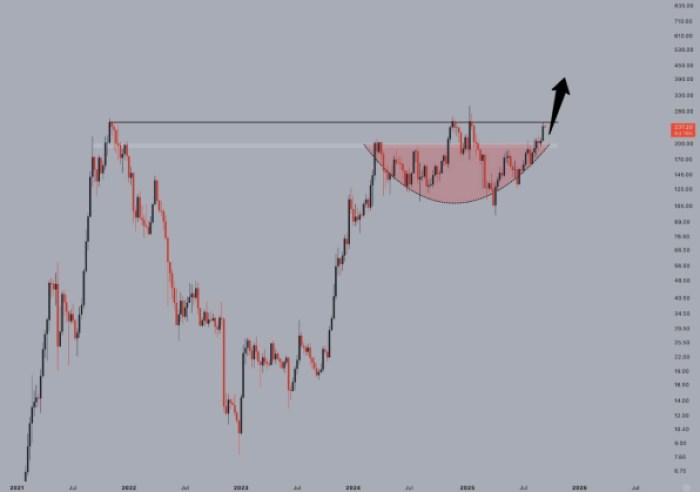
$SOL chart on TradingView with cup and handle pattern
Source: @TEKT0NIC on CoinMarketCap.

Z988Crypto sees the same setup but warns that confirmation only occurs if Solana breaks through resistance between $261 and $296. Until then, a short-term pullback to the $210-$220 range remains possible.

Amin_BTC zoomed in further, noting $235 as the key support to watch: hold it, and $245 is the next stop, lose it, and a deeper correction could follow.

Despite the caution, sentiment skews positive. Solana’s total value locked (TVL) has an all-time high of over $13B, while the month-to-date gains of over 23.5% leave $BTC and $ETH far behind.
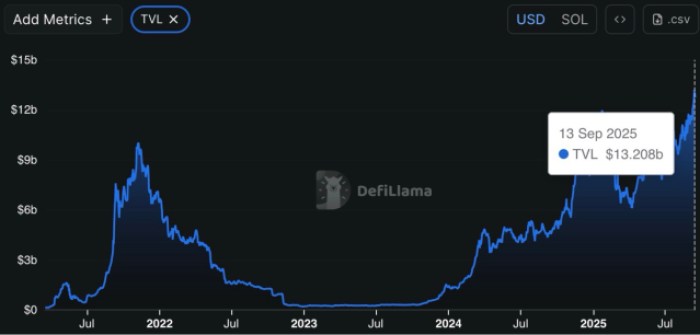
Solana TVL chart
Source: DefiLlama.

Historically, green Septembers have set the stage for strong Q4 rallies, and institutions buying early further reinforce that trend.

Still, the market remains fragile – $445M in liquidations occurred over the last 24 hours, including $32M in $SOL positions.

Solana’s Ecosystem Momentum

Beyond price action, Solana’s fundamentals are getting stronger. On-chain activity, including active addresses and revenue, shows signs of rebounding, which explains why $SOL is doing so well in September.
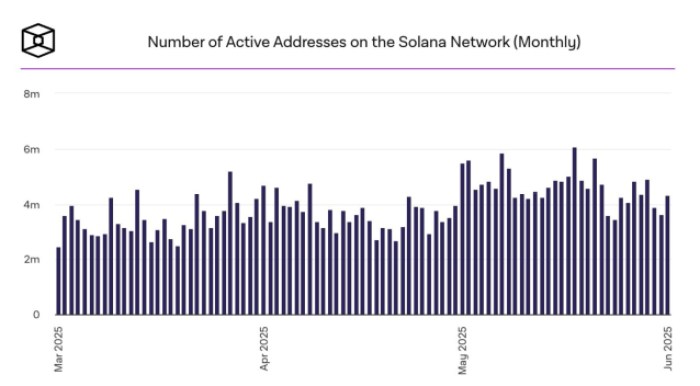
The number of active addresses on the Solana network, monthly bar chart
Source: TheBlock.

Analysts often describe this stage as ‘Altcoin Phase 3,’ where large-cap coins are spotlighted. For investors, it positions Solana as the clear challenger to Bitcoin and Ethereum’s dominance.

And as liquidity increases, demand flows into Solana-native tools like Snorter Token – projects aimed at helping retail traders capture the same alpha institutions seek.

Snorter Token ($SNORT) – Meme Branding Meets Trading Bot Utility

As Solana’s ecosystem heats up, demand for trading tools surges, and Snorter Token ($SNORT) aims to become the preferred choice.

Snorter is a Telegram-native bot designed for Solana and Ethereum. It allows traders to manage their entire playbook from chat: sub-second swaps, instant sniping at token launch, copy-trading top wallets, rugpull detection, and portfolio tracking.

Holding $SNORT lowers execution fees from 1.5% to 0.85%, making it cheaper than competitors like BONKbot and Trojan, while providing faster execution thanks to custom Solana RPC infrastructure. Unlike most meme coins, Snorter supports its branding with real functionality.

Discover how to buy Snorter Token ($SNORTER) in our step-by-step guide.
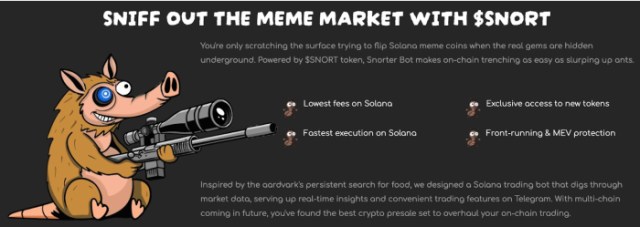
Snorter Token ($SNORT) benefits for holders

The presale has already gained attention, raising over $3.94M at a token price of $0.1045, with staking yields around 119%. The pitch resonates because Telegram bots are among crypto’s fastest-growing niches, with the market forecast to reach $154B by 2033.

Snorter positions itself as the next step in the evolution of trading bots, incorporating MEV protection, cross-chain support, and meme-driven community energy.

With strong early momentum and a discounted entry through the presale, $SNORT offers exposure to meme coin culture and a utility stack retail traders rely on to stay competitive with institutions.

Learn more about Snorter, its tokenomics, roadmap, and more in our comprehensive What is Snorter guide.

This article is not financial advice. Presales and crypto in general carry inherent risks. Please always do your own research (DYOR) before putting any capital at risk.

Authored by Bogdan Patru, Bitcoinist – https://bitcoinist.com/solana-price-prediction-in-september-snorter-token-gains/

Editorial Process for bitcoinist is centered on delivering thoroughly researched, accurate, and unbiased content. We uphold strict sourcing standards, and each page undergoes diligent review by our team of top technology experts and seasoned editors. This process ensures the integrity, relevance, and value of our content for our readers.

As a crypto writer, Bogdan’s responsibilities are split between researching and writing articles and entertaining the team with his humor bordering on the politically incorrect, an aspiring Bill Burr, if you will. Thanks to his 12+ years of writing experience in just as many fields, including tech, cybersecurity, modelling, fitness, crypto, and other topics-that-shall-not-be-named, he's become a genuine asset to the team. While his position as a senior writer at PrivacyAffairs thought him valuable lessons about the power of self-management, his entire writing career was and is an exercise in self-improvement. Now, he's ready to sink his teeth into crypto and teach people how to take control of their own money on the blockchain. With fiat as an eternally devaluing currency, Bitcoin and altcoins seem like the best-fitting alternative for Bogdan. Bogdan’s biggest professional accomplishment, aside from securing a position as a main writer for Bitcoinist, was his 5-year run as a writing manager at Blackwood Productions, where he coordinated a team of four writers. During that time, he learned the value of teamwork and that of creating a working environment that breeds efficiency, positivity, and friendship.

Lectures associées

Réévaluation de GrayScale de Zcash : À l'ère de la surveillance par l'IA, combien vaut la confidentialité financière ?

Le rapport de Grayscale remet en lumière Zcash (ZEC), en posant une question fondamentale : à l'ère des paiements en chaîne, des stablecoins et des outils d'analyse IA qui accroissent la traçabilité financière, la confidentialité restera-t-elle un besoin de niche ou redeviendra-t-elle un attribut monétaire central ? L'analyse suggère que la convergence de ces technologies pourrait déclencher un troisième cycle de débat sur la vie privée financière. Contrairement au Bitcoin transparent, Zcash permet grâce aux preuves à connaissance zéro des transactions « blindées » (masquant expéditeur, destinataire, montant), tout en autorisant une divulgation sélective via des clés de visualisation. Bien que le protocole existe depuis près de dix ans et que des améliorations récentes (portefeuilles, infrastructures minières) aient accru sa facilité d'utilisation, son adoption reste limitée. Les données citées indiquent que les transactions blindées représentent environ 90% des transactions et que 25% de l'offre en circulation est dans le pool blindé, signe d'une utilisation réelle mais encore modeste. L'argument d'investissement de Grayscale repose sur un rééquilibrage potentiel de la valorisation de marché si la confidentialité est reprixée. Une simulation indique qu'une part de marché de ZEC passant de 0,6% à 5% dans le segment des « monnaies numériques » pourrait multiplier sa valorisation par environ 9. Ce n'est pas une prévision, mais une illustration de l'élasticité potentielle. Cependant, cette thèse comporte des risques majeurs : les défis réglementaires persistants (conformité FATF, soutien des plateformes), la sécurité du protocole (vulnérabilités théoriques passées, migration quantique à long terme) et les risques d'exécution (adoption, déploiement des mises à niveau comme Tachyon). En conclusion, l'opportunité pour Zcash ne réside pas dans un remplacement du Bitcoin, mais dans sa capacité à devenir un « numéraire privé numérique » si la demande de confidentialité financière s'intensifie avec l'IA. Sa trajectoire dépendra de l'augmentation concrète de l'utilisation des blindages, de l'amélioration de l'expérience utilisateur et d'un environnement réglementaire et de marché favorable. Son évaluation actuelle représente essentiellement une option sur la valeur future que le marché attribuera à la vie privée financière.

marsbitIl y a 33 mins

Réévaluation de GrayScale de Zcash : À l'ère de la surveillance par l'IA, combien vaut la confidentialité financière ?

marsbitIl y a 33 mins

Vente de 290 milliards de dollars de bons du Trésor à court terme par les investisseurs étrangers : pourquoi les États-Unis misent-ils sur les stablecoins pour « reprendre le flambeau » ?

En juin, les investisseurs étrangers ont injecté 134 milliards de dollars nets dans les marchés financiers américains, mais ont simultanément vendu pour 29 milliards de dollars de bons du Trésor à court terme. Cette dynamique révèle une préférence marquée pour les actions américaines (achats de 181 milliards) par rapport à la dette publique, dont la demande s'affaiblit. Face à ce retrait partiel des acheteurs traditionnels, les stablecoins comme Tether ou Circle émergent comme une source potentielle de demande pour ces titres d'État. Leurs émetteurs doivent en effet détenir des réserves liquides et sûres, principalement constituées de bons du Trésor américains à court terme. Ainsi, la demande de dollars numériques se transforme indirectement en demande de dette américaine. Cependant, les données de juin montrent que la croissance modeste du secteur des stablecoins n'a pas suffi à absorber les 29 milliards de dollars de ventes. Pour que ce mécanisme soutienne réellement le marché des bons du Trésor, il faudrait une expansion significative de la masse des stablecoins en circulation. Les autorités américaines, via des projets de règlementation comme le GENIUS Act, semblent vouloir encourager cette voie, tissant un lien nouveau entre le dollar numérique et le financement de l'État.

marsbitIl y a 55 mins

Vente de 290 milliards de dollars de bons du Trésor à court terme par les investisseurs étrangers : pourquoi les États-Unis misent-ils sur les stablecoins pour « reprendre le flambeau » ?

marsbitIl y a 55 mins

Trading

Spot
活动图片