‘Crypto Cloud Reset’: Putin Adviser Accuses US Of Plot To Erase $35 Trillion Debt

bitcoinistPublié le 2025-09-09Dernière mise à jour le 2025-09-09

Résumé

A senior adviser to Russian President Vladimir Putin has alleged that the United States is preparing to use cryptocurrencies —specifically...

Trusted Editorial content, reviewed by leading industry experts and seasoned editors. Ad Disclosure

A senior adviser to Russian President Vladimir Putin has alleged that the United States is preparing to use cryptocurrencies —specifically US dollar stablecoins—alongside gold to “devalue” and ultimately reset its towering national liabilities. Speaking at the Eastern Economic Forum in Vladivostok, Anton Kobyakov framed crypto and gold as “alternative currencies” to the dollar-centric system and argued that Washington aims to harness them to address what he called a crisis of confidence in the greenback.

“Right now, the United States is trying to change the rules on the gold and cryptocurrency markets. Just think about their debt – $35 trillion. These are two alternative currencies to the global market,” Kobyakov said.
He added: “Washington’s actions in this direction clearly demonstrate one of the main American goals. They want to solve the problem of lowering the dollar’s trust. The United States, as it was in the 1930s and 1970s, will solve its financial problems at the expense of the whole world, driving everyone into the cryptocurrency cloud.”

Kobyakov’s most arresting claim was operational: “Over time, when part of the US government debt is placed in stablecoins, the US will devalue this debt. In other words, they have a $35 trillion debt, they drive it into the cryptocurrency cloud, devalue it and start from scratch.” The remarks, which were circulated by Russian state-adjacent outlets, did not include a detailed mechanism for how “placing” sovereign obligations into stablecoins would alter their real value.

Can Bitcoin And Crypto (Stablecoins) Erase The US Debt?

The accusation lands amid two relevant backdrops: a US debt load now measured in the mid-$30 trillions and a fast-expanding stablecoin and tokenized-Treasury ecosystem that nonetheless remains orders of magnitude smaller than public debt. Treasury data and Congressional dashboards put gross federal debt at roughly $37.4 trillion in early September, with about $30.1 trillion held by the public. By contrast, the entire stablecoin market stands in the high-$200 billions, and tokenized US Treasury products total about $7.4 billion—hardly a platform capable of “absorbing” sovereign liabilities at scale.

US policy developments complicate Kobyakov’s narrative in another way. In July, President Donald Trump signed the GENIUS Act, the first federal framework for payment stablecoins. The law requires 100% reserve backing in cash and short-term Treasuries and mandates regular public disclosures—design choices that, if anything, tie stablecoin growth to incremental demand for Treasury bills rather than a mechanism for extinguishing US obligations. That is, more regulated stablecoins typically mean more private-sector buying of T-bills to back those tokens, not fewer Treasuries outstanding.

Kobyakov’s historical analogy—invoking the 1930s and 1970s—references episodes when US authorities changed the monetary regime: FDR’s dollar devaluation against gold in 1933–34 and Nixon’s 1971 closure of the gold window. But translating that precedent into a “stablecoin devaluation” is tenuous.

Stablecoins are issued by private or specially licensed entities and are designed to be redeemed at par; moving government liabilities “into” them would neither novate the debt nor change its legal terms. Any genuine devaluation of dollar-denominated debt would still occur via familiar channels—higher inflation, negative real rates, buybacks at discounts, or maturity transformation—not by wrapping the debt in token form.

Beyond the stablecoin debate, Washington has already sketched an alternative pathway: a Strategic Bitcoin Reserve. On March 6, 2025, the White House issued an executive order establishing a federal bitcoin reserve alongside a US Digital Asset Stockpile to manage government-owned crypto (largely from forfeitures) on a long-term, “budget-neutral” basis; companion legislation—the BITCOIN Act introduced in both chambers—would codify governance and disclosure rules.

US President Donald Trump himself has floated the idea in blunt terms. In an Aug. 2024 Fox Business interview with Maria Bartiromo, he mused: “Who knows? Maybe we’ll pay off our $35 trillion, hand them a little crypto check, right? We’ll hand them a little Bitcoin and wipe out our $35 trillion.” The remark was rhetorical rather than an operational plan, but it prefigured the administration’s March 6, 2025 executive order establishing a Strategic Bitcoin Reserve.

At press time, Bitcoin traded at $113,237.
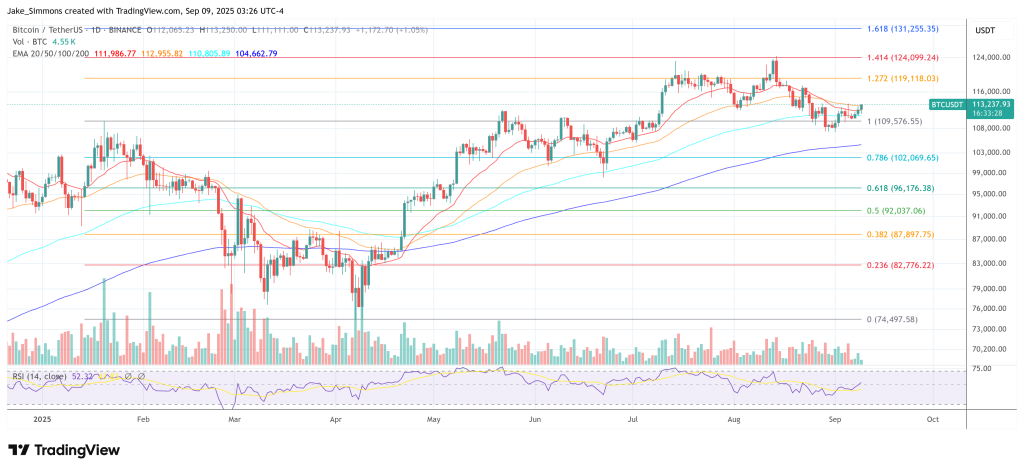
Bitcoin price
BTC rises back above $113,000, 1-day chart | Source: BTCUSDT on TradingView.com
Featured image created with DALL.E, chart from TradingView.com
Editorial Process for bitcoinist is centered on delivering thoroughly researched, accurate, and unbiased content. We uphold strict sourcing standards, and each page undergoes diligent review by our team of top technology experts and seasoned editors. This process ensures the integrity, relevance, and value of our content for our readers.

Jake Simmons has been a Bitcoin enthusiast since 2016. Ever since he heard about Bitcoin, he has been studying the topic every day and trying to share his knowledge with others. His goal is to contribute to Bitcoin's financial revolution, which will replace the fiat money system. Besides BTC and crypto, Jake studied Business Informatics at a university. After graduation in 2017, he has been working in the blockchain and crypto sector. You can follow Jake on Twitter at @realJakeSimmons.

Lectures associées

BIT Recherche : La réduction de moitié en 2028 n'est pas une fin en soi, le véritable remodelage de l'industrie minière du Bitcoin ne fait que commencer

L'industrie du minage de Bitcoin traverse actuellement l'ajustement structurel le plus complexe depuis la création du protocole. Malgré un prix du Bitcoin d'environ 61 000 $ et une puissance de calcul (hashrate) proche du record historique à 1 ZH/s, la rentabilité des mineurs se détériore. Plusieurs indicateurs montrent que le secteur fonctionne près du seuil de rentabilité, et le prochain halving de 2028 pourrait accélérer la consolidation. Les problèmes ne viennent pas seulement de la future réduction des récompenses de bloc, mais aussi de la transition incomplète vers un modèle de revenus basé sur les frais de transaction. De plus en plus d'entreprises minières évoluent de simples producteurs de Bitcoin vers des opérateurs d'infrastructures, d'énergie et de calcul pour l'IA/le HPC. La compétition se déplace ainsi de l'expansion de la puissance de calcul vers l'innovation des modèles économiques. Le modèle de coût de production indique un plancher actuel d'environ 46 744 $. Fait notable, les revenus des mineurs divergent historiquement du prix du Bitcoin. Alors que les revenus théoriques journaliers devraient être d'environ 78 millions de $, ils ne sont en réalité que de 33 millions de $. Les revenus provenant des frais sont également bas, à environ 220 000 $ par jour. En 2025, le coût de l'électricité a représenté 71,5% des revenus totaux des mineurs. Le prix d'équilibre pour le secteur est estimé à environ 65 000 $, rendant le minage seul peu rentable au prix actuel. Après le halving de 2028, le coût de production plancher pourrait atteindre ~93 289 $, favorisant les grandes entreprises aux ressources diversifiées. En conclusion, le secteur transforme son modèle fondamental : du "minage" vers les "infrastructures". La rentabilité future dépendra de la diversification des revenus, notamment via la gestion énergétique et l'hébergement de calcul IA/HPC. Pour les investisseurs, l'enjeu clé est d'identifier les entreprises capables de réussir cette transition et de bâtir un avantage compétitif résilient.

marsbitIl y a 1 h

BIT Recherche : La réduction de moitié en 2028 n'est pas une fin en soi, le véritable remodelage de l'industrie minière du Bitcoin ne fait que commencer

marsbitIl y a 1 h

Une vague de licenciements balaye le secteur crypto, Wall Street acquiert des actifs clés de la piste pour des milliards

La vague de licenciements balaie l'industrie cryptographique, alors que les acteurs de Wall Street déploient des milliards pour acquérir des actifs infrastructurels clés. Alors que le prix du Bitcoin reste bas, poussant les entreprises du secteur à des réductions d'emplois massives et à l'automatisation, l'activité de fusions et acquisitions (M&A) connaît un boom sans précédent. Les transactions de M&A ont atteint 9,37 milliards de dollars au premier semestre 2026, en hausse de 26 fois sur un an. Les institutions financières traditionnelles (banques, réseaux de paiement, gestionnaires d'actifs) sont les principaux moteurs de cette frénésie. Elles préfèrent acquérir directement des infrastructures numériques matures (licences, services de garde, solutions de paiement) plutôt que de les construire, bénéficiant de la clarté réglementaire croissante (comme MiCA dans l'UE). Des exemples incluent l'acquisition de BVNK par Mastercard pour 1,8 milliard de dollars. Parallèlement, le marché de l'emploi dans la crypto se contracte fortement, avec seulement 2932 postes ouverts recensés en juin 2026. Les licenciements se poursuivent chez les grands noms (Coinbase, Kraken, etc.). La demande en talents se recentre sur les rôles techniques et de conformité, avec une forte augmentation des compétences en IA requises. Les entreprises en difficulté, aux valuations effondrées, deviennent des cibles de rachat à bas prix, comme le montre l'acquisition de Messari par Blockworks. Les capitaux sont devenus extrêmement sélectifs, se concentrant presque exclusivement sur les entreprises à fort ancrage réglementaire, avec des cas d'usage réels dans la finance traditionnelle (jetonisation de titres, paiements en stablecoins). Les protocoles DeFi purement décentralisés ou les nouvelles blockchains sans application tangible sont largement ignorés par les flux de capitaux actuels. Cette période de marché baissier opère une sélection naturelle, consolidant l'industrie autour d'acteurs robustes, conformes et intégrés à l'écosystème financier classique.

Foresight NewsIl y a 1 h

Une vague de licenciements balaye le secteur crypto, Wall Street acquiert des actifs clés de la piste pour des milliards

Foresight NewsIl y a 1 h

Trading

Spot
活动图片