$USDD Takes on Tether: As L2s Innovate, $BEST Benefits

bitcoinistPublié le 2025-09-09Dernière mise à jour le 2025-09-09

Résumé

It looks like the stablecoin space is heating up! Justin Sun’s $USDD just landed on the Ethereum network, and it’s...

Trusted Editorial content, reviewed by leading industry experts and seasoned editors. Ad Disclosure

It looks like the stablecoin space is heating up! Justin Sun’s $USDD just landed on the Ethereum network, and it’s not just a casual visit. It’s a strategic move to challenge Tether, the reigning champ of the $2.5T stablecoin market.

Read on for how the news affects Best Wallet and its native Best Wallet Token ($BEST) bid to bring crypto investing and dApps to the masses.

USDD Launches with Peg Stability and a 12% Yield to Kick Things Off

$USDD is coming in hot with a Peg Stability module that lets you swap it directly for $USDT and $USDC. And to get the party started, there’s an airdrop campaign offering an up to 12% annual yield. That’s what you call a welcome gift!
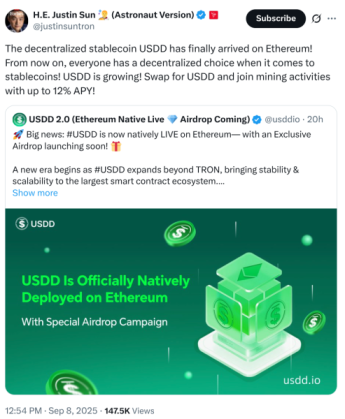
Justin Sun's X $USDD announcement on Ethereum.

Still, $USDD has its work cut out for it. Tether’s dominance is massive, with a market cap of over $169B compared to $USDD’s modest $450M. Tether is deeply rooted and has incredible liquidity, especially on TRON. For $USDD to really compete, it needs to earn trust, diversify its collateral, and get integrated into more real-world uses.

The Yield-Bearing Revolution: A Fresh Business Model for L2s

While $USDD is making its big move, another shift is happening behind the scenes. Ethereum’s Layer-2 (L2) solutions are finding new ways to make money.

MegaETH, an L2 backed by Vitalik Buterin himself, is launching a yield-bearing stablecoin called $USDm.
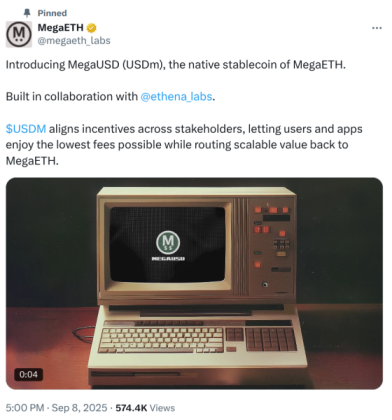
MegaETH announcement on X of the $USDm.Instead of relying on transaction fees, MegaETH plans to use the yield from USDm’s reserves to cover its own costs, specifically the fees it pays to the main Ethereum chain.

This clever approach could mean lower fees for users and more freedom for dApp developers. The stablecoin’s reserves will be invested in BlackRock’s tokenized US Treasury fund, providing a steady income.

This is happening as more yield-bearing stablecoins emerge, especially after the US’s GENIUS Act pushes protocols like Ethena and MegaETH to innovate.

It’s a sign that L2s aren’t just about speed; they’re also figuring out how to be more efficient and economical. It’s something they could learn from Best Wallet Token ($BEST), which provides its holders with everything they need to participate in the crypto economy, in one easy-to-use app.

$BEST Is Your Best Bet

While the battle of high yields rages between Tether and $USDD, what if a single token could help you navigate the entire crypto landscape? Cue Best Wallet Token ($BEST).

While $USDD is just one player in the stablecoin game, $BEST is your all-access pass to the entire digital asset show. It’s something investors are clearly responding to, as the presale has raised over $15.6M so far.

Instead of chasing the next asset, you can hold $BEST and get benefits that work across the board. You get reduced transaction and swap fees on multiple blockchains, saving you money no matter which token you’re trading.
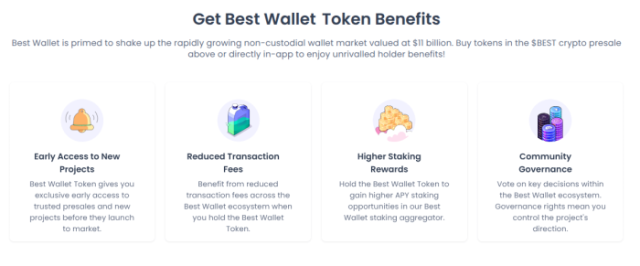
$BEST benefits as listed on the presale website.

Plus, $BEST holders get exclusive access to the ‘Upcoming Tokens’ section, meaning you can get in early on the next big crypto projects before they go public. That’s a massive advantage in a market that moves at lightning speed.

Get your $BEST now for $0.025615, or find step-by-step instructions in our ‘How to Buy Best Wallet Token’ guide.

More Than A Wallet, It’s a Secure Financial Hub

With new L2s like MegaETh boasting ever-improved business models, it’s clear that crypto is constantly evolving, and you need a platform that can keep up.

This is where Best Wallet shines. It’s built with Fireblocks MPC-CMP technology, meaning you can forget about the stress of managing complicated seed phrases. It’s a secure, non-custodial wallet that makes your crypto safe and easy to access.

But the best part? It turns your assets into a source of passive income. Beyond fee reductions and presale access, holding $BEST allows you to earn rewards through staking (currently sitting at a respectable 85%). This means your tokens are working for you, generating value while you hold them.

The upcoming Best Card will even let you spend your crypto in the real world and get cashback rewards.

Best Card feature from the Best Wallet website.

So while other projects are focusing on one specific problem, $BEST is building a complete, user-friendly ecosystem. It’s this focus on the future that leads us to believe it could reach $0.072 by the end of 2025, resulting in a massive 181% ROI on today’s price.

A Central Hub in the Innovation Storm

While $USDD is locked in a high-stakes battle for stablecoin supremacy and MegaETH is pioneering new L2 business models, Best Wallet Token ($BEST) brings everything together for you, the user. Join the presale now and buckle up for the next wave of crypto innovation.

Remember to always do your own research and only invest what you can afford. This is not intended as financial advice.

Authored by Ben Wallis, Bitcoinist, https://bitcoinist.com/justin-sun-launches-usdd-and-best-explodes/

Editorial Process for bitcoinist is centered on delivering thoroughly researched, accurate, and unbiased content. We uphold strict sourcing standards, and each page undergoes diligent review by our team of top technology experts and seasoned editors. This process ensures the integrity, relevance, and value of our content for our readers.

Ben is a freelance writer specializing in crypto developments (mainly altcoins) and the intricate ways global economics shape the digital asset space. His B.Ed. in Education provides a unique foundation for his writing, enabling him to distill complex crypto concepts and market shifts into clear, digestible insights. This skill is key to helping readers adapt and apply their understanding to the ever-evolving world of crypto investment. Passionate about making crypto accessible, Ben crafts content designed to educate a broad audience, from current market events to the essential foundational knowledge that underpins them. His goal is to empower readers through understanding. When he’s not immersed in crypto analysis and breaking down complex topics, Ben is an avid Pokémon fan and enjoys all things Disney.

Lectures associées

Il y a quelques instants, DeepSeek V4 a mis à jour DSpark, augmentant la vitesse d'inférence de 80 %

DeepSeek a annoncé une mise à jour majeure de son modèle DeepSeek-V4-Pro avec le lancement de DSpark, un nouveau cadre de décodage spéculatif (Speculative Decoding) open source, accompagné de l'infrastructure complète DeepSpec. Cette mise à jour, axée sur l'ingénierie et non sur les capacités fondamentales du modèle, vise à accélérer considérablement l'inférence des LLM en production. Le cœur de DSpark est l'introduction d'une **génération semi-autorégressive**. Cela combine la génération parallèle à haut débit d'un modèle "brouillon" léger avec une modélisation des dépendances entre tokens pour améliorer le taux d'acceptation. De plus, un système de **vérification planifiée par confiance et conscient du matériel** (Confidence-Scheduled Verification) évalue dynamiquement la probabilité que chaque token généré soit accepté par le modèle cible. Il adapte ainsi la longueur de vérification en temps réel pour optimiser l'utilisation des ressources GPU, notamment en charge élevée. Les résultats sont significatifs : face aux méthodes de pointe comme Eagle3 et DFlash, DSpark augmente la longueur moyenne de tokens acceptés de 26.7% à 30.9% et de 16.3% à 18.4% respectivement sur les modèles Qwen3. En déploiement réel, par rapport à la génération token par token précédente (MTP-1), **DSpark améliore la vitesse de génération pour l'utilisateur de 60% à 85% pour le modèle Flash et de 57% à 78% pour le modèle Pro**, à débit total constant. Le projet open source **DeepSpec** fournit une stack complète pour entraîner et évaluer des modèles brouillons pour le décodage spéculatif, supportant actuellement les algorithmes DSpark, DFlash et Eagle3, ainsi que les familles de modèles cibles Qwen3 et Gemma.

marsbitIl y a 1 h

Il y a quelques instants, DeepSeek V4 a mis à jour DSpark, augmentant la vitesse d'inférence de 80 %

marsbitIl y a 1 h

BIT Recherche : La réduction de moitié en 2028 n'est pas une fin en soi, le véritable remodelage de l'industrie minière du Bitcoin ne fait que commencer

L'industrie du minage de Bitcoin traverse actuellement l'ajustement structurel le plus complexe depuis la création du protocole. Malgré un prix du Bitcoin d'environ 61 000 $ et une puissance de calcul (hashrate) proche du record historique à 1 ZH/s, la rentabilité des mineurs se détériore. Plusieurs indicateurs montrent que le secteur fonctionne près du seuil de rentabilité, et le prochain halving de 2028 pourrait accélérer la consolidation. Les problèmes ne viennent pas seulement de la future réduction des récompenses de bloc, mais aussi de la transition incomplète vers un modèle de revenus basé sur les frais de transaction. De plus en plus d'entreprises minières évoluent de simples producteurs de Bitcoin vers des opérateurs d'infrastructures, d'énergie et de calcul pour l'IA/le HPC. La compétition se déplace ainsi de l'expansion de la puissance de calcul vers l'innovation des modèles économiques. Le modèle de coût de production indique un plancher actuel d'environ 46 744 $. Fait notable, les revenus des mineurs divergent historiquement du prix du Bitcoin. Alors que les revenus théoriques journaliers devraient être d'environ 78 millions de $, ils ne sont en réalité que de 33 millions de $. Les revenus provenant des frais sont également bas, à environ 220 000 $ par jour. En 2025, le coût de l'électricité a représenté 71,5% des revenus totaux des mineurs. Le prix d'équilibre pour le secteur est estimé à environ 65 000 $, rendant le minage seul peu rentable au prix actuel. Après le halving de 2028, le coût de production plancher pourrait atteindre ~93 289 $, favorisant les grandes entreprises aux ressources diversifiées. En conclusion, le secteur transforme son modèle fondamental : du "minage" vers les "infrastructures". La rentabilité future dépendra de la diversification des revenus, notamment via la gestion énergétique et l'hébergement de calcul IA/HPC. Pour les investisseurs, l'enjeu clé est d'identifier les entreprises capables de réussir cette transition et de bâtir un avantage compétitif résilient.

marsbitIl y a 2 h

BIT Recherche : La réduction de moitié en 2028 n'est pas une fin en soi, le véritable remodelage de l'industrie minière du Bitcoin ne fait que commencer

marsbitIl y a 2 h

Trading

Spot
活动图片