Google Bows To Crypto Fury, Unbans Non-Custodial Wallets

bitcoinistPublié le 2025-08-14Dernière mise à jour le 2025-08-14

Résumé

A policy whiplash at Google set the crypto industry ablaze on Wednesday before ending in a rare and explicit climbdown:...

Trusted Editorial content, reviewed by leading industry experts and seasoned editors. Ad Disclosure

A policy whiplash at Google set the crypto industry ablaze on Wednesday before ending in a rare and explicit climbdown: non-custodial wallets are not covered by the Play Store’s new licensing regime.

The clarification, posted by Google’s official communications account on X late August 13, came after lawyers, developers, and high-profile Bitcoiners blasted an earlier interpretation of revised rules that appeared to force Anti-Money-Laundering and Know-Your-Customer checks on self-custody software in the United States and effectively box out indie wallet teams across the European Union.

“Non-custodial wallets are not in scope of Google Play’s Cryptocurrency Exchanges and Software Wallets Policy. We are updating the Help Center to make this clear,” Google wrote.

The initial backlash was swift. VP of Regulatory Affairs at Paradigm Justin Slaughter called it a “surprising move… amid [Google’s] antitrust litigation,” arguing that “pure coding should not require a federal license,” while Jack Dorsey summed up the mood with a one-word verdict: “terrible.”

By nightfall in the US, crypto analyst Pentoshi declared “Breaking news Google has unbanned self custodial wallets,” while Pierre Rochard praised the course correction: “All companies make mistakes, great companies listen to online feedback and course-correct. Google Play can’t afford to ban itself from Bitcoin.”

Google Bow To Crypto Community (Partially)

Under the policy actually taking effect, Google is synchronizing Play Store distribution with licensing in roughly 15 jurisdictions for custodial products—crypto exchanges and custodial “software wallets”—with enforcement to begin on October 29, 2025. In practice that means US developers must operate under a federal or state banking charter or register with FinCEN as a money services business and obtain state money transmitter license; in the EU they must hold authorization as a MiCA crypto-asset service provider.

France and Germany have transitional windows before MiCA fully displaces national licensing. Google’s own policy pages and the updated explainers published Wednesday night underline that non-custodial wallets—apps where users retain their private keys and no third party takes custody—are outside this licensing scope.

The pivot capped a confusing news cycle. Several outlets reported during the day that Google would require licenses for all wallets, custodial and non-custodial alike, before clarifications on X and in follow-up coverage reversed that reading. Google’s statement confirms that self-custody apps are exempt, while noting that the Play Store will still gate custodial apps and exchanges in the US, EU, UK, and other listed markets. The net effect: the compliance burden shifts squarely onto entities that hold user funds, not the open-source code that enables users to hold their own.

Even with Google’s clarification, edge cases remain. Francis Pouliot, CEO of Bull Bitcoin, pressed the company to explain whether the policy captures non-custodial wallets that embed optional gateways to regulated exchanges, with access controls enforced inside the app rather than via Play Store geo-targeting. That unresolved ambiguity matters to builders who have stitched together self-custody with fiat on-ramps through partner integrations, and who must now assess whether those features nudge a wallet into “custodial software wallet” territory for Play’s purposes.

Developers also reported inconsistent enforcement as the policy story evolved. Adam Simecka, founder of the self-custodial Manna Wallet, said the app was de-listed from Play search “with no warning, notice, or recourse,” then later observed that visibility differed across devices and regions: “Some people are able to see it in their Play Store… Out of our family’s 3 Android devices, it is showing on 1.” He added that positive reviews had disappeared alongside search visibility.

For users and developers, the path ahead is clearer but not frictionless. The Help Center’s country-by-country matrix now anchors distribution for custodial apps to local licensure—FinCEN MSB and state money transmission in the US; CASP authorization under MiCA in the EU; FCA registration in the UK; and comparable regimes in Switzerland, the UAE, Japan, South Korea, and others—with France and Germany granted interim national options before their MiCA deadlines.

Google states the blockchain content policy update becomes effective October 29, 2025, with additional Help Center links added to reflect the new requirements. In parallel, Google has reiterated—now on the record—that non-custodial wallets are outside the scope of these licensing checks.

At press time, the total crypto market cap stood at $4.11 trillion.
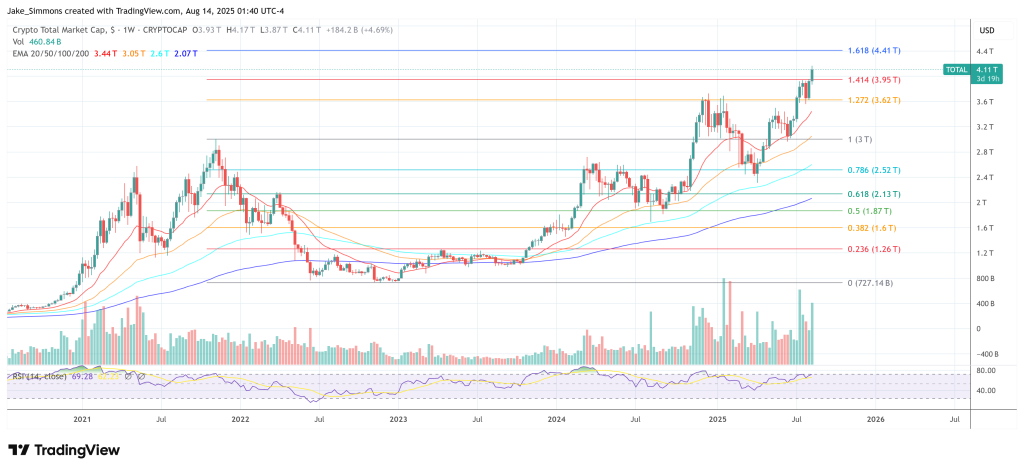
Total crypto market cap
Total crypto market cap, 1-week chart | Source: TOTAL on TradingView.com
Featured image created with DALL.E, chart from TradingView.com
Editorial Process for bitcoinist is centered on delivering thoroughly researched, accurate, and unbiased content. We uphold strict sourcing standards, and each page undergoes diligent review by our team of top technology experts and seasoned editors. This process ensures the integrity, relevance, and value of our content for our readers.

Jake Simmons has been a Bitcoin enthusiast since 2016. Ever since he heard about Bitcoin, he has been studying the topic every day and trying to share his knowledge with others. His goal is to contribute to Bitcoin's financial revolution, which will replace the fiat money system. Besides BTC and crypto, Jake studied Business Informatics at a university. After graduation in 2017, he has been working in the blockchain and crypto sector. You can follow Jake on Twitter at @realJakeSimmons.

Lectures associées

qinbaFrank : Récapitulation et perspectives de la vague de puissance de calcul de l'IA – Des trois grands débats de Nvidia à l'interconnexion optique, l'introduction en bourse de SpaceX, comment les capitaux sont-ils en train de se redéployer ?

Source : Cynthia, Hong Kong Ethereum Community Hub. Invité : qinbaFrank, investisseur en actions américaines et en crypto-marchés secondaires. Lors d'un événement VIP le 8 juin 2026, l'investisseur expérimenté qinbaFrank a partagé son analyse sur la vague de puissance de calcul de l'IA. Il a retracé le parcours du marché depuis 2023, marqué par trois grands débats : sur la nécessité des dépenses d'investissement (2023), sur l'accélération soutenue des dépenses des grandes entreprises technologiques (2024-début 2025), et sur la possible surévaluation de la puissance de calcul (début 2025). Un consensus s'est finalement établi en 2025. Le cadre central de son analyse repose sur le **taux de pénétration** comme clé de l'efficacité commerciale. Contrairement à la bulle Internet de 2000, l'IA bénéficie aujourd'hui d'infrastructures matures (cloud, API) permettant une diffusion et une adoption commerciale beaucoup plus rapides. Le point critique se situe à 10% de pénétration, un seuil déjà dépassé dans les entreprises, signant l'entrée dans une phase de croissance accélérée. La logique commerciale de l'IA diffère de celle d'Internet : elle ne se contente pas de connecter, mais remplace directement le **travail cognitif humain**. Une fois ses capacités dépassant la moyenne humaine, sa valeur commerciale croît de manière exponentielle. L'investissement dans la chaîne d'approvisionnement en puissance de calcul évolue d'une focalisation sur les GPU vers une réévaluation systémique, suivant trois logiques : 1. **Pénurie et tarification** : la demande se propage des GPU à la mémoire (HBM, DRAM), aux CPU pour l'ordonnancement, et enfin à l'alimentation électrique. 2. **Mise à niveau** : les interconnexions optiques (CPO), les réseaux d'alimentation (passage au HVDC 800V) et le packaging avancé (3D) deviennent essentiels pour gagner en efficacité. 3. **Perspective à long terme** : l'informatique en périphérie (edge computing) et l'IA physique (robots, véhicules autonomes) formeront la prochaine courbe de croissance. Le point d'ancrage fondamental pour la poursuite de la tendance est la croissance des **revenus annuels récurrents (ARR) des éditeurs de modèles** et des **revenus cloud** des grands acteurs technologiques. Tant que cette croissance reste soutenue, les dépenses d'investissement et la dynamique de la chaîne logistique restent justifiées. Les ajustements de marché sont alors plus susceptibles d'être des corrections de valorisation (niveau L1/L2) que le renversement d'une tendance structurelle (niveau L3). En conclusion, qinbaFrank considère l'IA non comme une révolution technologique isolée, mais comme une **amélioration fondamentale de la capacité cognitive sous-jacente** de la civilisation, ouvrant la voie à une série de vagues d'innovations (agents, robots, etc.). Le marché suivra une progression en vagues, alternant entre les phases de pénurie, de mise à niveau et de validation commerciale. *Disclaimer : Ce contenu présente les opinions de l'invité et ne constitue pas un conseil en investissement.*

marsbitIl y a 47 mins

qinbaFrank : Récapitulation et perspectives de la vague de puissance de calcul de l'IA – Des trois grands débats de Nvidia à l'interconnexion optique, l'introduction en bourse de SpaceX, comment les capitaux sont-ils en train de se redéployer ?

marsbitIl y a 47 mins

Un pays qui a miné du Bitcoin pendant 8 ans, construit une banque cryptographique qui lui est propre

Un petit pays de l'Himalaya, le Bhoutan, qui mine du Bitcoin depuis 2018, franchit une nouvelle étape dans l'écosystème crypto avec la création de la DK Bank. Située dans la nouvelle cité spéciale de Gakiling (GMC), cette banque agréée a pour objectif de combler le déficit de services bancaires pour les entreprises du secteur, souvent confrontées à des fermetures de comptes par les institutions traditionnelles. La DK Bank se distingue en offrant un compte unifié permettant de gérer simultanément des devises traditionnelles (9 monnaies fiduciaires) et des actifs numériques comme l'USDT ou l'USDC. Elle propose également des services de garde, de prêts gagés sur Bitcoin et des voies de conversion. Pour y parvenir, la banque a dû relever des défis techniques majeurs, notamment l'intégration de systèmes fonctionnant 24h/24 avec l'infrastructure bancaire classique, et mettre en place une solide vérification des clients, surveillant à la fois les flux financiers hors-chaîne et l'historique des portefeuilles sur la blockchain. Ce projet s'inscrit dans la stratégie plus large du Bhoutan et de la zone administrative spéciale de GMC, qui aspire à devenir un hub financier pour l'Asie du Sud. La cité a adopté un cadre réglementaire inspiré de Singapour et d'Abou Dhabi, offrant une voie accélérée d'agrément pour les entreprises déjà licenciées dans ces juridictions, tout en exigeant une présence commerciale réelle pour bénéficier d'avantages fiscaux. Les responsables soulignent que cette initiative n'est pas une spéculation sur le prix du Bitcoin, mais une diversification dans l'infrastructure blockchain (minage, garde, tokenisation d'actifs réels). Ils voient là une opportunité pour les petites nations de construire une souveraineté financière indépendante des grandes puissances. Alors que la ville de GMC est encore en construction, la DK Bank représente la première pierre de cet ambitieux projet visant à attirer les acteurs de la finance numérique avec des valeurs de stabilité et d'inclusion.

Foresight NewsIl y a 1 h

Un pays qui a miné du Bitcoin pendant 8 ans, construit une banque cryptographique qui lui est propre

Foresight NewsIl y a 1 h

Trading

Spot
Futures
活动图片