Dogecoin Bollinger Bands Tell A Bullish Story, Here’s The Level To Watch

bitcoinistPublié le 2025-02-22Dernière mise à jour le 2025-02-22

Résumé

Dogecoin's price action with the Bollinger Bands indicator shows it is now at a junction of either a breakout to...

Dogecoin’s price action with the Bollinger Bands indicator shows it is now at a junction of either a breakout to the upside or another downward move. Technical analysis shows that Dogecoin’s interaction with the Bollinger Bands suggests it could go on a swift upwards move. However, there remains a critical risk factor that the bulls need to keep an eye on.

Dogecoin’s Struggle Around The Middle Bollinger Band

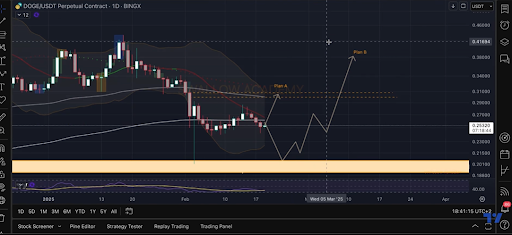
Dogecoin’s price action with the Bollinger Bands was noted on the TradingView platform by crypto analyst SwallowAcademy. SwallowAcademy’s analysis highlights that since the start of February, Dogecoin has been trading within the Bollinger bands, but not without turbulence. A price crash in early February saw Dogecoin break below the lower Bollinger band on February 3 with a strong wick. However, it has since recovered and is now back trading within the Bollinger bands. 

Typically, such a move is followed by a rally toward the middle Bollinger band, which has indeed happened. Instead of continuing into a full-fledged bullish trend, DOGE has faced resistance at the middle band. This shows that there’s either a lingering selling pressure or a lack of strong buying pressure. 
Dogecoin
DOGE trending inside the bollinger band | Source: SwallowAcademy on Tradingview

This behavior is unusual compared to Dogecoin’s price action this cycle, where it would typically see a reversal to the middle band and then a continued move toward the upper Bollinger band. Instead, the cryptocurrency remains stuck around the middle band, struggling to break through convincingly. As noted by the analyst, the key test now is whether the meme coin can break past this resistance, which could cause a rally of at least 15%.

The Danger Level To Watch For DOGE Bulls

The bullish plan is for Dogecoin to break above the middle Bollinger band and then aim for the upper band. If Dogecoin manages to hold support and push beyond the middle Bollinger band resistance, the bullish outlook remains intact. Breaking past this level would likely cause a return above $0.30. From here, there could be a stronger move toward the $0.40 price level, which would then confirm a continuation of the larger uptrend. However, there is a critical risk factor that bulls need to keep an eye on.

There’s a possibility of a deeper retest before a major breakout that cannot be ignored. The analyst noted that following Dogecoin’s explosive breakout in November 2024, there was no proper retest of a key resistance zone within that rally. As is the nature of cryptocurrencies, such gaps tend to get revisited, meaning there is a possibility that DOGE could decline to retest the unfilled order block.

If this scenario plays out, Dogecoin could drop to as low as $0.20 again. A successful retest of this zone could then lay the foundation for a significant breakout to the predicted $0.4 target.

At the time of writing, DOGE is trading at $0.2534.

Dogecoin
DOGE trading at $0.25 on the 1D chart | Source: DOGEUSDT on Tradingview.com
Featured image from Adobe Stock, chart from Tradingview.com
Scott Matherson

Scott Matherson

Scott Matherson is a leading crypto writer at Bitcoinist, who possesses a sharp analytical mind and a deep understanding of the digital currency landscape. Scott has earned a reputation for delivering thought-provoking and well-researched articles that resonate with both newcomers and seasoned crypto enthusiasts. Outside of his writing, Scott is passionate about promoting crypto literacy and often works to educate the public on the potential of blockchain.

Lectures associées

Compte à rebours de la loi CLARITY : Si elle n'est pas adoptée avant la pause d'août, quel impact sur le marché des cryptos ?

Le projet de loi CLARITY, visant à établir un cadre réglementaire clair pour les crypto-actifs aux États-Unis, est dans une course contre la montre. Il doit passer plusieurs étapes cruciales avant la suspension des travaux du Sénat le 10 août, nécessitant notamment 60 voix et une réconciliation avec d'autres textes. Les probabilités de passage cette année sont estimées bas, autour de 40%. Les négociations sont bloquées sur deux points : une clause éthique concernant les détentions de cryptos des élus et une clause de protection des développeurs, suscitant l'opposition des groupes de police. Un échec avant la trêve d'août prolongerait l'incertitude réglementaire. Le marché réagirait probablement par une sortie lente des capitaux, notamment des ETF spot, comme observé en juin avec des sorties record des ETF Bitcoin. Le XRP, qui bénéficierait le plus de la loi pour sa classification en tant que matière première, pourrait perdre une prime de valorisation. Le Bitcoin et l'Ether, déjà classés comme matières premières par des agences, seraient moins directement impactés, mais l'innovation dans la DeFi resterait entravée. Si la loi n'est pas adoptée cette année, le processus devra repartir de zéro avec le nouveau Congrès en 2027, retardant d'autant la clarté tant attendue par les investisseurs institutionnels.

marsbitIl y a 13 mins

Compte à rebours de la loi CLARITY : Si elle n'est pas adoptée avant la pause d'août, quel impact sur le marché des cryptos ?

marsbitIl y a 13 mins

L'impact de l'OUSD sur Circle, Tether et Paxos : Pas simplement une nouvelle négative, mais une recomposition concurrentielle plus complexe

**Résumé : L'impact d'OUSD sur Circle, Tether et Paxos est complexe, marquant une intensification de la concurrence plutôt qu'une simple menace.** * **Circle (USDC) :** La réaction du marché (baisse de 15-20% du cours CRCL) est raisonnable, mais ne sonne pas le glas pour Circle. La société conserve des atouts majeurs : liquidité profonde, intégrations existantes et avantage du premier mouvement. Une révision de l'accord avec Coinbase pourrait même doubler ses revenus nets à court terme et lui offrir plus de latitude concurrentielle. Cependant, OUSD pourrait devenir le stablecoin par défaut dans l'écosystème Stripe, grâce aux forces techniques et produits de ce dernier. Circle doit accélérer le développement de ses services de paiement et fintech et envisager des acquisitions défensives. * **Tether (USDT) :** OUSD ne cible pas son marché cœur. Tether devrait continuer à se concentrer sur des canaux de distribution non prioritaires pour Stripe et Circle. Sa part de marché pourrait diminuer à long terme, mais dans un marché global en forte croissance. * **Paxos (USDP) :** La pression est plus forte. OUSD érode le principal avantage de USDG (partage des revenus). De plus, l'avantage réglementaire de Paxos pourrait s'atténuer avec la clarification des cadres juridiques. Le défi pour Paxos est plus existentiel, ce qui explique son recentrage sur les services de courtage. **Obstacle persistant :** Pour une adoption massive par les entreprises, la question de la confiance dans l'émetteur (ni Circle ni Bridge n'ont une notation de crédit "investment grade") n'est pas résolue par OUSD. Les grandes banques et asset managers restent des concurrents potentiels pour les cas d'usage les plus lucratifs.

链捕手Il y a 17 mins

L'impact de l'OUSD sur Circle, Tether et Paxos : Pas simplement une nouvelle négative, mais une recomposition concurrentielle plus complexe

链捕手Il y a 17 mins

Trading

Spot
活动图片