Telegram CEO Pavel Durov’s Arrest: Experts Assess The Impact On Crypto

bitcoinistPublié le 2024-08-27Dernière mise à jour le 2024-08-28

Résumé

On August 24, Pavel Durov, co-founder and CEO of Telegram, was arrested in France, sending immediate shockwaves through the crypto...

On August 24, Pavel Durov, co-founder and CEO of Telegram, was arrested in France, sending immediate shockwaves through the crypto market as the value of Toncoin (TON) plunged. The arrest is notably significant given Telegram’s central role in the crypto industry as a primary hub for communications. However, the implications could be even more far-reaching.

Crypto Experts React To Telegram CEO Arrest

The charges against the Telegram CEO Durov are severe and numerous, encompassing a range of illegal activities allegedly facilitated by Telegram’s platform. These include complicity in allowing the platform to be used for illegal transactions, refusal to cooperate with law enforcement by not providing necessary data for lawful intercepts, and involvement in distributing and maintaining illicit content.

The breadth and severity of these charges have led to a swift and vocal response from the crypto and tech communities, concerned about the implications for privacy and regulatory overreach.

Wayne Vaughan, CEO of Tierion, framed the situation as a direct challenge to the crypto ethos, stating, “Telegram’s CEO is being charged for using cryptography without government approval. This should concern everyone in Bitcoin and crypto—no one should need government permission to do math.”

Scott Melker, a well-known crypto analyst, emphasized that Durov’s case might signal a worrying trend where developers are held accountable for the uses of their platforms, suggesting that “Durov is basically being charged for starting an encrypted platform and not policing its usage.”

Remarkably, the US government has taken similar action against the privacy-oriented Bitcoin wallets Samourai and Wasabi this year. The US Department of Justice (DOJ) charged the founders with “conspiracy to commit money laundering and conspiracy to operate an unlicensed money-transmitting business.”

Durov’s arrest has stirred a broader debate about the future of technology and encryption. Andy Yen, founder and CEO of Proton, pointed to the potential chilling effects on tech innovation, particularly in France, labeling the legal actions as “economic suicide” for French tech ambitions. “The unsealed charges against Durov are insane. […] I don’t see how tech founders could possibly travel to France, much less hire in France. This is economic suicide and is rapidly and permanently changing the perception of founders and investors,” Yen remarked via X.

Vitalik Buterin, the founder of Ethereum, while previously critical of Telegram’s approach to encryption, expressed grave concerns about the implications for communications freedom in Europe. Buterin noted that the charges against Durov, focused primarily on the lack of moderation and data provision, represent a significant threat to the foundational principles of software freedom in the region. “This looks very bad and worrying for the future of software and comms freedom in Europe,” Buterin said.

Lyudmyla Kozlovska, President of the Open Dialogue Foundation, warned of the broader stakes involved, particularly the need to defend against regulatory and governmental overreach that targets the crypto and tech sectors. She warned that without robust protections, privacy and encryption might soon be treated as criminal activities under regulatory frameworks similar to those being applied to Durov.

“Every time when I was said ‘bitcoin doesn’t care’ I was telling that we need to protect and PREVENT attacks against developers, investors, end-users and entire ecosystem of Bitcoin, including miners. Case of Durov is a bright example what we can expect if technology is labeled with negative language by regulators in western countries, especially EU,” she stated.

Kashif Raza, the founder of Bitinning, drew parallels between Durov’s arrest and a hypothetical scenario involving Satoshi Nakamoto. “The arrest of Pavel Durov just tells you what they would have done to Satoshi Nakamoto?? They are against everything that promotes FREE SPEECH. Pavel Durov’s arrest is an advertisement for the importance of Bitcoin.”

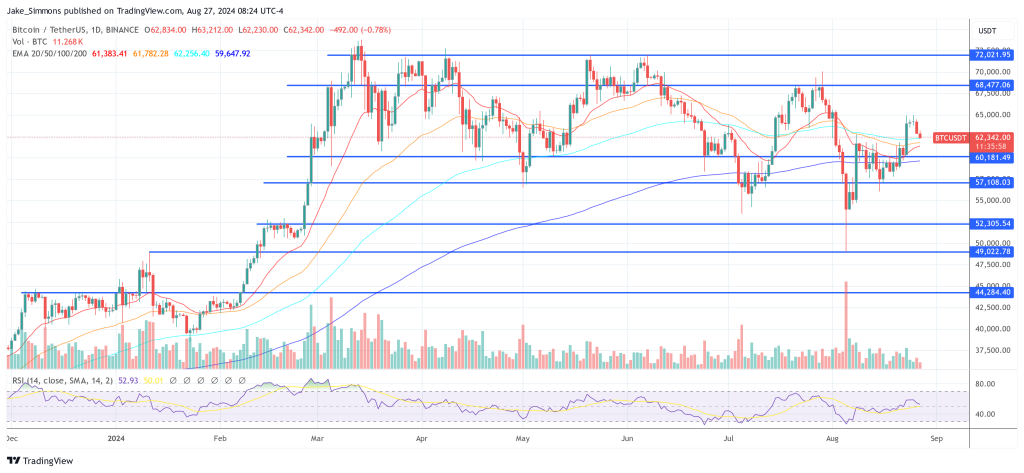
At press time, Bitcoin traded at $62,342.
Bitcoin price
Bitcoin price, 1-day chart | Source: BTCUSDT on TradingView.com
Featured image from yuz.uz, chart from TradingView.com
Jake Simmons

Jake Simmons

Jake Simmons has been a Bitcoin enthusiast since 2016. Ever since he heard about Bitcoin, he has been studying the topic every day and trying to share his knowledge with others. His goal is to contribute to Bitcoin's financial revolution, which will replace the fiat money system. Besides BTC and crypto, Jake studied Business Informatics at a university. After graduation in 2017, he has been working in the blockchain and crypto sector. You can follow Jake on Twitter at @realJakeSimmons.

Lectures associées

Il y a quelques instants, DeepSeek V4 a mis à jour DSpark, augmentant la vitesse d'inférence de 80 %

DeepSeek a annoncé une mise à jour majeure de son modèle DeepSeek-V4-Pro avec le lancement de DSpark, un nouveau cadre de décodage spéculatif (Speculative Decoding) open source, accompagné de l'infrastructure complète DeepSpec. Cette mise à jour, axée sur l'ingénierie et non sur les capacités fondamentales du modèle, vise à accélérer considérablement l'inférence des LLM en production. Le cœur de DSpark est l'introduction d'une **génération semi-autorégressive**. Cela combine la génération parallèle à haut débit d'un modèle "brouillon" léger avec une modélisation des dépendances entre tokens pour améliorer le taux d'acceptation. De plus, un système de **vérification planifiée par confiance et conscient du matériel** (Confidence-Scheduled Verification) évalue dynamiquement la probabilité que chaque token généré soit accepté par le modèle cible. Il adapte ainsi la longueur de vérification en temps réel pour optimiser l'utilisation des ressources GPU, notamment en charge élevée. Les résultats sont significatifs : face aux méthodes de pointe comme Eagle3 et DFlash, DSpark augmente la longueur moyenne de tokens acceptés de 26.7% à 30.9% et de 16.3% à 18.4% respectivement sur les modèles Qwen3. En déploiement réel, par rapport à la génération token par token précédente (MTP-1), **DSpark améliore la vitesse de génération pour l'utilisateur de 60% à 85% pour le modèle Flash et de 57% à 78% pour le modèle Pro**, à débit total constant. Le projet open source **DeepSpec** fournit une stack complète pour entraîner et évaluer des modèles brouillons pour le décodage spéculatif, supportant actuellement les algorithmes DSpark, DFlash et Eagle3, ainsi que les familles de modèles cibles Qwen3 et Gemma.

marsbitIl y a 48 mins

Il y a quelques instants, DeepSeek V4 a mis à jour DSpark, augmentant la vitesse d'inférence de 80 %

marsbitIl y a 48 mins

BIT Recherche : La réduction de moitié en 2028 n'est pas une fin en soi, le véritable remodelage de l'industrie minière du Bitcoin ne fait que commencer

L'industrie du minage de Bitcoin traverse actuellement l'ajustement structurel le plus complexe depuis la création du protocole. Malgré un prix du Bitcoin d'environ 61 000 $ et une puissance de calcul (hashrate) proche du record historique à 1 ZH/s, la rentabilité des mineurs se détériore. Plusieurs indicateurs montrent que le secteur fonctionne près du seuil de rentabilité, et le prochain halving de 2028 pourrait accélérer la consolidation. Les problèmes ne viennent pas seulement de la future réduction des récompenses de bloc, mais aussi de la transition incomplète vers un modèle de revenus basé sur les frais de transaction. De plus en plus d'entreprises minières évoluent de simples producteurs de Bitcoin vers des opérateurs d'infrastructures, d'énergie et de calcul pour l'IA/le HPC. La compétition se déplace ainsi de l'expansion de la puissance de calcul vers l'innovation des modèles économiques. Le modèle de coût de production indique un plancher actuel d'environ 46 744 $. Fait notable, les revenus des mineurs divergent historiquement du prix du Bitcoin. Alors que les revenus théoriques journaliers devraient être d'environ 78 millions de $, ils ne sont en réalité que de 33 millions de $. Les revenus provenant des frais sont également bas, à environ 220 000 $ par jour. En 2025, le coût de l'électricité a représenté 71,5% des revenus totaux des mineurs. Le prix d'équilibre pour le secteur est estimé à environ 65 000 $, rendant le minage seul peu rentable au prix actuel. Après le halving de 2028, le coût de production plancher pourrait atteindre ~93 289 $, favorisant les grandes entreprises aux ressources diversifiées. En conclusion, le secteur transforme son modèle fondamental : du "minage" vers les "infrastructures". La rentabilité future dépendra de la diversification des revenus, notamment via la gestion énergétique et l'hébergement de calcul IA/HPC. Pour les investisseurs, l'enjeu clé est d'identifier les entreprises capables de réussir cette transition et de bâtir un avantage compétitif résilient.

marsbitIl y a 2 h

BIT Recherche : La réduction de moitié en 2028 n'est pas une fin en soi, le véritable remodelage de l'industrie minière du Bitcoin ne fait que commencer

marsbitIl y a 2 h

Trading

Spot
活动图片