The Rainmakers of the Crypto Market

Token TerminalPublié le 2024-06-17Dernière mise à jour le 2024-08-23

Introduction

This week’s newsletter focuses on protocols (blockchains & decentralized applications) that generate the most fees. Understanding which protocols that generate the most fees is interesting for a few different reasons:

  1. Which protocols' services are users willing to pay for?
  2. What services do these protocols provide and how do they charge their users (business model)?
  3. How much are the users actually paying?
  4. Are some market sectors more popular than others?
  5. Is there a dominant protocol within these market sectors?

We’ll learn that analyzing only one chart from the Terminal can tell us a lot about the industry dynamics in the crypto market.

Let’s dive in!


1. Top fee-generating protocols with a highlight on Blockchains
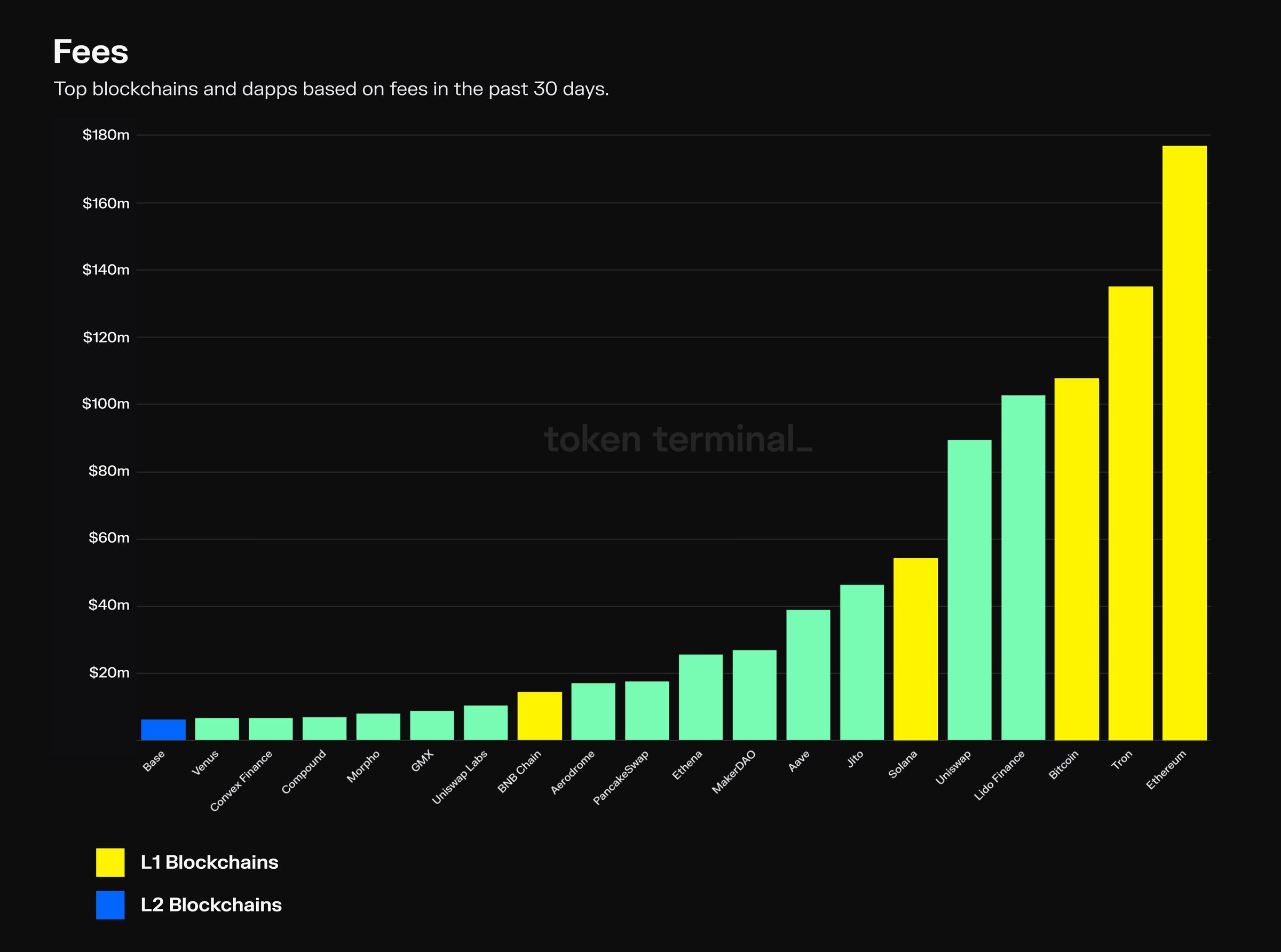
Highlighted protocols: Ethereum, Tron, Bitcoin, Solana, BNB Chain, and Base.

A majority of Fees is generated by general-purpose blockchains

  • Of the top 20, 5 are L1 blockchains, while only 1 is an L2 blockchain.
  • In the past 30 days, Ethereum generated the most Fees (~$180M). It’s worth highlighting that Base, despite the relatively low average transaction fee of ~$0.03 (compared to ~$4.5 on the Ethereum L1), still places among the top 20 because of the surge in user activity on the L2.
  • Outside of L1 & L2 blockchains, all the other protocols in the top 20 belong to the DeFi category.

2. Top fee-generating protocols with a highlight on Lido Finance and Jito
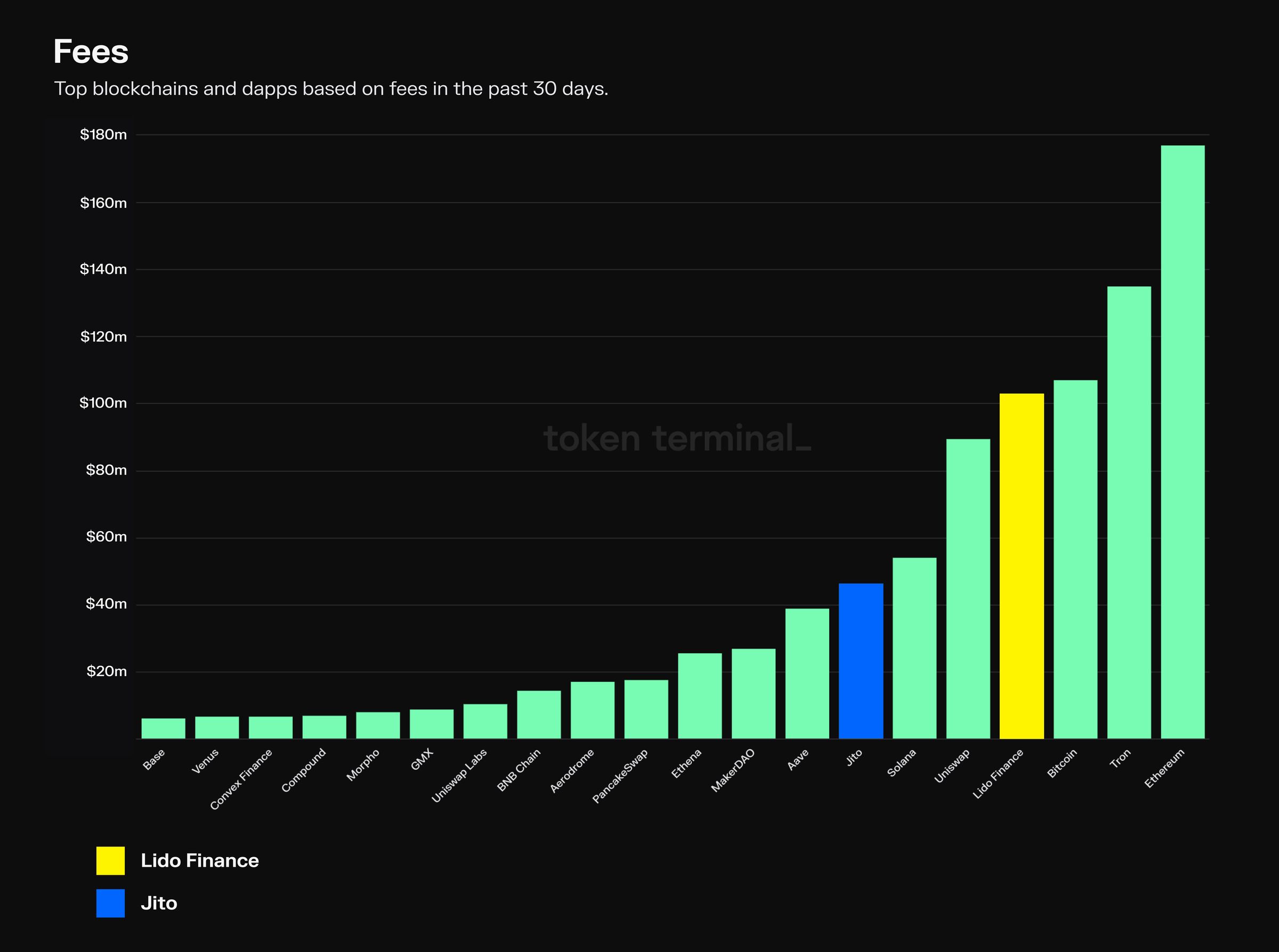
Highlighted protocols: Lido Finance and Jito.

Lido generates the most Fees out of all applications in crypto

  • Jito runs 2 different businesses: liquid staking (JitoSOL) and an MEV marketplace. The former monetizes via an AUM based management fee, and the latter by a take rate on the MEV tips paid to validators (the above chart includes only the MEV tips). Lido runs 1 business: liquid staking. It monetizes by charging a take rate on the staking rewards it earns for its depositors.
  • Lido generates ~2x in Fees compared to Jito, but Jito is growing faster.
  • Lido has $33.5B in Assets staked, whereas Jito has $1.6B. Lido’s fully diluted market cap is $1.9B, whereas Jito’s is $2.5B.

3. Top fee-generating protocols with a highlight on Exchanges (DEX)
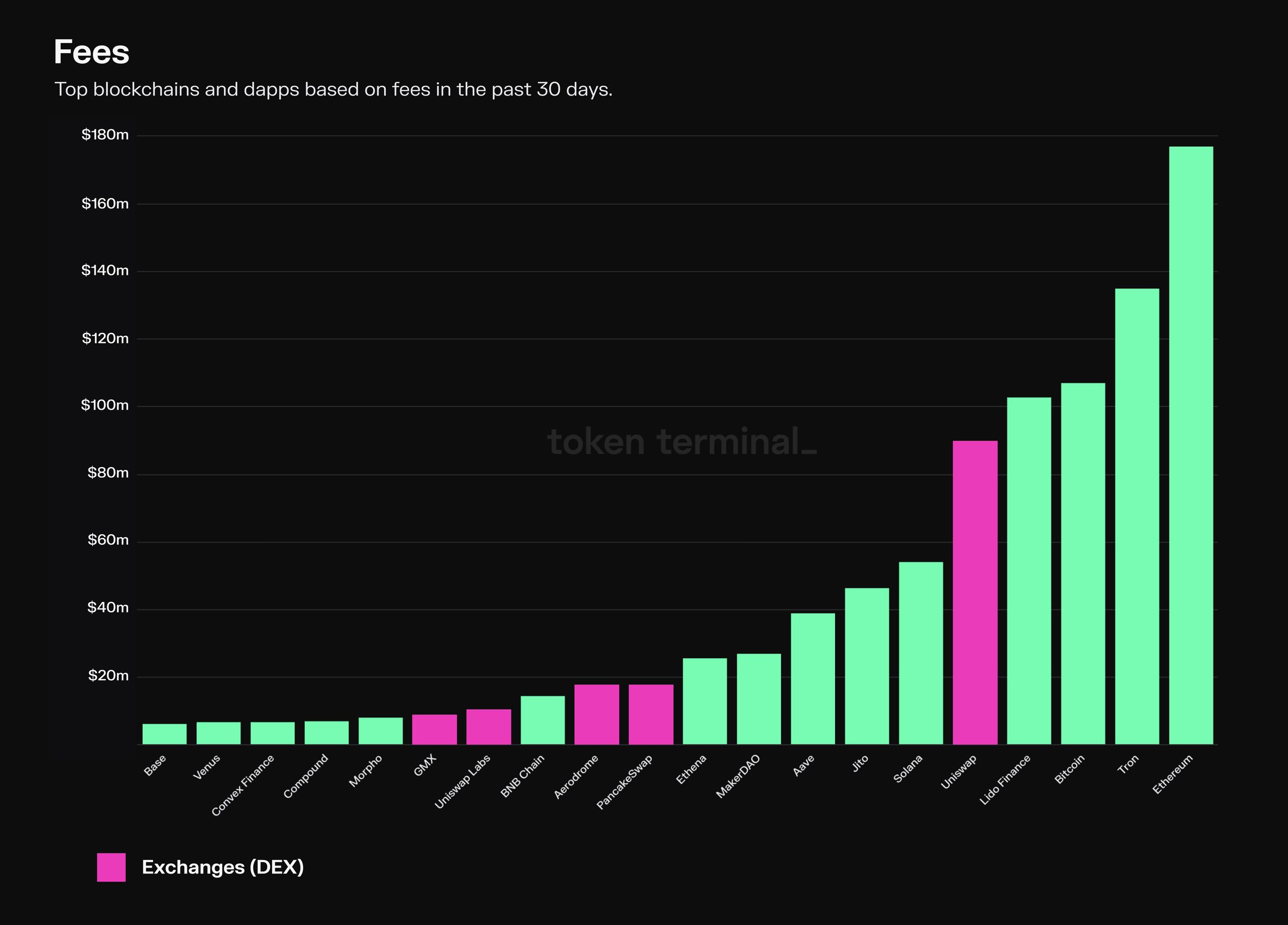
Highlighted protocols: Uniswap, PancakeSwap, Aerodrome, Uniswap Labs, and GMX.

The Uniswap DAO dominates the DEX category with monthly Fees nearing $100M

  • The Uniswap DAO generates the most Fees among DEXs. Note that Uniswap Labs is included as a separate entity, it monetizes by charging users who access the Uniswap Protocol through the official Uniswap Labs frontend application.
  • Uniswap DAO generates over ~2x in Fees compared to all the other DEXs in the top 20.
  • Aerodrome, a Base-native DEX, generates ~2x more fees than its underlying L2 blockchain.

4. Top fee-generating protocols with a highlight on MakerDAO and Ethena
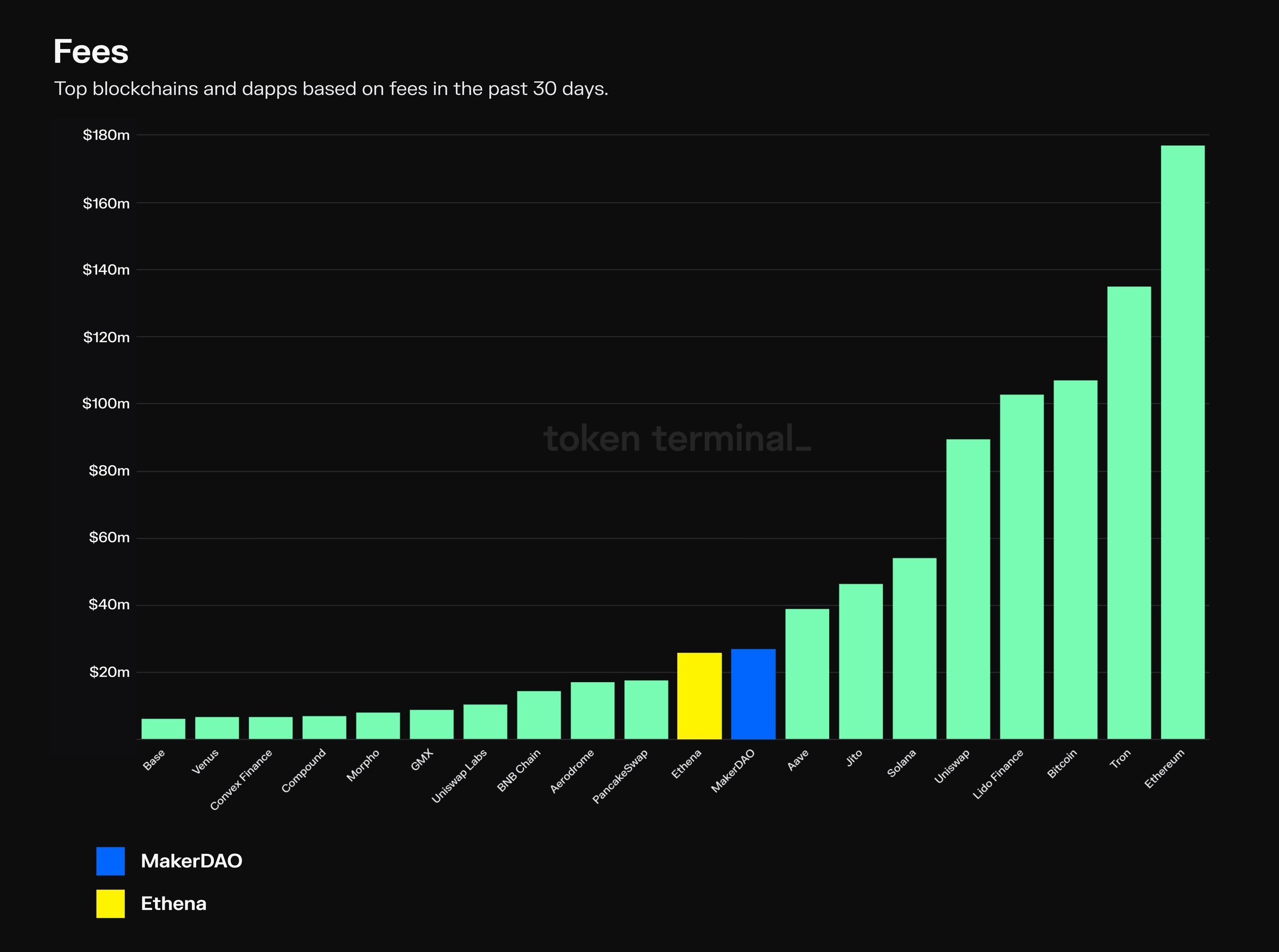
Highlighted protocols: MakerDAO and Ethena.

Ethena is on track to overtake MakerDAO in Fees

  • MakerDAO and Ethena dominate the decentralized Stablecoin issuers category.
  • The biggest stablecoin issuers, Tether (USDT) and Circle (USDC) are not included as they earn their Fees & Revenue offchain.
  • Ethena was launched in November 2024, whereas MakerDAO was launched already in November 2017.

5. Top fee-generating protocols with a highlight on Lending protocols
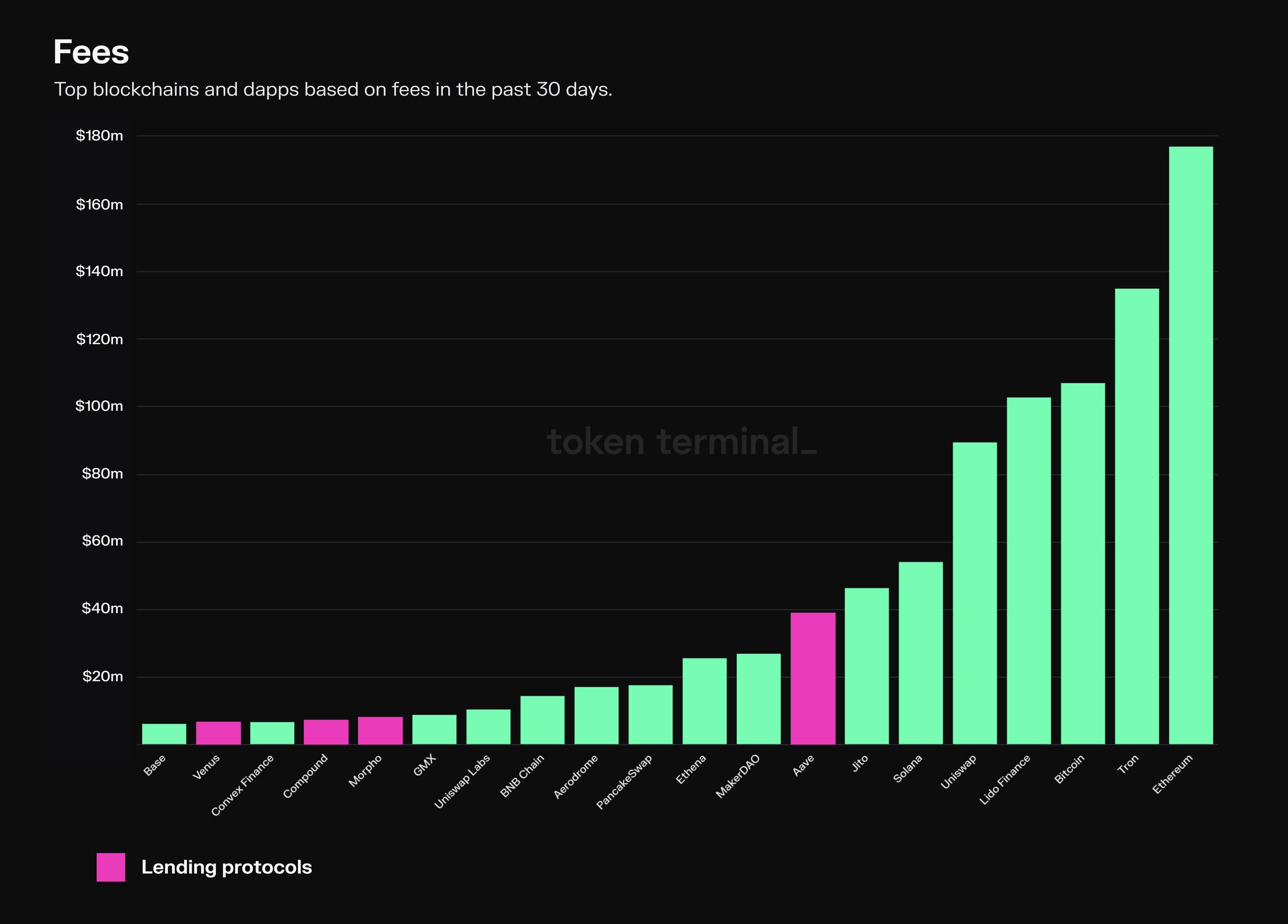
Highlighted protocols: Aave, Morpho, Compound, and Venus.

Aave is the 4th most fee-generating application in crypto

  • Aave is the clear market leader in the lending category, with a ~$30M Fee gap to Morpho, which comes in 2nd place in the lending market sector.
  • Compound and Aave both launched in 2020, but Aave has since managed to outcompete Compound in terms of Active loans and Fees.
  • Despite Aave’s dominance in the lending category, Venus stands out as the clear market leader for lending on the BNB Chain. Right now, ~90% of Venus’ Fees are generated from its deployment on the BNB Chain.

6. Top fee-generating protocols; breakdown by chain
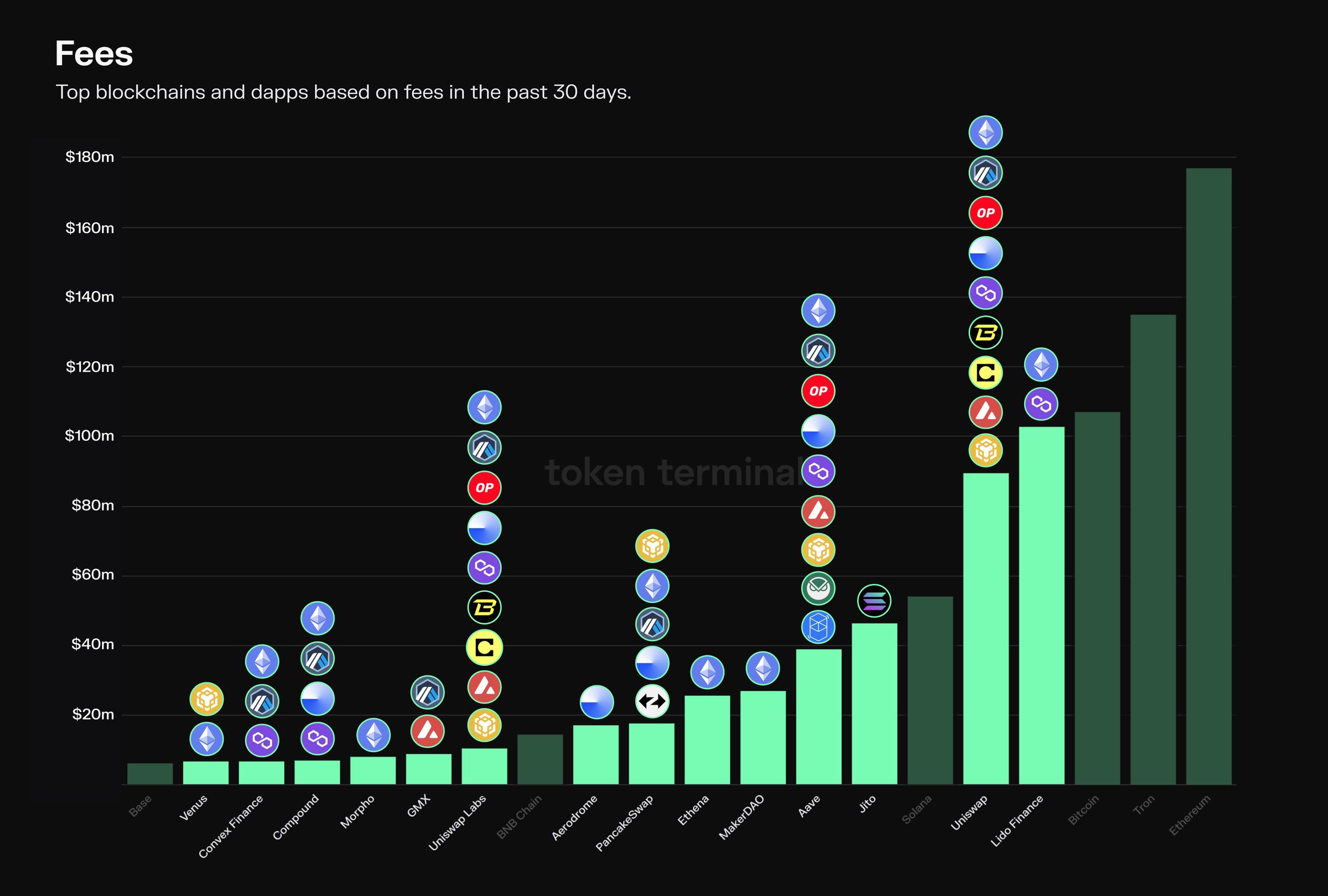
Highlighted which blockchains the applications are deployed to.

Most of the top fee-generating applications are deployed to multiple blockchains

  • A vast majority of the top 20 fee-generating applications in crypto have a deployment on Ethereum (L1 and L2s).
  • It is worth noting that asset issuers (Stablecoin issuers and Liquid staking providers) tend to be governed from a single chain, while their core product (stablecoin or LST) is made available as a bridged asset on multiple other chains.
  • Of the top 20, Aerodrome is the only application that has been launched from an L2 blockchain (Base).

FAQ

What are Fees?

  • The aggregate fees paid by the end users of the protocol’s service.
  • The methodology for Fees varies between Market sectors, because protocol’s in different Market sectors tend to have different business models:
    • Blockchains L1 & L2 = sell blockspace for transaction fees
    • Liquid staking = invest users’ stake to earn staking rewards
    • Exchange (DEX, Derivatives) = enable asset exchange against trading fees
    • Lending = provide loans against interest payments
    • Stablecoin issuers = provide access to USD against interest payments and/or invest user deposits to earn yield
    • Asset management = invest user deposits to earn yield

What’s the difference between Fees and Revenue?

  • Revenue is calculated based on the take rate (%) that the protocol applies to Fees.
  • The take rate can be anything between 0-100%.
  • Currently, the Uniswap DAO and Bitcoin both have a take rate of 0%, whereas Ethereum tends to have a take rate of ~80%.

What’s the difference between Revenue and Earnings?

  • Earnings is calculated by subtracting (i) Token incentives and (ii) Operating expenses from the Revenue.
    • Token incentives = an indication of how much the protocol spends on user acquisition. It’s calculated as the USD value of the protocol’s native tokens that have been distributed to users.
    • Operating expenses = an indication of how much the protocol spends on personnel and infrastructure to develop, maintain, and improve the protocol.
      • Note that a vast majority of protocols do not post their Operating expenses onchain, which is why that metric is yet to be added for most protocols.

When should you look at Fees vs. Revenue or Earnings?

  • As a rule of thumb, investors should pay attention to Fees for early-stage protocols that have not started to monetize yet, and Revenue and/or Earnings for protocols that have started to monetize:
    • Early-stage: Fees, indicates that the protocol has paying customers.
    • Later-stage: Revenue, indicates that the protocol is able to monetize its paying customers.
    • Mature-stage: Earnings, indicates that the protocol is able to return value to its tokenholders.
  • It’s also important to look at the ratios between:
    • Revenue / Fees = ideally, the protocol has so much leverage over its supply-side (LPs) that it can charge a high take rate on the Fees.
    • Earnings / Revenue = ideally, the protocol operates with a (i) low user acquisition spend, and (ii) operational overhead, which leads it to retain a high % of Revenue as Earnings.

The authors of this content, or members, affiliates, or stakeholders of Token Terminal may be participating or are invested in protocols or tokens mentioned herein. The foregoing statement acts as a disclosure of potential conflicts of interest and is not a recommendation to purchase or invest in any token or participate in any protocol. Token Terminal does not recommend any particular course of action in relation to any token or protocol. The content herein is meant purely for educational and informational purposes only, and should not be relied upon as financial, investment, legal, tax or any other professional or other advice. None of the content and information herein is presented to induce or to attempt to induce any reader or other person to buy, sell or hold any token or participate in any protocol or enter into, or offer to enter into, any agreement for or with a view to buying or selling any token or participating in any protocol. Statements made herein (including statements of opinion, if any) are wholly generic and not tailored to take into account the personal needs and unique circumstances of any reader or any other person. Readers are strongly urged to exercise caution and have regard to their own personal needs and circumstances before making any decision to buy or sell any token or participate in any protocol. Observations and views expressed herein may be changed by Token Terminal at any time without notice. Token Terminal accepts no liability whatsoever for any losses or liabilities arising from the use of or reliance on any of this content.

Stay in the loop

Join our mailing list to get the latest insights!

Email
Sign up

Cryptos en tendance

Lectures associées

Analyse de rapport : Les revenus d'IA de TSMC doubleront d'ici 2027, la capacité de production CoWoS reste le principal goulot d'étranglement

L'analyse de Morgan Stanley (23 juin) prévoit une croissance explosive des revenus liés à l'IA pour TSMC, atteignant 86,3 milliards de dollars en 2027, soit plus du triple par rapport aux 27,1 milliards de dollars estimés en 2026. Cette croissance est tirée par les GPU (28 G$), les puces IA sur mesure (18 G$) et, de manière significative, par l'emballage avancé CoWoS (40 G$). Nvidia reste le principal moteur de demande pour CoWoS, mais AMD (CPU Venice et GPU MI400) et les TPU de Google (via MediaTek et Broadcom) émergent comme de nouveaux moteurs de croissance forts. Malgré les plans d'expansion de TSMC portant la capacité mondiale de CoWoS à environ 280 000 tranches/mois d'ici fin 2027, la demande mondiale devrait atteindre 269,4 millions de tranches/an, créant une tension persistante, particulièrement pour les technologies les plus avancées comme le CoWoS-L essentiel pour Nvidia. Cette pénurie maintient le pouvoir de fixation des prix de TSMC. Des catalyseurs comme l'amélioration de l'approvisionnement en substrats ABF, la montée en puissance des nouveaux CPU (Vera, Venice) et la production de la future plateforme Rubin de Nvidia devraient soutenir la demande. MediaTek (partenaire de Google), ASE et KYEC sont identifiés comme des gagnants clés de la chaîne d'approvisionnement. En résumé, la croissance de l'IA de TSMC semble assurée, mais la capacité de production, surtout en emballage avancé, reste le facteur limitant critique.

marsbitIl y a 14 mins

Analyse de rapport : Les revenus d'IA de TSMC doubleront d'ici 2027, la capacité de production CoWoS reste le principal goulot d'étranglement

marsbitIl y a 14 mins

Citrini Research : Les 5 grands thèmes d'investissement cachés par le trading de l'IA

Lorsque l’attention du marché est entièrement captée par l’IA et les semi-conducteurs, d’autres thèmes d’investissement porteurs sont négligés. Citrini Research identifie cinq opportunités moins médiatisées : 1. **Compagnies aériennes** : Delta et United, pénalisées depuis 18 mois par des facteurs macroéconomiques (tarifs, pétrole), présentent une solide croissance tirée par la montée en gamme et la demande de voyages (Coupe du Monde 2026). 2. **Immobilier pour seniors** : Portée par le vieillissement démographique (les +80 ans augmenteront de 56% en 10 ans), la demande dépasse largement l’offre. Des sociétés comme Welltower et Brookdale en bénéficient. 3. **Divertissement en direct** : Une classe d’actifs performante, car "être présent" devient un luxe. Les franchises sportives, salles de concert (TKO Group) et cinémas premium (IMAX, Cinemark) en profitent. 4. **Concurrence boursière** : Le quasi-monopole du CME sur les dérivés de taux est contesté par FMX, soutenu par de grandes banques, grâce à des frais plus bas et une infrastructure fiable. 5. **Fintechs en reprise** : Après une forte correction en 2026, des acteurs comme SoFi (avec son stablecoin), Robinhood (en transformation) et Upstart montrent des signes de rebond sur l’amélioration de leurs fondamentaux. L’idée centrale : dans un marché saturé par le trade IA, le plus grand alpha pourrait se trouver dans ces thèmes sous-modélisés où l’écart entre attentes basses et réalité s’améliore crée des opportunités.

marsbitIl y a 34 mins

Citrini Research : Les 5 grands thèmes d'investissement cachés par le trading de l'IA

marsbitIl y a 34 mins

Les « retail investors » de Reddit « sauvent » le géant américain de la restauration rapide WEN, l'action bondit de 42 % en une journée, le phénomène s'étend aux meme coins en chaîne

Le titre de l'article : Les investisseurs individuels de Reddit « sauvent » le géant américain de la restauration rapide WEN, le cours de l'action bondit de 42% en un jour avant de se propager à un Meme en ligne. Résumé en français : La chaîne de restauration rapide Wendy's (WEN) a vu son action bondir de 42% en intraday et clôturer en hausse d'environ 26% mercredi. Ce mouvement a été déclenché par un post populaire sur le forum Reddit WallStreetBets, intitulé « We need to save Wendy's », qui a incité un afflux massif d'investisseurs particuliers. Le volume d'échanges a dépassé 200 millions d'actions, soit plus de 20 fois la moyenne quotidienne. Un taux de vente à découvert élevé, estimé à environ 34%, a créé les conditions propices à un squeeze. Parallèlement, la ferveur s'est propagée à la cryptomonnaie. Un meme coin homonyme « WEN », sans lien avec l'entreprise, a été créé sur Solana. Son marché a explosé, atteignant une capitalisation de 439 000 $ en 24 heures, soit une hausse de plus de 1450%. L'engouement n'est pas uniquement spéculatif. Des éléments fondamentaux soutiennent la narration : la nomination d'un nouveau directeur financier ayant un passé de succès avec le PDG, ainsi que des rumeurs de privatisation portées par le principal actionnaire activiste, Nelson Peltz. Le mouvement a également entraîné d'autres valeurs du secteur, comme Jack in the Box. Ce phénomène rappelle l'épisode GameStop de 2021, où les communautés en ligne ciblent des actions fortement vendues à découvert et reconnaissables, avant que le récit ne migre vers l'espace crypto.

marsbitIl y a 54 mins

Les « retail investors » de Reddit « sauvent » le géant américain de la restauration rapide WEN, l'action bondit de 42 % en une journée, le phénomène s'étend aux meme coins en chaîne

marsbitIl y a 54 mins

Super puissant, une explosion spirale, les résultats de Micron rallument la longue période haussière des semi-conducteurs

**Résumé en français :** Les résultats du troisième trimestre 2026 de Micron ont largement dépassé les attentes les plus optimistes, avec un chiffre d'affaires de 41,456 milliards de dollars (soit +346 % en glissement annuel) et un bénéfice net multiplié par près de 15. Les prévisions pour le T4, à environ 50 milliards de dollars, sont également très au-dessus des anticipations du marché. Cette performance exceptionnelle est principalement tirée par la demande IA, qui impacte désormais toute la chaîne de valeur du stockage. Au-delà des mémoires HBM (dont la capacité 2026 est entièrement vendue), les segments DRAM, SSD d'entreprise et NAND connaissent une forte croissance et des tensions d'approvisionnement. Un point capital est la signature par Micron de 16 accords stratégiques à long terme (SCA) avec des clients, la plupart d'une durée de 5 ans, certains allant jusqu'en 2030. Ces contrats, de type « take-or-pay » avec des garanties financières, couvrent déjà 20 % des volumes DRAM et un tiers du NAND, assurant un revenu garanti d'environ 100 milliards de dollars. Pour répondre à cette demande sécurisée, Micron prévoit des dépenses d'investissement massives, avec environ 10 milliards de dollars prévus pour le seul T4, concentrés sur les capacités de production HBM, DRAM avancé et packaging. Ces résultats ont relancé l'optimisme sur l'ensemble du secteur semiconducteur, confirmant que le cycle d'infrastructure IA est encore à un stade précoce et que le stockage en est un acteur central.

Odaily星球日报Il y a 1 h

Super puissant, une explosion spirale, les résultats de Micron rallument la longue période haussière des semi-conducteurs

Odaily星球日报Il y a 1 h

Trading

Spot
Futures

Articles tendance

Comment acheter TOP

Bienvenue sur HTX.com ! Nous vous permettons d'acheter TOP AI Network (TOP) de manière simple et pratique. Suivez notre guide étape par étape pour commencer votre parcours crypto.Étape 1 : Création de votre compte HTXUtilisez votre adresse e-mail ou votre numéro de téléphone pour ouvrir un compte sur HTX gratuitement. L'inscription se fait en toute simplicité et débloque toutes les fonctionnalités.Créer mon compteÉtape 2 : Choix du mode de paiement (rubrique Acheter des cryptosCarte de crédit/débit : utilisez votre carte Visa ou Mastercard pour acheter instantanément TOP AI Network (TOP).Solde :utilisez les fonds du solde de votre compte HTX pour trader en toute simplicité.Prestataire tiers :pour accroître la commodité d'utilisation, nous avons ajouté des modes de paiement populaires tels que Google Pay et Apple Pay.P2P :tradez directement avec d'autres utilisateurs sur HTX.OTC (de gré à gré) : nous offrons des services personnalisés et des taux de change compétitifs aux traders.Étape 3 : stockage de vos TOP AI Network (TOP)Après avoir acheté vos TOP AI Network (TOP), stockez-les sur votre compte HTX. Vous pouvez également les envoyer ailleurs via un transfert sur la blockchain ou les utiliser pour trader d'autres cryptos.Étape 4 : tradez des TOP AI Network (TOP)Tradez facilement TOP AI Network (TOP) sur le marché Spot de HTX. Il vous suffit d'accéder à votre compte, de sélectionner la paire de trading, d'exécuter vos trades et de les suivre en temps réel. Nous offrons une expérience conviviale aux débutants comme aux traders chevronnés.

181 vues totalesPublié le 2024.12.10Mis à jour le 2026.06.02

Comment acheter TOP

Discussions

Bienvenue dans la Communauté HTX. Ici, vous pouvez vous tenir informé(e) des derniers développements de la plateforme et accéder à des analyses de marché professionnelles. Les opinions des utilisateurs sur le prix de TOP (TOP) sont présentées ci-dessous.

活动图片