$2.5 Billion Liquidated: Crypto Market Cursed with Falling but Not Rising

marsbitPublié le 2026-02-01Dernière mise à jour le 2026-02-01

Résumé

On January 31, Bitcoin sharply dropped below $78,000, hitting a low of $75,700, a 7.6% decline, falling to levels last seen in April 2025. Ethereum fell below $2,400, down 12.28%, nearly erasing gains since July 2025, and Solana dropped 13.74% below $100. The broader crypto market liquidation totaled $2.522 billion in 24 hours, with long positions accounting for $2.411 billion. The downturn was triggered by escalating geopolitical tensions and a sharp sell-off in precious metals. Gold fell 15.7% and silver plunged 37%, partly due to market expectations of a more hawkish Federal Reserve under potential chair nominee Kevin Warsh. This led to a repricing of risk assets, with crypto—seen as a higher-risk asset—experiencing accelerated outflows. Notably, Bitcoin’s value relative to gold hit a historic low, suggesting extreme weakness but also potential long-term opportunity. However, the market displayed a “follow-the-drop-not-the-rise” pattern, falling alongside traditional risk-off moves without participating in rallies. Major players suffered significant losses. Garrett Bullish was liquidated for over $700 million in a single position on Hyperliquid, with total losses around $270 million over two weeks. Meanwhile, Trend Research fund held large ETH positions with nearly $500 million in unrealized losses, continuously adding collateral to avoid liquidation. The event underscores that crypto remains highly sensitive to macro sentiment and liquidity shifts, lacking the stabili...

Original | Odaily Planet Daily (@OdailyChina)

Author | Ding Dang (@XiaMiPP)
A flash crash has happened again.

On the night of January 31st, Bitcoin briefly fell below $78,000, hitting a low of $75,700, with a 24-hour drop of 7.6%. This decline was not only extremely rapid but, more critically, it directly broke through the price range where BTC had been consolidating for nearly three months, retreating to lows not seen since April 2025.

The situation for ETH is even more concerning, with its price falling below the $2,400 mark, a 24-hour plunge of 12.28%, nearly erasing all gains since July 2025. Solana was not spared either, falling below $100, a single-day drop of 13.74%, returning to levels last seen in February 2025.

With mainstream assets collectively declining, they all seem to be approaching a new critical point.

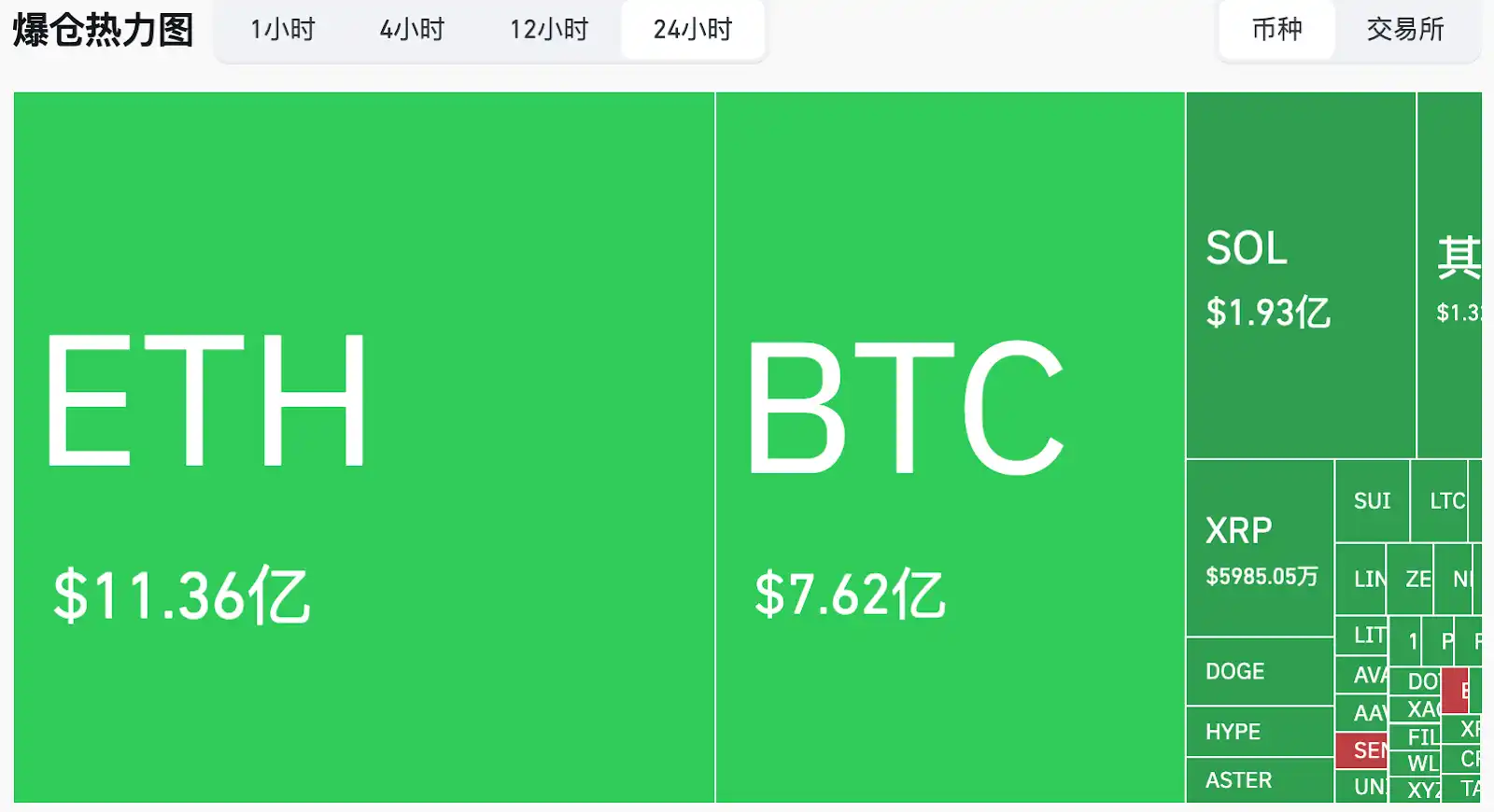
In derivatives, over the past 24 hours, $2.522 billion was liquidated, with long positions accounting for $2.411 billion and short positions $115 million. The largest single liquidation occurred on Hyperliquid - ETH-USD, worth approximately $222 million. Notably, in just the past hour, liquidation volume reached as high as $1.14 billion.
The Starting Point of the Decline is Not Solely Within the Crypto Market

The first domino of this market movement was not on-chain.

Looking at the timeline, market tension began to noticeably escalate from January 29th. The sudden intensification of geopolitical risk was one of the earliest triggering factors captured by the market. The US aircraft carrier USS Abraham Lincoln and its strike group entered a "lights-out" status with communications severed, while statements from Iran also clearly shifted to a wartime posture. Odaily Planet Daily had previously provided a detailed analysis in From Geopolitical Tension to Liquidity Tightening, BTC Dragged into Uncontrolled Market.

Even so, the speed of this crypto market decline far exceeded expectations. What truly caused the risk to spill over rapidly was the simultaneous crash in the precious metals market.

After Gold and Silver Fell, Crypto's Uncontrolled Decline Accelerated

On January 29th, gold turned sharply downward after briefly breaking above $5,600, falling to a low of around $4,740, a maximum drop of 15.7%. The adjustment in silver was even more severe, plummeting after breaking above $120 to a low of $76.6, a maximum drop of 37%.

Dirk Malach, Managing Director of SLC Management, pointed out that the plunge in gold and silver began with the market's reaction to reports that Trump would nominate Kevin Warsh as Fed Chair. Warsh's resume carries distinct hawkish tones, which somewhat weakened the expectation of a "long-term comprehensive devaluation of the US dollar." The market is re-anchoring to a more orderly monetary policy path. Related reading: 'Estée Lauder Son-in-Law' Kevin Warsh Takes Helm at the Fed, Hawkish Bigwig Turns Out to Be a Crypto Ally?

Seth R. Freeman, Senior Managing Director at GlassRatner Advisory & Capital Group, also believes the "good news" in this nomination is that the market might not have to repeatedly deal with the uncertainty and emotional disturbance caused by Trump's continuous pressure on the Fed. The sharp fall in gold and silver already reflects the market's repricing for a stronger dollar environment. In his view, it would not be particularly surprising if metal prices fail to show a significant rebound under this backdrop. Conversely, traders heavily long precious metals without effective hedging might face continued pressure, especially silver bulls. Some trading accounts could suffer severe losses by next Monday.

Additionally, analysts mentioned that month-end concentrated profit-taking trading behavior, and hedging operations by banks to guard against sudden declines, might have amplified the selling pressure in a short period.

Adrian Ash, Head of Research at BullionVault, stated that in his 20 years participating in the precious metals market, he has never seen a similar行情. However, he downplayed the "retail concentrated exodus" narrative, pointing out that abnormal volatility also occurred in base metal markets like copper—for instance, copper futures fell 4.5% on Friday. If it were only gold and silver, it could be attributed to retail sentiment, but the base metals market has almost no retail participation.

Bitcoin Fell to a Historical Low Relative to Gold

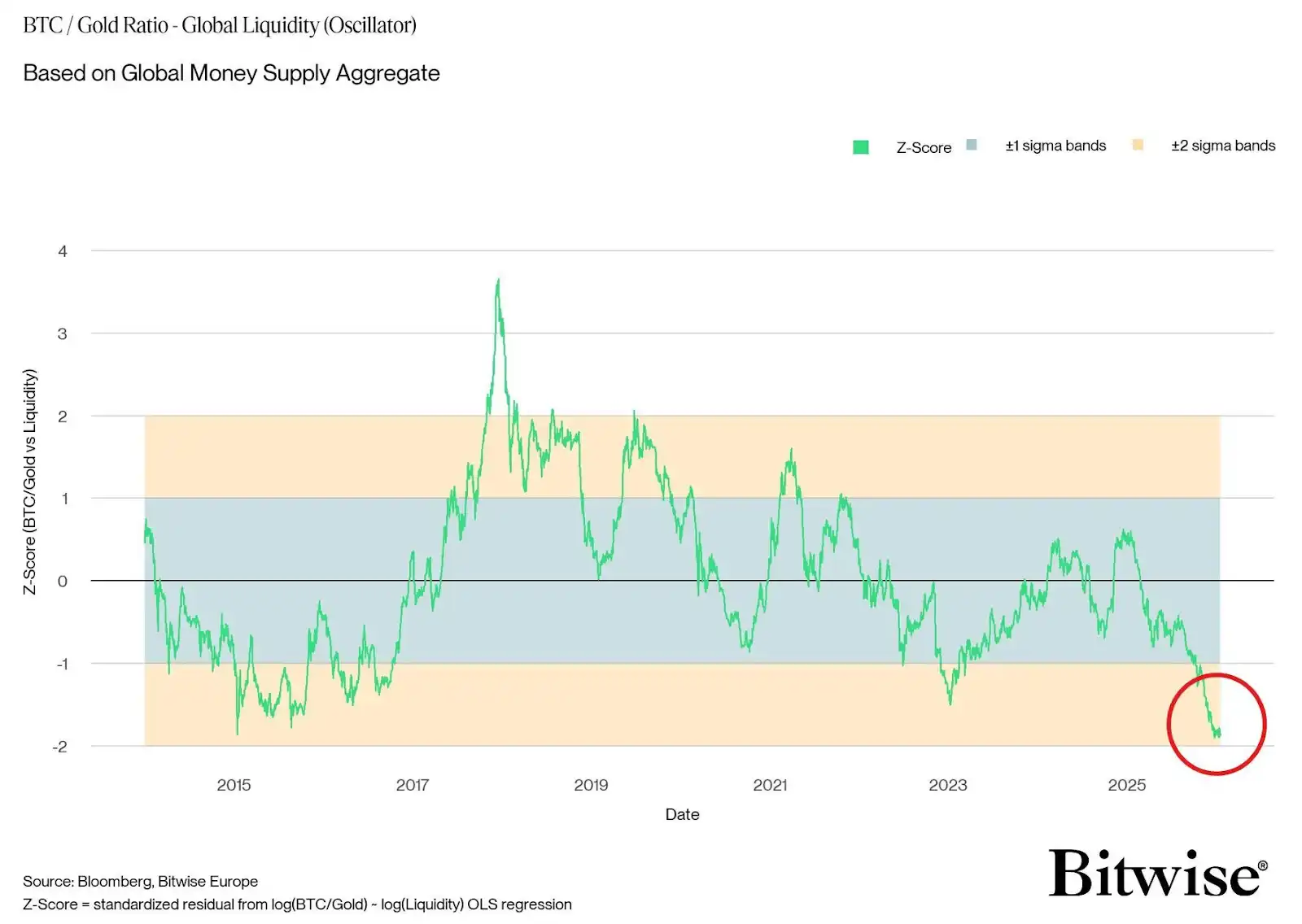
Data from Bitwise Europe shows that the price ratio of Bitcoin relative to gold has fallen to a historical low. This indicator has appeared multiple times in the past near阶段性 bottoms for Bitcoin.

This implies two coexisting realities: on one hand, Bitcoin is currently significantly weaker relative to gold; on the other hand, this extreme weakness also leads some analysts to view the current environment as a potential accumulation zone similar to the period before the 2015-2017 bull market launch.

The market widely observes that long-term holders are gradually absorbing the recent selling pressure. As funds rotate between safe-haven assets and risk assets, some traders anticipate that a阶段性回流 from gold to Bitcoin might occur starting in February.

However, more cautious views point out that fund rotation is not inevitable and requires continuous observation of macro policy, dollar trends, and overall risk appetite changes.
Risk Transmission, Chip Redistribution

The暴跌 in gold and silver ultimately transmitted to the crypto market. It must be said that the crypto market is now at the bottom of the food chain: when US stocks rise, crypto未必 rises; when US stocks fall, crypto often falls deeper; and now, as precious metals fall, crypto cannot escape either. The crypto market seems to have fallen into a "curse" of following declines but not gains.

In this situation, the "believers" long on crypto assets also seem to be losing their chips in this deluge.

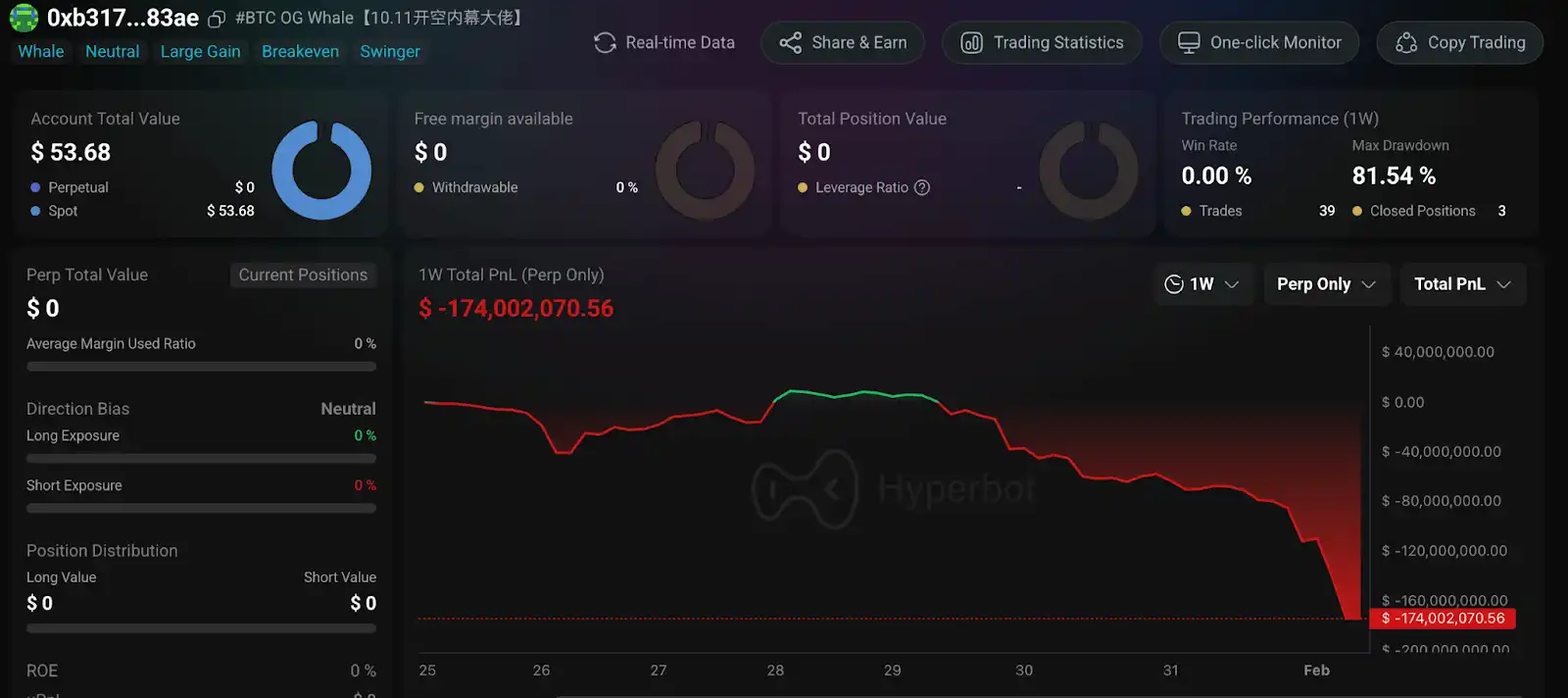
The lucky one, Garrett Bullish (@GarrettBullish), who gained the most profit in the previous 1011 flash crash, failed to躲过 this disaster. His position on Hyperliquid was fully liquidated, with a single liquidation规模 exceeding $700 million, leaving his account balance at just $53.68. This was also the largest single liquidation in this event. Data shows that his cumulative loss on Hyperliquid over the past two weeks was approximately $270 million.

On-chain records also show that since starting to use this account for trading in early October 2025, Garrett Bullish's historical cumulative PnL has lost over $128 million.
Behind the liquidations is protocol revenue. After Garrett Bullish's liquidation was completed, the Hyperliquid ecosystem treasury HLP gained approximately $15 million in收益. This single event brought about a 5.8% return for treasury depositors, translating to an annualized yield of about 110%. Data shows that HLP still holds an ETH long position worth approximately $230 million.

The whale高调 long on ETH also seems to be having a tough time. According to on-chain monitoring, the secondary fund Trend Research, under Yi Lihua, currently has a total collateral of 175,800 WETH on Aave V3, worth approximately $445 million, and has borrowed about 274 million USDT. The liquidation price for the ETH position is $1,558, with a loan health factor of 1.34. During the market decline, Trend Research continued to add margin. Yesterday, it withdrew approximately 109 million USDT from Binance and deposited it into Aave to reduce the liquidation risk of its Ethereum position.

As of January 29th, Trend Research held approximately 651,300 ETH with an average entry price of around $3,180. At the current price of $2,400, the floating loss is接近 $500 million.

Conclusion

From the escalation of geopolitical risks to the collapse of precious metals, crypto assets have become the first to be abandoned in this process. Does this indicate that they are not safe-haven assets and have not yet truly gained the consensus support of a "value anchor,"只能 passively bear the pressure amidst macro sentiment fluctuations?

This round of行情 is forcing the market to re-examine a question: in a deleveraging cycle, what justifies crypto assets being held long-term?


Cryptos en tendance

Questions liées

QWhat was the sharp decline in Bitcoin's price on January 31st, and what key support level did it break?

AOn January 31st, Bitcoin's price briefly fell below $78,000, hitting a low of $75,700, a 24-hour drop of 7.6%. This decline broke through the price range where BTC had been consolidating for nearly three months, retreating to its lowest level since April 2025.

QWhat was the total amount liquidated in the derivatives market in the 24-hour period, and what was the largest single liquidation order?

AThe total amount liquidated in the derivatives market over 24 hours was $2.522 billion. The largest single liquidation order occurred on Hyperliquid - ETH-USD, valued at approximately $222 million.

QAccording to the article, what external event was the first domino to trigger the market's nervousness and subsequent crypto sell-off?

AThe first domino was the escalation of geopolitical risks, notably the US aircraft carrier Abraham Lincoln and its strike group entering a 'lights out' and communications blackout status, coupled with Iran's shift to a more combat-ready posture.

QHow did the暴跌 (crash) in precious metals like gold and silver contribute to the acceleration of the crypto market's decline?

AGold fell a maximum of 15.7% and silver plummeted up to 37%. This crash was partly triggered by market reaction to the potential nomination of the perceived hawkish Kevin Warsh as Fed Chair, leading to a repricing for a stronger dollar environment. The risk and sell-off then spilled over into the crypto market.

QWhat does the article suggest about the current status of crypto assets in the 'food chain' compared to traditional markets like stocks and precious metals?

AThe article suggests crypto assets are at the bottom of the food chain, suffering from a 'curse' of falling without necessarily rising. It states that when stocks rise, crypto may not follow; when stocks fall, crypto often falls deeper; and now, when precious metals fall, crypto is also affected.

Lectures associées

Après trois trimestres consécutifs de baisse, le marché des cryptomonnaies pourra-t-il connaître une fenêtre de stabilisation au troisième trimestre ?

Le marché des cryptomonnaies a enregistré son pire trimestre depuis 2022, avec une capitalisation totale chutant de 12,6% à 2 100 milliards de dollars. Tous les indicateurs clés (volume des échanges, valeur des stablecoins) montrent une sortie nette de capitaux. Le Bitcoin a perdu 14,2% et l'Ethereum 25,4% sur le trimestre, rompant sa corrélation antérieure avec les actions technologiques. Les ETF spot américains sur le Bitcoin ont subi des rachats massifs, avec une sortie nette de 4,67 milliards de dollars au Q2, indiquant une pression de vente continue. Le resserrement de la politique de la Fed et les ventes d'entreprises comme Strategy ont accentué la déleveragisation du secteur. L'attention du marché se porte désormais presque exclusivement sur la réunion de la Fed fin juillet. Une position accommodante pourrait stabiliser le Bitcoin entre 68 000 et 84 000 dollars, tandis qu'un ton hawkish pourrait le faire osciller autour de 50 000-56 000 dollars. Parallèlement, la progression du *CLARITY Act*, une loi cruciale pour la clarté réglementaire, est au point mort au Sénat, réduisant les chances d'adoption en 2026 et maintenant une prime de risque élevée sur l'ensemble du secteur. Malgré ce contexte difficile, quelques secteurs résistent : les marchés de prédiction ont vu leur volume nominal augmenter de 48,7% et les biens collectionnables tokenisés ont progressé d'environ 143%. La tokenisation d'actifs du monde réel (RWA) continue également sa croissance régulière, portée par des fondamentaux indépendants du cycle crypto. Les bases d'un effondrement extrême semblent absentes, mais le marché est désormais guidé par les politiques monétaires, les prix et les attentes de taux, plutôt que par le simple récit haussier. La fin des sorties massives des ETF et le retour des achats des détenteurs à long terme pourraient indiquer une phase de stabilisation potentielle.

marsbitIl y a 4 h

Après trois trimestres consécutifs de baisse, le marché des cryptomonnaies pourra-t-il connaître une fenêtre de stabilisation au troisième trimestre ?

marsbitIl y a 4 h

The SpaceX Trade, Unlocked: SPCXON Débarque sur WEEX

En juin 2026, SpaceX a réalisé la plus grande introduction en bourse de l'histoire, mais l'accès à l'action a été limité pour de nombreux investisseurs en raison de restrictions régionales et de frictions liées aux courtiers. La plateforme WEEX propose désormais une solution via SPCXON/USDT, un instrument tokenisé sur le marché au comptant qui permet d'obtenir une exposition au cours de SpaceX en utilisant l'USDT, sans nécessiter de compte de courtage américain. SPCXON est un produit tokenisé construit sur l'infrastructure d'Ondo, conçu pour refléter l'économie de la détention d'actions SpaceX pour les traders éligibles en dehors des États-Unis, avec des dividendes réinvestis. Le cas d'investissement repose sur la croissance des revenus de Starlink et les progrès de Starship, malgré un valorisation déjà élevée et des risques liés à un flottant public réduit et à des déblocages d'actions internes à venir. Il est important de noter que SPCXON offre une exposition, et non la propriété directe d'actions ou de droits de vote. Son prix peut évoluer avec une prime ou une décote par rapport à la valeur liquidative. WEEX propose également d'autres produits tokenisés comme MSTRON et MUON dans un compte unifié, permettant une rotation entre crypto-monnaies et actions traditionnelles sans transfert de fonds. La plateforme souligne ainsi comment les barrières entre la finance traditionnelle et les actifs numériques s'estompent.

TheNewsCryptoIl y a 4 h

The SpaceX Trade, Unlocked: SPCXON Débarque sur WEEX

TheNewsCryptoIl y a 4 h

BIT Trading Moment : Le BTC reste sous la pression de l'EMA 200 hebdomadaire, un rejet pourrait relancer la baisse, les actions de stockage et de semi-conducteurs qui ont bondi cette nuit ont baissé en séance de nuit

**Résumé des marchés : Bitcoin sous pression, actions technologiques en réajustement** Le marché crypto poursuit son rebond, avec Bitcoin évoluant autour de 66 000 $. Il fait face à une résistance clé vers 68 000 $, niveau correspondant au coût moyen des investisseurs sur cinq mois. Les traders surveillent les moyennes mobiles clés (200 MA à ~63 333 $ et 200 EMA à ~68 328 $ en hebdomadaire). Une rupture au-dessus de 68 000 $ ouvrirait la voie à une hausse, tandis qu'un échec pourrait entraîner un retest des 63 000 $. L'analyse suggère que la dynamique actuelle ressemble à un rebond estival à faible liquidité plutôt qu'au début d'un véritable marché haussier. Sur le marché actions américain, après une forte séance mardi portée par les semi-conducteurs et les titres du stockage (Micron, AMD, Intel...), les contrats à terme indiquent une ouverture en baisse. Les secteurs ayant récemment bondi, comme les semi-conducteurs et le stockage, reculent en séance de nuit. Certaines valeurs se démarquent néanmoins, comme Super Micro Computer (SMCI), en hausse après des résultats et des perspectives robustes liées à la demande de serveurs IA. Des vents contraires persistent : les prix du pétrole (Brent >91$) et les rendements des obligations d'État américaines grimpent, ravivant les craintes inflationnistes. En Asie, les marchés ont suivi le rebond technologique américain, mais de manière hésitante. La tension reste forte sur le yen japonais, qui atteint son plus bas niveau depuis des décennies. **Points clés à surveiller :** * **Crypto :** Niveaux techniques de Bitcoin (68k$/63k$), flux des ETF spot. * **Actions :** Saison des résultats (Tesla, Alphabet, Intel...), activité d'AMD sur l'IA. * **Économie :** Données américaines sur l'emploi, décision de la BCE, tensions géopolitiques et prix de l'énergie.

marsbitIl y a 4 h

BIT Trading Moment : Le BTC reste sous la pression de l'EMA 200 hebdomadaire, un rejet pourrait relancer la baisse, les actions de stockage et de semi-conducteurs qui ont bondi cette nuit ont baissé en séance de nuit

marsbitIl y a 4 h

Gate Research Institute : La vague de « Wall Streetisation » des produits financiers cryptographiques, concurrence ou fusion ?

Le titre de l'article est : "Gate Institute : La vague de 'Wall Street-isation' des produits financiers cryptos, est-ce une compétition ou une fusion ?" Résumé en français (environ 1400 caractères) : Il y a dix-sept ans, Bitcoin fut créé avec une vision décentralisée et anti-establishment financier. Aujourd'hui, paradoxalement, son adoption massive passe souvent par des ETF émis par des géants comme BlackRock. Cet article analyse cette "Wall Street-isation" apparente des actifs cryptos : les institutions traditionnelles s'emparent-elles du pouvoir d'émission, de tarification, de garde et de distribution ? La réalité est plus nuancée. C'est une convergence à double sens. D'un côté, les plateformes cryptos comme Gate.io étendent leurs services aux actions traditionnelles (états-uniennes, hongkongaises, sud-coréennes), aux CFD et aux produits tokenisés, offrant un compte unifié. De l'autre, des courtiers traditionnels comme Robinhood intègrent les cryptomonnaies et explorent la tokenisation d'actions sur blockchain. Cette fusion vise à créer le "super-compte" financier de demain, où actions, cryptos, ETF et obligations tokenisées (RWA) coexistent dans une même interface, comblant les faiblesses de chaque écosystème. Les RWA, notamment les obligations d'État tokenisées, agissent comme une couche intermédiaire unificatrice. En conclusion, Wall Street n'a pas conquis la crypto, et la crypto n'a pas contourné Wall Street. Ils construisent ensemble une nouvelle forme de marché des capitaux, plus efficace et mondial, où l'idéal décentralisé persiste dans les protocoles, tandis qu'une expérience utilisateur unifiée émerge à l'interface.

marsbitIl y a 4 h

Gate Research Institute : La vague de « Wall Streetisation » des produits financiers cryptographiques, concurrence ou fusion ?

marsbitIl y a 4 h

Trading

Spot

Articles tendance

Comment acheter F

Bienvenue sur HTX.com ! Nous vous permettons d'acheter Synfutures (F) de manière simple et pratique. Suivez notre guide étape par étape pour commencer votre parcours crypto.Étape 1 : Création de votre compte HTXUtilisez votre adresse e-mail ou votre numéro de téléphone pour ouvrir un compte sur HTX gratuitement. L'inscription se fait en toute simplicité et débloque toutes les fonctionnalités.Créer mon compteÉtape 2 : Choix du mode de paiement (rubrique Acheter des cryptosCarte de crédit/débit : utilisez votre carte Visa ou Mastercard pour acheter instantanément Synfutures (F).Solde :utilisez les fonds du solde de votre compte HTX pour trader en toute simplicité.Prestataire tiers :pour accroître la commodité d'utilisation, nous avons ajouté des modes de paiement populaires tels que Google Pay et Apple Pay.P2P :tradez directement avec d'autres utilisateurs sur HTX.OTC (de gré à gré) : nous offrons des services personnalisés et des taux de change compétitifs aux traders.Étape 3 : stockage de vos Synfutures (F)Après avoir acheté vos Synfutures (F), stockez-les sur votre compte HTX. Vous pouvez également les envoyer ailleurs via un transfert sur la blockchain ou les utiliser pour trader d'autres cryptos.Étape 4 : tradez des Synfutures (F)Tradez facilement Synfutures (F) sur le marché Spot de HTX. Il vous suffit d'accéder à votre compte, de sélectionner la paire de trading, d'exécuter vos trades et de les suivre en temps réel. Nous offrons une expérience conviviale aux débutants comme aux traders chevronnés.

328 vues totalesPublié le 2024.12.21Mis à jour le 2026.06.02

Comment acheter F

Discussions

Bienvenue dans la Communauté HTX. Ici, vous pouvez vous tenir informé(e) des derniers développements de la plateforme et accéder à des analyses de marché professionnelles. Les opinions des utilisateurs sur le prix de F (F) sont présentées ci-dessous.

活动图片












