3 Stablecoins Command Positions in the Crypto Economy’s Top 10, Another Fiat-Pegged Token Is Close to Joining

newsbtcPublié le 2022-05-07Dernière mise à jour le 2022-05-07

Résumé

It is the first time in crypto history that three stablecoin market valuations have existed in the top ten market cap positions.

3 Stablecoins Command Positions in the Crypto Economy’s Top 10, Another Fiat-Pegged Token Is Close to Joining

The last five weeks has been brutal for digital currencies as more than 21% has been shaved off the crypto economy’s fiat value since March 27. While all the crypto assets combined shed roughly 0.8% in the last 24 hours, bitcoin has lost 9.4% since last week and seven day statistics show ethereum has dropped 8.1% against the U.S. dollar. Since the crypto economy’s significant losses, the stablecoin UST has managed to take the top ten market capitalization among 13,439 crypto assets.

3 Stablecoins Hold Top 10 Positions, Terrausd Enters the 10th Spot

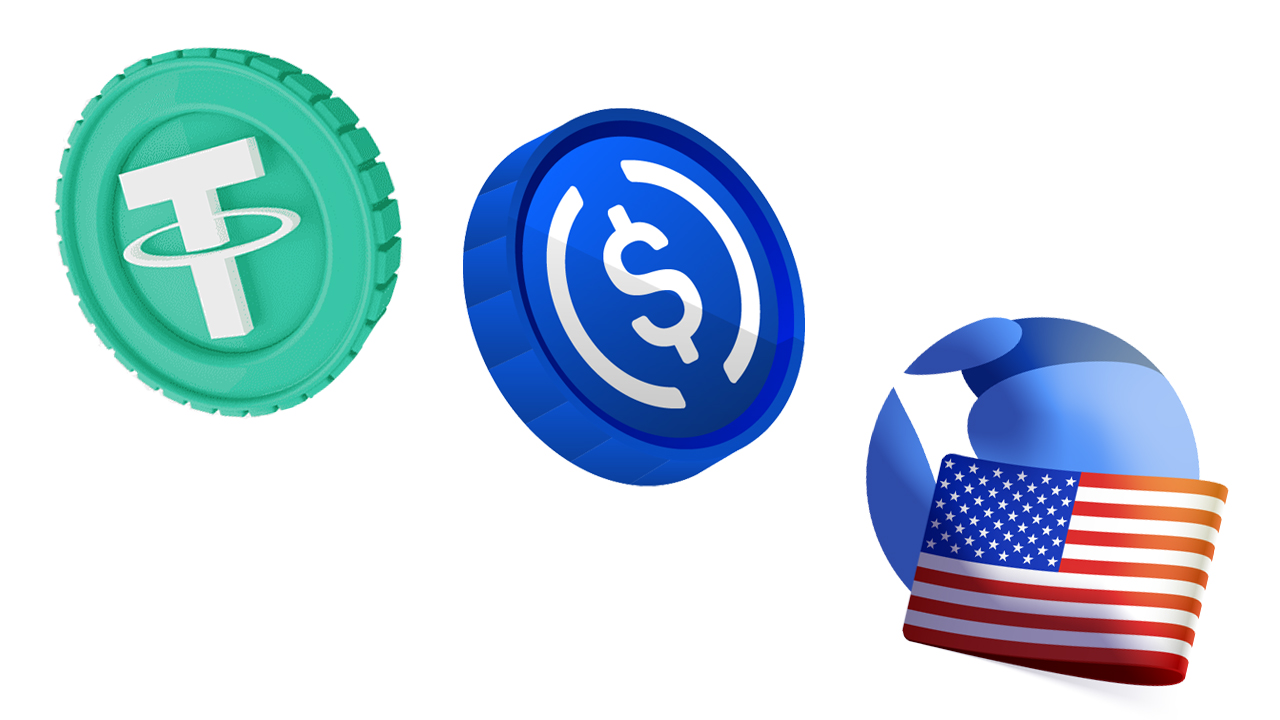
Today, three stablecoins now command a position in the top ten largest cryptocurrency market capitalizations. While tether (USDT) and usd coin (USDC) have been in the top ten for quite some time, Terra’s UST is now holding the top ten spot since the crypto economy’s market conditions turned red. Another fundamental that pushed UST higher is the fact that the algorithmic stablecoin’s market valuation expanded by 12.3% over the last 30 days.
3 Stablecoins Command Positions in the Crypto Economy’s Top 10, Another Fiat-Pegged Token Is Close to Joining

It is the first time in crypto history that three stablecoin market valuations have existed in the top ten market cap positions.

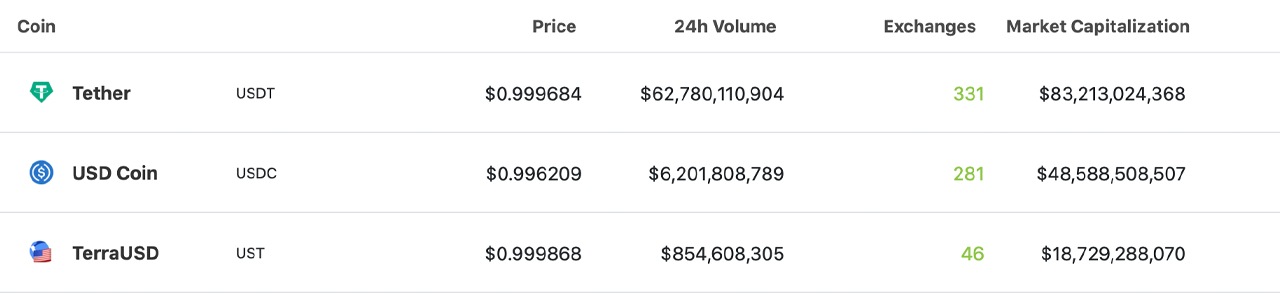
There hasnt been another time when three stablecoins command a top ten position and fiat-pegged tokens have been a prominent force in the crypto ecosystem. Tether (USDT) has a significantly large $83.3 billion market capitalization, which represents 4.78% of the entire crypto economy.

USDC has $48.7 billion market capitalization, which equates to 2.79% of the $1.7 trillion crypto economy. Terrausd (UST) has a valuation of around $18.76 billion and it represents 1.07% of the aggregate value of all 13,439 crypto assets combined.

5 Crypto Assets Represent 66.44% of the Crypto Economy, BUSD and DAI Hold Positions in the Top 20

Between all three of the stablecoins in the top ten, USDT, USDC, and UST represent 8.64% of the crypto economy’s fiat value. That’s pretty large seeing how bitcoin’s (BTC) market valuation is 39.2% and ethereum’s (ETH) capitalization is 18.6% of today’s $1.7 trillion total.

BTC, ETH, USDT, USDC, and UST equate to 66.44% of the entire crypto economy’s capitalization on May 6, 2022. In addition to the prominence of three stablecoins in the top ten crypto market positions, the Binance stablecoin BUSD is currently in the 11th spot with a $17.5 billion market cap.

Besides USDT, USDC, and UST, there’s only two stablecoin projects in the top 20 largest crypto market valuations. The stablecoins include BUSD and Makerdao’s decentralized stablecoin DAI.

Years ago when stablecoins were scoffed at and taken for granted, it’s likely no one thought the fiat-pegged token project’s would be top ten contenders. Furthermore, the entire lot of stablecoins today is worth $189.52 billion. Out of today’s $110.46 billion in global trade volume, stablecoin swaps represent $75.82 billion of Friday’s volume.

Lectures associées

qinbaFrank : Récapitulation et perspectives de la vague de puissance de calcul de l'IA – Des trois grands débats de Nvidia à l'interconnexion optique, l'introduction en bourse de SpaceX, comment les capitaux sont-ils en train de se redéployer ?

Source : Cynthia, Hong Kong Ethereum Community Hub. Invité : qinbaFrank, investisseur en actions américaines et en crypto-marchés secondaires. Lors d'un événement VIP le 8 juin 2026, l'investisseur expérimenté qinbaFrank a partagé son analyse sur la vague de puissance de calcul de l'IA. Il a retracé le parcours du marché depuis 2023, marqué par trois grands débats : sur la nécessité des dépenses d'investissement (2023), sur l'accélération soutenue des dépenses des grandes entreprises technologiques (2024-début 2025), et sur la possible surévaluation de la puissance de calcul (début 2025). Un consensus s'est finalement établi en 2025. Le cadre central de son analyse repose sur le **taux de pénétration** comme clé de l'efficacité commerciale. Contrairement à la bulle Internet de 2000, l'IA bénéficie aujourd'hui d'infrastructures matures (cloud, API) permettant une diffusion et une adoption commerciale beaucoup plus rapides. Le point critique se situe à 10% de pénétration, un seuil déjà dépassé dans les entreprises, signant l'entrée dans une phase de croissance accélérée. La logique commerciale de l'IA diffère de celle d'Internet : elle ne se contente pas de connecter, mais remplace directement le **travail cognitif humain**. Une fois ses capacités dépassant la moyenne humaine, sa valeur commerciale croît de manière exponentielle. L'investissement dans la chaîne d'approvisionnement en puissance de calcul évolue d'une focalisation sur les GPU vers une réévaluation systémique, suivant trois logiques : 1. **Pénurie et tarification** : la demande se propage des GPU à la mémoire (HBM, DRAM), aux CPU pour l'ordonnancement, et enfin à l'alimentation électrique. 2. **Mise à niveau** : les interconnexions optiques (CPO), les réseaux d'alimentation (passage au HVDC 800V) et le packaging avancé (3D) deviennent essentiels pour gagner en efficacité. 3. **Perspective à long terme** : l'informatique en périphérie (edge computing) et l'IA physique (robots, véhicules autonomes) formeront la prochaine courbe de croissance. Le point d'ancrage fondamental pour la poursuite de la tendance est la croissance des **revenus annuels récurrents (ARR) des éditeurs de modèles** et des **revenus cloud** des grands acteurs technologiques. Tant que cette croissance reste soutenue, les dépenses d'investissement et la dynamique de la chaîne logistique restent justifiées. Les ajustements de marché sont alors plus susceptibles d'être des corrections de valorisation (niveau L1/L2) que le renversement d'une tendance structurelle (niveau L3). En conclusion, qinbaFrank considère l'IA non comme une révolution technologique isolée, mais comme une **amélioration fondamentale de la capacité cognitive sous-jacente** de la civilisation, ouvrant la voie à une série de vagues d'innovations (agents, robots, etc.). Le marché suivra une progression en vagues, alternant entre les phases de pénurie, de mise à niveau et de validation commerciale. *Disclaimer : Ce contenu présente les opinions de l'invité et ne constitue pas un conseil en investissement.*

marsbitIl y a 4 h

qinbaFrank : Récapitulation et perspectives de la vague de puissance de calcul de l'IA – Des trois grands débats de Nvidia à l'interconnexion optique, l'introduction en bourse de SpaceX, comment les capitaux sont-ils en train de se redéployer ?

marsbitIl y a 4 h

Trading

Spot
Futures
活动图片