
[Featured Research]Liquid Staking Wars Are Just Getting Started

mediumPublié le 2023-02-01Dernière mise à jour le 2023-02-03

Résumé

You’ve probably noticed, some of the best-performing tokens like Lido (LDO) and Rocket Pool (RPL) are related to Liquid Staking Derivatives (LSD).

Ah, how I love the smell of green candles in the morning.

After more than a year of DownOnlyTM, courtesy of the Fed, we’re finally getting a pump in the coins.

And, as you’ve probably noticed, some of the best-performing tokens like Lido (LDO) and Rocket Pool (RPL) are related to Liquid Staking Derivatives (LSD).

What are LSDs anyway? And does this narrative have legs?

Well, LSDs are a way for Ethereum (ETH) stakers to have their cake and eat it, too.

Thanks for reading Espresso! Subscribe for free to receive new posts and support my work.

You are probably aware that now that Ethereum is a Proof-of-Stake (PoS) chain, you can stake your ETH for a comfy, stable yield of around 4–6%. Sad thing is, staked tokens cannot be used anywhere.

I know, I know, there’s a myriad of opportunities for an enterprising degen like you to make money in crypto, and yet you are supposed to settle for a single-digit APY? Bit boring, don’t you think? Un-American even.

But fret not, degens! LSDs allow you to stake your ETH in a smart contract and receive a tokenized derivative of this staked ETH in return. Armed with this derivative, you can head back to the wildlands of DeFi to degen away and make Su Zhu proud.

Now, is the LSD narrative gonna stay with us for a while?

Our view is that it will.

That’s because despite Ethereum’s dominance, staking ETH is still viewed as risky, as users are currently unable to withdraw their staked tokens.

Do you know what a typical staking ratio1 is for PoS chains? Between 40–70%, according to Staking Rewards.

Ethereum’s staking ratio? A meagre 13%.

As Ben pointed out in “Musical Chairs,” this number will likely increase after the upcoming Shanghai upgrade scheduled for March, which will allow users to withdraw their staked ETH. That will de-risk ETH staking, and as more tokens are staked, that will drive demand for LSDs.

In April 2021, LSDs started to gain momentum over other staking solutions. By the time Ethereum successfully switched from PoW to PoS (the Merge) in September 2022, they were cemented at the top of the food chain.
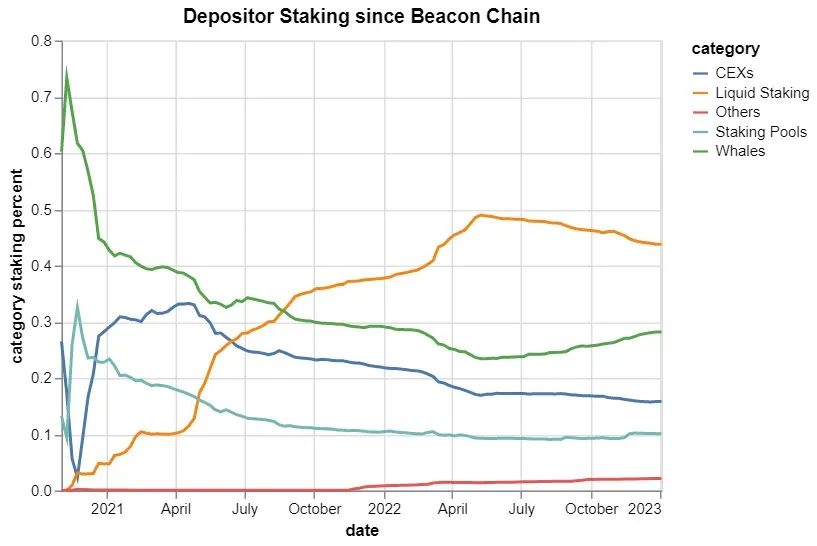
ETH staking by category. Source: Adapted from Write2Earn

Now that I (hopefully) have convinced you that LSDs are a narrative that won’t go away, let’s get down to business, and examine some of the most popular liquid staking solutions.

The Contenders

That’s right, this is crypto after all. LSD solutions are dApps, and you can always count on dApps to issue shares governance tokens to further decentralization, empower the community and all that jazz.

This gives us a chance to bet directly on LSDs’ growth and hype.

The leading LSD protocols according to DefiLlama are the following:
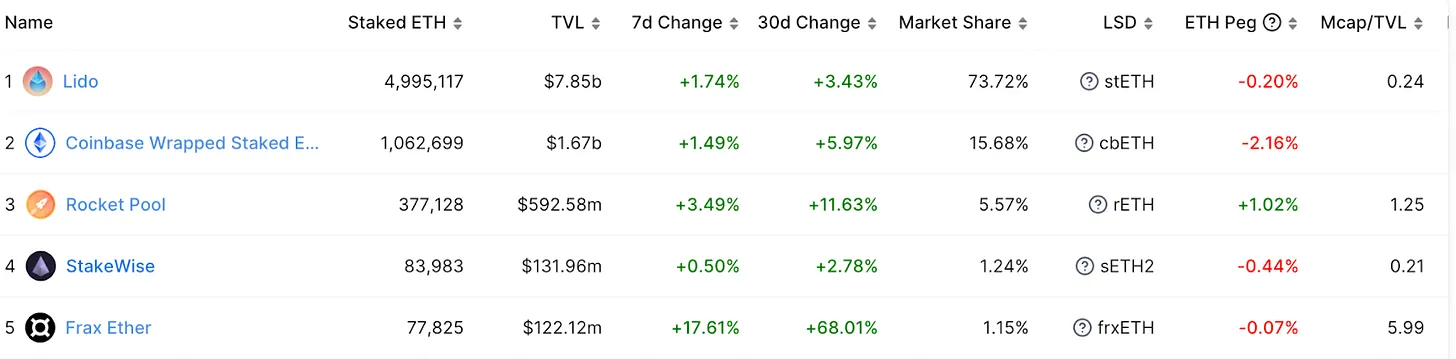
Top Ethereum LSD protocols by TVL. Source: Adapted from DefiLlama

Since we’re only focusing on protocols with governance tokens, we’ll leave out Coinbase. And while Stakewise has enjoyed some early success, its adoption has stalled, so we’re leaving it out of our discussion today.

So we think the three protocols that are best positioned to benefit from the LSD narrative are Lido, RocketPool, and Frax.

While there’s plenty to discuss regarding each one’s unique ETH derivatives, for today we’ll focus on their protocol’s tokens.

Lido (LDO)

The king at the top of the LSD mountain is Lido. A whopping 30% of all staked ETH and over 70% of all ETH in LSD protocols sits at Lido.

Lido is set up as a Decentralized Autonomous Organisation (DAO), and LDO is the “membership card” of the DAO.

The holders of LDO get to vote on some aspects relating to the functioning of Lido, such as the fees the DAO should get or what node operators and oracles Lido uses. The DAO also accumulates profits from fees that will be distributed towards research and development, liquidity incentives, etc.

However, LDO doesn’t accrue any value to token holders. Therefore, it’s more of a speculative bet on the success of LSDs and Lido continuing its dominance.

Not that there’s anything wrong with that. Sometimes, tokens relying only on narratives are the best bets.

Arguably the best-performing sector of the 2021 bull market was dog tokens. And Uniswap’s UNI, which is structured in a similar way to LDO, was one of the best-performing DeFi tokens. Until the crypto market matures, memes and narratives are king. Best we don’t forget that.

If, however, you want to get a share of the profits from the dApp you hold the token of, you’ll have to look somewhere else.

To Frax, for instance.

Frax (FXS)

Frax is the new kid on the block, at least when it comes to LSDs. And its growth has been staggering, becoming the fifth-most popular LSD solution by ETH staked in only three months. This is even more impressive considering we are in the midst of a bear market.
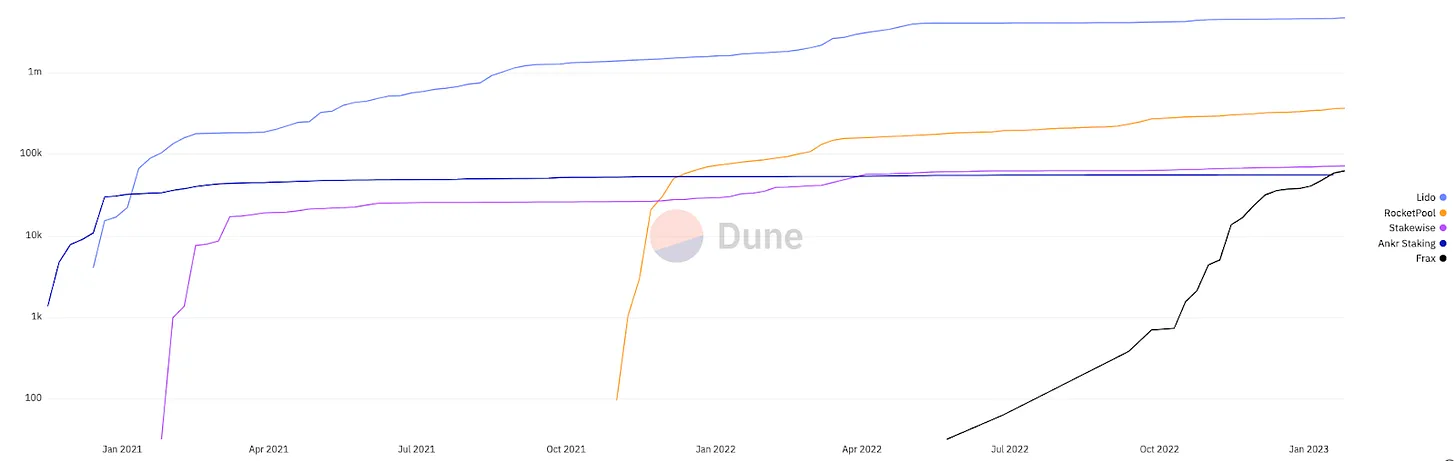
Staked ETH per LSD protocol. Source: Adapted from Dune Analytics

A big reason for Frax’s rapid success in LSDs is that it has already implemented a string of DeFi products, including a stablecoin, a lending market, a decentralized exchange, etc. Plus, it’s used its influence on Curve to juice the ETH yields for its users.2

So, how does Frax’s governance token, FXS, factor in?

Frax implemented a veToken model with FXS, similar to that of Curve.

Frax tokenholders can lock their FXS in exchange for veFXS; the longer they stake it for, the more veFXS they get. The more veFXS you have, the higher your yield boosts, voting power and share of profits.

At the time of writing, the current APR if you lock your FXS for four years is 1.58%. Not great, but better than nothing. And entirely profit-based and sustainable, which is quite rare in crypto.

The farming boosts are nice but are mostly related to other verticals within Frax, as is the success of Frax and FXS itself.

LSDs are but one of their products, and (for now) not their core product. So, FXS is not a pure bet on the success of LSDs, and even worse, since Frax’s products are intertwined, should one fail, others could fail, too.

This brings us to the token whose performance is a protocol which is probably more directly related to success in the LSD space.

Rocket Pool (RPL)

Launched in November 2021, Rocket Pool marketed itself as the LSD solution of the masses, standing against the VC-backed Lido. Whether this characterisation holds, the reality is that Rocket Pool managed to gain a significant market share of over 5%.

We won’t get into the minutiae of Rocket Pool’s staking mechanism. This we will leave for another day.

What is important to us right now is:

Rocket Pool node operators are rewarded both in ETH (from staking yield) and RPL (from Rocket Pool inflation)

Node operators must post collateral together with their ETH. This collateral acts as insurance, in case the node operator is slashed.

Guess what that collateral is denominated in?

That’s right, RPL. And the more RPL you post as collateral, the higher RPL rewards you get.

To deter RPL whales from getting the majority of inflation, there is a cap on the collateral you can post equal to 150% of the value of ETH a user has staked. But there is also a minimum collateral of 10% that you must put up in order to receive any RPL rewards.

These act as soft upper and lower bounds on RPL price relative to ETH.

If RPL increases too much in value, node operators will take collateral out of their vaults as they are not being rewarded past the 150% cap. There’s not much for them to do with RPL at that point other than sell it.

However, if RPL decreases too much in price, node operators will need to buy and post more RPL as collateral to keep getting RPL rewards.

In effect, this model stimulates demand for RPL based on ETH staking activity, tying the token’s success to the success of its staking solution.

Place Your Bets

So which LSD governance token offers the most potential?

If you want to play it safe, the answer is easy: LDO.

Lido is way ahead of the pack in the LSD space. Even more importantly, it has won over the narrative.

The first protocol that comes to mind when thinking of LSDs is Lido. It’s also most people’s first choice when staking ETH. And Lido’s stETH is synonymous with staked ETH.

Yeah yeah, the token does not accrue any value.

So what?

If DOGE can graze $1, useless governance tokens can and will make you fortunes.

If you want to play it a bit riskier, FXS is the token you should be eyeing.

Not for value accrual, mind you. Low single-digit APY in exchange for locking up my tokens for four years? I think not. Thank you and good day, sir.

No, FXS is a great bet right now because of its staggering growth.

However, betting on Frax means betting on all its DeFi arms, and their success is not guaranteed in the slightest. Hence, a riskier but possibly much more lucrative bet.

Lastly, we come to the ugly duckling.

Rocket Pool has achieved a great degree of success. However, RPL is just not an attractive bet right now. Rocket Pool is miles away from catching up to Lido, and it is just not growing that much anymore.

If that changes, we would change our view.

Overall, what’s clear is that the success of a protocol and its token are not as intertwined as one might think. Successful protocols can be bad investments. The reverse is also true, although much rarer.

In any case, the LSD wars are heating up and teams across DeFi are coming up with more innovative solutions. We expect that Shanghai will only stir things up even more when it makes ETH staking even more attractive.

Cryptos en tendance

Lectures associées

Des groupes catholiques et de l'application de la loi mettent en garde contre la loi CLARITY qui pourrait affaiblir les garde-fous contre la criminalité liée aux crypto-actifs

Une coalition de dirigeants catholiques, de groupes liés à l'application de la loi et de défenseurs de la lutte contre la traite des êtres humains met en garde contre le projet de loi CLARITY Act. Ils estiment qu'il pourrait affaiblir les garde-fous utilisés pour lutter contre la criminalité facilitée par les crypto-monnaies. Leurs critiques portent principalement sur des dispositions qui protégeraient les développeurs de logiciels non-custodiaux d'être assimilés à des transmetteurs de fonds. Ce débat soulève une question centrale de la régulation des crypto-actifs : comment distinguer un logiciel neutre d'une intermédiation financière ? Les partisans des crypto-monnaies soutiennent que les développeurs publiant du code non-custodial ne devraient pas être régulés comme des plateformes d'échange. Les critiques, quant à eux, craignent que des exemptions trop larges ne rendent plus difficile le suivi des financements illicites. Le logiciel non-custodial est au cœur de la finance décentralisée (DeFi), permettant des transactions sans qu'une entreprise ne contrôle les fonds. Si cette architecture est un pilier de la valeur des crypto-actifs, elle pose aussi des défis pour les autorités lorsque des acteurs malveillants l'utilisent. L'opposition rencontrée par le CLARITY Act signifie que ses partisans devront répondre aux préoccupations concernant d'éventuelles lacunes favorisant la finance illicite. Cela pourrait conduire à des amendements, des protections plus limitées ou des obligations de déclaration supplémentaires. Pour l'industrie, l'enjeu est de taille : des règles plus claires pourraient stimuler les investissements, mais si le projet est perçu comme affaiblissant la lutte contre le crime, son adoption politique deviendra plus difficile.

bitcoinistIl y a 47 mins

Des groupes catholiques et de l'application de la loi mettent en garde contre la loi CLARITY qui pourrait affaiblir les garde-fous contre la criminalité liée aux crypto-actifs

bitcoinistIl y a 47 mins

L'histoire complète de Blockstream, la licorne de la cryptographie, profondément impliquée dans de graves fraudes

Depuis le début de l'année, Blockstream, la société cofondée par le pionnier du Bitcoin Adam Back, est sous le feu des critiques. Une enquête publiée début juin par NatInfoSec accuse la société d'avoir potentiellement levé des milliards de dollars via des billets de mine (BMN) liés à des revenus miniers, mais soulève des doutes sur la réalité des fermes de minage et de la puissance de calcul sous-jacente, évoquant des caractéristiques de type schéma de Ponzi. Les principaux points d'accusation sont les suivants : 1. **Capacité de minage et de paiement douteuses** : Pour honorer ses obligations, Blockstream aurait besoin d'une puissance de calcul bien supérieure (20-45 EH/s) à celle affichée sur son tableau de bord (15 EH/s). Aucune preuve publique (connexions électriques, importations de matériel, parts de pool minier) ne corrobore l'existence d'une infrastructure à cette échelle. Les clauses contractuelles permettraient de plus d'utiliser des bitcoins provenant de sources non divulguées pour les paiements. 2. **Rendements élevés et risque** : Les billets offriraient des rendements fixes allant jusqu'à environ 20% par an, ce qui est considéré comme très élevé et difficile à justifier dans le secteur cyclique du minage de Bitcoin. 3. **Antécédents et divulgation concernant Chris Cook** : Christopher William Cook, ancien responsable des opérations minières de Blockstream et actuel PDG d'Exacore (une entité scindée), a été condamné en 2008 pour fraude postale. Ce passé judiciaire n'aurait pas été divulgué dans les documents d'offre des BMN. Des allégations portent également sur des déclarations trompeuses concernant son expérience professionnelle. 4. **Implications potentielles pour BSTR** : L'enquête soulève des questions sur l'entreprise Bitcoin Standard Treasury (BSTR), liée à Adam Back, qui prévoit une introduction en bourse via SPAC, s'interrogeant sur la divulgation des risques liés aux BMN et sur d'éventuels conflits d'intérêts dans sa structure. La recherche BitMEX a apporté des nuances, confirmant probablement les antécédents de Cook et s'interrogeant sur les rendements, mais estimant que d'autres accusations manquaient de preuves ou étaient trompeuses, notamment concernant la séparation juridique entre les BMN et BSTR. Le débat dans la communauté s'est concentré sur la **vérifiabilité** : les investisseurs et observateurs peuvent-ils indépendamment vérifier la puissance de calcul, les revenus miniers réels et la source des paiements ? Malgré les prises de position divergentes, des questions cruciales sur les BMN demeurent sans réponse claire : leur taille réelle et leurs limites de responsabilité, l'adéquation entre la puissance minière et les obligations, l'origine des rendements élevés, la traçabilité des paiements en BTC, et le rôle exact de Chris Cook. Blockstream n'a pas encore publié de réponse systématique à ces allégations.

marsbitIl y a 4 h

L'histoire complète de Blockstream, la licorne de la cryptographie, profondément impliquée dans de graves fraudes

marsbitIl y a 4 h

Le collectif Reddit qui avait "short-squeezé" Wall Street a-t-il trouvé le prochain GME ?

En juin 2024, l'action de Wendy's (WEN) a connu une hausse significative après la diffusion d'un post populaire sur le forum Reddit r/wallstreetbets intitulé "We need to save Wendy's". Cette dynamique rappelle le phénomène des meme stocks, comme celui de GameStop (GME) en 2021. Le post, jouant sur un running gag de la communauté (le fait de devoir travailler chez Wendy's après de mauvais trades), a généré un fort engouement retail, se traduisant par un volume d'échanges anormalement élevé et une hausse de prix. WEN présente certains ingrédients classiques d'un "short squeeze" potentiel : un taux de ventes à découvert élevé (environ 32% des actions en circulation) et une attention communautaire soutenue. Cependant, l'article nuance fortement la comparaison avec le squeeze historique de GME. La structure est jugée moins extrême : le taux de découvert est significatif mais loin des niveaux de GME (qui avait dépassé 100%), et il manque pour l'instant des preuves solides d'un "gamma squeeze" auto-entrenenu via les options. L'élan actuel semble davantage être un "meme pop" à court terme, alimenté par l'attention et un faible prix de l'action, plutôt qu'un mouvement de fond structurel. L'histoire montre que Wendy's, par sa notoriété et son lien avec la culture WSB, est propice à ce genre de vague, mais que la volatilité qui en découle est souvent temporaire. La durabilité de la hausse dépendra de la persistance de la discussion en ligne, des volumes d'échanges sur plusieurs jours et surtout de l'activité sur le marché des options, qui pourrait, ou non, amplifier mécaniquement la tendance.

marsbitIl y a 4 h

Le collectif Reddit qui avait "short-squeezé" Wall Street a-t-il trouvé le prochain GME ?

marsbitIl y a 4 h

Trading

Spot
Futures

Articles tendance

Comment acheter LDO

Bienvenue sur HTX.com ! Nous vous permettons d'acheter Lido (LDO) de manière simple et pratique. Suivez notre guide étape par étape pour commencer votre parcours crypto.Étape 1 : Création de votre compte HTXUtilisez votre adresse e-mail ou votre numéro de téléphone pour ouvrir un compte sur HTX gratuitement. L'inscription se fait en toute simplicité et débloque toutes les fonctionnalités.Créer mon compteÉtape 2 : Choix du mode de paiement (rubrique Acheter des cryptosCarte de crédit/débit : utilisez votre carte Visa ou Mastercard pour acheter instantanément Lido (LDO).Solde :utilisez les fonds du solde de votre compte HTX pour trader en toute simplicité.Prestataire tiers :pour accroître la commodité d'utilisation, nous avons ajouté des modes de paiement populaires tels que Google Pay et Apple Pay.P2P :tradez directement avec d'autres utilisateurs sur HTX.OTC (de gré à gré) : nous offrons des services personnalisés et des taux de change compétitifs aux traders.Étape 3 : stockage de vos Lido (LDO)Après avoir acheté vos Lido (LDO), stockez-les sur votre compte HTX. Vous pouvez également les envoyer ailleurs via un transfert sur la blockchain ou les utiliser pour trader d'autres cryptos.Étape 4 : tradez des Lido (LDO)Tradez facilement Lido (LDO) sur le marché Spot de HTX. Il vous suffit d'accéder à votre compte, de sélectionner la paire de trading, d'exécuter vos trades et de les suivre en temps réel. Nous offrons une expérience conviviale aux débutants comme aux traders chevronnés.

255 vues totalesPublié le 2024.12.11Mis à jour le 2026.06.02

Comment acheter LDO

Discussions

Bienvenue dans la Communauté HTX. Ici, vous pouvez vous tenir informé(e) des derniers développements de la plateforme et accéder à des analyses de marché professionnelles. Les opinions des utilisateurs sur le prix de LDO (LDO) sont présentées ci-dessous.

活动图片