2022 has proven to be a tumultuous year for projects and users alike in the crypto space. Crypto winter has set in, and the total crypto market cap currently sits at $829 billion as of January 1, 2023 — 64% lower than a year ago. While DeFi token prices and the demand for NFTs remain suppressed, builders have continued to develop new and innovative protocols, giving rise to new trends and narratives throughout the past year.
Our comprehensive 2022 Annual Crypto Industry Report covers everything from the crypto market landscape to analyzing Bitcoin and Ethereum, deep diving into the Decentralized Finance (DeFi) and Non-Fungible Token (NFT) ecosystem and reviewing the Centralized Exchanges (CEX) and Decentralized Exchanges (DEX) performance.
The key highlights have been summarized below, but be sure to dig into the full 49 slides below.
1. After a brutal Q2, the crypto market has been trading sideways, in the low $1 trillion range and below
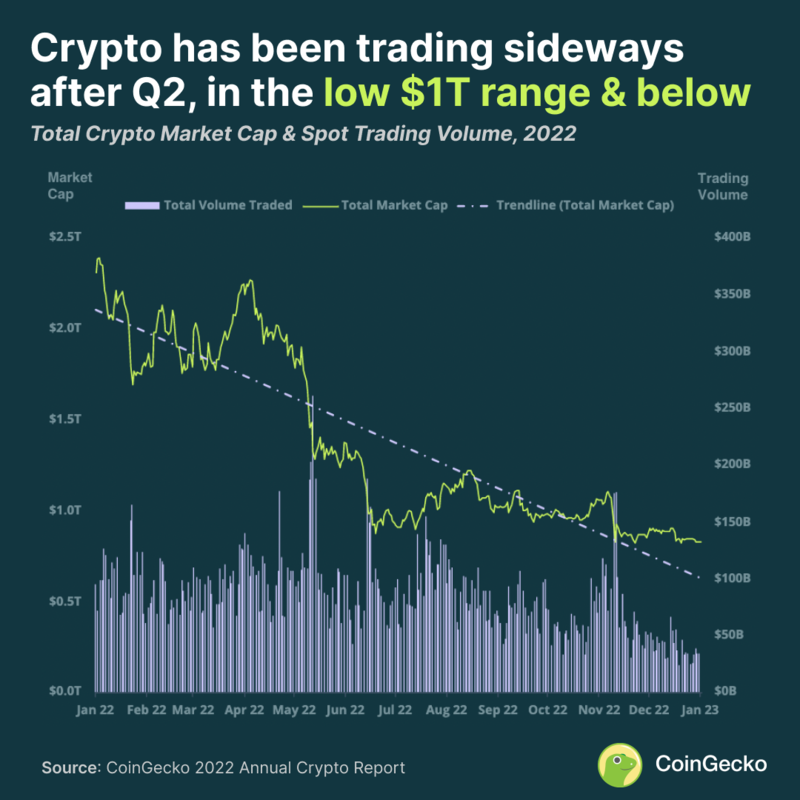
Amid challenging macroeconomic conditions and a slew of exploits, bankruptcies and debacles in the crypto industry, the year rounded off with a total crypto market capitalization of $829 billion, which is 64.1% lower than the $2.3 trillion at the start of year.
Q2 2022 was the most brutal period with the largest drawdown. Subsequently, markets have been drifting sideways, up until FTX’s collapse in November 2022.
Average daily trading volume last quarter dropped 32.8% from $88.1 billion in Q3 to $59.2 billion in Q4. Overall, daily trading volumes have steadily trended downwards over the year, averaging at $86.0 billion in 2022.
Movements in the crypto market were very closely correlated with movements of the US equities market, particularly the S&P500 through out the first three quarters of 2022. However in Q4 this correlation flipped negative as crypto took a dip due to FTX, while equities saw a recovery at the end of the year.
2. Stablecoins shed $27.3 billion despite their increased dominance; meanwhile USDC and BUSD saw gains in market cap
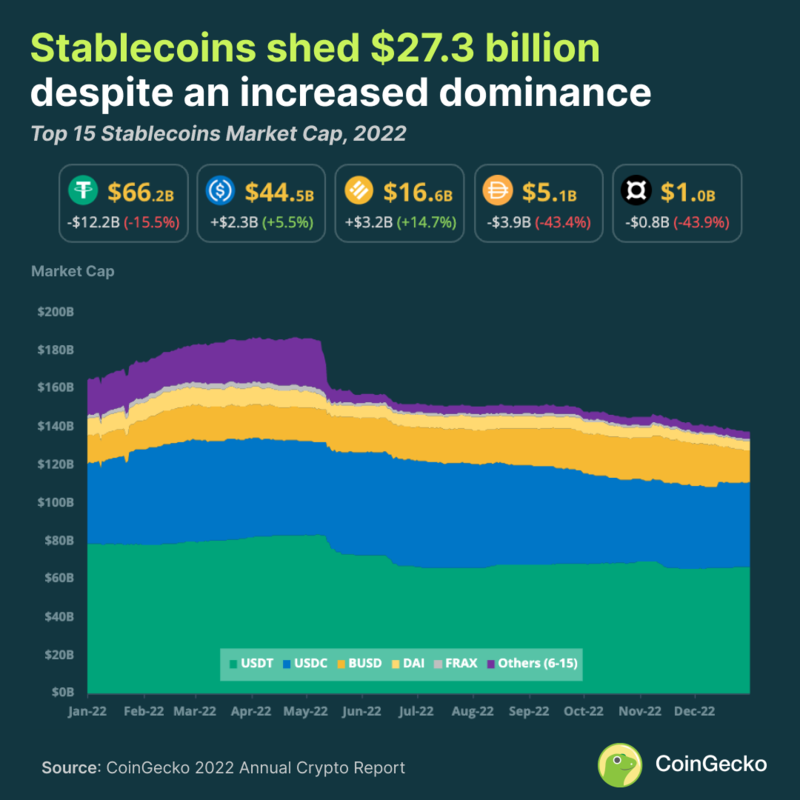
Crypto investors turned towards safer assets last year, with the top three stablecoins Tether (USDT), USD Coin (USDC) and Binance USD (BUSD) increasing their dominance in the crypto market. Yet, the stablecoins market was not spared from outflows, shedding a total of $27.3 billion or 16.6% by year-end. Most of this loss was recorded during the TerraUSD (UST) collapse in May 2022. The sector has fared relatively well since, despite periodic FUD (‘fear, doubt, and uncertainty’) of another depegging event.
The largest stablecoin USDT saw a decline in market cap of 15.5% or $12.2 billion in absolute terms. Conversely, USDC and BUSD each saw similar growth of $2.3 billion (+5.5%) and $2.1 billion (+14.7%) respectively.
Top decentralized stablecoins Dai (DAI) (-43.4%) and Frax (FRAX) (-43.9%) took similar percentage losses, although DAI’s $4 billion loss was almost 5 times larger in absolute terms.
Outside of the top 5, Neutrino USD (USDN) fell out of the top 15 after depegging in November, with MAI (MIMATIC) taking its place. USDD (USDD), a stablecoin launched in May, now sits at rank #8, and saw its market cap hovering around $700 billion since mid-year.
3. The FTX contagion impacted over 1 million estimated depositors, creditors and investors; more dominoes likely to fall in the coming months
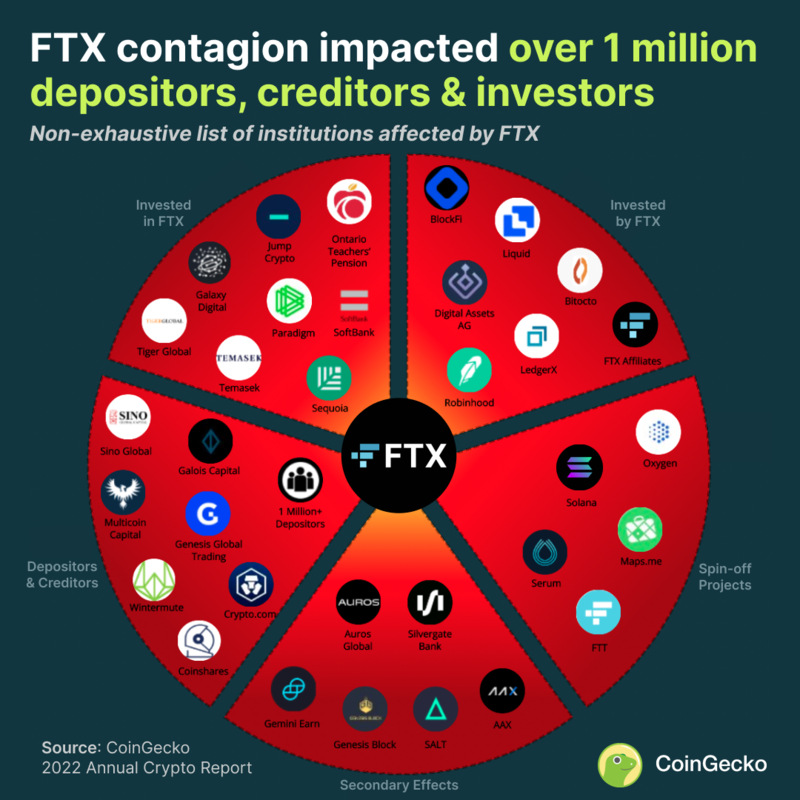
CoinDesk’s article alleged that the majority of Alameda’s assets were in FTT tokens issued by FTX. Shortly after, Binance CEO, Changpeng Zhao ‘CZ’ announced his intention to dump Binance’s FTT token stake. This triggered a bank run, which resulted in FTX halting withdrawals, and subsequently filing for Chapter 11 bankruptcy. It has since been revealed that Alameda was insolvent post-Terra / Luna crash, and user funds from FTX were used to prop up the failed trading firm.
To name a few, some of the severely hit entities are:
Lending platform BlockFi had $355 million on FTX, and a further $671 million lent to Alameda.
Genesis Global Trading had $175 million worth of inaccessible deposits on FTX, and are currently unable to serve redemptions from its lending product.
$8 billion on Silvergate Bank was withdrawn by depositors in FTX’s collapse aftermath. The bank has since laid off 40% of its workforce.
While many companies and institutions have already fallen, it is likely that many more are expected to follow suit throughout 2023.
4. Major assets performed poorly across the board, except Crude Oil and the US Dollar; BTC was the worst performing asset with a 64.2% drop.
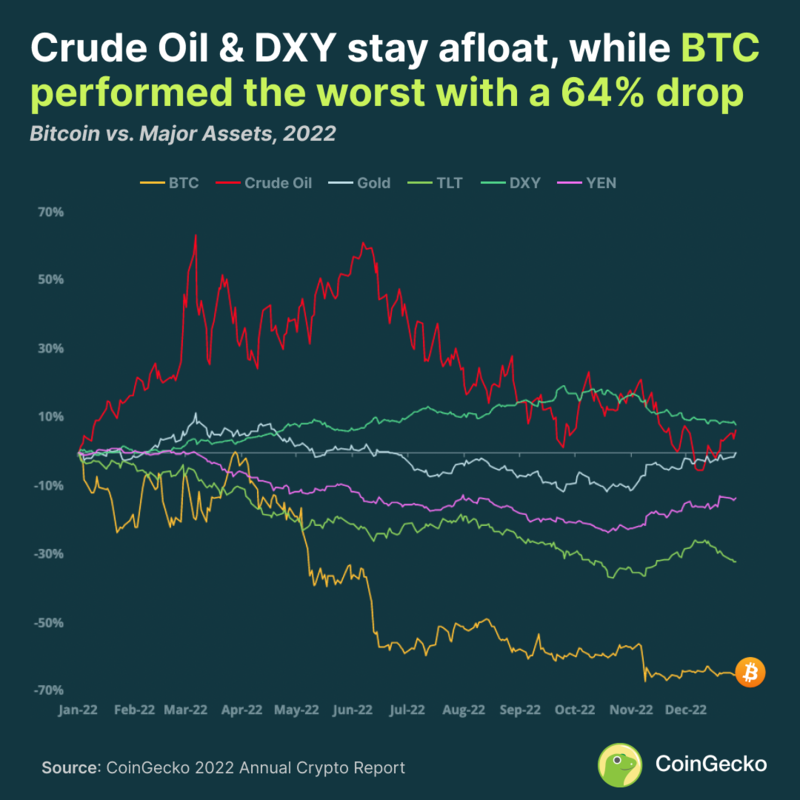
Majority of the assets, like Gold and TLT, closed the year in red. Of the assets, Bitcoin (BTC) was the worst performing in 2022, ending the year with a 64.2% decline.
Bitcoin vs Major Assets Price Returns Table 2022-CoinGecko Annual Crypto Report
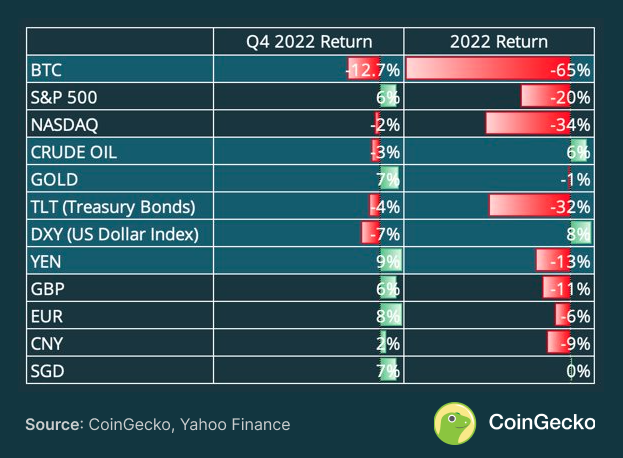
Outperforming all assets is the US Dollar Index (DXY), attributed to the Federal Reserve raising interest rates through 2022. Yet, most of its gains were lost in Q4 as interest rate hikes slowed; the DXY dipped -7.4% quarter-on-quarter (QoQ), and saw only an 8.0% price return year-to-date.
Crude oil saw significant gains of up to 63.4% towards the end of Q1 due to surging demand—lifted COVID-19 lockdowns worldwide coincided with a massive supply shortage driven by the Russia-Ukraine War. However, similar to the DXY, it has returned most of its gains and ended the year only 6.4% higher.
5. Ether staking sees steady growth to 15.8 million by year-end, driven by Ethereum upgrades
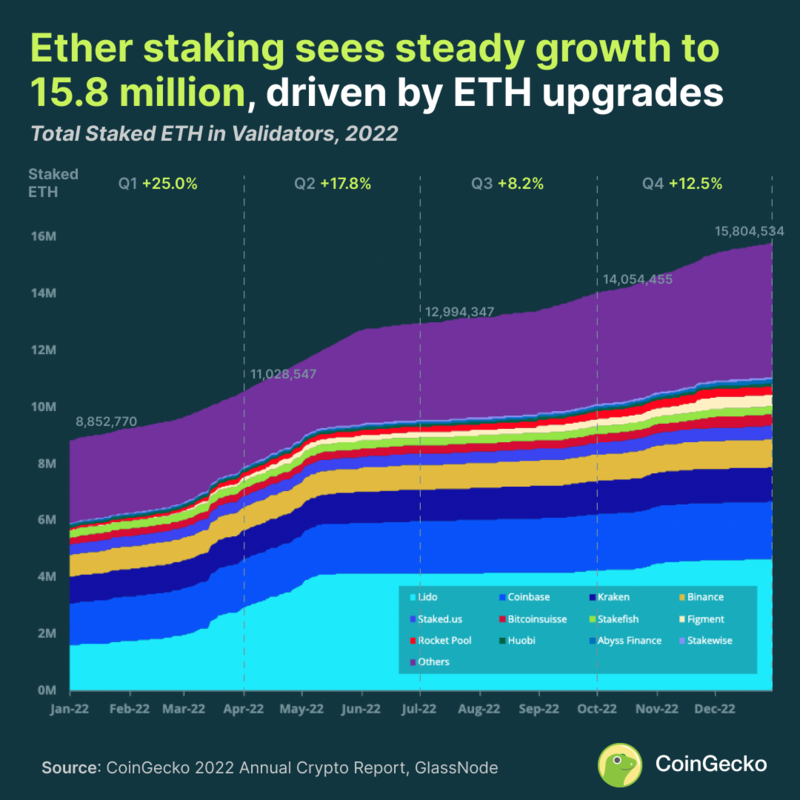
Despite the crypto market slump, total staked ether (ETH) saw a steady QoQ growth, increasing 25% in Q1, 17.8% in Q2, 8.2% in Q3 and 12.5% in Q4 2022. Total staked ETH closed the year at 15.8 million units, up from 8.8 million.
In the first half of 2022, growth of total staked ETH in validators can be attributed to a bullish Ethereum Merge sentiment. Following a successful Merge in mid-September, the crypto community began to anticipate the upcoming Shanghai upgrade – driving its notable growth last quarter.
Lido (LDO) continues to dominate, holding 29.4% of all staked ETH across its 29 node operators. Its closest competitor, Coinbase only held 12.8% of the market.
Ethereum’s Shanghai upgrade is expected to be implemented sometime in March 2023, and will allow stakers to withdraw their ETH – and may give rise to a reorganization of the staking leaderboard.
6. DeFi tokens market cap plummeted 72.9% and saw derivatives surpass yield aggregators in market share
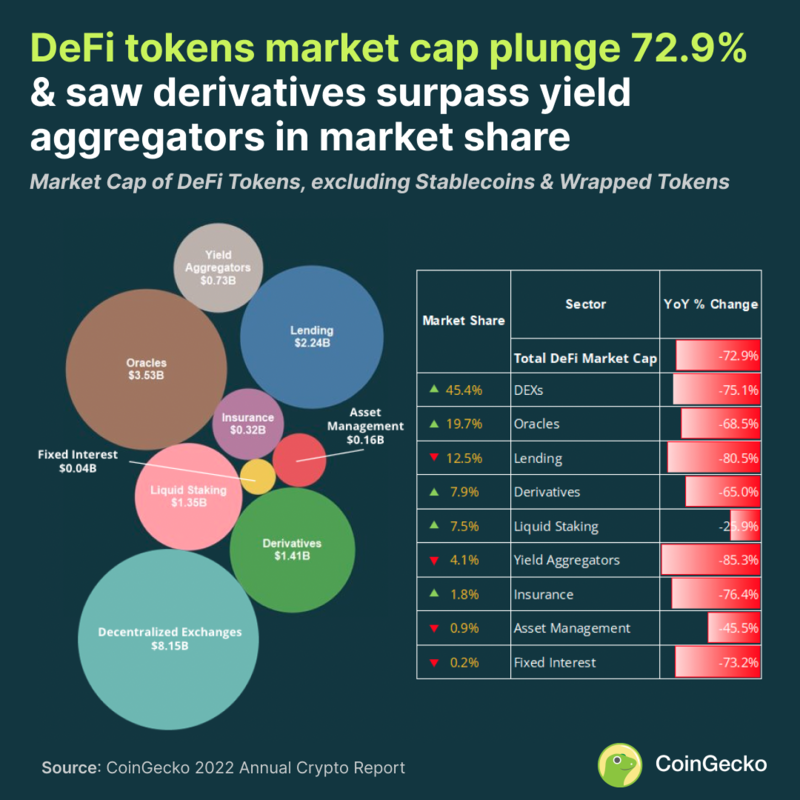
Compared to 2021, the Decentralized Finance (DeFi) market cap shrank by 72.9%, with various governance and utility tokens losing over $48.4 billion in value. The liquid staking category saw the smallest decrease of 25.9% YoY, likely due to the Ethereum Merge narrative that played out in Q3 2022.
DeFi protocols took a greater hit compared to the rest of the market, because of previously inflated valuations and capital withdrawals. Lending protocols and yield aggregators were the worst-performing sectors of the year, seeing declines as much as 80.5% and 85.3% respectively. Protocols such as Convex Finance (CVX) and Alchemix (ALCX) suffered price drops of up to 95.0%.
Despite a 65.0% decrease YoY, derivatives have maintained their market share at 7.9%, allowing them to surpass yield aggregators – attributed to a surge in popularity of decentralized perpetuals platforms like GMX (GMX) and Gains Network (GNS).
7. Amid first NFT winter, OpenSea’s market share slid to 65.4%, but still dominates
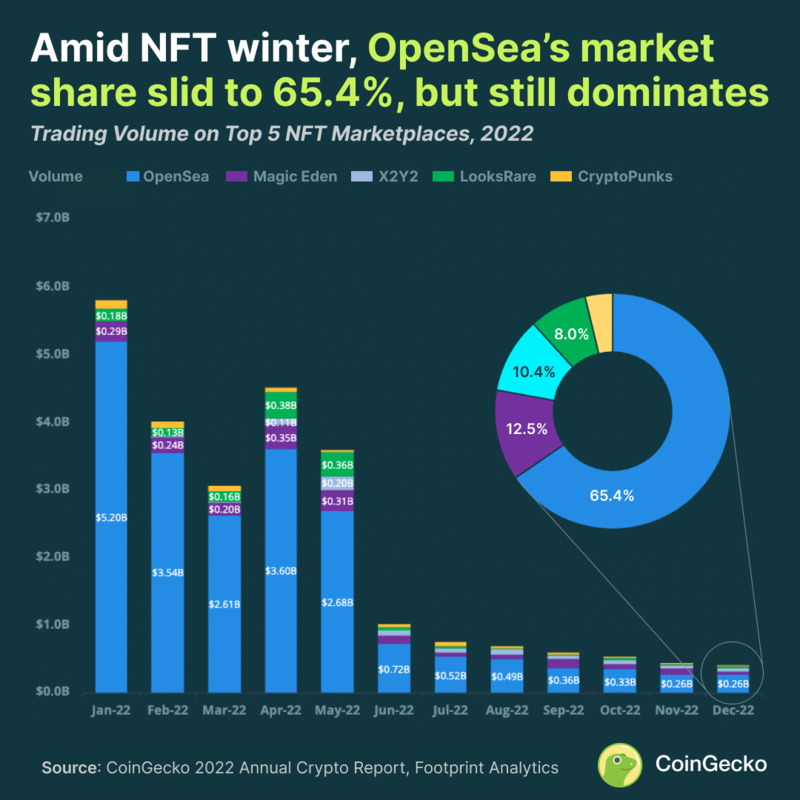
The NFT market is on its first bearish cycle – NFT trading volumes across the top 8 chains have plunged by 93.1% from $13.3 billion in Q1 to $1.5 billion in Q4 2022. In parallel, NFT creator royalties have similarly decreased by 95%, since the start of the year.
Amid NFT winter, OpenSea* still dominates with 65.4% market share of NFT trading volume, excluding wash trades. While their dominance has decreased by 24.3 percentage points since January 2022, the rise of Solana NFTs have propelled Magic Eden’s share of trading volume upwards to 12.5%, by the end of 2022.
Regardless, OpenSea has defended its position against new NFT marketplace contenders LooksRare (LOOKS) and X2Y2 (X2Y2), which incentivised users to trade and list popular collections on their platform. Instead, users turned to wash trading to earn these rewards. On LooksRare, 98.5% of total NFT trading volume were wash trades in January 2022. It has since reduced to 75.5% in December 2022, due to lower reward emissions.
*OpenSea trading volumes include Ethereum, Polygon and Solana
8. Spot trading volume shrank 67.3% from January 2022, with its largest QoQ decline of 21.2% in Q4 2022
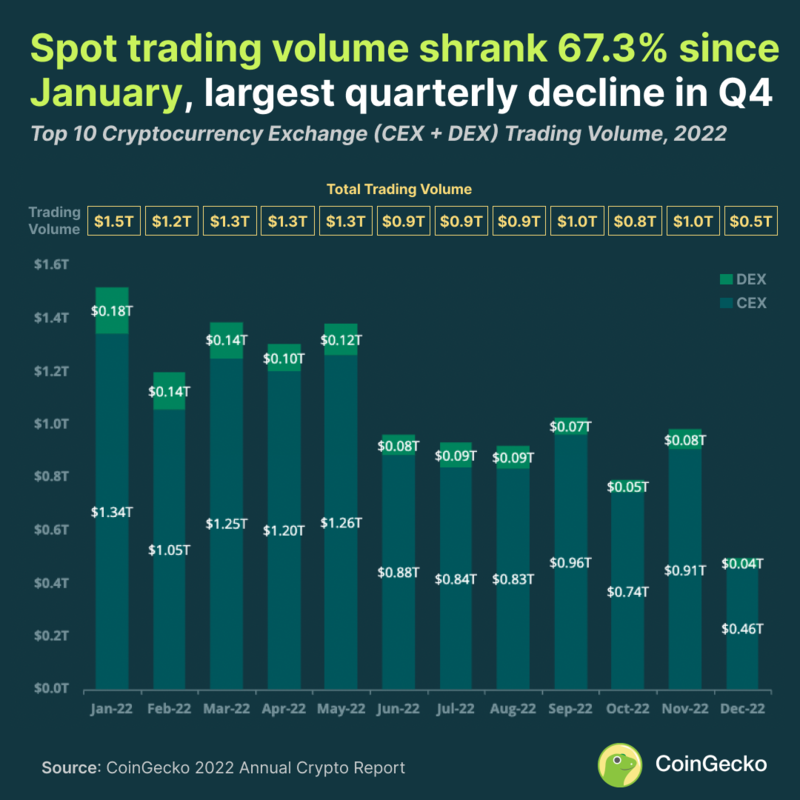
Spot trading volume across the top 10 crypto exchanges totalled $1.5 trillion in January, but sank 67.3% to all-year low levels of $0.46 trillion in December, in the aftermath of FTX’s collapse. The largest QoQ decline occurred in the last quarter, where total spot trading volume decreased by 21.2% from $2.9 trillion in Q3 to $2.3 trillion in Q4 2022.
Despite the open display of centralized risks, the CEX:DEX ratio remained consistently high. While FUD regarding Binance’s insolvency gave DEXs a small boost in market share in November, as at the end of 2022, CEXs command 92.5% of the market.
Dwindling volumes are a sign that investors are withdrawing further from the market, or leaving it entirely through CEX off-ramps.