Not AI, Not War: Should the US Stock Market Be Most Concerned About Japan?

链捕手Pubblicato 2026-07-24Pubblicato ultima volta 2026-07-24

Introduzione

The article warns that global markets may be underestimating a systemic risk from Japan, centered on the potential for its Government Pension Investment Fund (GPIF) to repatriate capital. With JPY at multi-decade lows and improving domestic investment appeal, political pressure is growing for GPIF—managing $1.8 trillion—to shift more assets home. Such a move, involving reallocating part of its ~$930 billion in overseas holdings, could boost demand for JPY and Japanese government bonds while pressuring US Treasuries (raising yields), weakening the USD, and weighing on risk assets like US stocks. A concurrent unwinding of yen carry trades could amplify the pressure. While markets currently price in little immediate risk, technical signals like the narrow USD/JPY cross-currency basis warrant attention. Conversely, the shift could benefit Japanese equities, which trade at a discount and are driven by corporate governance reforms rather than AI hype, though persistent JPY weakness remains a headwind for foreign investors.

Author: Zhao Ying

The global market is underestimating a potential systemic risk—Japan. As the yen falls to multi-decade lows and the attractiveness of Japanese domestic assets rises, the world's largest pension fund is facing policy pressure to repatriate assets on a massive scale. Once this process begins, the US stock market, bond market, and the US dollar could simultaneously face pressure.

Recently, Japanese Prime Minister Takaichi Sanae stated that the government will encourage the Government Pension Investment Fund (GPIF) and other national pension funds to increase investment in Japan's domestic financial assets. Finance Minister Katayama Satsuki had previously signaled similar intentions. Although GPIF has not announced any formal asset allocation adjustments, the market has begun to assess its potential impact: if the fund repatriates its overseas holdings, US Treasury yields could rise, the US dollar could weaken, and risk assets could come under pressure.

Currently, the market's pricing for the above risks remains relatively calm, but some technical indicators are already showing subtle changes. Investors should not be complacent.

The $1.8 Trillion Variable

GPIF manages about $1.8 trillion, with domestic and foreign assets each accounting for roughly half. Its overseas holdings total about $930 billion. In recent years, the fund's holdings of Japanese government bonds have decreased from about $770 billion to about $515 billion, while its holdings of foreign bonds have increased from about $128 billion to about $470 billion.

This structural change means that even a modest asset reallocation could trigger significant volatility in global markets. According to MarketWatch, analyst Michael Kramer points out that if GPIF repatriates some overseas assets, it would directly boost demand for the yen and introduce large-scale buying into the Japanese government bond market—a positive for Japan, but implying higher interest rates and a weaker dollar for the US.

At the same time, a large-scale unwinding of yen carry trades (borrowing low-interest yen, converting to dollars, and investing in US assets) would further weigh on the performance of risk assets.

Yen and JGBs: Rising Attractiveness of Domestic Assets

Driving GPIF's potential reallocation is a substantial improvement in the fundamentals of Japanese domestic assets. As Japan's inflation recovers and economic growth resumes, the appeal of domestic investment opportunities has increased significantly. In February of this year, the spread between US and Japanese two-year government bond yields narrowed to its lowest level since early 2022.

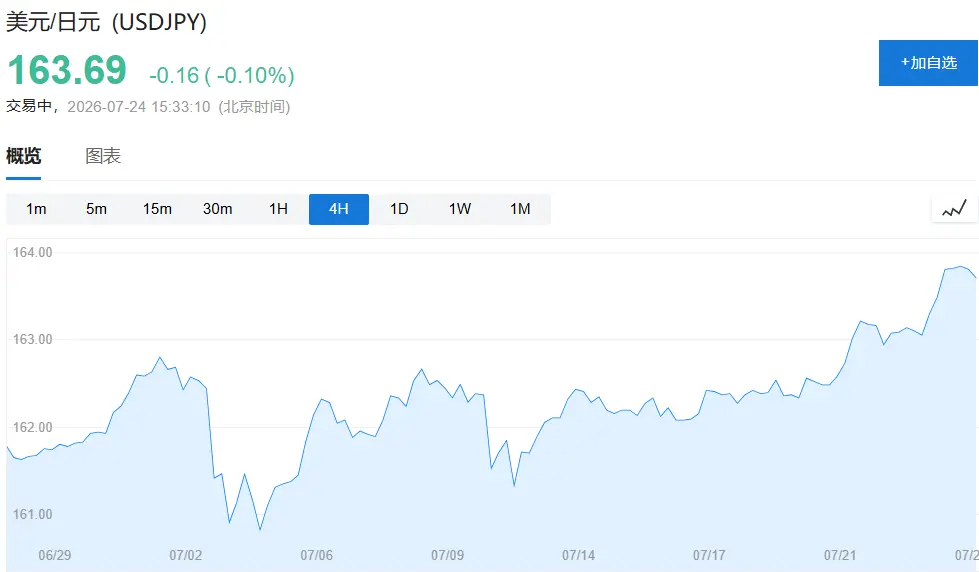
At the same time, the yen continues to weaken, with USD/JPY breaking above 163, reaching its highest level since 1986. From a technical analysis perspective, if the exchange rate rises further, the next resistance level is around 176. According to the Financial Times, Fredrik Repton of Neuberger Berman believes that if GPIF allocates more funds to domestic assets, it could be a "very elegant solution" to Japan's macro problems, but other domestic financial institutions would also need to follow suit, and "this process would take a very long time."
Japan's 10-year government bond yield recently touched 2.7%, the first time in 30 years. Deutsche Bank analyst Mallika Sachdeva noted in a recent report that the focus of Japanese authorities' policy may be shifting from exchange rate management to yield management. If this shift materializes, it would put further pressure on the yen.

The Market Hasn't Priced It In, But Signals Are Emerging

Currently, the global market's reaction to the risk of Japanese capital repatriation remains relatively restrained. The five-year USD/JPY cross-currency basis swap recently stood at around minus 30 basis points, the narrowest level since the data series began in 2021, indicating that the market's demand to hedge against yen appreciation has not risen significantly.

However, this indicator itself is a key signal for observing whether capital flows are beginning to shift. Historical data shows that the S&P 500 index and cross-currency basis swaps have moved in tandem during multiple periods—when hedging demand rises sharply, US stocks often fall as liquidity tightens. Once market expectations for yen appreciation heat up, demand for dollar hedging will climb, and the liquidity tightening effect will become more pronounced.

Japanese Stocks: The Other Side of the Risk

It is worth noting that GPIF's potential asset reallocation, while bringing pressure to the US market, also provides a new narrative for Japanese stocks. The Japanese stock market is benefiting from drivers quite different from those in the US market: the concentration of the technology sector in the Topix index is much lower than in the S&P 500, its exposure to artificial intelligence is relatively limited, and its valuation still trades at a discount of over 20% compared to the S&P 500.

Corporate governance reform is a core catalyst for Japanese stocks. Dan Rasmussen of Verdad Advisers points out that there are still about 1,000 companies in Japan whose stock prices are below book value. Among the cheapest one-fifth of companies, cross-shareholdings still account for about 40% of their market value. As cross-shareholdings are gradually unwound, a large amount of historically accumulated profits is expected to be released, providing a substantive positive impact on corporate earnings.

However, for foreign investors, the persistently weak yen is the biggest obstacle—yen depreciation over the past two years has significantly eroded the real returns for foreign capital in Japanese stocks. How to handle currency hedging, and whether the cost of hedging is bearable, remain core issues facing global investors.


Crypto di tendenza

Domande pertinenti

QAccording to the article, what is the potential systemic risk that global markets might be underestimating?

AThe article suggests that global markets are underestimating the potential systemic risk posed by Japan, specifically the possibility of massive capital repatriation by Japan's Government Pension Investment Fund (GPIF) back to domestic assets.

QWhat could be the impact on the US if Japan's GPIF reallocates its assets back to Japan?

AIf GPIF reallocates assets from overseas back to Japan, it could lead to higher U.S. Treasury yields, a weaker U.S. dollar, and put pressure on U.S. risk assets like stocks.

QWhat is the approximate size of Japan's GPIF and its overseas holdings?

AJapan's GPIF manages approximately $1.8 trillion. Its overseas holdings total around $930 billion, which is roughly half of its total assets.

QWhat are the two key factors that are increasing the attractiveness of Japanese domestic assets, according to the article?

AThe two key factors are: 1) The recovery of inflation and economic growth in Japan, and 2) The substantial depreciation of the yen to multi-decade lows against the dollar.

QWhat is a major obstacle for foreign investors in the Japanese stock market despite positive domestic catalysts?

AA major obstacle is the persistent weakness of the Japanese yen (JPY), which has significantly eroded the real returns for foreign investors in Japanese stocks over the past two years, raising concerns about the cost and feasibility of currency hedging.

Letture associate

Critical Moments in Bitcoin: Cost Zones That Demand Attention Have Been Identified!

Analytics firm Glassnode reported that reduced expectations for U.S. interest rate cuts, along with pricing in possible rate hikes, have suppressed risk appetite in the cryptocurrency market. The Fed's interest rate decisions are crucial for market direction. U.S. Treasury yields have surpassed returns from crypto carry trades, leading investors to favor cash and low-risk interest-bearing instruments over crypto assets. A strong U.S. dollar further weakens marginal demand for crypto. Bitcoin is currently trading below its most intensive cost basis level, with approximately $69,000 identified as the breakeven zone and significant resistance for short-term investors. For a stronger recovery, Bitcoin needs to reclaim the $69,000 threshold with increased trading volume. Renewed active demand for spot Bitcoin ETFs is also deemed critical. According to Glassnode, the current Bitcoin decline represents the shallowest bear market in terms of price drawdown depth to date. However, based on previous cycle durations, this downturn may not be over yet. Spot trading volumes have fallen to multi-year lows, and sell-side order books have thinned, though many buy orders are placed significantly below current prices. Glassnode's risk indicator, Vector, signaled "risk off," suggesting a capital preservation mindset. The current market structure is being driven more by macroeconomic factors like monetary policy, bond yields, and dollar strength than by crypto-sector developments. Losing Bitcoin's support range of $62,000-$68,000, coupled with renewed exchange inflows, could negate the recovery scenario. Conversely, more favorable monetary policy, increased trading volume, a Bitcoin recovery above $69,000, and a resumption of spot ETF buying could signal a market turnaround.

cryptonews.ru23 min fa

Critical Moments in Bitcoin: Cost Zones That Demand Attention Have Been Identified!

cryptonews.ru23 min fa

Breaking News: Full Detailed Rationale and Explanation of the Fed's Interest Rate Decision Released!

As expected, the Federal Reserve kept its key interest rate unchanged at 3.50-3.75 percent, marking the fifth consecutive meeting without a rate change. The Federal Open Market Committee's (FOMC) decision passed with a 9-3 majority vote. Cleveland Fed President Loretta Mester, Minneapolis Fed President Neel Kashkari, and Dallas Fed President Lorie Logan dissented, voting in favor of a 25 basis point rate hike. This was the first meeting since 2016 where three regional Fed presidents voted against holding rates steady, signaling growing influence among members advocating for tighter monetary policy to combat inflation. The Fed's statement noted that economic activity has been expanding at a solid pace despite high uncertainty, partly due to Middle East conflicts. It highlighted that growth in productivity and investment remained strong, employment gains have aligned with labor force growth, and the unemployment rate has remained relatively stable. The Fed also committed to maintaining ample reserves in the banking system. The statement emphasized that inflation remains above the Fed's 2% target. It noted that supply shocks, including in the energy sector, are adding to inflationary pressures. The Committee stated it will continue to closely monitor incoming data and risks in pursuit of its price stability goal. The dissenting members argued that the target range for the federal funds rate should have been increased by 25 basis points.

cryptonews.ru43 min fa

Breaking News: Full Detailed Rationale and Explanation of the Fed's Interest Rate Decision Released!

cryptonews.ru43 min fa

The Fed's Interest Rate Decision is Inevitable! Former Senior Fed Advisor Reveals His Forecast for Today!

Former Federal Reserve senior advisor John Faust stated he does not expect the Fed to raise interest rates at the FOMC meeting concluding today. He argued the Fed will not try to win credibility by deliberately surprising markets. In his assessment, Faust noted that Fed Chairman Kevin Warsh has used strong rhetoric on restoring price stability but largely failed to share details on how he plans to achieve it. This information gap has led to various market scenarios. However, Faust believes the reality is simpler: Warsh positions himself as a pragmatic, tough-minded policymaker, placing high importance on monetary policy communication while showing flexibility regarding balance sheet reduction. Faust compared Warsh's approach to the "refined intuitive approach" used by former Chairman Alan Greenspan. Faust stated that, unlike strict policy rules, this approach does not yield clear-cut answers on rate decisions. In current conditions, both a 25-basis-point hike and waiting for the next meeting could be reasonably justified. Aligning with market expectations, Faust predicts the Fed will choose to wait today. He believes the benefit of waiting outweighs the negatives, partly because he agrees that deliberately surprising markets to boost credibility is not a valid factor. Faust also argued there is no substantial macroeconomic difference between hiking today and holding steady, as a 25-basis-point move over eight weeks alone is not economically decisive. He emphasized that the important aspect will not be the decision itself, but how it is explained to markets. Warsh has so far advocated forward-looking policy without clear guidance on economic forecasts or the likely rate path. Faust warned that if the Fed does not explicitly state grounds for a hike and opts to wait for more data, markets may misinterpret the decision's meaning. Regardless of today's outcome, how Warsh explains the policy decisions at the meeting and press conference may be the most critical information for investors.

cryptonews.ru1 h fa

The Fed's Interest Rate Decision is Inevitable! Former Senior Fed Advisor Reveals His Forecast for Today!

cryptonews.ru1 h fa

Trading

Spot

Articoli Popolari

Come comprare WAR

Benvenuto in HTX.com! Abbiamo reso l'acquisto di WAR (WAR) semplice e conveniente. Segui la nostra guida passo passo per intraprendere il tuo viaggio nel mondo delle criptovalute.Step 1: Crea il tuo Account HTXUsa la tua email o numero di telefono per registrarti il tuo account gratuito su HTX. Vivi un'esperienza facile e sblocca tutte le funzionalità,Crea il mio accountStep 2: Vai in Acquista crypto e seleziona il tuo metodo di pagamentoCarta di credito/debito: utilizza la tua Visa o Mastercard per acquistare immediatamente WARWAR.Bilancio: Usa i fondi dal bilancio del tuo account HTX per fare trading senza problemi.Terze parti: abbiamo aggiunto metodi di pagamento molto utilizzati come Google Pay e Apple Pay per maggiore comodità.P2P: Fai trading direttamente con altri utenti HTX.Over-the-Counter (OTC): Offriamo servizi su misura e tassi di cambio competitivi per i trader.Step 3: Conserva WAR (WAR)Dopo aver acquistato WAR (WAR), conserva nel tuo account HTX. In alternativa, puoi inviare tramite trasferimento blockchain o scambiare per altre criptovalute.Step 4: Scambia WAR (WAR)Scambia facilmente WAR (WAR) nel mercato spot di HTX. Accedi al tuo account, seleziona la tua coppia di trading, esegui le tue operazioni e monitora in tempo reale. Offriamo un'esperienza user-friendly sia per chi ha appena iniziato che per i trader più esperti.

241 Totale visualizzazioniPubblicato il 2024.12.11Aggiornato il 2026.06.02

Come comprare WAR

Discussioni

Benvenuto nella Community HTX. Qui puoi rimanere informato sugli ultimi sviluppi della piattaforma e accedere ad approfondimenti esperti sul mercato. Le opinioni degli utenti sul prezzo di WAR WAR sono presentate come di seguito.

活动图片