Send a Message to Transfer Coins? Telegram to 'Stuff' a Crypto Wallet into 1 Billion Users This Summer

marsbitPublicado a 2026-07-22Actualizado a 2026-07-22

Resumen

Telegram founder Pavel Durov has announced that a native, non-custodial wallet called Gram wallet will be built into every Telegram app this summer. This move aims to provide instant, fee-free cryptocurrency transfers for the platform's over 1 billion monthly active users. Durov described it as the largest deployment of a non-custodial crypto wallet in history. The new wallet, developed by Telegram itself, differs fundamentally from the existing third-party @wallet bot. It will be non-custodial from the start, meaning users will control their private keys. Following the announcement, the GRAM token (formerly Toncoin) saw a price increase of approximately 8%. This initiative is part of Telegram's renewed control over the TON blockchain and its "Make TON Great Again" roadmap, marking a return to the project after a 2018 SEC lawsuit. The launch comes as other super-apps like X Money and Meta are also expanding into digital payments, with Telegram opting for a crypto-native approach. However, key details remain unclear, including the exact launch date beyond "this summer," how the promised zero fees will be implemented technically, and how asset support and private key management will work for mainstream users.

Author: Claude, Deep Tide TechFlow

Deep Tide's Guide: Telegram founder Pavel Durov announced that this summer, a native non-custodial Gram wallet will be built into all Telegram apps, offering zero-fee instant transfers to over 1 billion users. GRAM subsequently rose about 8% to $1.53. This wallet differs from the existing third-party-operated @wallet bot; it is developed by Telegram itself, with users directly controlling their private keys. Amid a competitive window where super apps like X Money and Meta's stablecoin payments are entering the fray, Durov is betting on a crypto-native route. However, the promise of the "largest deployment in human history" still lacks technical details and a definitive timeline.
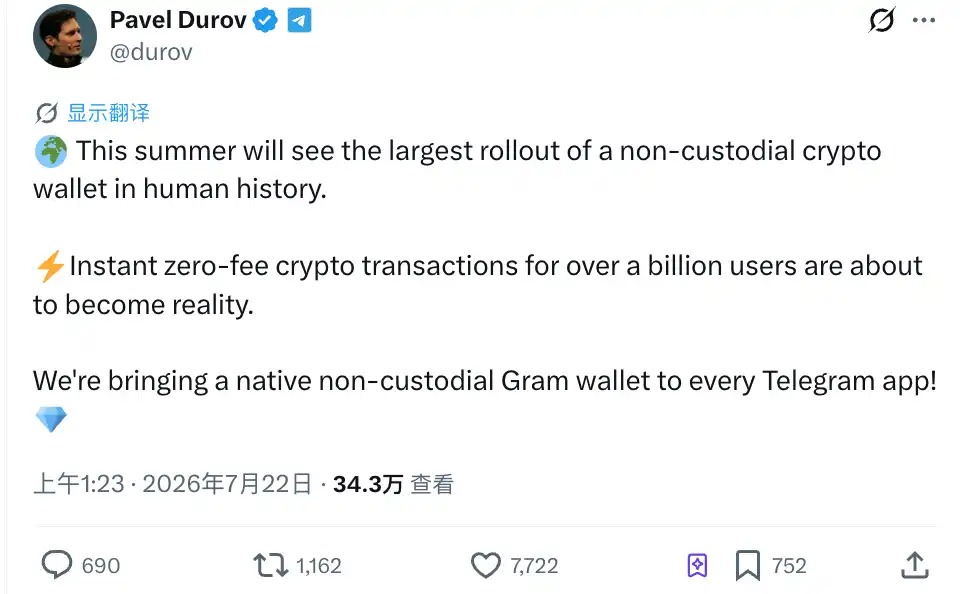
Telegram founder Pavel Durov announced in his Telegram channel on July 21 that this summer, a native non-custodial Gram wallet will be built into every Telegram application, providing instant, zero-fee cryptocurrency transfer services to over 1 billion monthly active users.

Durov characterized this launch as "the largest non-custodial crypto wallet deployment in human history." For comparison, the most widely used self-custody wallet in the crypto space, MetaMask, has tens of millions of users; no crypto wallet has ever started with a base of 1 billion users.

Completely Different from the Existing @wallet, Telegram Steps In Directly

This new wallet is fundamentally different from the existing @wallet bot within Telegram.

According to Decrypt, the existing @wallet is a mini-app developed and operated by the independent third-party company The Open Platform (TOP), and is not an official Telegram product. The service already boasts over 150 million registered users, with a default custodial model (meaning a third party holds user private keys), requiring users to actively switch to use its self-custody layer.

The new wallet announced by Durov is a feature natively embedded into the Telegram app, designed from the ground up as non-custodial, with users controlling their own private keys and assets. Non-custodial means there is no intermediary that can freeze, seize, or block transactions.

According to BeInCrypto, TOP founder Andrew Rogozov confirmed that the existing custodial @wallet service will continue to operate independently. However, key questions remain unanswered: whether the old and new wallets will ultimately coexist, which assets besides GRAM the new wallet will support, and how private key management will be handled for ordinary users who have never interacted with cryptocurrency.

GRAM Rises About 8%, But Still 88% Away from Previous High

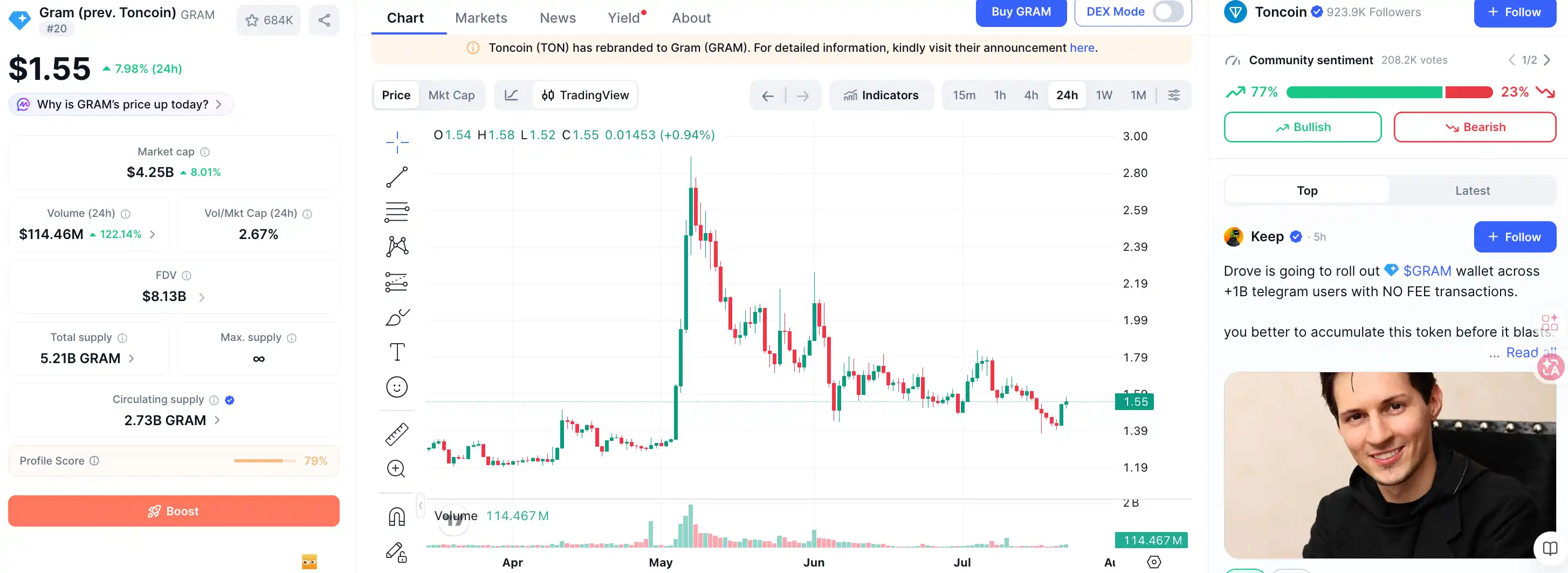
Following the announcement, GRAM (originally Toncoin, the native token of the TON blockchain) rose approximately 8.5% in 24 hours to around $1.53, with a market cap of about $4.18 billion. According to CoinMarketCap data, this partially offset a cumulative decline of about 25% since July, but significant reversal remains distant.

GRAM's 200-day exponential moving average is far above its current price, indicating a still bearish long-term trend. The token's all-time high was $8.25 (during the Telegram 'Tap-to-Earn' gaming frenzy in June 2024). It reached its yearly high of $2.89 in May 2026 when Telegram announced it was taking over the TON network. A return from the current price to the May high would require an increase of approximately 88%.
From SEC Lawsuit to 'Make TON Great Again', Durov's Seven-Year Comeback Battle

This wallet deployment is the latest chapter in a narrative that began in 2018.

In 2018, Telegram raised $1.7 billion for the TON blockchain project, planning to issue a token called Gram. The SEC subsequently sued, determining the token was an unregistered security. In 2020, Telegram settled with the SEC, refunding investors $1.2 billion and paying an $18.5 million fine, completely withdrawing from the project. Community developers took over, independently operating the token renamed as Toncoin for several years.

In 2026, Durov regained control of the TON network and launched a seven-step roadmap named "Make TON Great Again" (MTONGA). Publicly completed steps so far include: the Catchain 2.0 upgrade achieving a 10x speed increase and sub-second transaction confirmation; a 6x reduction in base transaction fees; Telegram becoming the network's largest validator; and the token name change (from Toncoin back to Gram) passed by 81% community vote on June 15. The built-in wallet is likely step five, with three remaining steps yet to be disclosed.

Super App Payments War Heats Up, Telegram Chooses Crypto-Native Route

Durov's wallet announcement comes during a dense window where multiple super apps are simultaneously deploying payment functions.

According to Glitchwire, Musk's X Money launched on June 26 for US Premium subscribers, offering 6% APY, Visa Direct peer-to-peer transfers, and 3% cashback, but currently only supports fiat currency. Crypto and stock trading features are on the roadmap but not yet live. Meta is also re-strategizing digital payments, reportedly sending partnership invitations to third-party stablecoin providers, planning to integrate stablecoin payments into WhatsApp, Instagram, and Facebook in the second half of 2026.

The route choices of the three super apps present a stark contrast: X Money takes a compliant fiat route (holding money transmitter licenses in over 40 states), Meta explores a stablecoin middle path, while Telegram directly bets on a crypto-native non-custodial wallet. Telegram's advantages lie in its user base (over 1 billion monthly active users) and natural affinity for the crypto community. The risks involve the user education costs associated with non-custodial models and regulatory uncertainty.

Zero-Fee Promise Still Lacks Key Details

Durov's promised "zero fees" is another issue requiring attention. Most crypto wallets still charge network fees, even if minimal. Telegram might bypass gas fees through internal subsidies or by using methods like off-chain settlement, but the specific technical solution has not been announced.

According to CryptoBriefing, in July 2025, Telegram launched a non-custodial TON Wallet to 87 million US users as a proof-of-concept. That deployment demonstrated that a messaging app could distribute wallet infrastructure at scale without the traditional friction of crypto onboarding, but a significant gap remained between the number of on-chain active wallets and the user base.

Beyond "this summer," Durov has not provided a more specific launch date.

Preguntas relacionadas

QWhat are the key differences between the new native Gram wallet announced by Telegram and the existing @wallet bot?

AThe new native Gram wallet is a core feature built directly into the Telegram app by Telegram itself, designed from the ground up as a self-custodial wallet where users control their private keys. In contrast, the existing @wallet bot is a third-party mini-app developed and operated by The Open Platform (TOP). It currently operates primarily as a custodial service (where TOP holds the keys), with a self-custodial layer available as an optional switch.

QWhat are some of the unanswered questions and uncertainties surrounding Telegram's planned Gram wallet deployment?

AKey unanswered questions include: a precise launch date beyond 'this summer'; technical details on how the promised 'zero-fee' transactions will be implemented; whether the new wallet will support assets beyond GRAM; how the wallet will manage the user experience and security for crypto-naive users among Telegram's billion-plus user base; and how the new official wallet will coexist with the existing third-party @wallet bot.

QHow has the announcement of the native Gram wallet affected the GRAM (TON) token's price and market position?

AFollowing the announcement, the GRAM token price rose approximately 8.5% to around $1.53. However, its overall market position remains challenging. The price is still about 88% below its year-to-date high of $2.89 from May 2026, and its 200-day exponential moving average is well above the current price, indicating a long-term bearish trend. It is also far from its all-time high of $8.25 set in June 2024.

QHow does Telegram's approach to payments compare with strategies from other 'super apps' like X (formerly Twitter) and Meta?

ATelegram, X, and Meta are taking distinct paths. X Money (on platform X) is pursuing a licensed, fiat-first approach in the US, offering features like yields and cashback, with crypto trading as a future roadmap item. Meta is reportedly exploring a partnership model with third-party stablecoin providers for integration into its apps. Telegram is taking a crypto-native route by directly building and integrating a self-custodial crypto wallet, leveraging its large user base and inherent appeal to the crypto community.

QWhat is the historical context of Telegram's involvement with the TON blockchain and the GRAM token?

ATelegram's history with TON and GRAM dates back to 2018 when it raised $1.7 billion for the TON blockchain project and planned to issue the Gram token. The SEC sued, alleging the token was an unregistered security. In 2020, Telegram settled, refunding investors and paying a fine, completely abandoning the project. Independent developers continued it as Toncoin. In 2026, under the 'Make TON Great Again' (MTONGA) roadmap, Durov and Telegram regained control, with key steps including network upgrades, fee reductions, Telegram becoming the top validator, and the community voting to rename Toncoin back to Gram.

Lecturas Relacionadas

The Verdict in Choi Tae-won's Divorce Case: Revealing the Inheritance Undercurrent Behind SK Hynix's Trillion-Won Empire

SK Group Chairman Chey Tae-won's high-profile divorce case, involving a record 1.38 trillion won settlement, has drawn attention to the succession plans for Korea's second-largest conglomerate, especially its crown jewel, SK hynix. Unlike traditional chaebol scripts centered on the eldest son, Chey's three children from his marriage to former President Roh Tae-woo's daughter, Roh Soh-yeong, are carving distinct, non-traditional paths. Eldest daughter Chey Yun-jung (b. 1989) is seen as the most evident successor. With a scientific and consulting background, she holds executive roles at SK bioscience and SK Inc.'s growth support department, focusing on future strategy and biopharma. Her marriage is to an AI infrastructure entrepreneur, not a traditional business alliance. Second daughter Chey Min-jung (b. 1991) took a unique route, voluntarily serving as a South Korean naval officer, including an anti-piracy deployment. She later worked on policy and strategy for SK hynix in Washington D.C. before co-founding an AI-driven healthcare startup. She married a former U.S. Marine Corps officer, connecting her to U.S. defense and policy circles—networks crucial for a global semiconductor giant. The only son, Chey In-geun (b. 1995), who studied physics like his father, worked briefly at SK E&S before joining McKinsey. Despite fitting the traditional "heir" profile as the eldest son, he remains silent and holds no public position or shares in SK, suggesting the old succession playbook is obsolete. As SK hynix's valuation soars, becoming a geopolitical asset in the AI era, the heirs' legitimacy is no longer automatic. They must prove themselves in fields like AI biotech, global policy, and strategic consulting. Their marriages also reflect new elite networks in tech and defense, not old political alliances. Their inheritance is the complex challenge of navigating a globalized, tech-driven world, not just a corporate throne.

marsbitHace 2 días 09:06

The Verdict in Choi Tae-won's Divorce Case: Revealing the Inheritance Undercurrent Behind SK Hynix's Trillion-Won Empire

marsbitHace 2 días 09:06

From OpenSea to OpenRouter: Is Alex Atallah Repeating His 'Exit at the Peak' Playbook?

From OpenSea to OpenRouter: Is Alex Atallah Repeating His "Exit at the Peak" Playbook? According to the Wall Street Journal, payments giant Stripe is in talks to acquire the AI model aggregation platform OpenRouter in a potential deal valuing the company near $100 billion. This would mark founder Alex Atallah's second creation of a company reaching a $100 billion valuation, following his co-founding of NFT marketplace OpenSea. OpenRouter, founded just over three years ago, has grown rapidly by acting as a unified gateway for developers to access over 400 AI models. It currently has about 10 million users and processes over 200 trillion tokens monthly. While the platform's annualized revenue is around $50 million, its valuation has skyrocketed from $1.3 billion in March 2026. The potential acquisition by Stripe, a company OpenRouter's founder once likened it to, represents a major expansion into AI infrastructure for the payments leader. This move echoes Atallah's previous timing with OpenSea, where he departed before the NFT market's significant downturn. For OpenRouter, selling now may be strategic. Despite its scale, its business model—charging a 5-5.5% fee on AI inference calls—faces pressure from competition, open-source models, and potential price wars among model providers, limiting its profitability narrative for an IPO. A key asset for potential acquirers like Stripe is OpenRouter's vast repository of real-world AI usage data, which offers unique insights into model performance and developer preferences that are difficult to replicate. Whether this potential deal signifies a new valuation benchmark for AI infrastructure or another market peak signal remains to be seen.

链捕手Hace 2 días 08:42

From OpenSea to OpenRouter: Is Alex Atallah Repeating His 'Exit at the Peak' Playbook?

链捕手Hace 2 días 08:42

Trading

Spot
活动图片





