Crypto hacks hit record high in H1 2026 – What’s fueling the surge?

ambcryptoPublished on 2026-07-02Last updated on 2026-07-02

Abstract

According to TRM Labs, crypto hacks reached a record high in the first half of 2026 with 207 incidents, more than double the 85 reported in H1 2025. While the number of breaches surged, the total value stolen fell to $972 million, less than half the $2.3 billion lost in the same period the previous year. Smart contract exploits were the most common attack type, constituting 125 cases. However, TRM Labs' Ari Redbord noted that three-quarters of the stolen value came from infrastructure failures like compromised keys and custody systems, highlighting a gap between improved code auditing and lagging operational security. Notably, North Korean-linked actors were responsible for 66% of the stolen funds. Major exploits, such as the $293 million attack on KelpDAO, triggered liquidity crises in protocols like Aave and contributed to a broader loss of confidence in DeFi, leading to significant capital outflows and a drop in Total Value Locked to a two-year low of $70 billion.

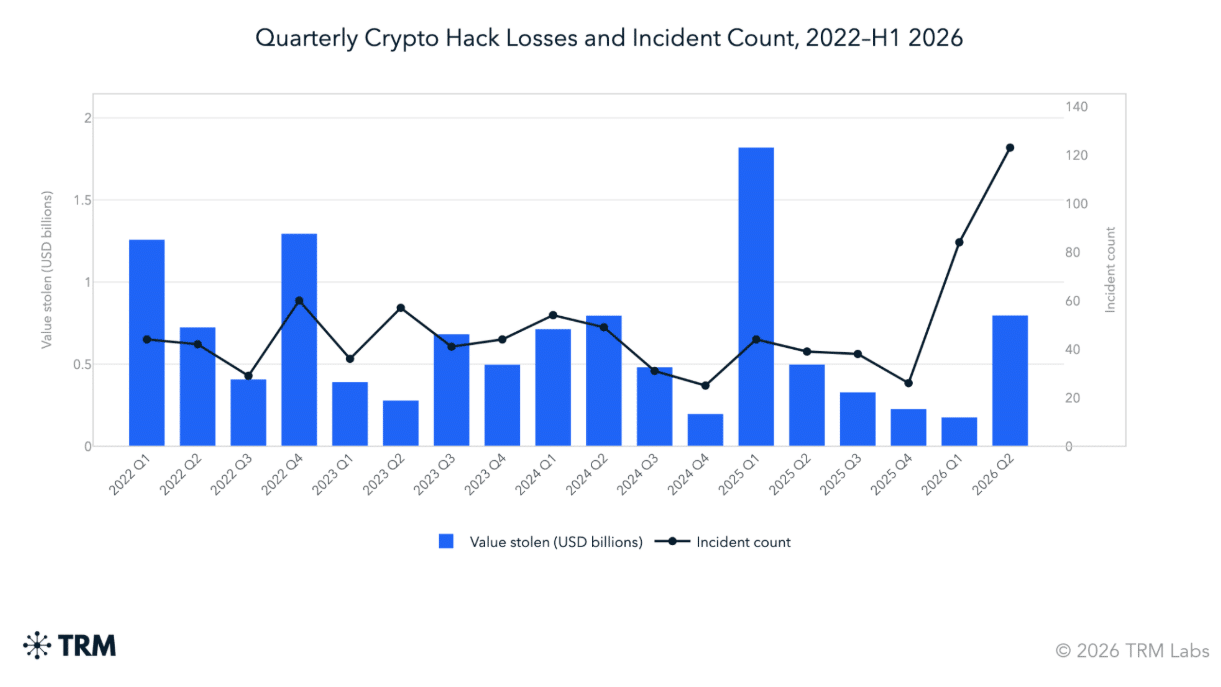
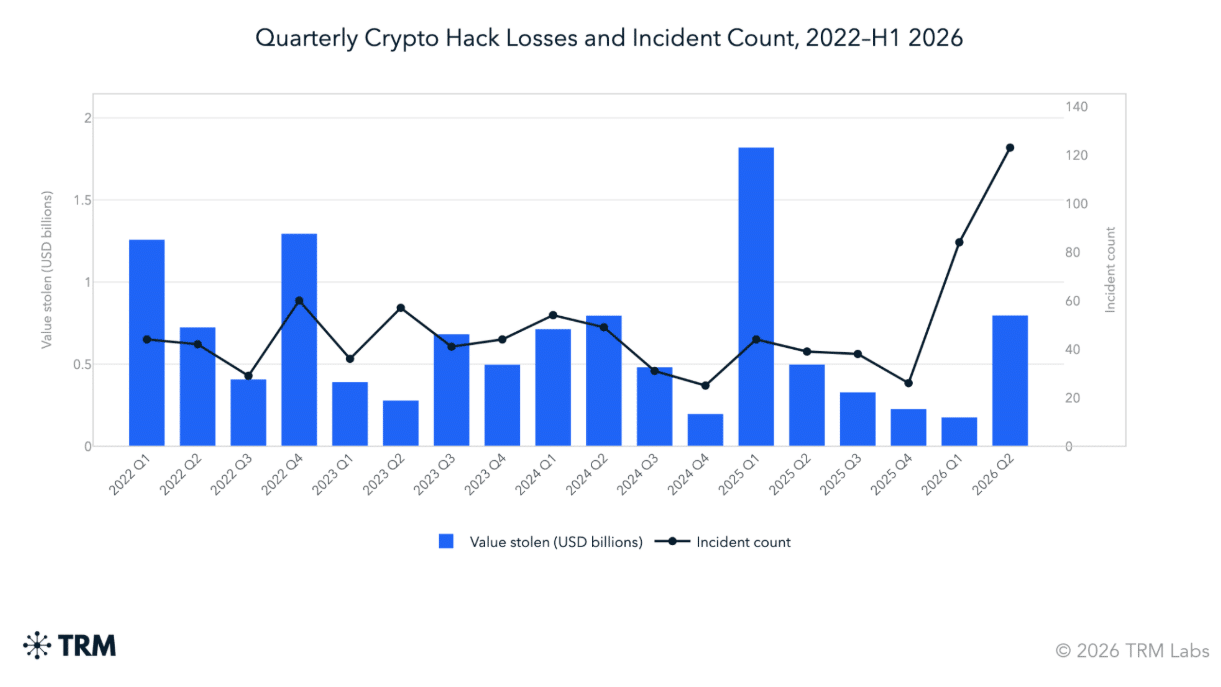
TRM Labs, a blockchain security firm, reported 207 crypto hacks in the first half of 2026, the most in any six-month period. The bulk of the crypto hack cases happened in Q2 (126 incidents), led by KelpDAO, Humanity, and Rhea Lend exploits.
Source: TRM Labs

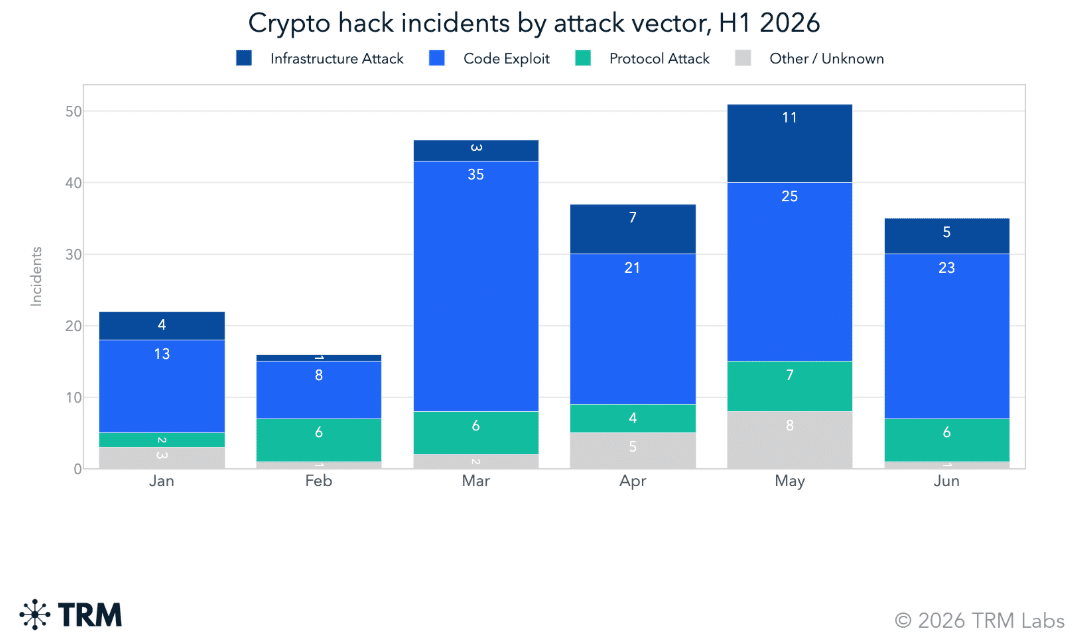
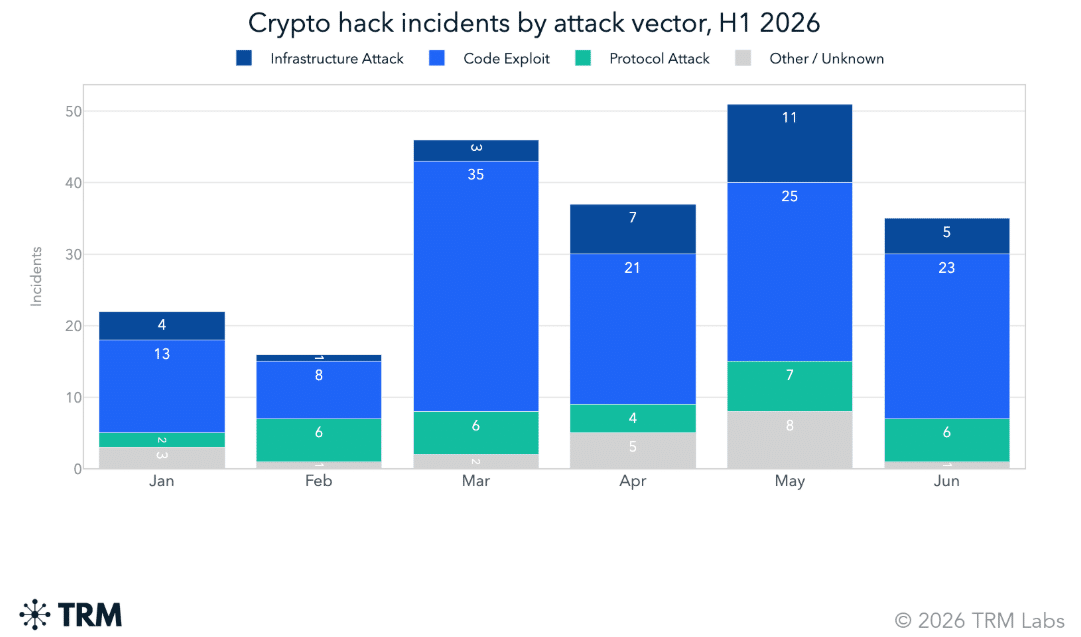
In the first half of 2025, 85 crypto hacks were reported. In other words, H1 2026 saw more than double the number of crypto hack cases over the same period. According to the report, most of the attacks were smart contract exploits, which accounted for 125 of the 207 incidents: a 60% dominance share in breaches.

Commenting on the same, Ari Redbord, global head of policy at TRM Labs, told AMBCrypto,

What I find most concerning is how concentrated these losses are in infrastructure failures. Three-quarters of all stolen value came from compromises of keys, custody systems, and signing infrastructure, not from smart contract bugs.

He concluded that,

The industry has improved at auditing code, but our operational security has not kept pace with our on-chain complexity.
Source: TRM Labs

North Korea-linked actors drive 66% of crypto hacks

Despite the record number of breaches, the overall value stolen in 2026 was relatively small compared to 2025.

The report noted that $972 million was lost as of June, which was below half of about $2.3 billion lost over the same period in 2025. Still, 66% of the stolen funds were driven by North Korean-linked entities.

By the end of Q2 2026, North Korea-linked attackers’ share of stolen crypto funds was over 75%. However, intensified activity from other entities during the quarter reduced their dominance to 66% at press time. The impact of the hacks has been more devastating for the DeFi sector. Amid the broader bearish sentiment, the intensified crypto hacks further drove investors from the DeFi sector.

In fact, in the KelpDAO’s $293 million hack, the attacker used fake tokens and deposited them in the Aave lending protocol and borrowed $190M in legitimate assets (wETH). There was a sudden liquidity crunch and subsequent bank run in Aave as investors feared the worthless collateral deposited by the attacker. As a result, Aave pools reached full utilization, preventing some late depositors from withdrawing their funds.

This added to broader DeFi security risk, which has triggered $55 billion in capital outflows in H1 2026. At the time of writing, the total DeFi TVL (total locked value) has hit a two-year low of $70 billion, up from $120B seen earlier in 2026.
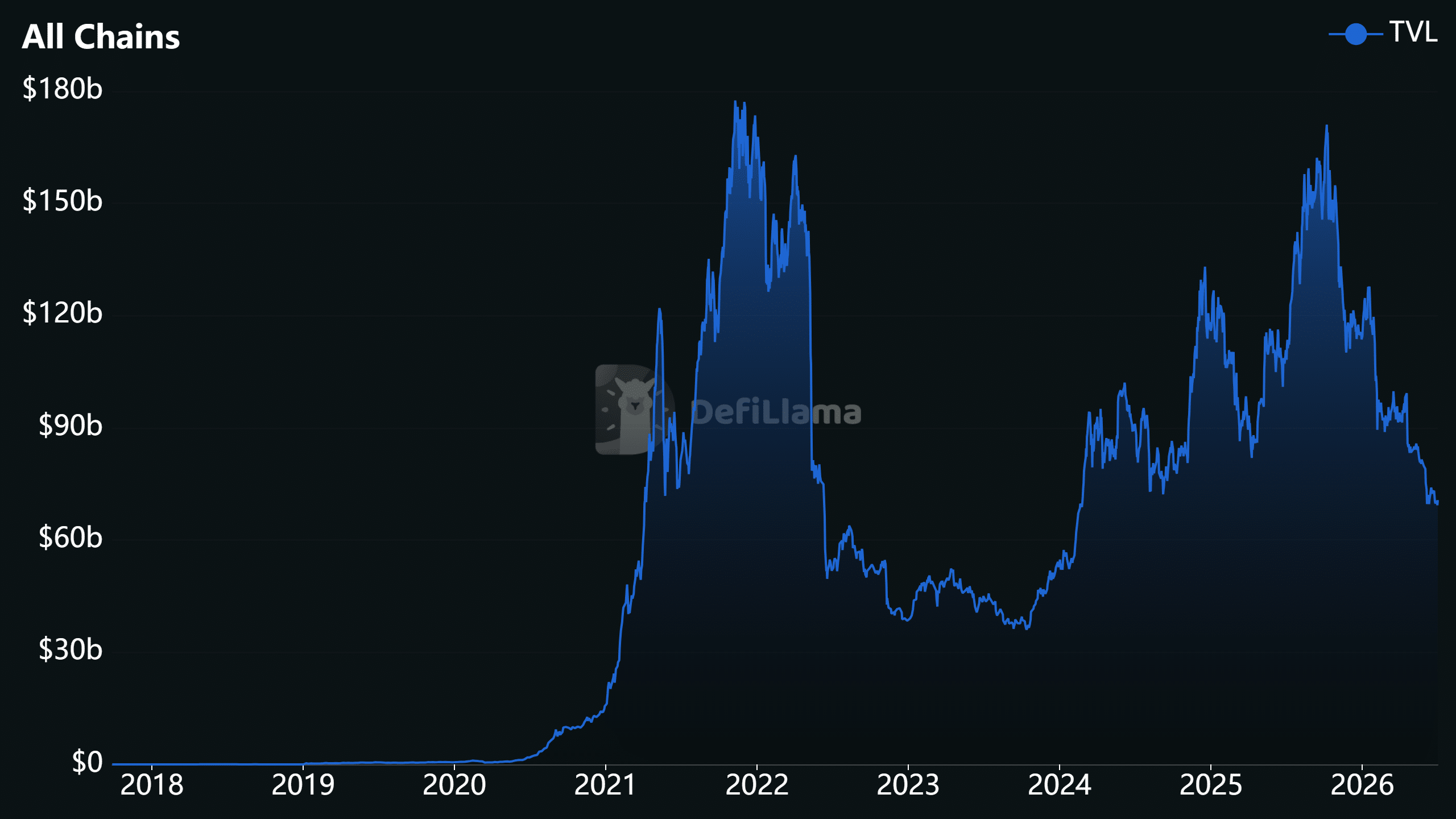
Source: DeFiLlama

Final Summary

  • Crypto hack cases hit a record high of 207 in H1 2026, but the stolen value was below $1B
  • North Korea-based threat actors accounted for $643M, or 66% of stolen funds over the same period.


Related Questions

QAccording to the report, what was the total number of crypto hacks reported in H1 2026 and how does it compare to the same period in 2025?

AThere were 207 crypto hacks reported in the first half of 2026, which is more than double the 85 hacks reported in H1 2025.

QWhat percentage of the crypto hacks in H1 2026 were due to smart contract exploits, and what was identified as the main source of the majority of stolen value?

ASmart contract exploits accounted for 125 out of 207 incidents, or 60% of the hacks. However, the main source of stolen value (75%) was compromises of keys, custody systems, and signing infrastructure, not smart contract bugs.

QWhat percentage of the total stolen funds in H1 2026 were attributed to North Korea-linked entities?

ANorth Korea-linked entities were responsible for 66% of the total stolen funds in H1 2026.

QHow did the overall value stolen from crypto hacks in H1 2026 compare to the value stolen in H1 2025?

AThe total value stolen in H1 2026 was $972 million, which is less than half of the approximately $2.3 billion stolen in H1 2025.

QWhat was one significant consequence of the KelpDAO hack, as described in the article?

AIn the KelpDAO hack, the attacker used fake tokens as collateral on Aave to borrow legitimate assets, causing a liquidity crunch and a bank run on Aave. This led to some Aave pools reaching full utilization, preventing some depositors from withdrawing their funds.

Related Reads

The Verdict in Choi Tae-won's Divorce Case: Revealing the Inheritance Undercurrent Behind SK Hynix's Trillion-Won Empire

SK Group Chairman Chey Tae-won's high-profile divorce case, involving a record 1.38 trillion won settlement, has drawn attention to the succession plans for Korea's second-largest conglomerate, especially its crown jewel, SK hynix. Unlike traditional chaebol scripts centered on the eldest son, Chey's three children from his marriage to former President Roh Tae-woo's daughter, Roh Soh-yeong, are carving distinct, non-traditional paths. Eldest daughter Chey Yun-jung (b. 1989) is seen as the most evident successor. With a scientific and consulting background, she holds executive roles at SK bioscience and SK Inc.'s growth support department, focusing on future strategy and biopharma. Her marriage is to an AI infrastructure entrepreneur, not a traditional business alliance. Second daughter Chey Min-jung (b. 1991) took a unique route, voluntarily serving as a South Korean naval officer, including an anti-piracy deployment. She later worked on policy and strategy for SK hynix in Washington D.C. before co-founding an AI-driven healthcare startup. She married a former U.S. Marine Corps officer, connecting her to U.S. defense and policy circles—networks crucial for a global semiconductor giant. The only son, Chey In-geun (b. 1995), who studied physics like his father, worked briefly at SK E&S before joining McKinsey. Despite fitting the traditional "heir" profile as the eldest son, he remains silent and holds no public position or shares in SK, suggesting the old succession playbook is obsolete. As SK hynix's valuation soars, becoming a geopolitical asset in the AI era, the heirs' legitimacy is no longer automatic. They must prove themselves in fields like AI biotech, global policy, and strategic consulting. Their marriages also reflect new elite networks in tech and defense, not old political alliances. Their inheritance is the complex challenge of navigating a globalized, tech-driven world, not just a corporate throne.

marsbitYesterday 09:06

The Verdict in Choi Tae-won's Divorce Case: Revealing the Inheritance Undercurrent Behind SK Hynix's Trillion-Won Empire

marsbitYesterday 09:06

From OpenSea to OpenRouter: Is Alex Atallah Repeating His 'Exit at the Peak' Playbook?

From OpenSea to OpenRouter: Is Alex Atallah Repeating His "Exit at the Peak" Playbook? According to the Wall Street Journal, payments giant Stripe is in talks to acquire the AI model aggregation platform OpenRouter in a potential deal valuing the company near $100 billion. This would mark founder Alex Atallah's second creation of a company reaching a $100 billion valuation, following his co-founding of NFT marketplace OpenSea. OpenRouter, founded just over three years ago, has grown rapidly by acting as a unified gateway for developers to access over 400 AI models. It currently has about 10 million users and processes over 200 trillion tokens monthly. While the platform's annualized revenue is around $50 million, its valuation has skyrocketed from $1.3 billion in March 2026. The potential acquisition by Stripe, a company OpenRouter's founder once likened it to, represents a major expansion into AI infrastructure for the payments leader. This move echoes Atallah's previous timing with OpenSea, where he departed before the NFT market's significant downturn. For OpenRouter, selling now may be strategic. Despite its scale, its business model—charging a 5-5.5% fee on AI inference calls—faces pressure from competition, open-source models, and potential price wars among model providers, limiting its profitability narrative for an IPO. A key asset for potential acquirers like Stripe is OpenRouter's vast repository of real-world AI usage data, which offers unique insights into model performance and developer preferences that are difficult to replicate. Whether this potential deal signifies a new valuation benchmark for AI infrastructure or another market peak signal remains to be seen.

链捕手Yesterday 08:42

From OpenSea to OpenRouter: Is Alex Atallah Repeating His 'Exit at the Peak' Playbook?

链捕手Yesterday 08:42

Trading

Spot
活动图片




