JPMorgan sees yield-bearing stablecoins growing from 6% to 50% of market share

THE BLOCKPublié le 2025-03-28Dernière mise à jour le 2025-03-28

Résumé

JPMorgan analysts forecast that yield-bearing stablecoins could rise from the current 6% to as much as 50% of the stablecoin market cap in the future.

JPMorgan analysts forecast that yield-bearing stablecoins could rise from the current 6% to as much as 50% of the stablecoin market cap in the future.

Yield-bearing stablecoins are attracting investors similarly to traditional money market funds, particularly in today’s high-interest-rate environment, the analysts said.

Yield-bearing stablecoins, including tokenized Treasurys, which offer interest returns similar to traditional financial products, could experience massive growth ahead, according to JPMorgan analysts.

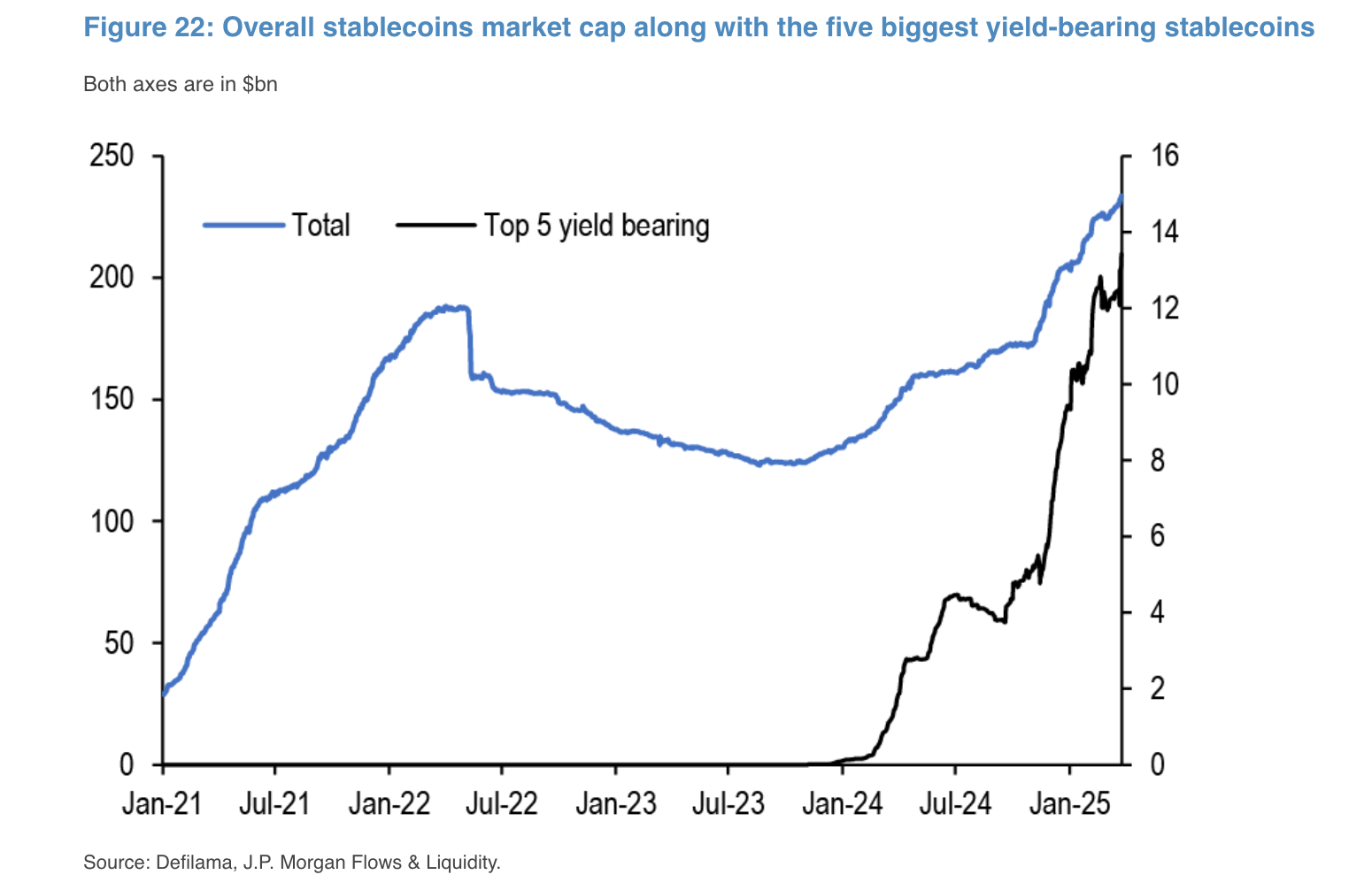
Yield-bearing stablecoins currently make up just 6% of the total stablecoin market cap but could expand significantly, potentially capturing up to 50% of the market unless regulatory changes intervene, JPMorgan analysts led by managing director Nikolaos Panigirtzoglou wrote in a report released Wednesday.

The top five yield-bearing stablecoins — Ethena's USDe, Sky Dollar's USDS, BlackRock's BUIDL, Usual Protocol's USD0 and Ondo Finance's USDY— have seen rapid growth since the U.S. election in November, rising from around $4 billion to over $13 billion in combined market cap, Panigirtzoglou told The Block.

According to analysts, this growth is expected to continue. They added that the U.S. Securities and Exchange Commission's recent approval of Figure Markets' application for a yield-bearing stablecoin, YLDS, which is registered as a security, provides further momentum to this segment.
Traditional stablecoins, such as Tether's USDT and Circle's USDC, do not share reserve yields with their users because doing so would classify these assets as securities, according to the analysts. Such a classification would also impose additional compliance requirements, hindering their current seamless use as collateral within the crypto ecosystem, they said.

Why yield-bearing stablecoins are on the rise

The JPMorgan analysts identified several factors driving the rapid growth of yield-bearing stablecoins.

First, investors prefer these assets because they offer interest without requiring holders to engage in risky trading or lending activities or give up custody of their assets.

Second, major crypto trading platforms such as Deribit and FalconX now accept tokenized Treasurys as collateral, enabling traders to earn yield on posted collateral.

Additionally, crypto investors are increasingly turning to tokenized Treasurys in decentralized finance (DeFi) to obtain higher yields, as typical DeFi yields have significantly decreased from their peak levels of 2022. Projects like Frax Finance are also adopting tokenized Treasurys as underlying assets, further fueling this growth.

Despite this positive outlook, the JPMorgan analysts noted barriers. Yield-bearing stablecoins are classified as securities, subjecting them to regulatory restrictions that limit their adoption, especially among retail investors. Moreover, traditional non-yield-bearing stablecoins continue to hold a notable liquidity advantage.

With a combined market cap of around $220 billion across multiple blockchains and centralized exchanges, traditional stablecoins offer efficient, fast and low-cost transactions, even at large volumes. In contrast, yield-bearing stablecoins are newer, smaller and comparatively less liquid.

However, "This liquidity disadvantage could potentially be lessened over time as yield-bearing stablecoins gain further traction in the future in crypto derivative trading as source of collateral, in DAO treasuries, liquidity pools, and idle cash with crypto venture funds," according to the analysts.

As a result, over time, yield-bearing stablecoins could attract much of the idle cash currently sitting in traditional stablecoins, the analysts said. While the exact amount of this idle cash is difficult to estimate, it's unlikely to represent the majority of the stablecoin market, according to the analysts.


Cryptos en tendance

Lectures associées

Moments critiques pour le Bitcoin : Les zones de coût à surveiller identifiées !

La société d'analyse cryptographique Glassnode souligne que l'assouplissement des attentes de baisse des taux d'intérêt aux États-Unis et la possibilité de nouvelles hausses ont freiné l'appétit pour le risque sur le marché des cryptomonnaies. La décision de la Fed sur les taux reste cruciale pour la tendance du marché. Actuellement, le rendement des obligations du Trésor américain dépasse celui des stratégies de portage sur le marché crypto, incitant les investisseurs à privilégier la liquidité et les instruments à faible risque. Le prix du Bitcoin évolue en dessous de son principal niveau de coût moyen, autour de 69 000 USD, qui constitue une zone de résistance clé pour les investisseurs à court terme. Un rebond plus solide nécessiterait de franchir ce seuil avec des volumes de trading accrus, ainsi qu'une reprise de la demande pour les ETF spot Bitcoin. Glassnode note que la baisse actuelle du Bitcoin est la moins profonde à ce jour, mais sa durée suggère que la correction n'est peut-être pas terminée. Les volumes de trading spot ont chuté à des niveaux bas depuis plusieurs années, et les indicateurs de risque signalent une aversion accrue. La structure du marché est actuellement davantage influencée par des facteurs macroéconomiques (politique monétaire, rendements obligataires, force du dollar) que par les dynamiques internes au secteur crypto. Une perte du support des 62 000 à 68 000 USD, combinée à de nouveaux afflux sur les plateformes d'échange, pourrait compromettre la reprise. À l'inverse, une politique monétaire plus accommodante, une hausse des volumes, un retour du Bitcoin au-dessus de 69 000 USD et une reprise des achats d'ETF seraient des signaux positifs.

cryptonews.ruIl y a 13 mins

Moments critiques pour le Bitcoin : Les zones de coût à surveiller identifiées !

cryptonews.ruIl y a 13 mins

Trading

Spot

Articles tendance

Comment acheter ONDO

Bienvenue sur HTX.com ! Nous vous permettons d'acheter OndoFinance (ONDO) de manière simple et pratique. Suivez notre guide étape par étape pour commencer votre parcours crypto.Étape 1 : Création de votre compte HTXUtilisez votre adresse e-mail ou votre numéro de téléphone pour ouvrir un compte sur HTX gratuitement. L'inscription se fait en toute simplicité et débloque toutes les fonctionnalités.Créer mon compteÉtape 2 : Choix du mode de paiement (rubrique Acheter des cryptosCarte de crédit/débit : utilisez votre carte Visa ou Mastercard pour acheter instantanément OndoFinance (ONDO).Solde :utilisez les fonds du solde de votre compte HTX pour trader en toute simplicité.Prestataire tiers :pour accroître la commodité d'utilisation, nous avons ajouté des modes de paiement populaires tels que Google Pay et Apple Pay.P2P :tradez directement avec d'autres utilisateurs sur HTX.OTC (de gré à gré) : nous offrons des services personnalisés et des taux de change compétitifs aux traders.Étape 3 : stockage de vos OndoFinance (ONDO)Après avoir acheté vos OndoFinance (ONDO), stockez-les sur votre compte HTX. Vous pouvez également les envoyer ailleurs via un transfert sur la blockchain ou les utiliser pour trader d'autres cryptos.Étape 4 : tradez des OndoFinance (ONDO)Tradez facilement OndoFinance (ONDO) sur le marché Spot de HTX. Il vous suffit d'accéder à votre compte, de sélectionner la paire de trading, d'exécuter vos trades et de les suivre en temps réel. Nous offrons une expérience conviviale aux débutants comme aux traders chevronnés.

416 vues totalesPublié le 2024.12.12Mis à jour le 2026.06.02

Comment acheter ONDO

Discussions

Bienvenue dans la Communauté HTX. Ici, vous pouvez vous tenir informé(e) des derniers développements de la plateforme et accéder à des analyses de marché professionnelles. Les opinions des utilisateurs sur le prix de ONDO (ONDO) sont présentées ci-dessous.

活动图片