Author: Cathy, Plain Talk Blockchain
Original Title: Did Maduro Really Hide $60 Billion in BTC?
In the early hours of January 3, 2026, U.S. special forces arrested Venezuelan President Nicolás Maduro in Caracas during a military operation codenamed "Absolute Resolve."
This event has sparked a major question in the crypto world: Did the Maduro regime truly possess the rumored "shadow reserves"?
According to a report from the investigative agency Whale Hunting and multiple intelligence sources, a startling rumor is circulating in the market: the Maduro regime may hold 600,000 to 660,000 Bitcoin. If true, this would be worth a staggering $60-67 billion at early 2026 market prices.
What does this mean?
MicroStrategy (now renamed Strategy), the company known as the "Bitcoin whale," held over 670,000 BTC as of January 2026, valued at approximately $61.3 billion. If the Venezuelan rumor is true, its holdings would be comparable to the world's largest corporate buyer, representing about 3% of Bitcoin's total supply (21 million coins).
But the question is: Does this fortune actually exist? And if so, where is it hidden?
In the crypto world, there's an ironclad rule: "Not your keys, not your coins."
01 How Did the Rumor Originate?
To understand where the rumor of "600,000 BTC" came from, we first need to understand the theoretical avenues through which the Maduro regime could have accumulated Bitcoin. It must be emphasized that the following analysis is based on public reports and intelligence estimates, not proven facts.
Avenue One: The Petro Scam – Paving the Way for Crypto
In February 2018, under heavy pressure from U.S. sanctions, Maduro announced the launch of the world's first "national cryptocurrency" – the Petro. The government claimed it raised $735 million on the first day, with a total fundraising target of $6 billion.
However, multiple investigations revealed serious problems with this ICO from the very beginning.
The Petro was first claimed to be based on Ethereum, then on NEM, and ultimately seemed to run on a private chain that didn't exist. The government claimed the Petro was backed by 5.3 billion barrels of crude oil in the Ayacucho block, but field investigations showed dilapidated infrastructure with no mining activity whatsoever.
The so-called "fundraising" was likely just internal regime assets shifting from one hand to another.
But while the Petro failed, it left a crucial byproduct: Sunacrip (National Superintendency of Crypto Assets). This agency was given the power to regulate all crypto activities, issue mining licenses, and even directly operate national mining pools. It wasn't a regulator; it was a national money laundering center.
In January 2024, Maduro officially shut down the Petro. This wasn't a failure, but a strategic pivot – moving from "issuer" to "holder," fully transitioning to truly globally liquid Bitcoin and USDT.
Avenue Two: The PDVSA-Crypto Scandal – $21 Billion Unaccounted For
Market rumors suggest the core source of the Maduro regime's Bitcoin reserves may have been the diversion of oil export revenues from the state-owned oil company PDVSA.
In 2019, the U.S. imposed comprehensive sanctions on PDVSA, cutting off its access to the global banking system. To survive, PDVSA initiated an "anti-blockade" strategy:
Dark Fleet: Using tankers with transponders turned off to ship crude oil to "teapot refineries" (small, non-state-owned refineries) in Asia.
Intermediary Network: Masking the origin of crude through shell companies registered in the UAE, Russia, and elsewhere. These intermediaries often had no oil trading experience; their only qualification was personal connections to the regime's core figures.
Crypto Settlements: Unable to receive dollar wire transfers, intermediaries were instructed to pay for oil in USDT (Tether).
In March 2023, Venezuela was rocked by the shocking "PDVSA-Crypto" scandal. An internal government audit revealed that approximately $21 billion in accounts receivable from oil exports between 2020 and 2023 was unaccounted for.
Where did this money go? It remains a mystery.
Some intelligence analysts speculate that a portion may have found its way back to regime-controlled wallets via cryptocurrency. Reportedly, Sunacrip established an automated "hop" mechanism:
-
Receive: Intermediaries send USDT to intermediate wallets controlled by Sunacrip
-
Launder: Obfuscate the fund trail through mixers like Tornado Cash
-
Exchange: Convert USDT to Bitcoin at OTC desks in Russia or Eastern Europe
-
Store: Bitcoin transferred to offline-generated cold wallets, with private keys held by the highest levels of the regime
The core designers of this system were Tareck El Aissami (former Oil Minister) and Alex Saab (the regime's "financial diplomat"). El Aissami resigned in March 2023 and was arrested in April 2024 on corruption charges, facing counts of treason, money laundering, and more. The assets he controlled were likely confiscated by the Maduro family.
Saab, however, returned to Venezuela in a prisoner swap with the U.S. in December 2023. Maduro exchanged 10 American prisoners for this financial architect, underscoring his perceived indispensability – an importance likely stemming from his control over the financial lifeline.
Avenue Three: Military Mining – "National Hashrate" from Confiscated Rigs
Beyond oil revenue, another theory suggests the Venezuelan regime may have directly produced Bitcoin by controlling the "means of production."
Venezuela has some of the world's cheapest electricity, primarily from the Guri Dam. This makes Bitcoin mining highly profitable. The Maduro government monopolized this advantage through a military commercial entity – CAMIMPEG (Military Company for Mining, Oil, and Gas).
CAMIMPEG established "Bolivarian Army Digital Asset Production Centers." These military mining farms enjoyed privileges:
-
Guaranteed Power: Priority access during nationwide frequent blackouts
-
Security: Heavily guarded by the National Guard
-
Zero-Cost Operation: With electricity effectively free (state-subsidized), marginal costs were near zero
But where did the equipment for these military farms come from? Largely from the confiscation of private miners.
Starting in 2020, Sunacrip, in conjunction with the military, launched a series of raids on private mining operations:
-
2020: National Guard seized 315 Antminer S9 units in Bolívar State
-
2023: Raided the headquarters of the "Tren de Aragua" gang in Tocorón Prison, seizing大量(mining rigs and weapons)
-
2024: Seized over 2300 Antminer S19J Pro units in a single operation in Maracay
According to intelligence source estimates, between 2020 and 2025, the government may have acquired tens of thousands of mining machines through confiscations from private farms and gang facilities. These devices were not destroyed but redeployed to CAMIMPEG-controlled facilities.
Based on the known thousands of high-performance miners, plus output from state-owned farms, this "zombie army" could have produced tens of thousands of Bitcoin over the past few years.
02 Data Sources and Skepticism Regarding the "600,000 BTC" Rumor
Key Question: Is this number credible?
Based on intelligence reports from Chainalysis, TRM Labs, and the investigative agency "Whale Hunting," the estimated figure circulating in the market is 600,000 to 660,000 BTC. But it must be emphasized:
This figure comes only from intelligence sources, not hard data traceable on the blockchain
No public on-chain evidence supports this number
The Whale Hunting report clearly states: "This estimate is from HUMINT (Human Intelligence), unconfirmed by blockchain analysis"
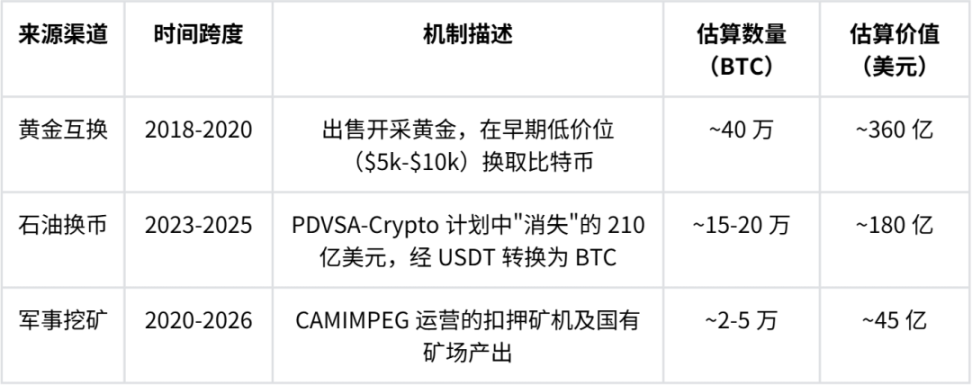
Nonetheless, the report still provided a hypothetical breakdown:
Is this rumor logically plausible?
Supporters' Viewpoints:
MicroStrategy Comparison: MicroStrategy (now Strategy) held over 670,000 BTC as of January 2026. A sovereign nation theoretically has the capacity to reach a similar scale.
Financial Backing: PDVSA had $21 billion unaccounted for in 2020-2023. If 50% of that was converted to Bitcoin, at average prices of the time, it could purchase 300,000-400,000 BTC.
Skeptics' Viewpoints:
-
Lack of On-Chain Evidence: If 600,000 BTC truly existed, traces should be found on the blockchain, but no one has been able to pinpoint specific addresses.
-
Suspiciously Round Number: The figure of 600,000 seems more like an estimate than an actual count and may be significantly overestimated.
-
Questionable Motive: This rumor might be used for political purposes or market manipulation.
Conclusion: In the absence of concrete blockchain evidence, this remains an unverified rumor.
03 If the Rumor is True: Who Would Hold the Private Keys?
Assuming this "shadow reserve" does exist, even Maduro's arrest does not mean the U.S. can control it.
The FBI's primary challenge would be: How to prove the existence of these Bitcoins and find the private keys?
Who might hold the private keys?
If this asset exists, intelligence analysts speculate it is unlikely managed by a single account, but more likely uses a multi-signature (Multisig) or private key sharding scheme.
Theoretical key holders might include:
-
Alex Saab: As the regime's financial architect, Saab not only understands the full picture of fund flows but likely holds the recovery seed phrases or knows the physical location of hardware wallets. His return to Venezuela in the December 2023 prisoner swap – 10 American prisoners for this financial brain – highlights his indispensability to the regime.
-
Nicolasito (Maduro's Son): Named in indictments, he was deeply involved in illegal gold mining and the regime's daily operations, potentially holding a backup of the family's portion of the private keys.
-
Cilia Flores (First Lady): Known as the "First Combatant," she holds a high position within the regime's inner circle. She might control physical access to some cold wallets.
-
Technocrat Layer: Former Sunacrip technicians might be responsible for maintaining the multi-signature technical infrastructure. While they might not know the complete private keys, their cooperation could be crucial for reconstructing wallet access.
Speculated Crypto Architecture
The most likely architecture is an M-of-N signature scheme (e.g., 3/5 or 5/7). This means signatures from 3 out of 5 core individuals would be required to move the funds.
If Maduro, Flores, and Saab were all under U.S. control, theoretically the U.S. could compel them to cooperate in unlocking the funds. But reality is far more complex:
-
Geographic Dispersion: Cold wallets could be stored分散ly in bunkers in Caracas, safes in Russia, or safe houses in Cuba.
-
Dead Man's Switch: The system might include an automatic trigger mechanism. If specific actions aren't performed for a prolonged period (e.g., Maduro goes missing), funds could automatically transfer to irrecoverable addresses or be sent to allies.
-
Ideological Resistance: Even facing life imprisonment, core figures holding the keys might refuse to cooperate. For them, this is not just wealth, but the final weapon against "American imperialism."
04 Market Impact: The Rumor Itself is Uncertainty
Even if this rumor is unverified, it has itself become a "Sword of Damocles" hanging over the crypto market. 600,000 Bitcoin represents 3% of BTC's total supply. If real, the impact would be enormous.
Three Possible Scenarios
Scenario One: Rumor is False
If thorough investigation by the FBI and blockchain analysis firms ultimately proves this "shadow reserve" does not exist or is severely overestimated, the market might breathe a sigh of relief. This means no potential selling pressure, neutral or slightly bullish for price.
Scenario Two: Rumor is True and FBI Gains Control
If this asset exists and the U.S. successfully seizes it, following standard procedure, these Bitcoin would enter judicial freezing, potentially locked for years. This effectively locks up a huge supply, reducing market circulation, which is bullish for price.
This is similar to the FBI's seizure of Silk Road Bitcoin in 2013. Around 170,000 BTC were frozen and eventually auctioned in batches. But during the freeze, these coins exited circulation, objectively reducing market selling pressure.
Scenario Three: Rumor is True but Keys are Lost
This is the most dangerous scenario. If the asset exists but the private keys are not controlled by the U.S., remnants of the fleeing regime might attempt to sell Bitcoin on OTC markets to fund their escape, triggering panic selling.
The German government's sale of just 50,000 BTC in 2024 caused short-term market volatility. 600,000 in selling pressure would be catastrophic.
05 Summary
Maduro's arrest has revealed a glimpse of the Venezuelan regime's use of cryptocurrency to evade sanctions.
From the failed Petro experiment to the $21 billion PDVSA-Crypto scandal, to militarized mining facilities – these are all confirmed facts. But the rumor of a "600,000 BTC shadow reserve" still lacks solid evidence.
What we can confirm: Venezuela did use crypto to evade sanctions, PDVSA did have $21 billion unaccounted for, and the regime did confiscate大量mining equipment.
What we cannot confirm includes: Whether 600,000 BTC were actually accumulated, who holds the private keys (if they exist), and whether these Bitcoin will enter the market.
This indeed raises a尖锐question: When decentralized technology is used to evade sanctions, how do we find a balance between freedom and order?
But until more evidence surfaces, the "$60 billion shadow reserve" remains just an unverified rumor.
Twitter:https://twitter.com/BitpushNewsCN
Bitpush TG Discussion Group:https://t.me/BitPushCommunity
Bitpush TG Subscription: https://t.me/bitpush