Ethereum Faces Whale Panic Fears as Coinbase Premium Turns Negative

TheNewsCryptoPubblicato 2025-12-18Pubblicato ultima volta 2025-12-18

Introduzione

Ethereum is on track for its fourth consecutive monthly decline in December, increasing pressure on large investors. The Coinbase Premium Index has turned negative, indicating significant selling pressure from U.S.-based institutional traders. Whale investors, holding between 1,000 to over 100,000 ETH, are nearing their breakeven threshold with minimal unrealized profits, having accumulated rather than sold during this cycle. While this suggests a potential bottom formation, the lack of retail participation and declining network activity pose risks. If the downtrend continues, whales may face actual losses, potentially triggering panic selling if key support around $3,000 fails to hold.

Ethereum appears headed toward a fourth consecutive monthly decline in December, creating pressure on large investors who accumulated throughout the year. The Coinbase Premium Index turned negative during December’s third week, signaling selling pressure from U.S.-based traders.

The indicator measures the percentage difference between ETH prices on Coinbase Pro’s USD pair versus Binance’s USDT pair. Negative readings indicate lower prices on Coinbase, reflecting institutional selling activity. After applying a 30-day exponential moving average filter, the index has remained negative for over one month.

Whale Investors Approach Breakeven Threshold

Data from the ETH Whale Unrealized Profit Ratio tracking addresses holding between 1,000 and over 100,000 ETH shows steady decline over four months. The ratio has approached zero, indicating large investors now hold average cost basis near current market prices with minimal unrealized profit.
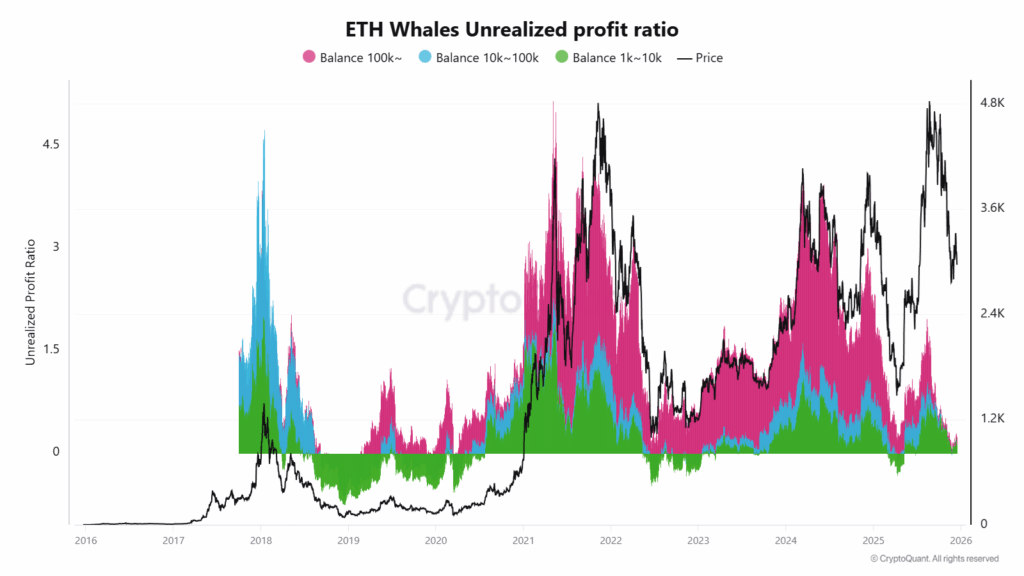
Ethereum Whale Unrealized Profit Ratio. Source: CryptoQuant

CryptoQuant analyst CW8900 stated that these holders did not take profits during this cycle and are increasing positions. This suggests the current price range offers an opportunity to acquire ETH at favorable levels. Continued accumulation at these prices could indicate a potential bottom formation zone.

However, bearish analysis raises questions about outcomes if the four-month downtrend continues. Whale investors would face actual losses in that scenario. Two factors suggest this possibility remains viable heading into year-end.

Active sending addresses for ETH reached the lowest level of 2025 in December. The metric displays a clear downward trend as network activity has cooled. Without retail buying pressure, ETH struggles to generate momentum needed for price breakouts even with institutional demand present.

CryptoOnchain analyst noted that lack of retail participation can limit short-term upside as retail flow typically drives momentum during early recovery phases. The realized price for ETH accumulation addresses serves as key support around $3,000.

These conditions place whale investors in a position requiring action. Selling to recover capital or limit losses could intensify downward pressure. Such movements could potentially trigger panic selling at institutional scale if support levels fail to hold through December close.

TagsETHEREUM

Domande pertinenti

QWhat does a negative Coinbase Premium Index indicate for Ethereum?

AA negative Coinbase Premium Index indicates lower Ethereum prices on Coinbase Pro's USD pair compared to Binance's USDT pair, reflecting selling pressure from U.S.-based institutional traders.

QWhat is the significance of the ETH Whale Unrealized Profit Ratio approaching zero?

AThe ETH Whale Unrealized Profit Ratio approaching zero indicates that large investors (holding 1,000 to 100,000+ ETH) now hold an average cost basis near current market prices with minimal unrealized profit, meaning they are close to their breakeven threshold.

QAccording to the article, what is a key support level for Ethereum's price?

AThe realized price for ETH accumulation addresses serves as a key support level around $3,000.

QWhat potential risk do whale investors face if the four-month downtrend in Ethereum continues?

AIf the four-month downtrend continues, whale investors would face actual losses on their positions, which could lead them to sell to recover capital or limit losses, potentially intensifying downward pressure and triggering panic selling.

QWhat factor is identified as limiting Ethereum's upside momentum despite institutional demand?

AA lack of retail participation is limiting Ethereum's short-term upside momentum, as retail flow typically drives momentum during early recovery phases, and active sending addresses have reached their lowest level of 2025.

Letture associate

Global Asset Rotation: Why Does Liquidity Drive the Cryptocurrency Cycle? (Part 1)

This article introduces a new series on global asset allocation and rotation, arguing that liquidity—not new narratives—is the primary driver of cryptocurrency market cycles. While narratives like RWA or X-402 can attract attention, they are triggers, not fundamental drivers. The real force is capital flow: ample liquidity amplifies even weak narratives, while liquidity contraction undermains the most compelling ones. The framework begins by mapping global assets not by traditional labels (stocks, bonds, commodities) but by their roles and dependencies within economic and liquidity cycles. Cryptocurrency is reclassified not as a traditional risk asset (like equities, which have cash flows and valuation models) but as a non-cash-flow alternative asset. Its price action is driven primarily by capital inflows and outflows, making it highly sensitive to liquidity and risk appetite. Five key macro indicators are identified as core drivers: interest rates (especially real rates), inflation metrics (CPI, PCE), economic growth indicators (PMI, GDP), systemic liquidity (central bank balance sheets, money supply), and risk appetite (volatility indices, credit spreads). A causal chain is proposed: inflation influences interest rates, which affect liquidity, which then drives risk preference and ultimately asset prices. The U.S. remains the anchor for global capital flows, and understanding its monetary policy cycle is crucial. During loose monetary conditions, risk assets like crypto thrive; during tightening, defensive assets like cash and bonds outperform. The article concludes that a structured framework focusing on macro drivers and cyclical patterns is essential for understanding asset rotation, avoiding emotional decisions, and identifying when liquidity shifts toward high-risk assets like cryptocurrency.

marsbit1 h fa

Global Asset Rotation: Why Does Liquidity Drive the Cryptocurrency Cycle? (Part 1)

marsbit1 h fa

Trading

Spot
Futures

Discussioni

Benvenuto nella Community HTX. Qui puoi rimanere informato sugli ultimi sviluppi della piattaforma e accedere ad approfondimenti esperti sul mercato. Le opinioni degli utenti sul prezzo di ETH ETH sono presentate come di seguito.

活动图片