Key Takeaways
- Wintermute has sharply reduced its on-chain crypto holdings over the past three weeks.
- On-chain trackers show large transfers of BTC and ETH, with some estimates reaching $1.5 billion.
- The selling comes amid broader market weakness, but does not necessarily signal distress.
Wintermute, one of the crypto industry’s most popular market makers, has drawn renewed attention after on-chain data revealed a sharp reduction in its asset holdings over recent weeks.
Blockchain analytics and community tracking suggest that Wintermute has offloaded a substantial portion of its inventory, primarily Bitcoin, Ethereum, and Solana, during a period marked by falling prices and heightened volatility across crypto markets.
XM.com
Bitunix
Bitget










































































































Large Transfers, Rising Scrutiny
According to on-chain data monitored by platforms such as Arkham Intelligence, Wintermute-linked wallets have sent large batches of BTC and ETH to centralized exchanges, including Binance, throughout late November and early December.
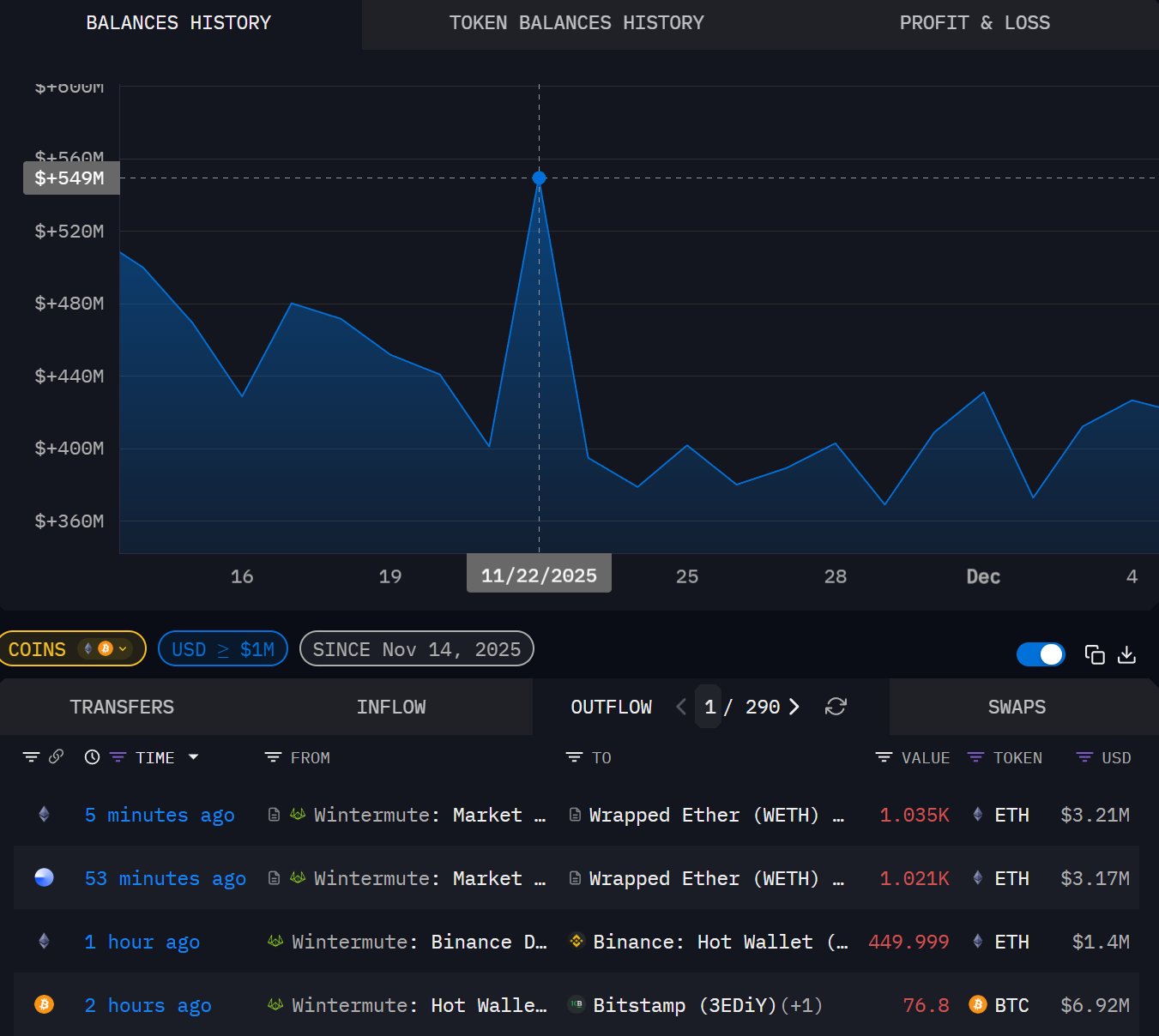
Some market observers estimate that more than $1.5 billion worth of Bitcoin alone has moved in a series of short bursts over roughly three weeks.
While exact figures vary depending on the attribution methods used, the trend is clear. Wintermute’s publicly tracked holdings have declined sharply during that window.
Arkham data shows Wintermute’s aggregate holdings falling from roughly $540 million at their peak in late November to closer to $320 million at one point, before partially rebounding.
As of Dec. 15, Arkham estimates Wintermute’s remaining on-chain holdings at approximately $422 million, spread across several major assets.
Those holdings include:
- 648,000 SOL tokens,
- 757 Bitcoins.
- 10,700 Ether,
- And over $27 million worth of USDC.
The selling activity has coincided with choppy market conditions and elevated correlations across crypto assets, amplifying short-term price pressure.
However, there has been no indication from Wintermute that the firm is facing insolvency or forced liquidation.
What Wintermute’s Selling Likely Signals—and What It Doesn’t
Market makers like Wintermute operate differently from directional traders.
Their role typically involves holding large inventories to provide liquidity, facilitate over-the-counter trades, and hedge exposure across venues.
As a result, heavy selling does not automatically signal financial stress.
Periods of sharp volatility often prompt market makers to reduce risk, rebalance inventories, or unwind positions accumulated during more favorable market conditions.
In some cases, large transfers may reflect the execution of client sell orders rather than proprietary dumping.
Wintermute itself has previously described recent market conditions as a “digestion phase,” characterized by capital rotation into major assets, such as Bitcoin and Ethereum, rather than fresh inflows into the broader market.
Historical data also shows that Wintermute’s on-chain balances can fluctuate significantly over short periods, rising and falling as positions are opened, hedged, and closed.
A Source of Pressure, Not a Verdict
While Wintermute’s selling adds near-term pressure to already fragile markets, it is unlikely to serve as a definitive signal of broader capitulation on its own.
Other on-chain indicators continue to show accumulation in select sectors, and institutional participation has not disappeared entirely.
Still, when a major liquidity provider reduces exposure at scale, the impact is felt, particularly during periods of thin liquidity.
For now, Wintermute’s activity appears more consistent with strategic risk management in a turbulent market than with any existential threat to the firm itself.