Zcash price prediction – Can Ironwood upgrade keep ZEC’s 37% rally alive?

ambcryptoPublicado a 2026-07-21Actualizado a 2026-07-21

Resumen

Zcash has rallied nearly 37% since its Ironwood (NU6.3) upgrade deployed to testnet in early July. This major upgrade introduces a new shielded pool and a "turnstile" mechanism to strengthen supply verification without compromising privacy. Concurrently, it marks the retirement of the legacy zcashd node, a significant architectural shift for the network. After its rally, ZEC is consolidating around $546, with buyers attempting to establish support. Immediate resistance lies near $560, with a breakout potentially targeting $600, while the $500 region acts as key support. The final testing phase precedes Ironwood's planned mainnet activation later this month.

Zcash [ZEC] has rallied nearly 37% since developers deployed the Ironwood [NU6.3] upgrade to testnet earlier this month, with the privacy-focused cryptocurrency outperforming many of its peers ahead of the protocol’s next major network upgrade.

As the community prepares for Ironwood’s mainnet activation, the upgrade also marks the beginning of the end for zcashd. This is the network’s long-running reference node, making this one of the most significant transitions in Zcash’s history.

Ironwood aims to strengthen confidence in Zcash’s supply

The Zcash Open Development Lab deployed the Ironwood [NU6.3] upgrade to testnet on July 2, with activation following on July 4. The milestone serves as the final testing phase before the planned mainnet rollout later this month.

Ironwood was introduced following the disclosure of an Orchard protocol vulnerability in June. While developers said there was no evidence the issue had been exploited or that user funds were at risk, the flaw highlighted a limitation in proving the integrity of Zcash’s shielded supply.

To address that, Ironwood introduces a new shielded pool alongside a “turnstile” mechanism that enables the network to verify the amount of ZEC migrating into the new pool without compromising transaction privacy.

The upgrade is designed to strengthen confidence in Zcash’s circulating supply while preserving the privacy guarantees that distinguish the network from other cryptocurrencies.

Legacy zcashd node heads for retirement

Ironwood also marks a major infrastructure shift for the ecosystem.

The long-running zcashd reference implementation will not support NU6.3. It is being phased out as the network transitions to a Rust-based architecture built around Zebra, Zaino, and Zallet.

Developers have urged node operators to migrate before Ironwood activates on mainnet, as legacy zcashd nodes are approaching their automatic end-of-life shutdown. It will no longer participate in the upgraded network.

The transition represents one of the largest architectural changes since Zcash launched. It replaces the software that has underpinned the blockchain for years.

ZEC price prediction: Bulls pause after 37% advance

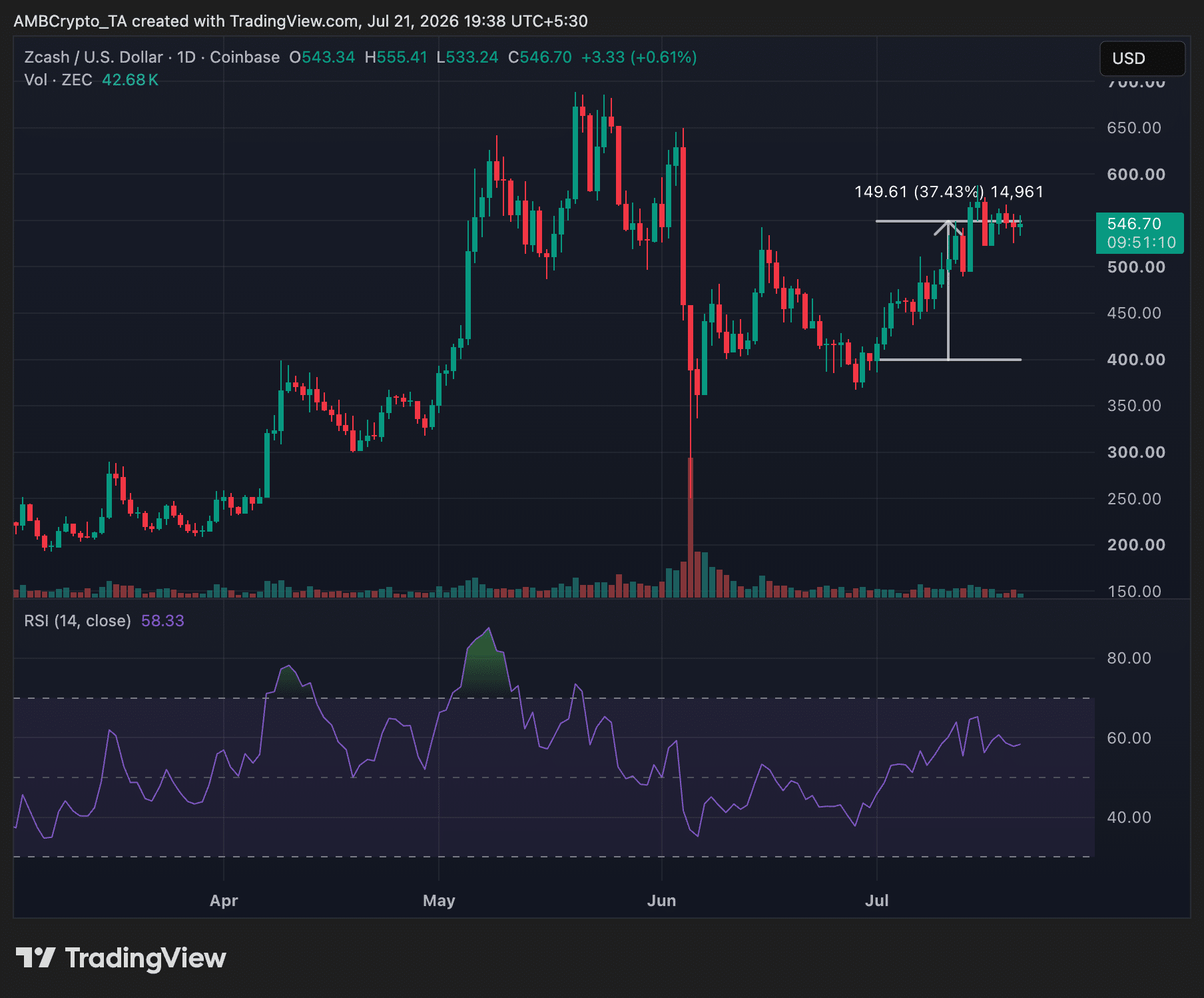
At press time, ZEC traded around $546, up roughly 37.4% from its early July lows.

The rally has since slowed into a period of consolidation, with buyers attempting to establish support after reaching the recent highs.

The daily RSI stood at around 58, indicating bullish momentum remained intact without entering overbought territory. That suggests buyers still hold a modest advantage. However, the strong upside momentum seen earlier in the month has begun to moderate.
Source: TradingView

The immediate resistance lies around $560, where recent advances have repeatedly stalled.

A decisive breakout above that level could pave the way for another attempt at $600, a price zone that acted as resistance earlier this year.

On the downside, the $500 region has emerged as the first meaningful support. Holding above that level would preserve the current higher-low structure. At the same time, a break below it could trigger a deeper pullback before buyers attempt another advance.


Final Summary

  • Zcash’s Ironwood upgrade has entered its final testing phase, introducing a new shielded pool while paving the way for the retirement of the legacy zcashd node.
  • ZEC has gained nearly 37% since Ironwood entered testnet, with bulls now attempting to break above the $560 resistance to target $600.


Criptos en tendencia

Preguntas relacionadas

QWhat is the Ironwood upgrade and what key problem does it aim to address for Zcash?

AIronwood is Zcash's NU6.3 network upgrade, currently on testnet. It was introduced to address a limitation in proving the integrity of Zcash's shielded supply, following the disclosure of an Orchard protocol vulnerability. It introduces a new shielded pool and a 'turnstile' mechanism to verify ZEC migrating into it without compromising transaction privacy.

QWhy is the Ironwood upgrade a significant infrastructure shift for the Zcash network?

AIronwood marks a major infrastructure shift because the legacy reference node software, zcashd, will not support the upgrade. It is being phased out as the network transitions to a new Rust-based architecture built around Zebra, Zaino, and Zallet, representing one of the largest architectural changes since Zcash's launch.

QHow has ZEC's price reacted to the Ironwood upgrade news, and what are the key technical levels to watch?

AZEC rallied approximately 37% since the Ironwood upgrade was deployed to testnet. At the time of writing, it was consolidating near $546. Key resistance is at $560, with a breakout potentially targeting $600. Key support is at the $500 level.

QWhat is the role of the 'turnstile' mechanism in the Ironwood upgrade?

AThe 'turnstile' mechanism enables the Zcash network to verify the total amount of ZEC migrating into the new shielded pool, thereby strengthening confidence in the circulating supply, all while preserving the privacy of individual transactions.

QWhat is the current status of the Ironwood upgrade and its final deployment timeline?

AThe Ironwood (NU6.3) upgrade was deployed to testnet on July 2 and activated on July 4. This is the final testing phase before its planned mainnet activation later in the same month (July).

Lecturas Relacionadas

In Jinjiang, Fujian, a Storage Super Unicorn Lies Quiet

In Fujian's Jinjiang, a city known for sportswear, lies a quiet semiconductor giant: Fujian Jinhua Integrated Circuit Co. (JHICC). Once a promising domestic DRAM manufacturer alongside Yangtze Memory and ChangXin Memory Technologies (CXMT), its journey was derailed in 2018 when the U.S. placed it on an Entity List and filed criminal charges for alleged trade secret theft. This halted production for years. A turning point came in February 2024 when a U.S. federal court found JHICC not guilty. However, it had lost crucial time. While CXMT soared to become a top-valued A-share company in 2024, JHICC, with an estimated valuation of 80 billion RMB, was just restarting. Its current output is primarily customized DDR4 chips, not the advanced DDR5/HBM demanded for AI, but it still benefits from the broader memory chip upcycle. JHICC's story is tied to Chen Zhengkun, a veteran engineer who left Micron to lead the venture. Founded in 2016 with state-backed funding, JHICC partnered with Taiwan's UMC to develop DRAM technology. Rapid progress was cut short by the U.S. actions, which Micron initiated, partly due to its heavy reliance on the Chinese market. Post-sanctions, Chen's team worked to rebuild the production line with reduced reliance on U.S. technology. According to its records, JHICC achieved small-scale production and revenue growth under immense pressure. It now focuses on the stable "niche" DRAM market (e.g., TVs, routers) with a monthly capacity of ~40,000 wafers, aiming for 60,000 by 2026. It holds over 1,000 patents but remains on the Entity List. For Jinjiang, investing in JHICC was a bold industrial leap. The local government provided unwavering financial and logistical support during the crisis, helping the company survive. JHICC has become the anchor for a growing local semiconductor cluster. Though its scale lags behind domestic peers, JHICC's persistence symbolizes a hard-won foothold in a global market long dominated by Samsung, SK Hynix, and Micron. Having missed one boom, it seeks a place in the new AI-driven memory supercycle.

marsbitHace 2 hora(s)

In Jinjiang, Fujian, a Storage Super Unicorn Lies Quiet

marsbitHace 2 hora(s)

Trading

Spot

Artículos destacados

Cómo comprar ZEC

¡Bienvenido a HTX.com! Hemos hecho que comprar Zcash (ZEC) sea simple y conveniente. Sigue nuestra guía paso a paso para iniciar tu viaje de criptos.Paso 1: crea tu cuenta HTXUtiliza tu correo electrónico o número de teléfono para registrarte y obtener una cuenta gratuita en HTX. Experimenta un proceso de registro sin complicaciones y desbloquea todas las funciones.Obtener mi cuentaPaso 2: ve a Comprar cripto y elige tu método de pagoTarjeta de crédito/débito: usa tu Visa o Mastercard para comprar Zcash (ZEC) al instante.Saldo: utiliza fondos del saldo de tu cuenta HTX para tradear sin problemas.Terceros: hemos agregado métodos de pago populares como Google Pay y Apple Pay para mejorar la comodidad.P2P: tradear directamente con otros usuarios en HTX.Over-the-Counter (OTC): ofrecemos servicios personalizados y tipos de cambio competitivos para los traders.Paso 3: guarda tu Zcash (ZEC)Después de comprar tu Zcash (ZEC), guárdalo en tu cuenta HTX. Alternativamente, puedes enviarlo a otro lugar mediante transferencia blockchain o utilizarlo para tradear otras criptomonedas.Paso 4: tradear Zcash (ZEC)Tradear fácilmente con Zcash (ZEC) en HTX's mercado spot. Simplemente accede a tu cuenta, selecciona tu par de trading, ejecuta tus trades y monitorea en tiempo real. Ofrecemos una experiencia fácil de usar tanto para principiantes como para traders experimentados.

408 Vistas totalesPublicado en 2024.12.12Actualizado en 2026.06.02

Cómo comprar ZEC

Discusiones

Bienvenido a la comunidad de HTX. Aquí puedes mantenerte informado sobre los últimos desarrollos de la plataforma y acceder a análisis profesionales del mercado. A continuación se presentan las opiniones de los usuarios sobre el precio de ZEC (ZEC).

活动图片












