Zcash Founder Says Ironwood Will Verify ZEC Supply On Day One

bitcoinistPublicado a 2026-06-10Actualizado a 2026-06-10

Resumen

Zcash founder Zooko Wilcox states that the proposed Ironwood upgrade will allow users to independently and immediately verify the correctness of ZEC's circulating supply from its first day of activation. This addresses community concerns following a remediated Orchard vulnerability, shifting focus from proving past counterfeiting to enabling trustless, real-time supply verification. Ironwood will deactivate the old, shielded Orchard pool for new transactions, requiring funds to pass through a turnstile accounting mechanism to enter the new pool. This design, according to Wilcox, will "snuff out" any potential excess ZEC above the legitimate 4.5 million ZEC in Orchard, ensuring the total supply aligns with the known 16 million ZEC (eventually 21 million). Users running a full node can thus verify supply soundness without relying on trust in developers or assumptions about past events. While Wilcox personally believes no counterfeiting occurred, Ironwood is designed to function regardless. If excess ZEC attempts to exit the old pool, the turnstile will block it, both protecting the supply and potentially revealing any past exploit. The upgrade aims to provide definitive, trustless assurance about the current supply state.

Zcash founder Zooko Wilcox says the proposed Ironwood upgrade will give users immediate, trustless verification that ZEC’s circulating supply is sound from the first block of activation. His comments address a central concern in the Zcash community following the disclosure of a recently remediated Orchard vulnerability: whether users can verify the supply without relying on developers, auditors, or post-hoc assumptions.

In a post on X and a follow-up discussion on the Zcash Community Forum, Wilcox argued that Ironwood’s purpose is not primarily to prove whether counterfeiting ever occurred inside Orchard. Instead, he framed the upgrade as a way to make the current circulating supply independently verifiable by any user running a full node.

“When Zcash Ironwood activates, you will immediately, on Day 1 of Ironwood, gain trustless verification from your own full node that the actual supply of Zcash is correct,” Wilcox wrote, referring to “16M ZEC now, 21M ZEC eventually.”

Zcash Ironwood To Enable Trustless Supply Checks

The distinction matters because the Orchard pool is shielded. That privacy property is central to Zcash’s design, but it also complicates the question of whether a past soundness bug could have been exploited without leaving the kind of public trace visible in a transparent ledger. Wilcox’s response is to separate two issues that have become conflated in the debate: whether counterfeit coins were ever created, and whether the current supply can be verified as sound after Ironwood.

“This appears to be super confusing to almost everyone, because they are confusing two different things: No counterfeit coins were created. The current supply is sound,” Wilcox wrote. “These are different things! I’m prioritizing the second one.”

Under the Ironwood proposal, the old Orchard pool would effectively be prevented from continuing as an active internal circulation venue. Transactions creating new outputs in the old Orchard pool would be rejected, meaning funds could no longer keep moving privately inside that pool after activation. Instead, funds would have to exit through Zcash’s turnstile accounting mechanism before entering the new Ironwood pool.

That turnstile is the key to the argument. It tracks how much ZEC legitimately entered and exited a pool and blocks attempts to move out more than the amount that entered. According to Wilcox, that means users do not need to wait for every Orchard user to migrate, nor rely on game-theoretic assumptions about how a hypothetical attacker might behave.

“And what I said above — that you will immediately gain that trustless, local verification of the soundness of the Zcash supply — is true regardless of whether or not there are any counterfeit coins in the Orchard pool,” he wrote. “How is this possible!? Because Ironwood will, on Day 1, in the first block that activates Ironwood, snuff out any excess ZEC in the Orchard pool.”

Wilcox specified the relevant threshold as the amount “legitimately part of the supply of ZEC in the Orchard pool,” which he put at 4.5 million ZEC. Any excess ZEC above that would be unable to remain economically useful under the new rules, because it could not continue circulating within the old Orchard pool or escape into another pool beyond the turnstile limit.

“It will snuff out any excess ZEC immediately, trustlessly, and globally,” he added. “It will snuff out any excess ZEC regardless of whether there actually is any excess ZEC. If there isn’t, then all Ironwood does is give you the ability to prove to yourself that there isn’t.”

Wilcox said he personally believes there is no counterfeit ZEC, citing reasons he said he had previously given. But he emphasized that Ironwood is designed to remove the need for trust in his assessment, or in any other individual’s judgment. In his forum post, he laid out two possible worlds: one in which an unlimited amount of counterfeit ZEC was created inside Orchard before the vulnerability was closed, and one in which it was not. In both, he argued, Ironwood should allow users to verify on Day 1 that no more than 16 million ZEC is currently circulating.

The proposal may also produce evidence over time about whether Orchard was ever exploited. If no excess ZEC attempts to leave the old pool as users migrate, that would support the view that no counterfeiting occurred. If excess ZEC does try to leave, the turnstile should reject it, preserving the circulating supply while exposing that counterfeiting had taken place.

At press time, ZEC traded at $
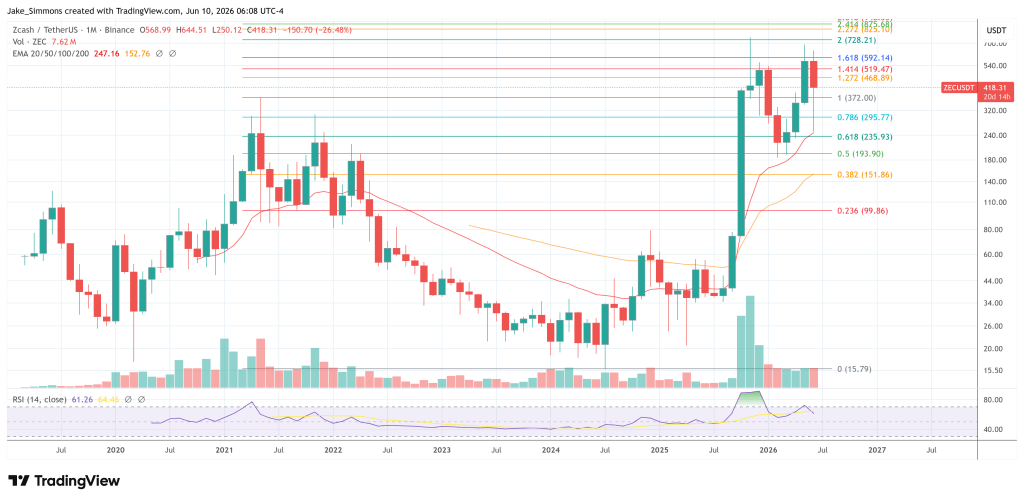
ZEC remains above the prior all-time high, 1-month chart | Source: ZECUSDT on TradingView.com

Lecturas Relacionadas

12.9 Million Candidates: The First Summer of Fate in the Hands of AI

The 2026 Chinese college entrance exam, or Gaokao, saw a novel phenomenon: AI aggressively entering the college application advice arena before results were even released. Major tech companies like Alibaba, Tencent, Baidu, and others launched free AI-powered "agents" and tools designed to generate personalized university and major recommendations for over 12.9 million candidates. For years, a lucrative industry thrived on the "information gap" in college applications, with personalized consulting services costing families thousands of dollars. AI is now disrupting this by providing similar, data-driven analysis for free. These tools process standardized data—scores, rankings, historical admission trends—to create tailored application strategies, offering a form of information parity previously unavailable, especially to students from rural or less-resourced backgrounds. This shift represents more than just a marketing trend; it signifies AI's first large-scale entry into a critical, high-stakes life decision for millions of Chinese families. The Gaokao application, with its clear inputs and outputs, is an ideal scenario for AI. Its involvement begins to level the informational playing field, potentially reducing the advantage held by families with greater social capital or access to expensive consultants. However, the article raises a profound question: while AI can optimize choices for employability and financial return based on cold data, it risks promoting a homogenized, utilitarian path. It might steer a passionate student away from a less lucrative field like literature or archaeology toward supposedly "safer" options like computer science. The core dilemma remains: as AI flattens information disparities, does it also flatten the diversity of life choices and the freedom to make—and learn from—mistakes? Ultimately, 2026 may be remembered not for exam questions, but as the year AI began formally influencing the life trajectories of ordinary Chinese people. The real test lies not in the algorithm's recommendations, but in whether individuals will retain the courage to make their own choices and bear the consequences in an increasingly algorithmic age.

marsbitHace 27 min(s)

12.9 Million Candidates: The First Summer of Fate in the Hands of AI

marsbitHace 27 min(s)

IC3 Top Universities Collaborative Analysis: Is AI x Crypto the Real Future or Just a Narrative Bubble?

IC3 researchers from leading universities analyze the convergence of AI and crypto. They argue meaningful integration is still nascent, with hype often outstripping progress. The report frames AI as a "translation middleware" making blockchain accessible, while crypto serves as a "trust middleware" via tools like ZK proofs and TEEs for integrity, availability, and confidentiality. Two main directions are examined: 1) **Crypto x AI**: Using AI to enhance blockchain via analysis (fraud detection), algorithmic design, and AI oracles (with accuracy varying by task). New risks include AI-driven malicious smart contracts. 2) **AI x Crypto**: Using crypto to enhance AI via decentralized infrastructure (DePIN), data markets, agent micropayments, governance, and securing AI pipelines (training/federated learning, secure inference). The "Protected Pipeline" (Props) framework combines oracles and trusted computation for secure use of private data. Key challenges are highlighted: The industry must rigorously prove decentralized AI's cost competitiveness and crypto's utility for agent payments. Major research gaps include providing systemic security for autonomous agents and addressing novel threats like unstoppable AI agents. The report concludes by debunking five common misconceptions: blockchain cannot inherently detect AI content, solve algorithmic bias, grant true AI autonomy, ensure AI trustworthiness through mere transparency, or guarantee that decentralization is always cheaper for AI tasks. The field remains in an early, evidence-seeking phase.

marsbitHace 1 hora(s)

IC3 Top Universities Collaborative Analysis: Is AI x Crypto the Real Future or Just a Narrative Bubble?

marsbitHace 1 hora(s)

Anthropic Released the "Most Powerful Model," But Most People Can't Use It

In April, Anthropic launched a preview of its "Mythos" model, which was not publicly released due to its exceptional ability to autonomously discover high-risk zero-day vulnerabilities, posing a security threat if misused. It was restricted to a trusted group of security partners under "Project Glasswing." On June 10, Anthropic officially released Fable 5 and Mythos 5. They share the same underlying model but are distributed under different rules. Fable 5 is for general users, while Mythos 5 remains locked for trusted security partners. Benchmarks show Fable 5 leading in software engineering and long-task execution, with significant improvements in generating production-ready code. However, Fable 5 includes a safety classifier that automatically downgrades requests related to cybersecurity, biochemistry, or model distillation to the weaker Opus 4.8 model. This mechanism, while intended for safety, can affect the user experience and has faced criticism for being overly conservative. Pricing is another key point. Fable 5's API costs are double that of Opus 4.8. Furthermore, after a free trial period ending June 23, it will be removed from standard subscription plans, requiring users to purchase additional credits for access. This shift signals a move towards pay-as-you-go pricing for the most advanced capabilities. The strategy highlights a growing divergence in the AI industry: while some players like DeepSeek are drastically cutting prices, Anthropic is increasing them for its top-tier model, using cost as a filter for high-value users. The article suggests the AI market is stratifying, with commoditized capabilities becoming cheaper while premium, cutting-edge models command a significant price premium.

marsbitHace 1 hora(s)

Anthropic Released the "Most Powerful Model," But Most People Can't Use It

marsbitHace 1 hora(s)

Trading

Spot
Futuros

Artículos destacados

Cómo comprar ZEC

¡Bienvenido a HTX.com! Hemos hecho que comprar Zcash (ZEC) sea simple y conveniente. Sigue nuestra guía paso a paso para iniciar tu viaje de criptos.Paso 1: crea tu cuenta HTXUtiliza tu correo electrónico o número de teléfono para registrarte y obtener una cuenta gratuita en HTX. Experimenta un proceso de registro sin complicaciones y desbloquea todas las funciones.Obtener mi cuentaPaso 2: ve a Comprar cripto y elige tu método de pagoTarjeta de crédito/débito: usa tu Visa o Mastercard para comprar Zcash (ZEC) al instante.Saldo: utiliza fondos del saldo de tu cuenta HTX para tradear sin problemas.Terceros: hemos agregado métodos de pago populares como Google Pay y Apple Pay para mejorar la comodidad.P2P: tradear directamente con otros usuarios en HTX.Over-the-Counter (OTC): ofrecemos servicios personalizados y tipos de cambio competitivos para los traders.Paso 3: guarda tu Zcash (ZEC)Después de comprar tu Zcash (ZEC), guárdalo en tu cuenta HTX. Alternativamente, puedes enviarlo a otro lugar mediante transferencia blockchain o utilizarlo para tradear otras criptomonedas.Paso 4: tradear Zcash (ZEC)Tradear fácilmente con Zcash (ZEC) en HTX's mercado spot. Simplemente accede a tu cuenta, selecciona tu par de trading, ejecuta tus trades y monitorea en tiempo real. Ofrecemos una experiencia fácil de usar tanto para principiantes como para traders experimentados.

352 Vistas totalesPublicado en 2024.12.12Actualizado en 2026.06.02

Cómo comprar ZEC

Discusiones

Bienvenido a la comunidad de HTX. Aquí puedes mantenerte informado sobre los últimos desarrollos de la plataforma y acceder a análisis profesionales del mercado. A continuación se presentan las opiniones de los usuarios sobre el precio de ZEC (ZEC).

活动图片













