Zaporizhzhia Nuclear Plant For Crypto Mining? Putin Claims US Interest

bitcoinistPublicado a 2025-12-27Actualizado a 2025-12-27

Resumen

Russian President Vladimir Putin has claimed the United States is interested in using the Zaporizhzhia Nuclear Power Plant’s electricity for crypto mining and supplying power to Ukraine, according to a report citing Russian media. The plant, Europe’s largest nuclear facility, was captured by Russian forces in 2022 and has since halted power generation. While crypto mining—an energy-intensive process—could utilize excess energy, reactivating the plant remains complex. All six reactors are shut down, and the International Atomic Energy Agency states that restart is impossible while military conflict continues. Meanwhile, Bitcoin trades around $88,600.

Russian President Vladimir Putin has reportedly said that the United States is interested in using Zaporizhzhia’s nuclear electricity for crypto mining.

US & Russia Are In Talks About Zaporizhzhia Nuclear Power Plant

Russia and the US are negotiating joint control of the Zaporizhzhia nuclear power plant, according to a report from Kyiv Post, citing Russian business newspaper Kommersant. The Zaporizhzhia nuclear power plant is located in Southeastern Ukraine and is the largest nuclear energy facility in Europe. It used to be responsible for more than a fifth of the electricity in Ukraine, but in 2022, Russian forces captured it, and it has since ceased power generation.

It would now appear that discussions have emerged about the future use of the power plant. As per the report, Vladimir Putin said at a meeting with major business figures on Christmas Eve that the US is interested in using the plant’s electricity for crypto mining and for supplying power to Ukraine.

Crypto mining, the most prominent example of which is Bitcoin mining, can be an energy-intensive process, leveraging computing power to solve mathematical puzzles that allow the operator to have a chance at adding the next block to the blockchain.

Crypto mining has features like portability and modularity that have made many consider its application in using waste or excess energy in power grids to produce value in the form of digital assets. On a global scale, Bitcoin mining has seen some rapid expansion during the past three years, with the Hashrate, a measure of the network’s total computing power, expanding by almost five times.
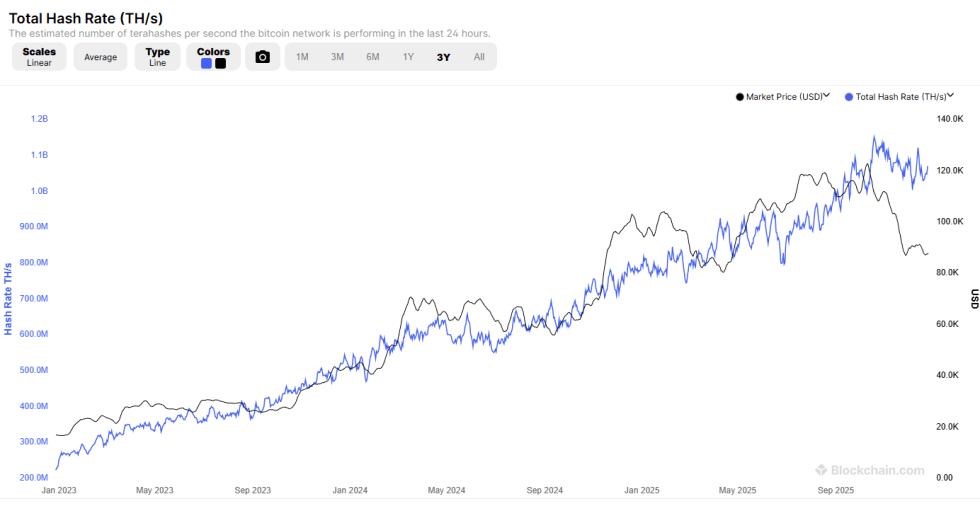
The data for the 7-day average Bitcoin Hashrate | Source: Blockchain.com

Restarting the Zaporizhzhia nuclear power plant for crypto mining, or any other purpose, however, wouldn’t be a simple task. By late 2022, all six reactors of the plant were shut down, with five of them being put in a state of cold shutdown.

One reactor was kept in hot shutdown to produce steam for nuclear safety purposes. Even so, the plant isn’t in a state where a restart is possible, according to the International Atomic Energy Agency (IAEA). As the IAEA wrote in a press release earlier this year:

Nuclear safety remains precarious at Ukraine’s Zaporizhzhya Nuclear Power Plant (ZNPP) and its six reactors cannot be restarted as long as the military conflict continues to jeopardize the situation at the site, Director General Rafael Mariano Grossi told IAEA Member States this week.

Given this context, it only remains to be seen whether any reported negotiations around the nuclear power plant will actually lead it to be used for any energy-related purpose, crypto mining or otherwise.

Bitcoin Price

At the time of writing, Bitcoin is trading around $88,600, up 1.3% over the last 24 hours.

Looks like the price of the coin has been moving sideways over the last few days | Source: BTCUSDT on TradingView


Preguntas relacionadas

QWhat did Vladimir Putin claim about the United States' interest in the Zaporizhzhia nuclear power plant?

AVladimir Putin claimed that the United States is interested in using the Zaporizhzhia nuclear power plant's electricity for crypto mining and for supplying power to Ukraine.

QWhat is the current operational status of the Zaporizhzhia nuclear power plant according to the IAEA?

AAccording to the International Atomic Energy Agency (IAEA), the Zaporizhzhia nuclear power plant is not in a state where a restart is possible, and its six reactors cannot be restarted as long as the military conflict continues to jeopardize the site's safety.

QWhat is the main reason crypto mining, like Bitcoin mining, is considered for using the plant's energy?

ACrypto mining is considered because of its features like portability and modularity, which make it suitable for using waste or excess energy in power grids to produce value in the form of digital assets.

QWhat was the Bitcoin price mentioned in the article at the time of writing?

AAt the time of writing, Bitcoin was trading around $88,600, up 1.3% over the last 24 hours.

QHow has the Bitcoin network's computing power, or Hashrate, changed in the past three years?

AOver the past three years, the Bitcoin network's Hashrate, a measure of its total computing power, has expanded by almost five times.

Lecturas Relacionadas

The Recursive AI Anthropic Warned About: Tian Yuandong's New Company Has Just Taken the "First Step"

Anthropic recently highlighted the rapid progress toward "recursive self-improvement," where AI systems autonomously design and train their successors. In response, Recursive Superintelligence, a new company co-founded by former Meta researcher Tian Yuan Dong, has publicly demonstrated its first step toward automating AI research. The company released a system designed to autonomously execute the full AI research cycle: generating ideas, implementing code, running experiments, and learning from results. It validated this approach by achieving state-of-the-art results on three diverse benchmarks: 1. **NanoChat Autoresearch:** Optimizing a small language model's validation loss under a fixed 5-minute GPU budget, improving upon the community's best result. 2. **NanoGPT Speedrun:** Reducing the time to train a GPT model to a specific loss on 8 H100 GPUs from 79.7 seconds to 77.5 seconds, beating a highly optimized, human-driven community effort. 3. **SOL-ExecBench:** Improving the overall score on NVIDIA's suite of 235 GPU kernel optimization tasks by 18%, closing the gap to the hardware limit. The system discovered novel optimizations in this highly specialized domain without direct human expertise. Recursive's system operates as a general framework, capable of parallel exploration and cross-task knowledge transfer while incorporating safeguards against reward hacking. The company, backed by $650M in funding and a star-studded team including Richard Socher and Alexey Dosovitskiy, aims to create AI that recursively enhances its own research capabilities. This development represents an early but concrete move toward a new paradigm where AI accelerates its own advancement. It occurs alongside Anthropic's warnings about the need for industry coordination and potential pauses when recursive self-improvement thresholds are reached, highlighting the dual trajectory of rapid technical progress and growing calls for careful stewardship.

marsbitHace 4 min(s)

The Recursive AI Anthropic Warned About: Tian Yuandong's New Company Has Just Taken the "First Step"

marsbitHace 4 min(s)

The Gold Buy-on-the-Dip Guide: Watch Interest Rates, Not Just War

"Gold Buying Guide: Focus on Interest Rates, Not Just War" Four months ago, gold buyers likely didn't anticipate buying at a peak that even a war couldn't sustain. After hitting a record high of $5,596 on January 29, gold entered a bear market just 91 days later, its fastest decline since 2008. A key trigger was the Fed's hawkish shift, highlighting that monetary policy, not geopolitics, is the primary driver. The article argues that the traditional "buy gold in turmoil" script has changed. While the US-Iran conflict initially boosted prices, the sustained rally in oil prices heightened inflation fears, forcing central banks to maintain or consider tighter policy. Since gold yields no interest, higher rates increase its opportunity cost, eroding its appeal. This dynamic was evident when gold fell sharply on May 18 despite positive peace talks, as lower oil prices eased inflation and thus rate hike pressures. The recent sell-off is also part of a broader market deleveraging. Correlations between gold, Nasdaq, and Bitcoin spiked as leveraged investors sold liquid assets to cover losses, creating a synchronized downturn. Historically, gold bottoms align with policy shifts, not conflict resolutions. The 2008 and 2022 bear markets ended with shifts to extreme easing and peak inflation expectations, respectively. For potential buyers, the author suggests monitoring three signals: 1) Peak interest rate hike expectations, 2) Reopening of the Strait of Hormuz (to ease oil/inflation pressure), and 3) A return to net inflows for Gold ETFs, indicating the end of forced selling. While predicting the exact bottom is impossible, the author's personal strategy involves scaling into a position across price levels like $4000, $3700, and $3500, committing no more than 30% of the intended total allocation initially, and adding the remainder only if key signals emerge. The core conclusion: In turbulent times, watching interest rates is more crucial than watching wars.

marsbitHace 10 min(s)

The Gold Buy-on-the-Dip Guide: Watch Interest Rates, Not Just War

marsbitHace 10 min(s)

Recent On-Chain Review: No Clear Narrative Under U.S. Stock Market Pressure, Just Hype

This article analyzes the current state of the Solana meme coin and community token ecosystem, highlighting a market caught between two dominant forces: attention-based PvP and a gradual return to community-centric projects. The first part explores the "Attention PvP" dynamic, where success is driven by celebrity endorsements, viral events, and speed. Examples include $JOTCHUA, which surged after its meme creator's social media activity, and $WORLDCUP, which outperformed a similar Base chain project ($PITCH) largely due to influencer support. The recent "pump.fun GO" feature, allowing bounty tasks for token promotion, is critiqued for fostering sensationalist and often negative stunts—like people getting token tickers tattooed on their bodies for rewards—reminiscent of old internet shock content. In contrast, the article points to a resurgence of organic, community-driven tokens that survive market volatility through strong holder bases and shared ideology, not just hype. Influencer Ansem is cited, arguing that durable meme coins rely on communities willing to endure losses and promote their core message daily. Examples given are older tokens like $neet (anti-work ethos), $troll, $buttcoin, and $triplet, which have maintained relative price stability. A prime example of this community-build model is the new project $KINS, the token for the browser-based MMORPG Kintara. Its success stems not from advanced graphics but from consistently delivering updates, fostering player trust, and creating genuine engagement (e.g., in-game economies, events, property auctions). It has attracted a growing player base and even notable KOLs as participants, demonstrating that sustainable growth can come from building trust rather than orchestrating pumps. The article concludes by questioning whether the market is ultimately a game of mutual trust or mutual deception, expressing hope that such reflection might lead to a healthier ecosystem.

marsbitHace 10 min(s)

Recent On-Chain Review: No Clear Narrative Under U.S. Stock Market Pressure, Just Hype

marsbitHace 10 min(s)

On-Chain Scene on Opening Day: $20 Billion Already Staked, How Do On-Chain Contracts Know Who Wins?

On the opening day of the 2026 World Cup, over $2 billion had already been wagered on just the "tournament winner" contracts on platforms like Polymarket and Kalshi. This article explores how these blockchain-based prediction markets actually function once the games begin. It breaks down the massive volume and explains how single-game and tournament-long contracts are priced, with values moving between 1-99 cents to reflect implied probabilities. A key mechanism highlighted is "elimination zeroing," where a team's "champion yes" contract immediately settles to zero once they are mathematically eliminated. The core technical question answered is: how does a smart contract "know" who won a real-world match? The answer lies in oracles. The article details two primary paradigms: UMA's "optimistic oracle" (used by most of Polymarket), which allows a challenge period after a proposed result, and Chainlink's multi-source data aggregation (used by FIFA partners like ADI Predictstreet), which automates settlement with minimal dispute windows. Finally, the article injects a note of caution, citing research estimating that a significant portion of historical trading volume on these platforms might be "wash trading" to inflate numbers. It concludes by contrasting the legal status of these "event contracts" under CFTC rules in the U.S. versus traditional, state-regulated sports betting. As the tournament progresses, the real-time operation of this multi-billion dollar machine—its settlements, eliminations, and underlying mechanisms—becomes a story as compelling as the football itself.

marsbitHace 25 min(s)

On-Chain Scene on Opening Day: $20 Billion Already Staked, How Do On-Chain Contracts Know Who Wins?

marsbitHace 25 min(s)

Trading

Spot
Futuros

Artículos destacados

Cómo comprar US

¡Bienvenido a HTX.com! Hemos hecho que comprar Talus Network (US) sea simple y conveniente. Sigue nuestra guía paso a paso para iniciar tu viaje de criptos.Paso 1: crea tu cuenta HTXUtiliza tu correo electrónico o número de teléfono para registrarte y obtener una cuenta gratuita en HTX. Experimenta un proceso de registro sin complicaciones y desbloquea todas las funciones.Obtener mi cuentaPaso 2: ve a Comprar cripto y elige tu método de pagoTarjeta de crédito/débito: usa tu Visa o Mastercard para comprar Talus Network (US) al instante.Saldo: utiliza fondos del saldo de tu cuenta HTX para tradear sin problemas.Terceros: hemos agregado métodos de pago populares como Google Pay y Apple Pay para mejorar la comodidad.P2P: tradear directamente con otros usuarios en HTX.Over-the-Counter (OTC): ofrecemos servicios personalizados y tipos de cambio competitivos para los traders.Paso 3: guarda tu Talus Network (US)Después de comprar tu Talus Network (US), guárdalo en tu cuenta HTX. Alternativamente, puedes enviarlo a otro lugar mediante transferencia blockchain o utilizarlo para tradear otras criptomonedas.Paso 4: tradear Talus Network (US)Tradear fácilmente con Talus Network (US) en HTX's mercado spot. Simplemente accede a tu cuenta, selecciona tu par de trading, ejecuta tus trades y monitorea en tiempo real. Ofrecemos una experiencia fácil de usar tanto para principiantes como para traders experimentados.

558 Vistas totalesPublicado en 2025.12.11Actualizado en 2026.06.02

Cómo comprar US

Discusiones

Bienvenido a la comunidad de HTX. Aquí puedes mantenerte informado sobre los últimos desarrollos de la plataforma y acceder a análisis profesionales del mercado. A continuación se presentan las opiniones de los usuarios sobre el precio de US (US).

活动图片












