Year-End Critical Moment: What the FOMC Decision Means for the Crypto Market

比推Publicado a 2025-12-18Actualizado a 2025-12-18

Resumen

Amid a critical year-end period, Bitcoin hovers around $90,000 with the crypto fear and greed index hitting 25 (extreme fear). The December FOMC meeting delivered an expected 25-basis-point rate cut but adopted a hawkish tone, projecting only one more cut in 2026, causing a brief dip below $90k. However, the Fed also initiated a Reserve Management Purchase (RMP) plan, injecting $40 billion monthly in Treasury liquidity—a form of "stealth QE" that may reshape 2026 market dynamics. On-chain data shows significant capitulation among short-term holders, with realized losses near historic highs, while exchange reserves decline sharply, suggesting accumulation by long-term investors. Seasonal patterns like the "Christmas low-Lunar New Year rally" and increasing institutional adoption—shifting from pure Bitcoin exposure to ETH, altcoins, and tokenized assets—support a potential rebound. Despite short-term volatility and macro uncertainty, indicators like MVRV Z-Score and RHODL Ratio signal a buying opportunity. The convergence of cyclical patterns, improving liquidity, and structural institutional participation frames the current pullback as a mid-cycle adjustment rather than a bear market, offering a strategic entry point for 2026 positioning.

At the end of 2025, the crypto market is at a critical juncture. Bitcoin (BTC) is hovering around $90,000, the market Fear & Greed Index has dropped to 25 (Extreme Fear), and short-term holder capitulation has reached its second-highest level in history, second only to the bottom of the August 2024 Yen carry trade crash. The December 10th FOMC meeting has concluded, with the Federal Reserve (Fed) cutting interest rates by 25 basis points as expected by the market, lowering the federal funds rate to 3.50%-3.75%. However, the forward guidance turned hawkish—only one rate cut is expected in 2026. This caused BTC to briefly fall below the $90,000 mark. The market reaction was muted, showing a "buy the rumor, sell the news" type of correction.

However, the Fed also initiated a "Reserve Management Purchases" (RMP) plan, injecting $40 billion in short-term Treasury liquidity per month. This is seen as a signal of mild easing, a form of "non-QE," which could reshape market dynamics in 2026. In this "year-end final exam," should one "hold coins through the holidays" to welcome a potential rebound, or "take profits off the table" to lock in gains? This article explores allocation strategies and the outlook for 2026 positioning by combining the impact of the FOMC, on-chain data, institutional trends, and historical patterns.

FOMC Decision Analysis
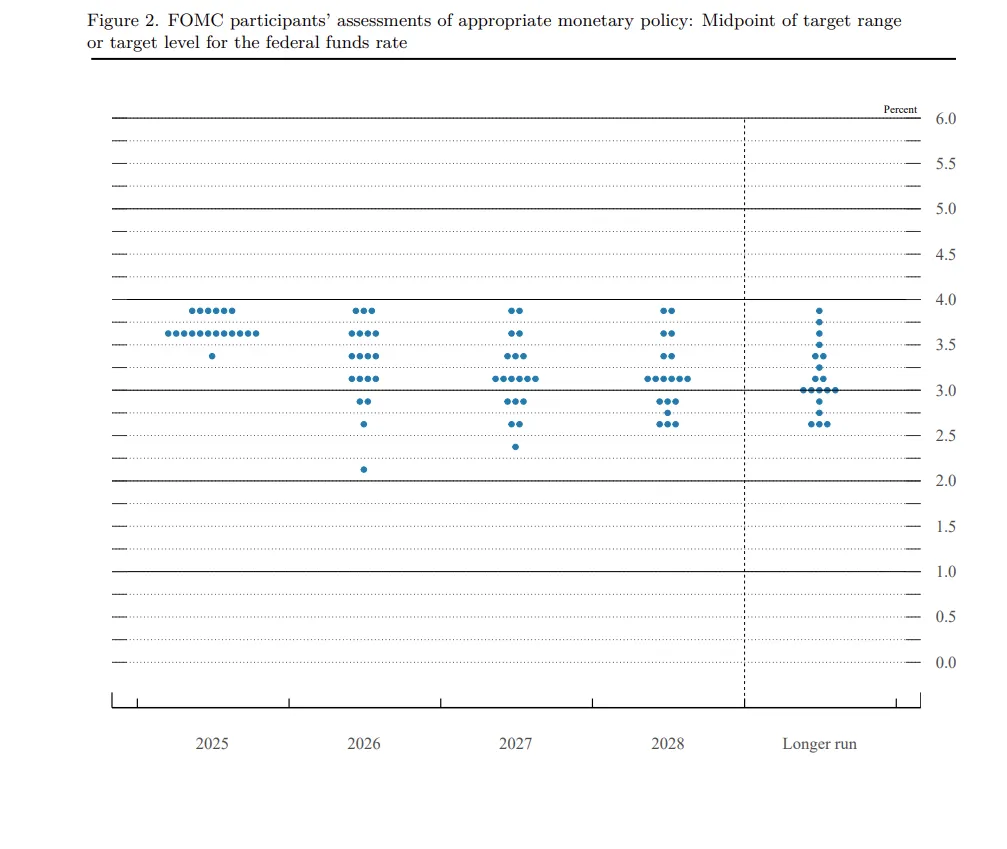
A Liquidity Turning Point Under Hawkish Rate Cuts The FOMC meeting was the final monetary policy decision of 2025. The decision to cut rates was passed with a 9:3 split vote, but the "dot plot" showed a slower path for rate cuts in 2026, with only one 25-basis-point cut remaining.

This reinforces the "hawkish cut" narrative: the Fed is wary of rebounding inflation and is aiming for a soft landing in the job market, unwilling to ease too aggressively in the short term. The market had priced in an 89% probability of a cut, leading to only minor fluctuations in BTC post-event, while ETH consolidated around $3,000.

The impact on crypto is dual:

  • Short-term pressure: Hawkish guidance increases risk aversion. BTC did not rally to the expected high of $94,000 but instead triggered tens of billions of dollars in leveraged liquidations. Thin year-end liquidity (e.g., perpetual open interest down 40%-50% from October), combined with Bank of Japan (BOJ) decisions, makes the market prone to "pump and dump" behavior.

  • Long-term positive: QT (Quantitative Tightening) officially ended on December 1st. The Fed's balance sheet shrank from $9 trillion to $6.5 trillion and has now begun to expand again. The RMP plan is equivalent to "stealth QE," expected to inject trillions in liquidity in 2026, driving a re-rating of risk assets. Historical data shows that liquidity turning points often trigger crypto rallies (e.g., the BTC surge after the Fed's pivot in 2024). Furthermore, explosive growth in global M2 money supply, a weakening DXY US Dollar Index, and stimulus policies from China/the EU will further tilt capital towards risk assets.

The FOMC reinforced the "macro-dominated" narrative. Crypto is no longer driven solely by its own cycles but is increasingly correlated with stocks and AI assets. Short-term volatility is intensifying, but liquidity injections are paving the way for 2026.
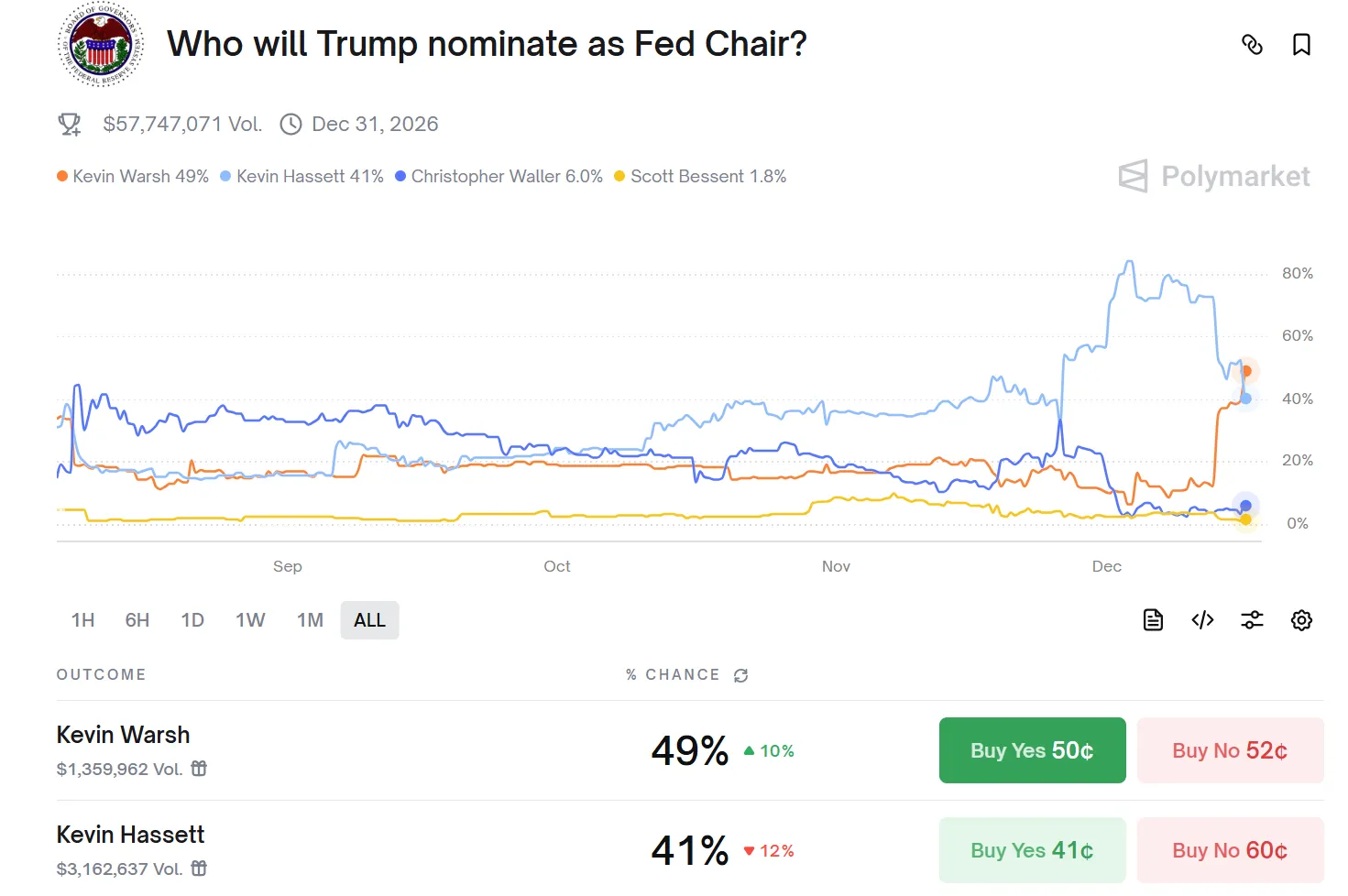
The appointment of the new Fed Chair will also be a key variable for the 2026 liquidity environment. Jerome Powell's term as Chair officially ends in May 2026 (his term as Governor lasts until January 2028). President Trump has indicated he will announce a nominee for his successor in early 2026. Current top candidates focus on the "two Kevins": National Economic Council Director Kevin Hassett (advocates for more aggressive rate cuts) and former Fed Governor Kevin Warsh (recently visited the White House, emphasizing consulting the President on interest rate views).

A Chair more aligned with Trump and more inclined towards accommodative policy could strengthen the 2026 rate cut path and accelerate liquidity injection, resonating with policies like the RMP plan and national Bitcoin reserves, further boosting confidence in risk assets.

Institutional Trends Preview: 2026 Positioning—From "Defense" to "Structural Participation"

2025 is seen as the "Year of Crypto Mainstreaming." Institutional entry is no longer a fringe experiment but a systemic shift. According to a16z's "State of Crypto 2025 Report," traditional financial institutions like Visa, BlackRock, Fidelity, and JPMorgan Chase have fully launched crypto products, while tech-native players like PayPal and Stripe are doubling down on payment infrastructure.

This marks a paradigm shift from "retail-led" to "institution-led": A joint survey by EY-Parthenon and Coinbase shows 83% of institutional investors plan to increase their crypto allocation in 2025. DeFi exposure is expected to jump from 24% to 75%, with a focus on derivatives, lending, and yield opportunities.

Institutional Allocation Trends: From Single BTC Allocation to Multi-Asset Portfolios

  • BTC remains core, but its share is declining: BTC as "digital gold" continues to dominate institutional positions (ETF AUM exceeds $168 billion, accounting for 60-80% of institutional crypto exposure), but institutions view it as a low-correlation diversification tool rather than a single speculative asset.

  • Expansion into ETH, Altcoins, and Emerging Assets: Institutions are increasing exposure to ETH (attracted by staking yields), Solana (high TPS and institutional partnerships), stablecoins (payment infrastructure), and RWA (real-world asset tokenization). A Coinbase report shows 76% of institutions plan to invest in tokenized assets in 2026, focusing on tokenized Treasuries, private equity, and bonds, offering instant settlement and fractional ownership.

  • Pension Funds and Sovereign Wealth Funds Testing the Waters: Although mostly indirect exposure (e.g., the Norwegian fund holds BTC via MicroStrategy), 2026 is expected to see more direct allocations of 0.5-3% (via ETFs or tokenized instruments). Reports from BlackRock and others note that sovereign funds and pension funds are seriously considering crypto as a long-term diversification hedge, with allocation ratios gradually increasing.

Historical Pattern: BTC's Year-End "Spring Festival Effect"
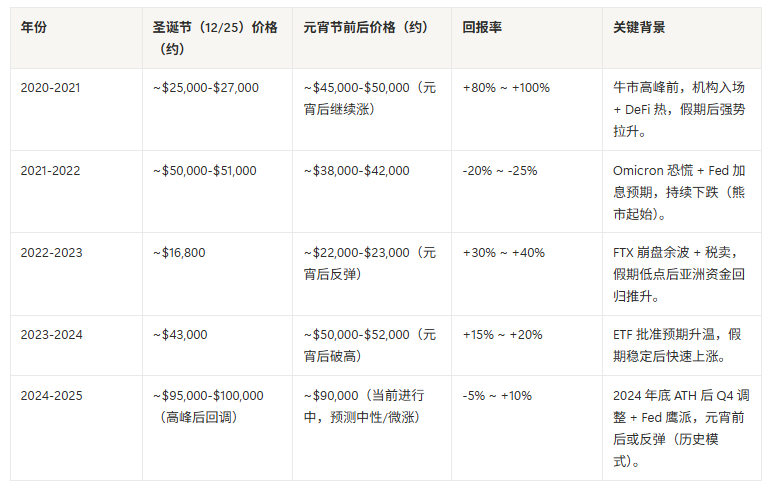
Drivers of the "Christmas Low - Spring Festival Rally" Pattern

Western Liquidity Drain: From December 20th to early January,欧美 (European and American) institutions enter holiday mode, and trading volume plummets. In a low-liquidity environment, any selling pressure amplifies volatility, forming technical lows.

Asian Capital Inflow: Around the Spring Festival (late January to mid-February), year-end bonuses and red packets are distributed in Mainland China, Hong Kong, Singapore, etc., leading retail and high-net-worth individuals to increase allocations to risk assets. Historical data shows that BTC buying volume on Asian exchanges (like Binance, OKX) typically rises in the two weeks before the Lunar New Year.

Portfolio Rebalancing: January marks the start of the new fiscal year for many institutions. Pension funds and hedge funds reassess their asset allocations. If BTC shows relative resilience in December (e.g., only a 5-10% pullback in 2025), institutions tend to add positions in January to catch up with benchmark returns.

On-Chain Data: A Concentration of Bottom Signals

Following the hawkish Fed rate cut, the crypto market has entered a typical "year-end low liquidity" phase. Bitcoin (BTC) is oscillating repeatedly in the $88,000-$92,000 range, and the Fear & Greed Index has dropped to 25 (Extreme Fear). Superficially, this looks like a "sell the news" correction. However, on-chain data reveals more structural signals: deep capitulation by short-term holders, continued accumulation by long-term holders, accelerated outflows from exchange reserves, and bottoming characteristics in medium-to-long-term indicators. This data suggests the current situation is not a simple bear market but rather a "mid-cycle adjustment + washout" phase within a bull market.

1. Short-Term Holder (STH) Capitulation: Pain Nearing an End
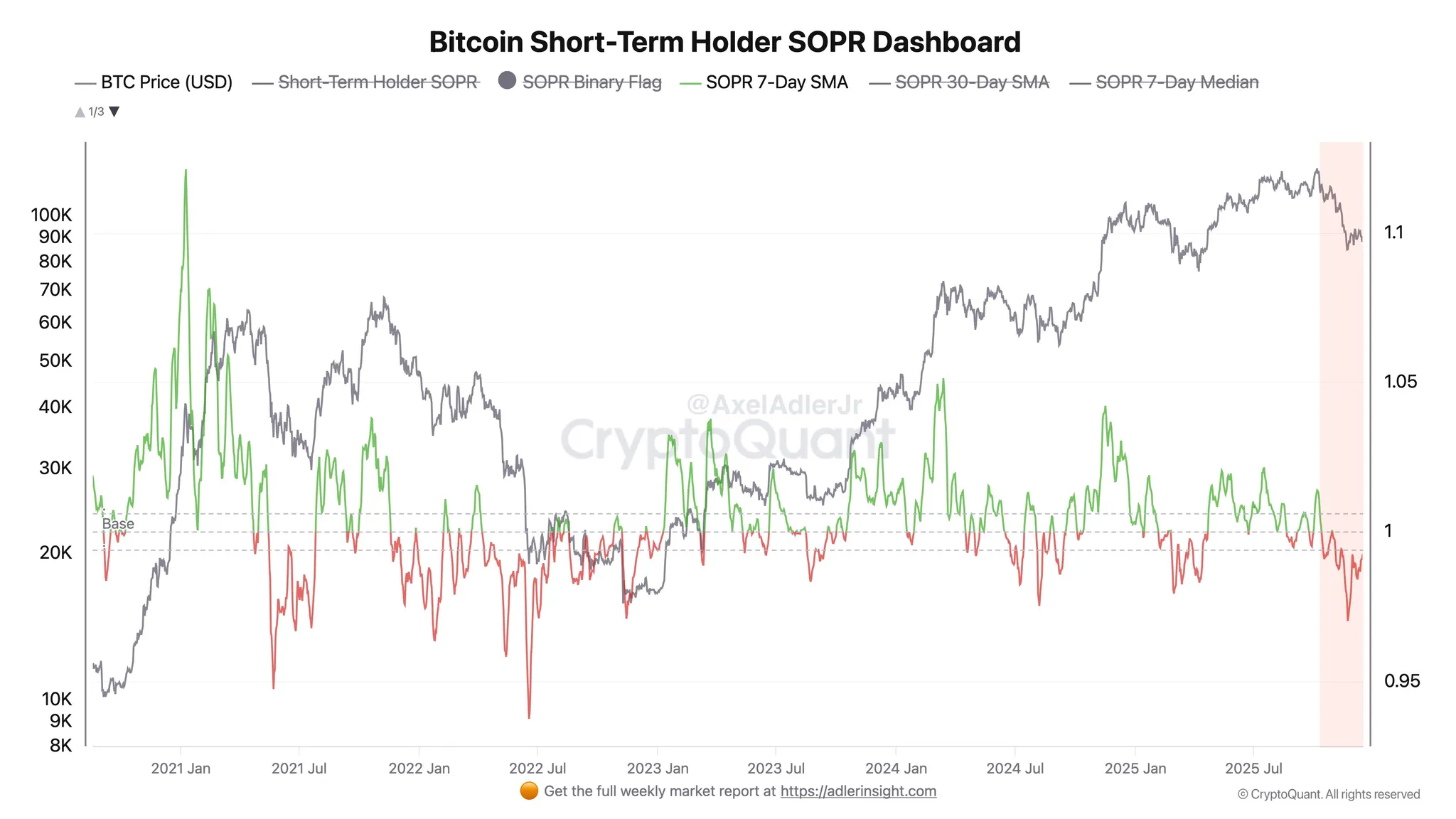
  • Realized Loss Scale: Over the past 30 days, short-term holders (holding <155 days) have realized losses exceeding $4.5 billion, second only to the $5.2 billion during the August 2024 Yen carry trade crash (Glassnode data). This indicates leveraged players and FOMO-driven散户 (retail investors) have largely capitulated.

  • SOPR Indicator: The Short-Term Holder SOPR (Spent Output Profit Ratio) has remained below 1 (indicating average selling at a loss) for over 3 weeks. History shows that after such deep capitulation, BTC often finds a阶段性底部 (stage bottom) within 1-3 months.

2. Exchange Reserves & Withdrawals: Strengthening De-platforming Trend
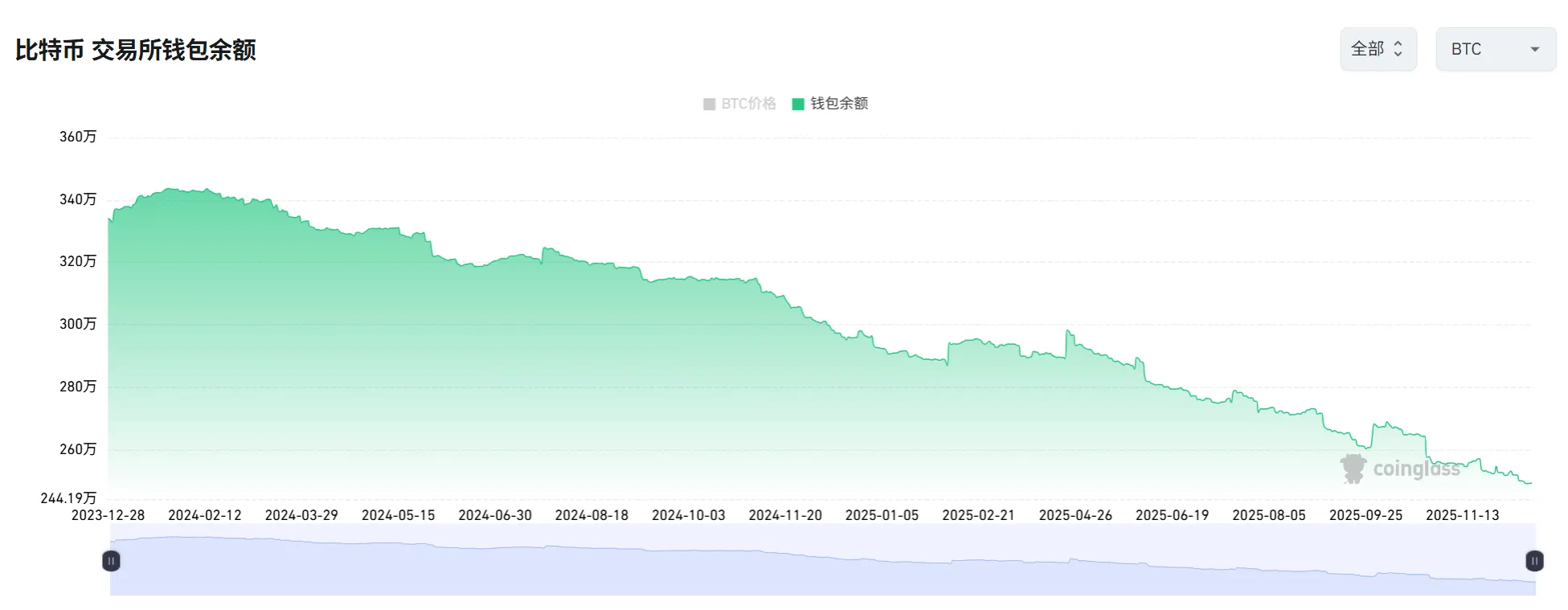
  • Exchange BTC Balance: Over the past 30 days, BTC reserves across all exchanges have decreased by approximately 120,000 coins (about 2.5%), falling below 2.6 million (CryptoQuant), the lowest level since 2018.

  • ETH Exchange Reserves: Decreased by about 1.2 million ETH during the same period, with withdrawal speeds hitting a 2025 high, reflecting strong staking and self-custody demand.

  • Stablecoin Reserves: Exchange balances of USDT/USDC have seen seasonal declines, but active addresses and transfer volumes on-chain remain stable, indicating capital has not left the ecosystem but is moving to cold storage awaiting re-entry.

Capital flowing out of exchanges often预示价格底部 (foreshadows a price bottom), reducing selling pressure while building momentum for a subsequent rebound.

3. Medium-to-Long Term Indicators: Concentration of Bottom Signals
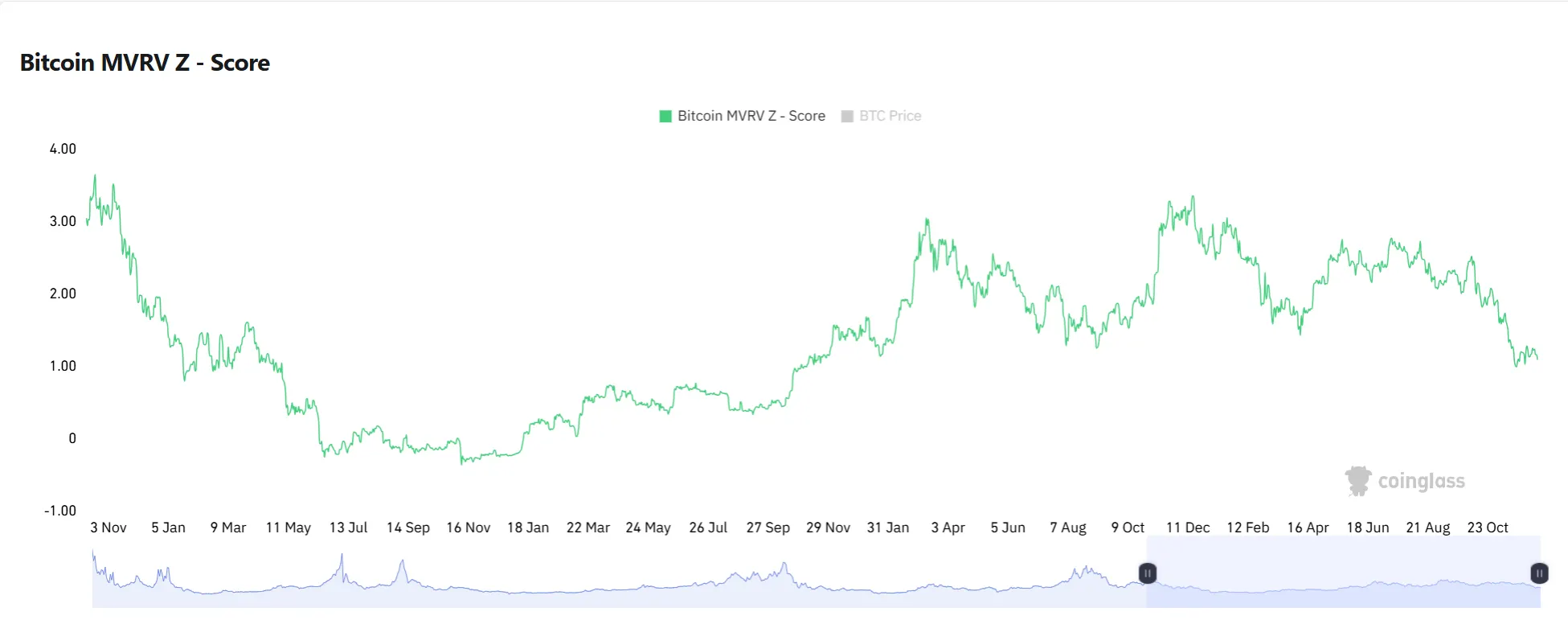
  • MVRV Z-Score: Currently at 1.1, entering the historical "green buy zone."

  • RHODL Ratio: Has fallen to levels seen at the bottom of the 2022 bear market, indicating market fervor has completely cooled.

  • Puell Multiple: The miner revenue indicator has fallen back to 0.6. Historical lows are often accompanied by price reversals following mining capitulation.

  • Active Addresses & Transaction Volume: Although低迷 (sluggish) short-term, the 30-day MA has not experienced a cliff-like drop, unlike the "activity exhaustion" seen at the 2021 bull market top.

Allocation Strategy: Finding Certainty Amid Uncertainty

The market is at a rare confluence:

  • Short-term sentiment is extremely fearful (Fear & Greed Index 25), but on-chain data shows a concentration of bottom characteristics.

  • The historical "Christmas Low - Spring Festival Rally" pattern provides seasonal support, validated successfully three times in the past five years.

  • Macro liquidity is about to turn (QT ended, RMP initiated), but is still suppressed by hawkish guidance in the short term.

  • The institutionalization process is accelerating, transforming the market structure from "speculation-driven" to "allocation-driven."

For investors seeking long-term value, the current environment provides a relatively clear risk-reward framework: deep capitulation by short-term holders, accelerated outflows from exchange reserves, continued accumulation by long-term holders, and valuation indicators like MVRV and RHODL entering historical buy zones—these signals, when they appeared in the past, have marked the opening of medium-to-long term allocation windows. For traders focused on liquidity management, December's liquidity drought period presents both risk and opportunity. Maintaining sufficient flexibility, preserving ammunition during market panic, and acting opportunistically when the Spring Festival effect is validated might be wiser than chasing short-term volatility.

Data for this report was compiled and edited by WolfDAO. Please contact us if you have any questions requiring updates;

Author: Nikka / WolfDAO ( X : @10xWolfdao )


Original link:https://www.bitpush.news/articles/7596651

Preguntas relacionadas

QWhat was the immediate market reaction to the December 10th FOMC decision to cut rates by 25 basis points?

AThe market reaction was muted, characterized by a 'buy the news, sell the fact' pullback, with Bitcoin briefly falling below the $90,000 mark.

QWhat long-term liquidity measure did the Fed announce alongside the rate cut, and what is its potential impact for 2026?

AThe Fed announced the 'Reserve Management Purchases' (RMP) plan to inject $40 billion per month in short-term Treasury liquidity. This is seen as a form of 'stealth QE' that could inject trillions in liquidity by 2026, potentially drive a re-rating of risk assets like crypto, and reshape market dynamics.

QAccording to the article, what key on-chain data signals suggest the market may be nearing a bottom?

AKey on-chain bottom signals include: Short-Term Holder (STH) capitulation with $4.5B in realized losses (2nd highest ever), STH SOPR below 1 for over 3 weeks, exchange reserves dropping to multi-year lows, and valuation metrics like MVRV Z-Score and RHODL Ratio entering historical buy zones.

QHow is institutional involvement in crypto changing, as described in the a16z report cited?

AInstitutional involvement is shifting from a 'retail-dominated' to an 'institution-dominated' paradigm. It's no longer an edge experiment but a systemic shift, with 83% of institutional investors planning to increase crypto allocations in 2025 and a focus expanding from just Bitcoin to ETH, altcoins, stablecoins, and tokenized real-world assets (RWA).

QWhat is the historical 'Christmas Low - Spring Festival Rally' pattern, and what are its main drivers?

AIt's a historical pattern where Bitcoin often forms a technical low around the Christmas holiday period due to low Western liquidity and then rallies around the Chinese Lunar New Year. The main drivers are: illiquid holiday markets amplifying sell pressure, and Asian capital inflows from year-end bonuses and red packets during the Spring Festival, alongside institutional portfolio rebalancing in the new fiscal year.

Lecturas Relacionadas

a16z: AI's 'Amnesia', Can Continuous Learning Cure It?

The article "a16z: AI's 'Amnesia' – Can Continual Learning Cure It?" explores the limitations of current large language models (LLMs), which, like the protagonist in the film *Memento*, are trapped in a perpetual present—unable to form new memories after training. While methods like in-context learning (ICL), retrieval-augmented generation (RAG), and external scaffolding (e.g., chat history, prompts) provide temporary solutions, they fail to enable true internalization of new knowledge. The authors argue that compression—the core of learning during training—is halted at deployment, preventing models from generalizing, discovering novel solutions (e.g., mathematical proofs), or handling adversarial scenarios. The piece introduces *continual learning* as a critical research direction to address this, categorizing approaches into three paths: 1. **Context**: Scaling external memory via longer context windows, multi-agent systems, and smarter retrieval. 2. **Modules**: Using pluggable adapters or external memory layers for specialization without full retraining. 3. **Weights**: Enabling parameter updates through sparse training, test-time training, meta-learning, distillation, and reinforcement learning from feedback. Challenges include catastrophic forgetting, safety risks, and auditability, but overcoming these could unlock models that learn iteratively from experience. The conclusion emphasizes that while context-based methods are effective, true breakthroughs require models to compress new information into weights post-deployment, moving from mere retrieval to genuine learning.

marsbitHace 58 min(s)

a16z: AI's 'Amnesia', Can Continuous Learning Cure It?

marsbitHace 58 min(s)

Can a Hair Dryer Earn $34,000? Deciphering the Reflexivity Paradox in Prediction Markets

An individual manipulated a weather sensor at Paris Charles de Gaulle Airport with a portable heat source, causing a Polymarket weather market to settle at 22°C and earning $34,000. This incident highlights a fundamental issue in prediction markets: when a market aims to reflect reality, it also incentivizes participants to influence that reality. Prediction markets operate on two layers: platform rules (what outcome counts as a win) and data sources (what actually happened). While most focus on rules, the real vulnerability lies in the data source. If reality is recorded through a specific source, influencing that source directly affects market settlement. The article categorizes markets by their vulnerability: 1. **Single-point physical data sources** (e.g., weather stations): Easily manipulated through physical interference. 2. **Insider information markets** (e.g., MrBeast video details): Insiders like team members use non-public information to trade. Kalshi fined a剪辑师 $20,000 for insider trading. 3. **Actor-manipulated markets** (e.g., Andrew Tate’s tweet counts): The subject of the market can control the outcome. Evidence suggests Tate’sociated accounts coordinated to profit. 4. **Individual-action markets** (e.g., WNBA disruptions): A single person can execute an event to profit from their pre-placed bets. Kalshi and Polymarket handle these issues differently. Kalshi enforces strict KYC, publicly penalizes insider trading, and reports to regulators. Polymarket, with its anonymous wallet-based system, has historically been more permissive, arguing that insider information improves market accuracy. However, it cooperated with authorities in the "Van Dyke case," where a user traded on classified government information. The core paradox is reflexivity: prediction markets are designed to discover truth, but their financial incentives can distort reality. The more valuable a prediction becomes, the more likely participants are to influence the event itself. The market ceases to be a mirror of reality and instead shapes it.

marsbitHace 1 hora(s)

Can a Hair Dryer Earn $34,000? Deciphering the Reflexivity Paradox in Prediction Markets

marsbitHace 1 hora(s)

Trading

Spot
Futuros

Artículos destacados

Qué es BITCOIN

Entendiendo HarryPotterObamaSonic10Inu (ERC-20) y Su Posición en el Espacio Cripto En los últimos años, el mercado de criptomonedas ha sido testigo de un aumento en la popularidad de las monedas meme, capturando el interés no solo de los comerciantes, sino también de aquellos que buscan compromiso comunitario y valor de entretenimiento. Entre estos tokens únicos se encuentra HarryPotterObamaSonic10Inu (ERC-20), un proyecto intrigante que mezcla referencias culturales en el tejido de las criptomonedas. Este artículo profundiza en los aspectos clave de HarryPotterObamaSonic10Inu, explorando sus mecanismos, ethos impulsado por la comunidad y su relación con el paisaje cripto más amplio. ¿Qué es HarryPotterObamaSonic10Inu (ERC-20)? Como su nombre sugiere, HarryPotterObamaSonic10Inu es una moneda meme construida sobre la blockchain de Ethereum, clasificada bajo el estándar ERC-20. A diferencia de las criptomonedas tradicionales que pueden enfatizar la utilidad práctica o el potencial de inversión, este token prospera en el valor de entretenimiento y la fuerza de su comunidad. El proyecto tiene como objetivo fomentar un entorno donde los usuarios comprometidos puedan reunirse, compartir ideas y participar en actividades inspiradas por diversos fenómenos culturales. Una característica notable de HarryPotterObamaSonic10Inu es su cero impuestos en las transacciones. Este atractivo elemento tiene como objetivo incentivar el comercio y la participación comunitaria, sin cargos adicionales que puedan disuadir a los comerciantes de pequeña escala. El suministro total de la moneda está establecido en mil millones de tokens, una cifra que marca su intención de mantener una circulación sustancial dentro de la comunidad. Creador de HarryPotterObamaSonic10Inu (ERC-20) Los orígenes de HarryPotterObamaSonic10Inu están algo envueltos en misterio; los detalles sobre el creador siguen siendo desconocidos. El desarrollo de este token carece de un equipo identificable o de un plan explícito, lo cual no es inusual dentro del sector de monedas meme. En cambio, el proyecto ha surgido de manera orgánica, con su progreso muy dependiente del entusiasmo y la participación de su comunidad. Inversores de HarryPotterObamaSonic10Inu (ERC-20) En cuanto a inversiones externas y respaldo, HarryPotterObamaSonic10Inu también sigue siendo ambiguo. El token no lista ninguna fundación de inversión conocida o apoyo organizacional significativo. En cambio, la savia del proyecto es su comunidad de base, que informa su crecimiento y sostenibilidad a través de la acción colectiva y el compromiso en el espacio cripto. ¿Cómo Funciona HarryPotterObamaSonic10Inu (ERC-20)? Como una moneda meme, HarryPotterObamaSonic10Inu opera principalmente fuera de los marcos tradicionales que a menudo rigen el valor de los activos. Hay varios aspectos distintivos que definen cómo funciona el proyecto: Transacciones Sin Impuestos: Sin tarifas impositivas en las transacciones, los usuarios pueden comprar y vender el token libremente sin preocuparse por costos ocultos. Compromiso Comunitario: El proyecto prospera en la interacción comunitaria, aprovechando plataformas de redes sociales para crear entusiasmo y facilitar la participación. Las discusiones, el intercambio de contenido y el compromiso son elementos cruciales que ayudan a expandir su alcance y fomentar la lealtad entre los seguidores. Sin Utilidad Práctica: Cabe señalar que HarryPotterObamaSonic10Inu no ofrece utilidad concreta dentro del ecosistema financiero. Más bien, se clasifica como un token principalmente para actividades de entretenimiento y comunitarias. Referencia Cultural: El token incorpora astutamente elementos de la cultura popular para atraer interés, conectando con entusiastas de los memes y seguidores de las criptomonedas por igual. HarryPotterObamaSonic10Inu ejemplifica cómo las monedas meme operan de manera diferente a los proyectos de criptomonedas más tradicionales, ingresando al mercado como construcciones sociales innovadoras en lugar de activos utilitarios. Cronología de HarryPotterObamaSonic10Inu (ERC-20) La historia de HarryPotterObamaSonic10Inu está marcada por varios hitos notables: Creación: El token surgió de un meme viral, capturando la imaginación de muchos entusiastas de las criptomonedas. Las fechas específicas de creación no están disponibles, subrayando su ascenso orgánico. Listado en Exchanges: HarryPotterObamaSonic10Inu ha llegado a varios exchanges, permitiendo un acceso y comercio más fácil por parte de la comunidad. Iniciativas de Compromiso Comunitario: Actividades continuas destinadas a mejorar la interacción comunitaria, incluyendo concursos, campañas en redes sociales y generación de contenido por parte de fanáticos y defensores. Planes de Expansión Futuros: La hoja de ruta del proyecto incluye el lanzamiento de una colección de NFT, mercancía y un sitio de comercio electrónico relacionado con sus temas culturales, involucrando aún más a la comunidad e intentando añadir más dimensiones a su ecosistema. Puntos Clave Sobre HarryPotterObamaSonic10Inu (ERC-20) Naturaleza Impulsada por la Comunidad: El proyecto prioriza la participación colectiva y la creatividad, asegurando que la involucración de los usuarios esté a la vanguardia de su desarrollo. Clasificación como Moneda Meme: Representa la epítome de las criptomonedas basadas en el entretenimiento, diferenciándose de los vehículos de inversión tradicionales. Sin Afiliación Directa con Bitcoin: A pesar de la similitud en el nombre del ticker, HarryPotterObamaSonic10Inu es distinto y no tiene relación con Bitcoin u otras criptomonedas establecidas. Enfoque en la Colaboración: HarryPotterObamaSonic10Inu está diseñado para crear un espacio para la colaboración y el intercambio de historias entre sus poseedores, proporcionando una vía para la creatividad y el vínculo comunitario. Perspectivas Futuras: La ambición de expandirse más allá de su premisa inicial hacia NFTs y mercancías describe un camino para que el proyecto potencialmente ingrese a avenidas más tradicionales dentro de la cultura digital. A medida que las monedas meme continúan capturando la imaginación de la comunidad de criptomonedas, HarryPotterObamaSonic10Inu (ERC-20) se destaca debido a sus lazos culturales y su enfoque centrado en la comunidad. Si bien puede no encajar en el molde típico de un token impulsado por la utilidad, su esencia radica en la alegría y la camaradería fomentadas entre sus seguidores, destacando la naturaleza en evolución de las criptomonedas en una era cada vez más digital. A medida que el proyecto continúa desarrollándose, será importante observar cómo las dinámicas comunitarias influyen en su trayectoria en el cambiante paisaje de la tecnología blockchain.

1.3k Vistas totalesPublicado en 2024.04.01Actualizado en 2024.12.03

Qué es BITCOIN

Cómo comprar BTC

¡Bienvenido a HTX.com! Hemos hecho que comprar Bitcoin (BTC) sea simple y conveniente. Sigue nuestra guía paso a paso para iniciar tu viaje de criptos.Paso 1: crea tu cuenta HTXUtiliza tu correo electrónico o número de teléfono para registrarte y obtener una cuenta gratuita en HTX. Experimenta un proceso de registro sin complicaciones y desbloquea todas las funciones.Obtener mi cuentaPaso 2: ve a Comprar cripto y elige tu método de pagoTarjeta de crédito/débito: usa tu Visa o Mastercard para comprar Bitcoin (BTC) al instante.Saldo: utiliza fondos del saldo de tu cuenta HTX para tradear sin problemas.Terceros: hemos agregado métodos de pago populares como Google Pay y Apple Pay para mejorar la comodidad.P2P: tradear directamente con otros usuarios en HTX.Over-the-Counter (OTC): ofrecemos servicios personalizados y tipos de cambio competitivos para los traders.Paso 3: guarda tu Bitcoin (BTC)Después de comprar tu Bitcoin (BTC), guárdalo en tu cuenta HTX. Alternativamente, puedes enviarlo a otro lugar mediante transferencia blockchain o utilizarlo para tradear otras criptomonedas.Paso 4: tradear Bitcoin (BTC)Tradear fácilmente con Bitcoin (BTC) en HTX's mercado spot. Simplemente accede a tu cuenta, selecciona tu par de trading, ejecuta tus trades y monitorea en tiempo real. Ofrecemos una experiencia fácil de usar tanto para principiantes como para traders experimentados.

4.7k Vistas totalesPublicado en 2024.12.12Actualizado en 2025.03.21

Cómo comprar BTC

Qué es $BITCOIN

ORO DIGITAL ($BITCOIN): Un Análisis Integral Introducción al ORO DIGITAL ($BITCOIN) ORO DIGITAL ($BITCOIN) es un proyecto basado en blockchain que opera en la red Solana, cuyo objetivo es combinar las características de los metales preciosos tradicionales con la innovación de las tecnologías descentralizadas. Aunque comparte un nombre con Bitcoin, a menudo referido como “oro digital” debido a su percepción como un refugio de valor, ORO DIGITAL es un token separado diseñado para crear un ecosistema único dentro del paisaje Web3. Su meta es posicionarse como un activo digital alternativo viable, aunque los detalles sobre sus aplicaciones y funcionalidades aún están en desarrollo. ¿Qué es ORO DIGITAL ($BITCOIN)? ORO DIGITAL ($BITCOIN) es un token de criptomoneda diseñado explícitamente para su uso en la blockchain de Solana. A diferencia de Bitcoin, que proporciona un papel de almacenamiento de valor ampliamente reconocido, este token parece centrarse en aplicaciones y características más amplias. Aspectos notables incluyen: Infraestructura Blockchain: El token está construido sobre la blockchain de Solana, conocida por su capacidad para manejar transacciones de alta velocidad y bajo costo. Dinámicas de Suministro: ORO DIGITAL tiene un suministro máximo limitado a 100 cuatrillones de tokens (100P $BITCOIN), aunque los detalles sobre su suministro circulante no se han divulgado actualmente. Utilidad: Si bien las funcionalidades precisas no están delineadas explícitamente, hay indicios de que el token podría ser utilizado para diversas aplicaciones, potencialmente involucrando aplicaciones descentralizadas (dApps) o estrategias de tokenización de activos. ¿Quién es el Creador de ORO DIGITAL ($BITCOIN)? En la actualidad, la identidad de los creadores y el equipo de desarrollo detrás de ORO DIGITAL ($BITCOIN) sigue siendo desconocida. Esta situación es típica entre muchos proyectos innovadores dentro del espacio blockchain, particularmente aquellos alineados con las finanzas descentralizadas y fenómenos de monedas meme. Si bien tal anonimato puede fomentar una cultura impulsada por la comunidad, intensifica las preocupaciones sobre la gobernanza y la responsabilidad. ¿Quiénes son los Inversores de ORO DIGITAL ($BITCOIN)? La información disponible indica que ORO DIGITAL ($BITCOIN) no tiene patrocinadores institucionales conocidos ni inversiones destacadas de capital de riesgo. El proyecto parece operar en un modelo de peer-to-peer centrado en el apoyo y la adopción de la comunidad en lugar de rutas de financiamiento tradicionales. Su actividad y liquidez se sitúan principalmente en intercambios descentralizados (DEX), como PumpSwap, en lugar de plataformas de trading centralizadas establecidas, lo que resalta aún más su enfoque de base. Cómo Funciona ORO DIGITAL ($BITCOIN) Los mecanismos operativos de ORO DIGITAL ($BITCOIN) pueden elaborarse en función de su diseño blockchain y atributos de red: Mecanismo de Consenso: Al aprovechar el único proof-of-history (PoH) de Solana combinado con un modelo de proof-of-stake (PoS), el proyecto asegura una validación de transacciones eficiente que contribuye al alto rendimiento de la red. Tokenómica: Si bien los mecanismos deflacionarios específicos no se han detallado extensamente, el vasto suministro máximo de tokens implica que podría atender microtransacciones o casos de uso nicho que aún están por definirse. Interoperabilidad: Existe el potencial de integración con el ecosistema más amplio de Solana, incluyendo varias plataformas de finanzas descentralizadas (DeFi). Sin embargo, los detalles sobre integraciones específicas permanecen no especificados. Cronología de Eventos Clave Aquí hay una cronología que destaca hitos significativos relacionados con ORO DIGITAL ($BITCOIN): 2023: El despliegue inicial del token ocurre en la blockchain de Solana, marcado por su dirección de contrato. 2024: ORO DIGITAL gana visibilidad al estar disponible para trading en intercambios descentralizados como PumpSwap, permitiendo a los usuarios comerciar contra SOL. 2025: El proyecto presencia actividad de trading esporádica y potencial interés en compromisos liderados por la comunidad, aunque no se han documentado asociaciones notables o avances técnicos hasta el momento. Análisis Crítico Fortalezas Escalabilidad: La infraestructura subyacente de Solana soporta altos volúmenes de transacciones, lo que podría mejorar la utilidad de $BITCOIN en varios escenarios de transacción. Accesibilidad: El potencial bajo precio de trading por token podría atraer a inversores minoristas, facilitando una participación más amplia debido a oportunidades de propiedad fraccionada. Riesgos Falta de Transparencia: La ausencia de patrocinadores, desarrolladores o un proceso de auditoría conocidos públicamente puede generar escepticismo sobre la sostenibilidad y confiabilidad del proyecto. Volatilidad del Mercado: La actividad de trading depende en gran medida del comportamiento especulativo, lo que puede resultar en una volatilidad de precios significativa y en incertidumbre para los inversores. Conclusión ORO DIGITAL ($BITCOIN) surge como un proyecto intrigante pero ambiguo dentro del ecosistema de Solana en rápida evolución. Si bien intenta aprovechar la narrativa del “oro digital”, su alejamiento del papel establecido de Bitcoin como refugio de valor subraya la necesidad de una diferenciación más clara de su utilidad y estructura de gobernanza previstas. La aceptación y adopción futura dependerán probablemente de abordar la actual opacidad y de definir sus estrategias operativas y económicas de manera más explícita. Nota: Este informe abarca información sintetizada disponible hasta octubre de 2023, y pueden haber ocurrido desarrollos más allá del período de investigación.

83 Vistas totalesPublicado en 2025.05.13Actualizado en 2025.05.13

Qué es $BITCOIN

Discusiones

Bienvenido a la comunidad de HTX. Aquí puedes mantenerte informado sobre los últimos desarrollos de la plataforma y acceder a análisis profesionales del mercado. A continuación se presentan las opiniones de los usuarios sobre el precio de BTC (BTC).

活动图片














