XRP Ledger Gets AI Agent Payments Through Virtuals And t54

bitcoinistPublicado a 2026-03-21Actualizado a 2026-03-21

Resumen

Virtuals Protocol and t54 have integrated "agent commerce" into the XRP Ledger, enabling AI agents to autonomously transact using XRP and RLUSD. The system combines Virtuals' Agent Commerce Protocol (ACP) for commercial workflows—including escrowed jobs, evaluator-based verification, and programmable settlement—with t54's x402 facilitator, which handles payment verification and settlement without traditional API keys or custodial wallets. This infrastructure allows AI agents to programmatically pay for services via standard web requests, leveraging the HTTP 402 payment standard. The collaboration, supported by RippleX, aims to create a native financial environment for autonomous agents, addressing needs like verifiable identity and real-time risk assessment.

Virtuals Protocol and t54 have announced that they are bringing “agent commerce” to the XRP Ledger, a move that would let AI agents transact natively using escrowed jobs, evaluator-based verification and programmable settlement.

The announcement was delivered through coordinated posts from Virtuals, t54 and RippleX rather than a visible standalone press release. Virtuals wrote via X:

“Virtuals is powering agent commerce on XRPL. $95B+ in cumulative transaction volume. 75+ regulatory licenses across global markets. The ledger built from day one for payments is now extending into agent commerce. Together with t54, Virtuals is bringing the commerce infrastructure for agents to transact natively on the XRPL.”

While RippleX only commented: “Agent Commerce is Coming,” t54 added: “Agent commerce is coming to the XRPL. With Virtuals, agents can transact autonomously: escrowed jobs, verification through evaluators, and programmable settlement. Using t54’s x402 facilitator, agents can already natively pay in XRP and RLUSD.”

AI Agents Can Now Pay In XRP And RLUSD

Under the hood, the architecture appears to split cleanly across two layers. Virtuals brings the commerce logic through its Agent Commerce Protocol, or ACP. t54 brings the payment rail through its x402 facilitator, which its documentation describes as infrastructure that “verifies and settles presigned payment transactions” so an API can charge per request “without API keys, custodial wallets, or custom payment glue.” In the same documentation set, t54 shows support for XRP payments and IOU-style assets, including RLUSD.

That matters because x402 is not just a product name inside this announcement. Coinbase describes x402 as an open payment protocol built around the dormant HTTP 402 “Payment Required” status code, designed to let APIs, websites and autonomous agents pay programmatically for access over standard web requests.

In practice, this means an agent can hit a paid endpoint, receive payment requirements, sign a transaction, and have the facilitator submit and settle it on-ledger without the old account-and-session model that most API monetization still relies on.

Virtuals’ role is to give those payments a commercial workflow instead of a raw transfer. In its whitepaper, the protocol describes ACP as a framework for “secure, transparent, and verifiable commerce between autonomous AI agents.”

The mechanics line up closely with RippleX’s summary on X: buyer and provider agents can create jobs, lock payment into smart-contract escrow, route approval through either the buyer or an optional evaluator, and release funds only after successful evaluation.

t54 has been making a broader institutional case for this market since its February seed round, which included strategic participation from Ripple and Virtuals Ventures. At the time, founder Chandler Fang said existing finance rails were built around human actors and now need “agent-native financial primitives” such as verifiable identity, real-time risk assessment and programmable accountability.

At press time, XRP traded at $1.44.
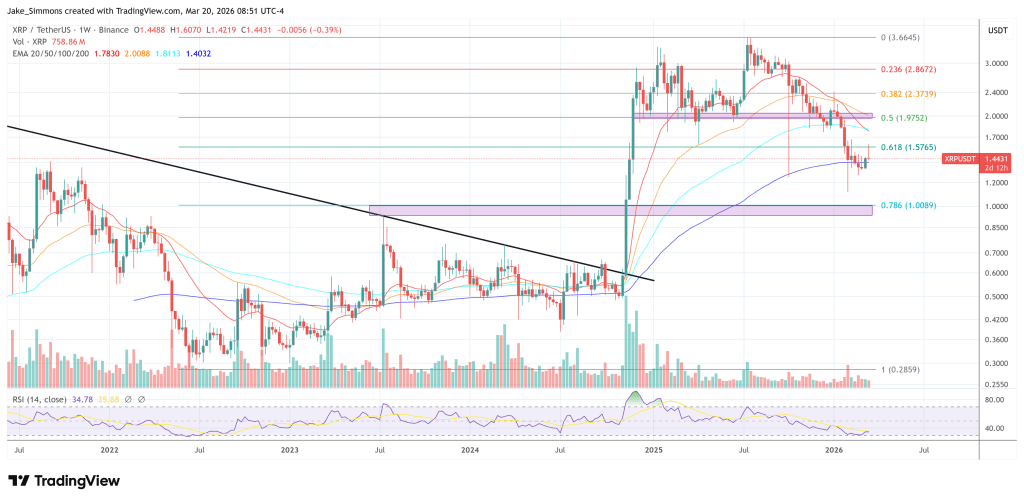
XRP must rise above the 0.618 Fib, 1-week chart | Source: XRPUSDT on TradingView.com

Preguntas relacionadas

QWhat is the main announcement made by Virtuals Protocol and t54 regarding the XRP Ledger?

AVirtuals Protocol and t54 are bringing 'agent commerce' to the XRP Ledger, enabling AI agents to transact natively using escrowed jobs, evaluator-based verification, and programmable settlement.

QWhich two key technologies are involved in this new agent commerce infrastructure on XRPL?

AVirtuals provides the commerce logic through its Agent Commerce Protocol (ACP), and t54 provides the payment rail through its x402 facilitator.

QWhat cryptocurrencies can AI agents use to pay natively via the t54 x402 facilitator?

AAI agents can natively pay in XRP and RLUSD using the t54 x402 facilitator.

QWhat is the purpose of the x402 payment protocol as described by Coinbase?

ACoinbase describes x402 as an open payment protocol built around the HTTP 402 'Payment Required' status code, designed to allow APIs, websites, and autonomous agents to pay programmatically for access over standard web requests without traditional account-and-session models.

QWhat was Ripple's involvement in t54's February seed round?

ARipple, along with Virtuals Ventures, participated strategically in t54's seed round in February.

Lecturas Relacionadas

The Verdict in Choi Tae-won's Divorce Case: Revealing the Inheritance Undercurrent Behind SK Hynix's Trillion-Won Empire

SK Group Chairman Chey Tae-won's high-profile divorce case, involving a record 1.38 trillion won settlement, has drawn attention to the succession plans for Korea's second-largest conglomerate, especially its crown jewel, SK hynix. Unlike traditional chaebol scripts centered on the eldest son, Chey's three children from his marriage to former President Roh Tae-woo's daughter, Roh Soh-yeong, are carving distinct, non-traditional paths. Eldest daughter Chey Yun-jung (b. 1989) is seen as the most evident successor. With a scientific and consulting background, she holds executive roles at SK bioscience and SK Inc.'s growth support department, focusing on future strategy and biopharma. Her marriage is to an AI infrastructure entrepreneur, not a traditional business alliance. Second daughter Chey Min-jung (b. 1991) took a unique route, voluntarily serving as a South Korean naval officer, including an anti-piracy deployment. She later worked on policy and strategy for SK hynix in Washington D.C. before co-founding an AI-driven healthcare startup. She married a former U.S. Marine Corps officer, connecting her to U.S. defense and policy circles—networks crucial for a global semiconductor giant. The only son, Chey In-geun (b. 1995), who studied physics like his father, worked briefly at SK E&S before joining McKinsey. Despite fitting the traditional "heir" profile as the eldest son, he remains silent and holds no public position or shares in SK, suggesting the old succession playbook is obsolete. As SK hynix's valuation soars, becoming a geopolitical asset in the AI era, the heirs' legitimacy is no longer automatic. They must prove themselves in fields like AI biotech, global policy, and strategic consulting. Their marriages also reflect new elite networks in tech and defense, not old political alliances. Their inheritance is the complex challenge of navigating a globalized, tech-driven world, not just a corporate throne.

marsbitAyer 09:06

The Verdict in Choi Tae-won's Divorce Case: Revealing the Inheritance Undercurrent Behind SK Hynix's Trillion-Won Empire

marsbitAyer 09:06

From OpenSea to OpenRouter: Is Alex Atallah Repeating His 'Exit at the Peak' Playbook?

From OpenSea to OpenRouter: Is Alex Atallah Repeating His "Exit at the Peak" Playbook? According to the Wall Street Journal, payments giant Stripe is in talks to acquire the AI model aggregation platform OpenRouter in a potential deal valuing the company near $100 billion. This would mark founder Alex Atallah's second creation of a company reaching a $100 billion valuation, following his co-founding of NFT marketplace OpenSea. OpenRouter, founded just over three years ago, has grown rapidly by acting as a unified gateway for developers to access over 400 AI models. It currently has about 10 million users and processes over 200 trillion tokens monthly. While the platform's annualized revenue is around $50 million, its valuation has skyrocketed from $1.3 billion in March 2026. The potential acquisition by Stripe, a company OpenRouter's founder once likened it to, represents a major expansion into AI infrastructure for the payments leader. This move echoes Atallah's previous timing with OpenSea, where he departed before the NFT market's significant downturn. For OpenRouter, selling now may be strategic. Despite its scale, its business model—charging a 5-5.5% fee on AI inference calls—faces pressure from competition, open-source models, and potential price wars among model providers, limiting its profitability narrative for an IPO. A key asset for potential acquirers like Stripe is OpenRouter's vast repository of real-world AI usage data, which offers unique insights into model performance and developer preferences that are difficult to replicate. Whether this potential deal signifies a new valuation benchmark for AI infrastructure or another market peak signal remains to be seen.

链捕手Ayer 08:42

From OpenSea to OpenRouter: Is Alex Atallah Repeating His 'Exit at the Peak' Playbook?

链捕手Ayer 08:42

Trading

Spot
活动图片





