XRP Bull-Bear Showdown Imminent: Downtrend Shows Cracks—Is This a Last Stand or the Final Drop?

金色财经Publicado a 2025-12-11Actualizado a 2025-12-11

Resumen

XRP remains constrained by a long-term bearish trend, but recent price movements suggest that selling pressure may be weakening. While the overall market structure is still defined by a steep descending red trendline, internal momentum is shifting. Bullish rallies are becoming stronger and more decisive, while bearish declines are losing intensity and duration—a sign that buyers are accumulating at lower levels. Key resistance lies near $2.48; a decisive break above this level could trigger a strong upward move as accumulated bullish energy is released. Important support is found in the $1.88–$1.95 zone, aligned with Fibonacci retracement levels. Failure to break above resistance, however, could lead to further downside toward the $1.40 region. In summary, XRP is at a critical juncture: either it breaks out into a new uptrend or remains trapped within the larger bearish structure. The outcome depends on whether it can sustainably overcome key resistance and convert it into support.

Article Source: WeChat Official Account Mama Encryption Talk

XRP remains constrained by a long-term downtrend, but recent price movements suggest that bears may be losing control. The upward moves are becoming stronger and more forceful, while the downward momentum is slowing, indicating that buyers are quietly entering the market. Once key resistance levels are breached, bulls may be preparing to launch a powerful counterattack.

Overall Bearish Structure: The Upper Limit of the Red Trendline

According to the latest XRP chart from MakroVision Research, the overall market structure remains in a downtrend, with the steep descending red trendline clearly outlining this trend. These trendlines continue to hinder every rebound attempt, keeping the overall technical picture unchanged and biased toward bearish.

Although the internal market structure has begun to show clear signs of improvement, short-term price movements indicate that upward moves are becoming more rapid, forceful, and distinct. Meanwhile, the momentum during downward phases is gradually weakening, with longer durations and reduced kinetic energy.

This shift is typical of waning selling pressure and increased buyer activity at lower levels. The market may still be below key resistance levels, but its internal dynamics are no longer as weak as before.
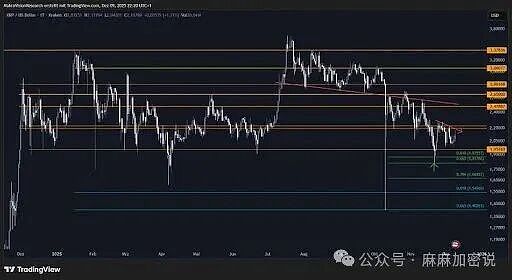
If XRP can decisively break through the red trendline near $2.48, it will unleash the upward potential that has been quietly accumulating. If it fails to break through, the token will technically remain under pressure, but the foundation for a potential reversal is clearly forming.

Key price levels to watch include the resistance zone at $2.20 to $2.22, the major breakout level at $2.48, and the support area around $1.95 to $1.88, which aligns with Fibonacci retracement levels and recent reaction points.

Dual-Track Conflict: Bearish Trend vs. Bullish Internal Structure

In summary, MakroVision Research points out that XRP is currently experiencing a dual-track movement. While the technical picture shows that the broader trend remains downward, its internal price structure is increasingly exhibiting bullish characteristics. This weakening of downward momentum makes the current chart dynamics exciting.

XRP's current fate hinges entirely on its ability to sustainably break through the aforementioned key resistance levels, particularly the $2.48 trendline. Analysts warn that if XRP successfully converts this major resistance level into support, the accumulated upward momentum could be rapidly unleashed, leading to a sharp price surge.

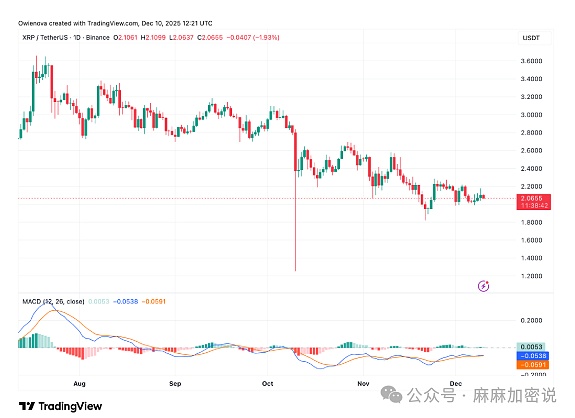
For now, the key question remains whether XRP can achieve a lasting trend reversal and leverage its internal strengths, or whether the overall bearish pressure will ultimately prevail, forcing prices lower toward the significant $1.4 low.
Preguntas relacionadas

QWhat is the main resistance level that XRP needs to break for a potential trend reversal according to the article?

AThe main resistance level that XRP needs to break is $2.48, which is the key trendline.

QWhat does the article suggest about the internal market structure of XRP despite the overall bearish trend?

AThe article suggests that the internal price structure is becoming increasingly bullish, with stronger rallies and weakening sell-offs, indicating that buyers are becoming more active.

QWhich price zone is mentioned as a support area for XRP in the analysis?

AThe support area mentioned is around $1.95 to $1.88, which aligns with Fibonacci retracement levels and recent reaction points.

QWhat could happen if XRP fails to break the key resistance at $2.48?

AIf XRP fails to break the $2.48 resistance, it will remain technically pressured, and the overall bearish pressure might push the price down further towards the $1.4 low.

QWhat is the 'dual-track conflict' described in the article regarding XRP's price action?

AThe 'dual-track conflict' refers to the situation where the overall market structure is still bearish (controlled by the descending red trendline), but the internal price structure is showing signs of strengthening bullish momentum.

Lecturas Relacionadas

M&A Deals in the Crypto Market Are Unusually Active

Title: M&A Activity in Crypto Market Becomes Unusually Active A rare signal is emerging in the crypto primary market: mergers and acquisitions (M&A) are nearing half of all financing deals. According to RootData, this month, M&A cases in the crypto industry reached 10, while financing rounds numbered only 14, meaning M&A accounts for approximately 42% of primary market transactions—the highest level in history. This does not signal a sudden industry boom. Instead, the rapid rise in M&A share primarily reflects the continued downturn in the financing market. Since November 2024, monthly crypto M&A deals have remained between 10-20, while financing deals have plummeted from around 100 to about 50, possibly hitting a new low this month. For project teams, this means the traditional path of relying on narratives, token expectations, and ecosystem subsidies to maintain valuations is narrowing. For leading companies, it presents a rare window to acquire teams, licenses, technology, liquidity, and market access at lower prices, with less competition and stronger bargaining power. Key active buyers include Coinbase, Kraken, Ripple, MoonPay, Polymarket, Kaiko, Sol Strategies, GSR, Keyrock, Jupiter, Paxos, and Ondo Finance. Their M&A logic is consistent: acquiring key capabilities at lower costs during the industry downturn. This is driven by more attractive valuations, reduced time and trial-and-error costs, the acquisition of licenses and compliance resources, and the integration of industry upstream and downstream segments. Current M&A focuses are concentrated in four areas: trading infrastructure (e.g., Coinbase acquiring Deribit, Kraken acquiring NinjaTrader), payments and stablecoins (e.g., MoonPay, Ripple expanding payment networks), compliance licenses, and asset issuance/distribution (e.g., acquisitions related to RWA and token issuance platforms like Coinbase's purchases of Liquifi and Echo). The rise in M&A is altering the primary market's exit logic. It provides an alternative path to the token-dependent model, encouraging teams to build tangible products, revenue, and strategic value that can be integrated. This could inject confidence into the market, showing that asset buyers and exit possibilities still exist, albeit with a stricter focus on real utility. However, this trend also indicates the crypto industry is becoming more centralized. As asset issuance, trading, market-making, custody, payments, and data gradually consolidate in the hands of a few major players, the industry's initial emphasis on openness and anti-monopoly is being reshaped by commercial realities. Coupled with rising compliance barriers, this signals the end of the low-barrier era for crypto entrepreneurship.

链捕手Hace 25 min(s)

M&A Deals in the Crypto Market Are Unusually Active

链捕手Hace 25 min(s)

M&A Deals Are Exceptionally Active in the Crypto Market

Mergers and acquisitions (M&A) activity in the cryptocurrency primary market has reached a historic high, accounting for approximately 42% of total deals in the current month, nearly matching the number of financing rounds. This shift does not signal a new boom cycle but rather reflects a severe contraction in the venture capital funding environment. As financing dwindles, established industry giants—including major exchanges, payment firms, and infrastructure providers—are seizing the opportunity to acquire strategic assets at lower valuations. Key drivers behind the surge in M&A include depressed project valuations, the need to quickly acquire talent and technology to capture short market windows, the pursuit of crucial regulatory licenses, and the strategic expansion into adjacent business verticals such as derivatives, payments, stablecoins, and real-world asset (RWA) issuance. Major acquisitions, like Coinbase's purchase of Deribit and Kraken's acquisition of NinjaTrader, exemplify the push to expand into high-margin areas like derivatives and multi-asset trading. This trend is reshaping the industry's exit landscape, offering an alternative to token-based exits and incentivizing startups to build tangible products and revenue streams with inherent strategic value for acquisition. However, it also points toward increasing centralization, as critical functions—trading, custody, payments, compliance—become concentrated within a few large, well-capitalized platforms, potentially raising barriers to entry for new ventures.

marsbitHace 26 min(s)

M&A Deals Are Exceptionally Active in the Crypto Market

marsbitHace 26 min(s)

Solana Privacy Ecosystem Panorama: A Complete Privacy Stack from Compute to AI

**Title: The Solana Privacy Ecosystem: A Full-Stack View from Compute to AI** **Summary:** This article provides a comprehensive overview of the emerging privacy landscape on the Solana blockchain, characterizing it as still in early development. It identifies two primary verticals—Neobanks and Private DeFi—as key drivers, while noting gaps in tooling and user experience. The discussion centers on two main approaches to private computation: Arcium, which utilizes Multi-Party Computation (MPC) networks (Multi-Party eXecution Environments) to process encrypted data with final settlement on Solana; and Magic Block, which leverages Trusted Execution Environments (TEEs) via its Private Ephemeral Rollup (PER). Both enable confidential applications like dark pools and private DeFi with minimal code changes. Building on this infrastructure, projects are creating privacy-focused applications. Umbra, built on Arcium, offers Encrypted Token Accounts (ETAs) for private balances, transfers, and selective disclosure for compliance. Other wallets like Privacy Cash and Hush provide mixer-like functionality for SOL. For private trading, encifherio uses TEEs to encrypt swap details routed through Jupiter, while VanishTrade and Darklake focus on shielding transaction intent and liquidity routing, with Darklake introducing a "blind slippage pool" to prevent front-running. Further applications include private prediction markets (e.g., Melee Markets using Arcium's encrypted order books) and private AI. Loyal exemplifies the latter, using both Magic Block and Arcium to enable decentralized AI agents that store user data, conversations, and transactions confidentially on-chain. The article concludes by framing privacy not as a single technology but as an evolving "ultimate privacy stack," with experts like Helius's Mert envisioning a future combination of Fully Homomorphic Encryption (FHE) and Zero-Knowledge proofs (ZK). Helius Privacy itself is developing a ZK-based UTXO privacy layer for Solana.

Foresight NewsHace 31 min(s)

Solana Privacy Ecosystem Panorama: A Complete Privacy Stack from Compute to AI

Foresight NewsHace 31 min(s)

Trading

Spot
Futuros

Artículos destacados

Qué es ATWO

I. Introducción al ProyectoArena Two es una plataforma interactiva descentralizada que permite a los fanáticos jugar un papel activo y tokenizado en los resultados de eventos en tiempo real. A diferencia de los modelos de transmisión tradicionales que reducen a los fanáticos a espectadores pasivos, Arena Two aprovecha la tecnología blockchain para permitir que los fanáticos voten directamente en tiempo real e influyan en los resultados en el campo.II. Información del TokenNombre del token: ATWO (Arena Two)III. Enlaces RelacionadosSitio web: https://arenatwo.com/Exploradores: https://basescan.org/token/0x499D35eBE6cEe9B2Ac35Fd003fcBbeeB9CFc7B32Twitter: https://x.com/arenatwoXNota: La introducción del proyecto proviene de los materiales publicados o proporcionados por el equipo oficial del proyecto, que es solo para referencia y no constituye asesoramiento de inversión. HTX no se hace responsable de ninguna pérdida directa o indirecta resultante.

182 Vistas totalesPublicado en 2026.05.18Actualizado en 2026.06.02

Qué es ATWO

Cómo comprar ATWO

¡Bienvenido a HTX.com! Hemos hecho que comprar Arena Two (ATWO) sea simple y conveniente. Sigue nuestra guía paso a paso para iniciar tu viaje de criptos.Paso 1: crea tu cuenta HTXUtiliza tu correo electrónico o número de teléfono para registrarte y obtener una cuenta gratuita en HTX. Experimenta un proceso de registro sin complicaciones y desbloquea todas las funciones.Obtener mi cuentaPaso 2: ve a Comprar cripto y elige tu método de pagoTarjeta de crédito/débito: usa tu Visa o Mastercard para comprar Arena Two (ATWO) al instante.Saldo: utiliza fondos del saldo de tu cuenta HTX para tradear sin problemas.Terceros: hemos agregado métodos de pago populares como Google Pay y Apple Pay para mejorar la comodidad.P2P: tradear directamente con otros usuarios en HTX.Over-the-Counter (OTC): ofrecemos servicios personalizados y tipos de cambio competitivos para los traders.Paso 3: guarda tu Arena Two (ATWO)Después de comprar tu Arena Two (ATWO), guárdalo en tu cuenta HTX. Alternativamente, puedes enviarlo a otro lugar mediante transferencia blockchain o utilizarlo para tradear otras criptomonedas.Paso 4: tradear Arena Two (ATWO)Tradear fácilmente con Arena Two (ATWO) en HTX's mercado spot. Simplemente accede a tu cuenta, selecciona tu par de trading, ejecuta tus trades y monitorea en tiempo real. Ofrecemos una experiencia fácil de usar tanto para principiantes como para traders experimentados.

201 Vistas totalesPublicado en 2026.05.18Actualizado en 2026.06.02

Cómo comprar ATWO

Qué es ZEST

I. Introducción al ProyectoEl Protocolo Zest es un protocolo de préstamos en Bitcoin que permite a los proveedores de liquidez de Bitcoin ganar rendimiento en Bitcoin a través de fondos de préstamos gestionados profesionalmente.II. Información del TokenNombre del token: ZEST (Protocolo Zest)III. Enlaces RelacionadosSitio web: https://www.zestprotocol.com/Exploradores: https://bscscan.com/token/0x5506599c722389a60580b5213ea1da60d64754a1Twitter: https://twitter.com/ZestProtocolNota: La introducción al proyecto proviene de los materiales publicados o proporcionados por el equipo oficial del proyecto, que es solo para referencia y no constituye asesoramiento de inversión. HTX no se hace responsable de ninguna pérdida directa o indirecta resultante.

221 Vistas totalesPublicado en 2026.05.19Actualizado en 2026.06.02

Qué es ZEST

Discusiones

Bienvenido a la comunidad de HTX. Aquí puedes mantenerte informado sobre los últimos desarrollos de la plataforma y acceder a análisis profesionales del mercado. A continuación se presentan las opiniones de los usuarios sobre el precio de A (A).

活动图片