M&A Deals Are Exceptionally Active in the Crypto Market

marsbitPublicado a 2026-06-16Actualizado a 2026-06-16

Resumen

Mergers and acquisitions (M&A) activity in the cryptocurrency primary market has reached a historic high, accounting for approximately 42% of total deals in the current month, nearly matching the number of financing rounds. This shift does not signal a new boom cycle but rather reflects a severe contraction in the venture capital funding environment. As financing dwindles, established industry giants—including major exchanges, payment firms, and infrastructure providers—are seizing the opportunity to acquire strategic assets at lower valuations. Key drivers behind the surge in M&A include depressed project valuations, the need to quickly acquire talent and technology to capture short market windows, the pursuit of crucial regulatory licenses, and the strategic expansion into adjacent business verticals such as derivatives, payments, stablecoins, and real-world asset (RWA) issuance. Major acquisitions, like Coinbase's purchase of Deribit and Kraken's acquisition of NinjaTrader, exemplify the push to expand into high-margin areas like derivatives and multi-asset trading. This trend is reshaping the industry's exit landscape, offering an alternative to token-based exits and incentivizing startups to build tangible products and revenue streams with inherent strategic value for acquisition. However, it also points toward increasing centralization, as critical functions—trading, custody, payments, compliance—become concentrated within a few large, well-capitalized platforms, pote...

Author: Gu Yu, ChainCatcher

A rare signal is emerging in the crypto primary market: the proportion of M&A deals is approaching half that of financing rounds.

According to RootData statistics, this month alone, the number of M&A cases in the crypto industry has reached 10, while the number of financing rounds is only 14. Calculated as a proportion of total primary market deals, M&A now accounts for approximately 42%, the highest level in history.
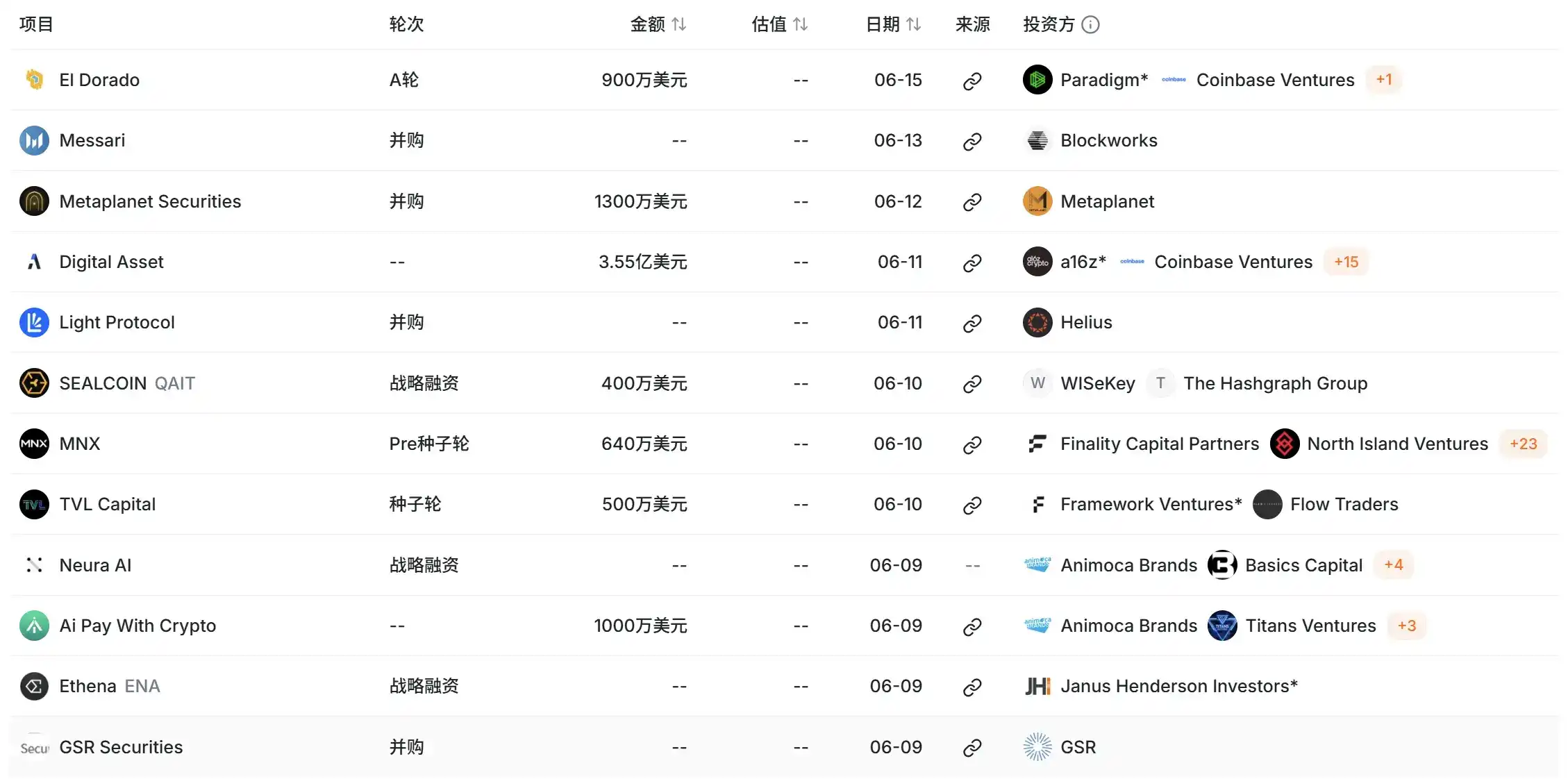
The meaning of this data is not complicated: in the past, the protagonist of the crypto primary market was fundraising; now, more and more deals are becoming acquisitions.

This does not mean the industry has suddenly entered a boom cycle. On the contrary, the rapid rise in the proportion of M&A primarily reflects the continued downturn in the financing market. Since November 2024, the monthly number of M&A transactions in the crypto industry has remained basically in the range of 10-20 deals, while the number of financing transactions has dropped significantly from around 100 to around 50, potentially setting a new low this month.

In other words, M&A transactions have not truly replaced the heat of the financing market; rather, they have become the most stable form of transaction in the primary market after the financing market contracted.

For project teams, this means the path of relying on narratives for fundraising, token expectations, and ecosystem subsidies to maintain valuations is narrowing. For leading companies, however, this means a rare window: to acquire teams, licenses, technology, liquidity, and market entry points at lower prices, with less competition, and stronger bargaining power.

After the ebb of fundraising, the crypto primary market has not stopped functioning; it's just that pricing power is shifting from VCs to buyer giants.

I. Why M&A Activity Remains High

Over the past year, frequent buyers have included Coinbase, Kraken, Ripple, MoonPay, Polymarket, Kaiko, Sol Strategies, GSR, Keyrock, Jupiter, Paxos, Ondo Finance, etc.

These companies operate in different sectors, including exchanges, payment companies, market makers, data service providers, prediction markets, RWA platforms, Solana treasury companies, as well as stablecoin and financial infrastructure firms. However, their M&A logic is highly consistent: to complement key capabilities at lower cost during the industry downturn.

First, valuations are cheap enough.

When the financing environment tightens, many projects cannot continue to raise funds at their previous round's valuation. For buyers, this means better acquisition prices, fewer competitors in bidding, and stronger bargaining power. For sellers, even if the price isn't ideal, being acquired by a leading company may offer more certainty than further dilution, layoffs, or pivots.

Take the recently acquired Messari as an example. The project's highest valuation once reached $300 million, with cumulative funding exceeding $70 million. However, as its core investment research business was severely impacted by AI and competitors, leading to repeated layoffs and business contraction, Blockworks' acquisition price was only a little over ten million dollars.

Second, saving time and trial-and-error costs.

Windows of opportunity in the crypto industry are often very short. When a regulatory gap opens, a new product model proves successful, or an asset class heats up, the market won't give companies two or three years to build a team from scratch. Acquiring a mature team is often faster than internal incubation and avoids unnecessary trial-and-error costs.

Coinbase's acquisition of Deribit for $2.9 billion is a typical case. Deribit is one of the world's major crypto options platforms, with trading volume reaching approximately $1.2 trillion in 2024. Through this transaction, Coinbase directly entered the core global crypto derivatives market, rather than building an options trading platform from scratch.

Third, acquiring licenses and compliance resources.

As regulatory frameworks in the US, EU, Hong Kong, Singapore, and other regions gradually become clearer, licenses are becoming core assets for crypto companies. Trading, custody, payment, stablecoins, brokerage, clearing, derivatives—every link requires a compliant entry point.

Kraken's acquisition of NinjaTrader follows this logic. NinjaTrader is a futures trading platform for retail users, with trading volume of $15 billion; this deal helps Kraken expand into multi-asset trading and regulated derivatives businesses.

Fourth, integrating industry chain upstream and downstream.

Crypto giants are moving from single-point products towards financial conglomerates. Exchanges are not just matching orders; they also want to offer derivatives, wallets, custody, payments, RWA, token issuance, data, and institutional services. Stablecoin companies don't just issue tokens; they want to build payment networks, AI agents, and financial infrastructure. RWA platforms don't just issue assets; they want to master compliance, distribution, liquidity, and data entry points.

The M&A path of crypto payment giant MoonPay is typical. In 2025, MoonPay acquired crypto payment startup Helio for approximately $175 million; later, it announced the acquisition of stablecoin infrastructure platform Iron to expand its enterprise payment and stablecoin capabilities.

II. Which Areas Are the Focus of M&A?

Judging from recent M&A directions, areas crypto giants are most willing to spend money on are mainly concentrated in four categories: trading infrastructure, payments & stablecoins, compliance licenses, and asset issuance & distribution.

Trading infrastructure remains the biggest battleground.

Coinbase's acquisition of Deribit and Kraken's acquisition of NinjaTrader are driven by the same judgment: spot trading growth is limited, while derivatives, options, futures, multi-asset trading, and institutional services are higher-value profit pools. Especially with the gradual rise of ETFs, RWA, tokenized stocks, and prediction markets, the boundaries of trading platforms are expanding from "crypto-to-crypto exchanges" to "global asset trading gateways."

Payments and stablecoins form the second main line.

MoonPay, Ripple, Paxos, Tether, and other companies are expanding around payment, stablecoin clearing, merchant acquiring, enterprise settlement, and cross-border transfers. Ripple's acquisition moves in recent years have been particularly aggressive, including the $250 million acquisition of custody company Metaco in 2023, followed by expansions focusing on stablecoin payments, prime brokerage, and enterprise treasury management.

This indicates that the stablecoin war is no longer just about issuance scale; it's about payment networks, compliance channels, institutional clients, and scenario access.

RWA and asset issuance are also becoming new M&A hotspots.

Companies like Ondo Finance, Jupiter, Polymarket, and Coinbase are expanding their asset issuance, liquidity distribution, and trading gateway capabilities through acquisitions or integrations. Coinbase's acquisitions of Liquifi and Echo are precisely focused on token issuance and on-chain financing capabilities. The Echo deal, valued at $375 million, helps Coinbase expand into an on-chain capital formation platform; Liquifi provides token distribution and management tools, aligning with Coinbase's bet on compliant token issuance pathways.

The strategic significance of such M&A lies in the fact that whoever controls asset issuance controls the source of trading. In the past, exchanges mainly profited from trading fees on existing assets; in the future, leading platforms prefer to profit from the entire chain encompassing asset creation, financing, listing, distribution, market making, custody, and trading. M&A is the fastest way to integrate this chain.

III. M&A Is Rewriting the Primary Market Exit Logic

The warming of M&A is not necessarily bad for entrepreneurs.

In the past, the exit path for crypto projects was overly reliant on tokens. A project's success often depended on whether it could issue a token, list it on exchanges, maintain market cap, and create liquidity. However, this mechanism created numerous problems over the past few years: founders exiting early, VC unlocking sell pressure, retail investors left holding the bag, high valuations with low circulation, and real business being held hostage by token prices.

M&A offers an alternative path. Even if a team cannot independently grow into a giant, as long as it can develop genuine capabilities in a certain area—such as licenses, technology, liquidity, compliance, users, data, risk control, market making, payment networks—it has the potential to be acquired by a larger platform.

This will change entrepreneurs' behavior. In the past, many projects issued tokens for the sake of issuing tokens and packaged narratives for fundraising; in the future, more teams might refocus on product, revenue, customers, and strategic value that can be integrated.

This is also why the M&A boom can, to some extent, give the primary market a shot in the arm. It shows that there are still asset buyers in the crypto industry, there is still value revaluation, and exit possibilities still exist.

It's just that the market is screening value in a more demanding way. What can be bought is no longer grand narratives on PowerPoint slides, but real capabilities that can be directly integrated into business blueprints.

IV. The Crypto Industry Is Becoming More Centralized

Behind the M&A boom lies the downturn in the financing market, declining project valuations, and increasing exit pressure on startup teams. But it also indicates that the crypto industry has not lost its capital vitality; it is simply completing resource reorganization in a different way.

Another issue that must be recognized is: the crypto industry is becoming more centralized.

As asset issuance, trading, market making, custody, payments, and data gradually concentrate in the hands of a few companies, the openness and anti-monopoly emphasis of the crypto industry's early days may be reshaped by realistic business logic.

Especially as compliance becomes a core barrier, the difficulty for new entrepreneurs to enter the market will increase further. The future crypto industry may develop a landscape similar to traditional finance: a few large platforms hold licenses, customers, and liquidity, while small and medium-sized teams can only become technology suppliers, ecosystem plugins, or potential acquisition targets.

Therefore, another implication of the rising proportion of M&A is: the crypto industry is bidding farewell to the era of low-barrier entrepreneurship.

Future entrepreneurs will not only face market competition but also the ecosystem boundaries and regulatory barriers of giants.


Preguntas relacionadas

QWhat is the current proportion of M&A deals in the crypto primary market, and what is this trend a reflection of?

AAccording to the article, M&A deals now account for approximately 42% of all primary market transactions, a historically high level. This trend primarily reflects the continued downturn in the fundraising market, not a sudden industry boom. The number of M&A deals has remained relatively stable while fundraising deals have significantly declined, making M&A the most stable form of transaction in this market environment.

QWhat are the four main reasons driving the surge in M&A activity according to the article?

AThe four main reasons are: 1) Valuations have become sufficiently cheap for buyers. 2) Acquisition saves time and trial-and-error costs compared to building capabilities from scratch. 3) Acquiring licenses and compliance resources is crucial in a tightening regulatory landscape. 4) To integrate and control the industry's upstream and downstream value chain.

QWhich key areas are currently the focus of acquisitions by crypto giants?

AThe key acquisition areas are: 1) Trading infrastructure (especially derivatives and multi-asset trading). 2) Payments and stablecoins (focusing on payment networks and compliance). 3) Compliance and licenses. 4) Asset issuance and distribution (RWA, token issuance platforms).

QHow does the article suggest the rise in M&A is changing the exit logic for crypto startups?

AThe article suggests M&A provides an alternative exit path to the traditional reliance on token listings and price performance. It incentivizes startups to build genuine strategic value—like real products, revenue, compliance assets, or specific technological capabilities—that can be integrated into a larger platform's business, potentially leading to a more tangible acquisition exit.

QWhat potential long-term consequence of increasing M&A activity does the article highlight regarding industry structure?

AThe article highlights that the increase in M&A activity is leading to greater centralization within the crypto industry. Resources like asset issuance, trading, custody, payments, and data are becoming concentrated in the hands of a few large platforms. This, combined with rising compliance barriers, is making the industry less accessible for new entrepreneurs, potentially leading to a structure resembling traditional finance with dominant incumbents.

Lecturas Relacionadas

Dalio's Latest Warning: Don't Get Carried Away by AI, Real Returns on US Stocks in the Next 5-10 Years Could Be -5% to -10%

Ray Dalio, founder of Bridgewater Associates, warns investors against excessive concentration in AI stocks. He argues the current market, dominated by a few AI giants, mirrors historical patterns where revolutionary new technologies lead to high risk, volatility, and uncertainty. While acknowledging AI's transformative potential, Dalio emphasizes that most investors fail at this stage of the cycle by over-concentrating in a handful of leading companies. He cites inherent risks: companies cannot accurately forecast investment needs or external shocks (e.g., monetary policy, geopolitics, taxes), face potential disruption from future technologies and international competition (notably from China), and experience significant price swings. Dalio's core advice is diversification, calling it his "Holy Grail of Investing." He presents a mathematical case that a well-diversified portfolio of 15-20 uncorrelated, good bets offers a superior risk-adjusted return compared to a concentrated position. Dalio also offers a cautious outlook, suggesting U.S. stocks may deliver real returns of -5% to -10% over the next 5-10 years based on valuation and bubble indicators. He concludes that in the face of high uncertainty, the prudent strategy is not to avoid betting entirely, but to avoid large, concentrated bets where one lacks sufficient informational edge. Instead, investors should build a strategically balanced, diversified portfolio.

marsbitHace 25 min(s)

Dalio's Latest Warning: Don't Get Carried Away by AI, Real Returns on US Stocks in the Next 5-10 Years Could Be -5% to -10%

marsbitHace 25 min(s)

Rain Valuation Approaches $20 Billion: The Battle for U-Cards Extends to Rewards Systems

Rain, a stablecoin payments infrastructure company, is shifting the competitive focus for U Cards from simple issuance to user retention and repeated usage. On June 15, Rain launched "Rain Rewards," an embedded loyalty program capability within its card-issuing infrastructure. This allows partner businesses—like fintech platforms and neobanks—to configure branded loyalty points, earning rules, redemptions, and merchant promotions directly within their card products. The system, built from the 2025 acquisition of Uptop, ensures points are only issued upon final transaction settlement, preventing liabilities from refunds. Trials, such as with Avalanche Card, reportedly boosted spending by 25% among enrolled users. Founded by Farooq Malik and Charles Yoo-Naut, Rain evolved from a tool for managing Web3 company expenses into a full-stack enterprise platform. It is a Principal Member of Visa and Mastercard, enabling partners to issue stablecoin-backed cards and wallets while leveraging traditional payment networks. Notably, the popular U Card Plasma One is issued by Rain under Visa's authority. Rain also integrates with Visa's stablecoin settlement pilot, using USDC for network settlement. Rain's rapid funding reflects growing institutional interest in stablecoin payment infrastructure. It raised a $245 million Series A in March 2025, a $58 million Series B in August 2025, and a $250 million Series C in January of this year, reaching a $19.5 billion valuation. Annualized transaction volume exceeds $3 billion, serving over 200 partners including Western Union and Nuvei. Beyond cards, Rain is expanding into programmable payments. Its June 2026 "Agent Control Layer" allows businesses to set spending rules—like merchant categories, amounts, and frequency—for AI agents before transactions occur. This positions Rain not as a single product but as an operating system for stablecoin payments, handling everything from card issuance and wallet management to rewards, on/off-ramps, and automated compliance. The goal is to enable seamless, often invisible, real-world spending of on-chain assets.

Foresight NewsHace 28 min(s)

Rain Valuation Approaches $20 Billion: The Battle for U-Cards Extends to Rewards Systems

Foresight NewsHace 28 min(s)

Google TPU Shipments Revised Up by 50%

Recent industry research indicates a significant upward revision in the shipments of Google's TPU (Tensor Processing Unit) chips. Previous expectations for 2027 were set at around 10 million units, but new estimates now point to 15 million units, a 50% increase. This substantial boost directly translates to higher demand across the entire supporting supply chain. Google's TPU clusters utilize a standardized all-optical interconnect architecture. Consequently, key hardware components are deeply integrated and scaled in fixed ratios with the chips. The 15 million TPU target will drive corresponding demand increases for NPO optical engines (roughly a 1:1 match), 1.6T optical modules, OCS optical switches, high-end server power supplies, fiber optics & MPO connectors, and liquid cooling solutions. Among these, liquid cooling is highlighted as the sector experiencing the most significant transformation and offering the most stable potential for excess returns. As next-generation TPU chips reach power levels where traditional air cooling is insufficient, liquid cooling becomes essential. 2026 is forecasted as the first year of substantial adoption for Google's liquid cooling solutions. This shift, coupled with delivery and capacity bottlenecks faced by incumbent overseas manufacturers, is creating a prime window for domestic Chinese suppliers to enter and secure Google's core supply chain. The market size for Google-specific liquid cooling is projected to potentially triple from a baseline of hundreds of billions to around 300 billion units by 2028. The logic for the fiber optic sector is also being rewritten. Once considered a cyclical commodity tied to telecom operator procurement, fiber is now a strategic and scarce resource for AI Data Centers (AIDC). A severe supply-demand imbalance, driven by the long lead time for preform production (18-24 months) and surging demand from cloud giants, is supporting strong performance. Chinese fiber manufacturers are well-positioned to capture a significant share of global AIDC demand, with exports potentially reaching 200-300 million core kilometers in 2026. Overall, the investment focus within the AI computing industry is shifting from pure "chip performance speculation" towards the more certain incremental growth in computing infrastructure and its supporting ecosystem. The upward revision in Google TPU shipments, along with the potential for further doubling by 2028, is seen as solidifying performance visibility for the entire supporting supply chain over the next two years.

marsbitHace 2 hora(s)

Google TPU Shipments Revised Up by 50%

marsbitHace 2 hora(s)

What Wall Street Really Wants After the Crypto Story Recedes

The tide of speculative crypto narratives has receded, revealing Wall Street's true objective: building a controlled, yield-generating, and compliant financial pipeline on distributed ledgers. They are migrating core functions onto blockchains, not for decentralization, but for efficiency and new revenue streams. Key developments include BlackRock's BUIDL fund, a tokenized treasury fund acting as a foundational reserve asset, and the rise of Securitize, which is going public and partnering with the NYSE to build a 24/7 digital securities trading and settlement system. This signals a major shift of securities clearing to blockchain technology. To make volatile assets like Bitcoin palatable for institutional investors, firms like BlackRock and Goldman Sachs are creating "covered call" ETFs (e.g., BITA). These products systematically sell options on Bitcoin holdings, transforming price volatility into stable monthly income, effectively repackaging crypto as a yield-bearing asset. Stablecoins are being positioned not as speculative tools but as efficient payment rails. Companies like Stripe and Mastercard are integrating them for instant, low-cost merchant settlements and cross-border card payments, respectively. Critically, new legislation like the GENIUS Act shapes them as non-interest-bearing, heavily regulated extensions of the US dollar system. In summary, Wall Street is quietly constructing a parallel, blockchain-based financial infrastructure featuring tokenized traditional assets, structured crypto yields, and programmable dollar pipelines—all under its control and fully integrated with existing regulatory and credit frameworks.

marsbitHace 2 hora(s)

What Wall Street Really Wants After the Crypto Story Recedes

marsbitHace 2 hora(s)

Trading

Spot
Futuros

Artículos destacados

Qué es DOGE M

Doge Matrix ($doge m): La Nueva Raza de Criptomonedas Impulsadas por la Comunidad Introducción En el paisaje en constante evolución de las criptomonedas, nuevos proyectos emergen constantemente, cada uno con el objetivo de captar el interés de inversores y entusiastas por igual. Uno de los últimos en entrar en este dominio es Doge Matrix, representado por el símbolo de ticker $doge m. Este proyecto ha atraído atención gracias a sus raíces en la popular cultura de memes que rodea a Dogecoin, estableciendo su lugar dentro del espacio web3. Este artículo tiene como objetivo proporcionar un análisis integral de Doge Matrix, cubriendo su visión general, creador, inversores, funcionalidad, cronología y aspectos notables. ¿Qué es Doge Matrix ($doge m)? Doge Matrix es un proyecto de criptomoneda impulsado por la comunidad que aparentemente se basa en el atractivo generalizado de Dogecoin, una moneda digital conocida por su mascota Shiba Inu y sus orígenes en memes. Si bien los objetivos generales de Doge Matrix no están ampliamente definidos, se caracteriza por un compromiso con la participación y el apoyo de la comunidad. A diferencia de las criptomonedas tradicionales que a menudo enfatizan la utilidad o el valor intrínseco a través de tecnologías subyacentes, Doge Matrix se posiciona dentro de un espacio que abraza el fenómeno cultural de las criptomonedas, apelando particularmente a aquellos que resuenan con la ética de los activos basados en memes. Aprovechando las fortalezas de la comunidad de Dogecoin, Doge Matrix opera como parte de un ecosistema más amplio, invitando a la participación y el compromiso de usuarios que comparten un interés en la criptomoneda y el paisaje digital. ¿Quién es el Creador de Doge Matrix ($doge m)? La identidad del creador de Doge Matrix sigue siendo desconocida. Esta falta de transparencia no es un acontecimiento poco común en el espacio de las criptomonedas, donde algunos proyectos se lanzan sin revelar las identidades de sus fundadores. La ausencia de información sobre el equipo fundador puede generar preguntas entre los posibles inversores sobre la responsabilidad y dirección del proyecto. ¿Quiénes son los Inversores de Doge Matrix ($doge m)? Hasta el momento, no hay información disponible públicamente que detalle los inversores o fundaciones de inversión que respaldan a Doge Matrix. El proyecto parece depender principalmente del apoyo de la comunidad en lugar de inversiones institucionales. Este modelo se alinea con la naturaleza impulsada por la comunidad de la iniciativa, fomentando un entorno donde la dirección del proyecto es moldeada por sus participantes en lugar de ser dictada por unos pocos patrocinadores financieros seleccionados. ¿Cómo Funciona Doge Matrix ($doge m)? Los detalles sobre los mecanismos operativos de Doge Matrix son algo vagos, reflejando una tendencia más amplia de proyectos en el espacio de las monedas meme donde las funcionalidades innovadoras no siempre están claramente articuladas. No obstante, Doge Matrix parece estar diseñado para aprovechar el ecosistema existente de criptomonedas alentar la participación de los usuarios mientras se conecta con las referencias culturales familiares asociadas a Dogecoin. Sus características potencialmente únicas derivan de las interacciones comunitarias en lugar de avances tecnológicos, enfatizando experiencias compartidas y colaboración entre los poseedores de tokens. Si bien las innovaciones exactas no se han delineado explícitamente, el proyecto parece crear un espacio donde los miembros de la comunidad pueden interactuar, compartir ideas y propulsar el potencial del proyecto hacia adelante. Cronología de Doge Matrix ($doge m) Reflexionar sobre la cronología del proyecto revela eventos notables que han definido su trayectoria hasta ahora: 25 de noviembre de 2024: Doge Matrix alcanzó su valor máximo histórico, marcando un hito significativo en su historia temprana. 1 de enero de 2025: Por el contrario, Doge Matrix alcanzó su valor mínimo histórico, ilustrando la volatilidad a menudo asociada con las criptomonedas, especialmente en las primeras etapas del ciclo de vida de un proyecto. En curso: El proyecto continúa siendo activamente negociado y respaldado por su comunidad, aunque aún no se han divulgado hitos u objetivos futuros específicos. Puntos Clave Sobre Doge Matrix ($doge m) Enfoque Comunitario En el corazón de Doge Matrix hay un compromiso con la participación de la comunidad. El proyecto prospera sobre la premisa de colaboración y objetivos compartidos entre sus miembros, enfatizando la importancia del esfuerzo colectivo. A diferencia de los proyectos centralizados que a menudo tienen una estructura de liderazgo definida, Doge Matrix actualmente muestra un enfoque más fluido hacia la gobernanza, donde la voz de cada miembro de la comunidad importa. Volatilidad El mercado de criptomonedas es notorio por su volatilidad, y Doge Matrix no es una excepción. Su historial de precios refleja fluctuaciones significativas entre valores altos y bajos, lo cual es típico de muchas nuevas criptomonedas, pero subraya los riesgos asociados con la inversión en tokens emergentes. Falta de Información Detallada Una de las características más llamativas de Doge Matrix es la escasez de información detallada sobre sus fundamentos tecnológicos y mecanismos operativos. Esta ambigüedad requiere que los posibles inversores realicen una diligencia debida exhaustiva antes de involucrarse con el proyecto. Conclusión En resumen, Doge Matrix ($doge m) ilustra una nueva ola de proyectos de criptomonedas que se apoyan en gran medida en la participación de la comunidad y la relevancia cultural. Si bien carece de ciertos detalles, como liderazgo claro, objetivos definidos y funcionalidad detallada, el proyecto ha logrado generar interés dentro de la comunidad cripto, aprovechando el atractivo establecido de la cultura de memes. Al igual que con cualquier inversión en el espacio de las criptomonedas, comprender los riesgos inherentes y realizar una investigación exhaustiva es esencial para los participantes potenciales. Doge Matrix se erige como un recordatorio de la naturaleza dinámica y, a veces, impredecible de la industria cripto, marcada por una evolución constante y entusiasmo por iniciativas impulsadas por la comunidad.

419 Vistas totalesPublicado en 2025.02.03Actualizado en 2025.02.03

Qué es DOGE M

Qué es $M

Entendiendo Mantis ($M): Una Nueva Era en la Interoperabilidad entre Cadenas En el paisaje en constante evolución de Web3 y las criptomonedas, nuevos proyectos se esfuerzan por ofrecer soluciones innovadoras destinadas a mejorar la experiencia del usuario y expandir las posibilidades funcionales dentro del ecosistema financiero descentralizado. Uno de estos proyectos que está ganando atención es Mantis ($M), un protocolo pionero fundado en los principios de interoperabilidad entre cadenas y liquidaciones basadas en intenciones. Este artículo profundiza en los aspectos esenciales de Mantis, incluyendo su funcionalidad central, creadores, respaldo de inversión, características innovadoras y hitos críticos. ¿Qué es Mantis ($M)? Mantis se describe como un protocolo de liquidación de intenciones multi-dominio que simplifica las interacciones entre cadenas, permitiendo a los usuarios ejecutar transacciones financieras complejas a través de varias plataformas de blockchain sin problemas. El protocolo opera a través de tres capas principales: Expresión de Intenciones: Los usuarios pueden articular sus objetivos de transacción utilizando un lenguaje natural facilitado por el DISE LLM, un modelo de lenguaje de IA avanzado. Por ejemplo, un usuario podría expresar el deseo de intercambiar Ethereum (ETH) por Solana (SOL) con una tolerancia de deslizamiento específica del 1%. Ejecución: Esta capa emplea una red de solucionadores que compiten para cumplir con las intenciones de los usuarios. Las transacciones se ejecutan utilizando mecanismos como Coincidencia de Deseos (CoWs) y Subastas de Flujo de Órdenes (OFAs), que aseguran que las demandas de los usuarios se satisfagan de manera óptima. Liquidación: Aprovechando el protocolo de Comunicación Inter-Blockchain (IBC), Mantis permite transacciones atómicas entre cadenas, permitiendo a los usuarios operar a través de varias cadenas soportadas, incluyendo Ethereum, Solana y Cosmos. Mantis está diseñado para introducir generación de rendimiento nativa para activos inactivos, utilizando pruebas criptográficas para mantener la integridad de las transacciones a lo largo de todo el proceso. Creadores y Equipo de Desarrollo Mantis fue concebido por la Composable Foundation, una organización impulsada por la investigación notable por su énfasis en soluciones de interoperabilidad de blockchain. Esta fundación colabora con instituciones académicas de renombre, incluyendo la Universidad de Harvard y la Universidad de Lisboa, contribuyendo a extensos esfuerzos de investigación y desarrollo que informan la arquitectura y funcionalidad de Mantis. El compromiso de la Composable Foundation de fomentar la innovación en el espacio de blockchain posiciona a Mantis como una solución robusta para la creciente demanda de interoperabilidad entre múltiples redes de blockchain. Inversores y Respaldo Si bien los detalles específicos sobre inversores individuales no se han divulgado públicamente, Mantis disfruta de un respaldo sustancial de varias entidades, incluyendo: Subvenciones del ecosistema de cadenas habilitadas por IBC, que apoyan el crecimiento del protocolo y su integración dentro de ecosistemas de finanzas descentralizadas. Asociaciones estratégicas con proveedores de infraestructura que mejoran las capacidades de la red de Mantis y sus estrategias de implementación. Financiamiento a través del tesoro de la Composable Foundation, asegurando un apoyo financiero sostenido para el desarrollo continuo y los costos operativos. Estos esfuerzos colaborativos reflejan un consenso entre las partes interesadas sobre la importancia de mejorar la funcionalidad entre cadenas y la utilidad potencial de las innovaciones infraestructurales de Mantis. Innovaciones Clave Mantis se distingue por varias innovaciones pioneras que mejoran su funcionalidad y utilidad: Intenciones Agnósticas a la Cadena: Los usuarios pueden iniciar transacciones desde cualquier cadena soportada mientras liquidan en otra. Esta flexibilidad empodera a los usuarios, impulsando una mayor interacción entre diferentes plataformas. Interfaz Potenciada por IA: La integración del DISE LLM permite a los usuarios realizar operaciones complejas de DeFi utilizando lenguaje natural, simplificando así las interacciones y haciendo que la tecnología blockchain sea accesible a un público más amplio. Captura de MEV Inter-Dominio: Mantis crea un mercado interno para el valor máximo extraíble (MEV) a través de competencias entre solucionadores. Este enfoque innovador permite una mayor eficiencia y extracción de valor en transacciones complejas. Capa de Liquidación Modular: El protocolo soporta varios métodos de verificación, incluyendo pruebas de conocimiento cero y rollups optimistas, proporcionando un marco versátil que puede adaptarse a las tecnologías de blockchain emergentes. Línea de Tiempo Histórica El desarrollo de Mantis está marcado por varios hitos críticos que trazan su trayectoria y crecimiento: | Año | Hito | |————|———————————————————————–| | 2022 | Desarrollo del concepto inicial dentro de la división de investigación de la Composable Foundation. | | Q3 2024 | Lanzamiento de la testnet con capacidades de puenteo entre Solana y Ethereum. | | Q1 2025 | Evento de Generación de Token (TGE) anticipado junto con el lanzamiento de la mainnet. | | Q2 2025 | Integración esperada del DISE LLM y expansión de las capacidades entre cadenas. | | 2025 H2 | Soporte planeado para más de 15 cadenas a través de futuras actualizaciones de IBC. | Esta línea de tiempo describe la evolución de Mantis, desde discusiones conceptuales hasta la implementación activa y fases de crecimiento futuro. Estrategia de Crecimiento del Ecosistema La estrategia de Mantis para el crecimiento del ecosistema incluye varias iniciativas diseñadas para fomentar la participación de los usuarios y el compromiso de los desarrolladores: Sistema de Créditos: Los usuarios pueden ganar créditos del protocolo al proporcionar liquidez y participar en programas de referidos. Estos créditos son canjeables por incentivos en el futuro, fomentando una comunidad de usuarios robusta. Kit de Desarrollo de Software Modular (SDK): Este conjunto de herramientas empodera a los desarrolladores para crear aplicaciones basadas en modelos impulsados por intenciones utilizando la infraestructura de Mantis, promoviendo así la innovación dentro de su ecosistema. Modelo de Gobernanza: A medida que el protocolo madura, los poseedores de tokens $M tendrán voz en la gobernanza del protocolo, permitiéndoles votar sobre actualizaciones y cambios propuestos, mejorando así el compromiso de la comunidad y la descentralización. Mantis representa un avance significativo en el ámbito de la arquitectura entre cadenas. Al integrar sin problemas algoritmos avanzados de IA con un marco de liquidación robusto, Mantis busca abordar los problemas de fragmentación dentro de los ecosistemas multi-cadena. Su enfoque innovador prioriza la mejora de la experiencia del usuario mientras se adhiere a los principios fundamentales de descentralización y seguridad, estableciendo un nuevo estándar para la futura interoperabilidad de las tecnologías blockchain. A medida que Mantis continúa su camino de crecimiento e implementación, promete ser un proyecto a seguir de cerca en el competitivo paisaje de Web3 y las finanzas descentralizadas. Con su enfoque en cruzar fronteras y elevar la participación del usuario, Mantis está preparado para ser una parte integral de los futuros desarrollos en el espacio de las criptomonedas.

38 Vistas totalesPublicado en 2025.03.18Actualizado en 2025.03.18

Qué es $M

Cómo comprar M

¡Bienvenido a HTX.com! Hemos hecho que comprar MemeCore (M) sea simple y conveniente. Sigue nuestra guía paso a paso para iniciar tu viaje de criptos.Paso 1: crea tu cuenta HTXUtiliza tu correo electrónico o número de teléfono para registrarte y obtener una cuenta gratuita en HTX. Experimenta un proceso de registro sin complicaciones y desbloquea todas las funciones.Obtener mi cuentaPaso 2: ve a Comprar cripto y elige tu método de pagoTarjeta de crédito/débito: usa tu Visa o Mastercard para comprar MemeCore (M) al instante.Saldo: utiliza fondos del saldo de tu cuenta HTX para tradear sin problemas.Terceros: hemos agregado métodos de pago populares como Google Pay y Apple Pay para mejorar la comodidad.P2P: tradear directamente con otros usuarios en HTX.Over-the-Counter (OTC): ofrecemos servicios personalizados y tipos de cambio competitivos para los traders.Paso 3: guarda tu MemeCore (M)Después de comprar tu MemeCore (M), guárdalo en tu cuenta HTX. Alternativamente, puedes enviarlo a otro lugar mediante transferencia blockchain o utilizarlo para tradear otras criptomonedas.Paso 4: tradear MemeCore (M)Tradear fácilmente con MemeCore (M) en HTX's mercado spot. Simplemente accede a tu cuenta, selecciona tu par de trading, ejecuta tus trades y monitorea en tiempo real. Ofrecemos una experiencia fácil de usar tanto para principiantes como para traders experimentados.

835 Vistas totalesPublicado en 2025.07.02Actualizado en 2026.06.02

Cómo comprar M

Discusiones

Bienvenido a la comunidad de HTX. Aquí puedes mantenerte informado sobre los últimos desarrollos de la plataforma y acceder a análisis profesionales del mercado. A continuación se presentan las opiniones de los usuarios sobre el precio de M (M).

活动图片













