XRP Army Rift: Zach Rector Accuses Jake Claver Of Misleading The Community

bitcoinistPublicado a 2026-01-02Actualizado a 2026-01-02

Resumen

Zach Rector has publicly accused fellow XRP community figure Jake Claver, CEO of Digital Ascension Group, of misleading investors. Rector specifically targeted Claver's highly confident but failed prediction that XRP would reach $100 by the end of 2025, arguing it was not merely a wrong forecast but a manipulative tactic implying insider knowledge. Beyond price predictions, Rector made serious allegations regarding XRP-focused funds operated through Claver's Digital Wealth Partners. He claims there is a significant discrepancy between Claver's public statements and private investor reports, alleging one fund lost over 4% before fees. Rector cited a past legal case involving fabricated documents to question Claver's credibility and called for a third-party audit of the funds, stating he will not trust the performance reports without verified financials.

A loud internal fight is spilling out across the XRP Army, with Zach Rector accusing Jake Claver of using high-certainty price narratives, most notably the “$100 XRP by end of 2025” call, to pull attention, credibility, and capital from the community.

Rector released a two-part video series on Dec 31, aimed at “addressing Jake Claver’s lies.” Claver, the CEO of Digital Ascension Group, ist one of the louder XRP bulls. While the $100 XRP call by Jan. 1, 2026 clearly failed, Rector argues that the miss wasn’t just a bad call, it was the certainty and urgency behind it, sold into a community that has spent years marinating in catalyst talk, NDA hints, and timeline debates.

The $100 XRP Call

Rector said he has challenged the $100 XRP claim throughout 2025 and was surprised Claver continued doubling down into the final days of the year. In Rector’s telling, the problem is not prediction-making, he said he has missed targets too, but the way extreme outcomes were marketed as near-certain, with the implication of privileged information.

He played a clip from Claver’s live show after Rector criticized the $100 call. When confronted, Claver did not concede, instead implying he may “know something.”

“If I was going to pivot, should have pivoted by now,” Claver said in the clip Rector quoted. “Unless I know something. Why wouldn’t I? ... We’ll see what ends up happening by the end of the year. We’ll see where the price is. And I think the results will speak for themselves.”

Rector argued that this kind of messaging: NDA-coded, “trust me” signaling becomes a lever inside XRP culture, where many holders have learned to treat timelines and insider claims as tradable narratives. Rector calls this behaviour “manipulation,” saying Claver’s “business model is so reliant upon that manipulation” that he “can’t back out now.”

Serious Allegations

Rector’s sharper allegations go beyond price talk and into what he described as XRP-focused funds offered through Digital Wealth Partners (DWP). He claimed the community has sent “so much XRP” into Claver’s orbit and that there is “a massive discrepancy from what he’s saying publicly and what investors are telling me privately.”

“Jake and his scheme, his business has grown so big they’ve taken in so much XRP from our community,” Rector said. “There’s a massive discrepancy from what he’s saying publicly and what investors are telling me privately.”

Rector said he has received fund reports and performance updates and claimed he is not sharing them publicly out of concern about retaliation, alleging investors have been warned not to share reporting and that reports are being watermarked with timestamps. He also made a specific performance claim: “one of the funds... has been losing money all year,” he said, adding it “lost over 4% on the year,” before fees, including “AUM fees of 2% in some cases.”

Rector’s broader point was that XRP holders are being asked to accept a “trust me bro relationship” around returns, even as he says he has not heard from any investor who can confirm “payments and distributions coming out” in a way that matches the marketing.

To explain why he views the trust gap as serious for XRP holders, Rector leaned on a prior legal dispute involving Claver and Digital Ascension. Rector said the case is public record and described it as “VeriVend versus Jacob Levi Claver and Digital Ascension Group” in the Western District of New York. He read from what he described as court filings and emphasized that the allegations and admissions, as he presented them, involve fabricated wire confirmations and impersonation.

“This is a serious deal,” Rector said, arguing the behavior he described should matter to XRP holders being asked to trust performance claims, NDAs, and time-sensitive narratives. He urged viewers to review the “answer to the complaint,” which he said includes admissions such as registering a VeriVend-related domain and fabricating purported wire transfer confirmations.

Rector also said the case settled, pointing to a “mediation certification” dated Feb. 12, 2025. He claimed, separately, that Claver paid the opposition in XRP to settle, an assertion Rector stated as a confirmation.

Rector framed his goal as containment rather than escalation, saying he wants the community “to stay together” and “not be divided,” but he also laid down an explicit remedy: third-party verification. “I want a third-party audit of those funds,” he said, arguing that absent audited financials he will not trust performance reporting tied to XRP strategies.

At press time, XRP traded at $1.85.
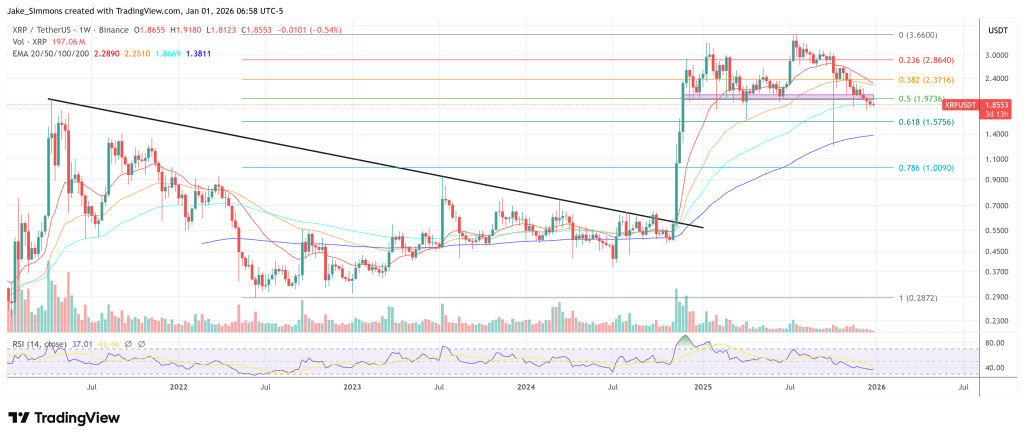
XRP remains below key support, 1-week chart | Source: XRPUSDT on TradingView.com

Criptos en tendencia

Preguntas relacionadas

QWhat is the main accusation Zach Rector makes against Jake Claver in the XRP community?

AZach Rector accuses Jake Claver of using high-certainty price narratives, specifically the '$100 XRP by end of 2025' prediction, to mislead the community and attract attention, credibility, and capital, which Rector describes as manipulation.

QWhat specific evidence does Rector provide to challenge Claver's credibility beyond the price prediction?

ARector references a public legal case, 'VeriVend versus Jacob Levi Claver and Digital Ascension Group,' in the Western District of New York, alleging it involved fabricated wire confirmations and impersonation, and claims the case was settled with Claver paying in XRP.

QWhat does Rector allege about the performance of funds managed by Claver's associated company, Digital Wealth Partners (DWP)?

ARector claims that one of the funds has been losing money all year, with a loss of over 4% before fees, and that there is a discrepancy between public statements and private investor reports, with investors being warned not to share watermarked performance updates.

QWhat solution does Zach Rector propose to address the trust issues he raises about Jake Claver's operations?

ARector calls for a third-party audit of the funds managed by Claver's associated entities, stating that without audited financials, he will not trust the performance reporting related to XRP strategies.

QHow did Jake Claver respond when confronted about his failed $100 XRP price prediction?

AWhen confronted, Claver did not concede but instead implied he might 'know something,' suggesting he had privileged information and stating, 'We'll see what ends up happening by the end of the year. We'll see where the price is. And I think the results will speak for themselves.'

Lecturas Relacionadas

Stablecoin Salaries: Why Are They Becoming the First Choice for Cross-Border Workers?

Stablecoin Salaries: Why They're Becoming the Top Choice for Global Remote Workers The traditional global salary system carries hidden exchange rate risks for freelancers in countries like India, Argentina, and Turkey who earn in USD but spend in local currencies. When salaries are instantly converted to local currency, workers lose purchasing power if that currency depreciates against the dollar. For instance, an Indian designer converting a $2000 monthly salary to rupees lost over 10% in purchasing power last year due to the rupee's decline. Holding even a portion of income in USD or USD-pegged stablecoins can preserve value. Stablecoins offer a solution by breaking down barriers to holding dollars. Opening foreign USD bank accounts is difficult, and international wire transfers incur high fees (averaging 6.5%) and delays. In contrast, stablecoin transfers are fast and low-cost. Furthermore, many countries with high inflation and depreciating currencies restrict citizens' access to foreign currency. Self-custody stablecoin wallets enable workers to hold dollar-equivalent assets without needing bank approval, bypassing these limits. These wallets integrate multiple functions: they allow users to convert only what's needed for daily expenses into local currency, keep the remainder in stablecoins, connect to on-chain lending or yield products, and even link to payment cards for direct spending. While challenges remain—such as the lack of deposit insurance and evolving regulatory frameworks—the trend is clear. Reports indicate a growing preference for USD or stablecoin payments among freelancers in high-inflation countries. This shift represents a fundamental restructuring of salary functions: payment currency, asset storage, yield generation, spending, and cross-border flow. It offers the freedom and flexibility that are core to money's purpose, signaling a profound change in the global financial landscape.

Foresight NewsHace 12 min(s)

Stablecoin Salaries: Why Are They Becoming the First Choice for Cross-Border Workers?

Foresight NewsHace 12 min(s)

Don't Just Focus on Layoffs, The New Structure of the Ethereum Foundation is More Worthy of Appreciation

The Ethereum Foundation (EF) has undergone a significant organizational restructuring, with the most notable change being a strategic refocusing of its priorities rather than just a 20% staff reduction (approximately 54 people). The new structure clearly prioritizes the Protocol and Access layers, which now comprise the largest teams (57 and 34 people, respectively). This signals EF's intent to concentrate its core resources on fundamental, hard-to-outsource aspects of Ethereum: protocol evolution, security, privacy, client development, and the foundational access layer. Key areas within the Protocol layer, led by an architecture group including Vitalik Buterin and Justin Drake, receive heightened emphasis. These include post-quantum security, zkEVM, formal verification, and long-term roadmap development ("Strawmap"). This reflects a shift towards tackling complex, interdependent challenges like scalability, privacy, and future-proofing the protocol, potentially moving from a pure "redundant security" multi-client model towards more specialized clients aided by AI-assisted formal verification. Financially, EF's budget is being reduced by approximately 40%. The goal is to transition from spending about 15% of its remaining funds annually to a more sustainable 5% rate, akin to a long-term endowment, ensuring its longevity. Concurrently, the restructuring involves pushing certain responsibilities—such as application development, adoption, and ecosystem coordination—to external organizations like EthLabs, the Ethereum Apps Guild, and others. This "multi-node" model aims to increase ecosystem resilience by decentralizing functions beyond the EF, though it introduces new coordination challenges. In essence, the reorganization represents EF consciously narrowing its scope to focus on the hardest, most critical protocol-level problems while fostering a more distributed and sustainable ecosystem structure for Ethereum's future growth.

Foresight NewsHace 41 min(s)

Don't Just Focus on Layoffs, The New Structure of the Ethereum Foundation is More Worthy of Appreciation

Foresight NewsHace 41 min(s)

Report Analysis: What Is Coherent Planning as CPO Booms?

Title: Report Interpretation: What Moves Is Coherent Making Amid the CPO Boom? Summary: JP Morgan analyst Samik Chatterjee reiterates an Overweight rating on Coherent (COHR), citing undervalued growth potential across three core areas: data center optical transceivers, co-packaged optics (CPO) chips, and industrial lasers/thermal management. COHR's 1.6T data center transceivers are in high demand, with pricing remaining firm. The rise of CPO is seen not as a threat but as a catalyst, creating higher demand for sophisticated optical components, an area where COHR holds a competitive edge with its comprehensive portfolio (lasers, isolators, VCSELs, thermoelectric coolers). Each CPO chip offers significantly greater revenue potential than traditional transceivers. Furthermore, its Optical Circuit Switch (OCS) technology targets a potential $4B market with reliability and power advantages. The company is expanding its InP (Indium Phosphide) device capacity fourfold within two years, securing substrate supply and transitioning to more cost-effective 6-inch wafers. As one of only two major suppliers of high-quality pump lasers—currently in severe shortage—COHR can now move up the value chain from components to complete line cards/systems, boosting ASP over tenfold. Gross margin targets (>42%) may be revised upward due to high-end product premiums, cost improvements from the wafer transition, and contributions from new high-margin products like CPO and OCS. Its efficient thermadite thermal material also offers long-term growth. Industrial segment revenue grows at a steady 5-10%, supported by semiconductor equipment orders. Changes in Apple's Face ID protocol present a re-competition opportunity for 3D sensing. Overall, Coherent is positioned as a key infrastructure provider, with AI-driven compute demand fueling the need for high-speed optical interconnectivity. Growth from CPO/OCS, stable industrial performance, and margin improvement support the bullish thesis. *Disclaimer: This summary interprets a third-party analyst report from JP Morgan. It does not constitute investment advice.*

marsbitHace 1 hora(s)

Report Analysis: What Is Coherent Planning as CPO Booms?

marsbitHace 1 hora(s)

Dan Koe's New Article: Escape the Fate of the Wage Slave, How to Survive in the Tide of AI Replacement?

Dan Koe's article argues that the real threat in the AI era is not technology itself, but financial dependency on employers. He critiques the "wage slavery" of unfulfilling work and identifies five core skills for resilience: agency, taste, persuasion, persistence, and iteration. These are developed not by consuming content, but by starting your own venture. The key to escaping the "employee mindset" is a radical identity shift. This requires: 1) Drastically changing your environment and daily inputs, 2) Choosing a creative medium (like content or code) that provides real-world feedback through trial and error, and 3) Using that feedback to learn and adapt. Koe strongly advocates for content creation over coding for beginners, as it builds irreplaceable subjective taste and audience connection. The practical starting point is a 15-minute self-inquiry to define your "life's work." Answer: What do you know deeply? What innate abilities do you have? What childhood interests were suppressed? Then, identify your contrarian beliefs—what does the mainstream get wrong in your area? The overlap is your unique direction. The final, non-negotiable step is to publish your first piece of content tomorrow. Embrace that it will be bad; the goal is to enter the feedback loop of creation, learning, and iteration, which is the true path to independence.

marsbitHace 1 hora(s)

Dan Koe's New Article: Escape the Fate of the Wage Slave, How to Survive in the Tide of AI Replacement?

marsbitHace 1 hora(s)

After Laying Off 20% of Staff, What Are the Key Points of EF's New Structure?

Following the completion of a months-long organizational restructuring, the Ethereum Foundation (EF) announced a 20% workforce reduction (approximately 54 employees) on June 23rd. It reorganized its teams into five new core clusters: Protocol, Access, User, Community, and Institutional (plus Operations/Management support units). Officially, this move implements the EF's 2026 Mandate and 2025 Treasury Management Policy, aiming to create a more focused and "self-sovereign" organization. The restructuring prioritizes the CROPS principles—Censorship Resistance, Openness & Freedom, Privacy, and Security—as foundational organizational tenets. The Protocol cluster will focus on core protocol R&D, including MEV reduction and zkEVM. The Access cluster emphasizes preserving user "zero option" for non-custodial, permissionless interaction. The User, Community, and Institutional clusters will manage external engagement, with the latter handling institutional and regulatory matters. While offering enhanced severance and transition support for affected employees, the EF did not disclose budget allocations or specific KPIs for the new clusters. This has led to market uncertainty about the impact on project funding and development priorities. Analysts note the announcement's positive tone of mission focus contrasts with a backdrop of recent EF leadership changes and broader ecosystem pressures. The true impact—whether this signifies strategic realignment or reactive contraction—will become clearer as the new structure's resource allocation and project prioritization are revealed in the coming months.

marsbitHace 1 hora(s)

After Laying Off 20% of Staff, What Are the Key Points of EF's New Structure?

marsbitHace 1 hora(s)

Trading

Spot
Futuros

Artículos destacados

Qué es XRP 2.0

XRP 2.0: Una Nueva Frontera en el Panorama de las Criptomonedas Introducción a XRP 2.0 En el siempre cambiante ámbito de las criptomonedas, nuevos proyectos surgen continuamente, compitiendo por atención y adopción. Una de estas iniciativas prometedoras es XRP 2.0, un nuevo proyecto de criptomoneda diseñado para aprovechar la tecnología blockchain avanzada y metodologías de encriptación robustas. Aunque el nombre establece paralelismos con el XRP de Ripple, es crucial señalar que XRP 2.0 opera de manera independiente, enfocándose en mejorar la seguridad de las transacciones, la privacidad y la escalabilidad. A medida que el panorama financiero digital abraza cada vez más soluciones descentralizadas, XRP 2.0 busca contribuir de manera significativa a web3 y a la expansión general de los proyectos de criptomonedas. ¿Qué es XRP 2.0? En esencia, XRP 2.0 es un proyecto de criptomoneda que busca crear un ecosistema de moneda digital seguro y descentralizado. Su tecnología fundamental integra principios avanzados de blockchain con técnicas de encriptación de vanguardia. El objetivo principal de XRP 2.0 es establecerse como una plataforma confiable y eficiente que permita la ejecución rápida de transacciones mientras prioriza la protección de la privacidad de sus usuarios. El proyecto se promociona como una solución a muchas limitaciones enfrentadas por las criptomonedas existentes, proponiendo un sistema que puede manejar un mayor volumen de transacciones con mejor velocidad y privacidad. Esta versatilidad posiciona a XRP 2.0 como un competidor significativo en un mercado plagado de diversas monedas digitales. ¿Quién es el Creador de XRP 2.0? La identidad del creador detrás de XRP 2.0 ha sido señalada como 'Wilbur.' Sin embargo, los detalles completos sobre Wilbur o su entidad asociada siguen siendo elusivos. La anonimidad de muchos creadores de criptomonedas no es un fenómeno poco común en la industria, a menudo diseñado para mantener un grado de privacidad y seguridad. ¿Quiénes son los Inversores de XRP 2.0? Hasta ahora, la información específica relacionada con las fundaciones o organizaciones de inversión que apoyan a XRP 2.0 no está disponible públicamente. En el sector de las criptomonedas, el respaldo de inversores respetables puede influir significativamente en la credibilidad y el éxito de un proyecto, sin embargo, la transparencia sobre los patrocinadores financieros de XRP 2.0 no se ha establecido. ¿Cómo Funciona XRP 2.0? XRP 2.0 se destaca al emplear una combinación de tecnología blockchain y algoritmos de encriptación avanzados que aseguran transacciones seguras y descentralizadas. Su estructura innovadora incluye características únicas diseñadas para fomentar el compromiso del usuario y ampliar las funcionalidades más allá de las transacciones convencionales de criptomonedas. Entre estas características, XRP 2.0 incorpora capacidades impulsadas por IA, como funcionalidades de texto a imagen y de texto a voz. Estas adiciones están diseñadas para mejorar la experiencia interactiva de los usuarios, promoviendo una mayor aplicabilidad en diversos sectores. Al unir avances tecnológicos con un diseño centrado en el usuario, XRP 2.0 busca captar la atención de una amplia gama de individuos y empresas que buscan integrar soluciones de criptomonedas en sus marcos operativos. Cronología de XRP 2.0 Entender XRP 2.0 requiere examinar los hitos que han definido su viaje hasta ahora: 23 de julio de 2023: Se presenta XRP 2.0 como un nuevo proyecto de criptomonedas, con el objetivo de revolucionar las capacidades de transacciones seguras y descentralizadas en el ámbito de blockchain. 8 de septiembre de 2023: Se lanza otro proyecto, XRP20, marcando la aparición de un token ERC-20 en la blockchain de Ethereum que no guarda relación con XRP 2.0. 13 de noviembre de 2023: El Libro Mayor de XRP experimenta una actualización significativa con el lanzamiento de la versión 2.0.0 del software del servidor rippled. Es esencial señalar que este desarrollo está desconectado del proyecto de criptomonedas XRP 2.0. Puntos Clave sobre XRP 2.0 Para destilar la esencia de XRP 2.0, surgen varios factores críticos: Características Únicas: La inclusión de características como texto a imagen y texto a voz impulsadas por IA diversifica aún más las aplicaciones potenciales de XRP 2.0. Tecnología Blockchain: El marco utiliza mecanismos avanzados de blockchain y protocolos de encriptación, asegurando un entorno seguro y descentralizado para las transacciones. Escalabilidad y Privacidad: XRP 2.0 prioriza la protección mejorada de la privacidad en los procesos de transacción y la escalabilidad necesaria para acomodar una base de usuarios creciente. No Afiliación con Ripple: Es importante destacar que, a pesar de su nombre, XRP 2.0 no tiene ninguna lealtad ni colaboración con el XRP de Ripple, diferenciando su marco operativo y objetivos dentro del ecosistema de criptomonedas. Conclusión XRP 2.0 representa una ambiciosa aventura en la esfera de las criptomonedas, buscando ofrecer una combinación de seguridad, privacidad y eficiencia en las transacciones digitales. Al integrar tecnologías sofisticadas y características amigables para el usuario, el proyecto se propone ampliar los horizontes de lo que la criptomoneda puede lograr en la economía digital de hoy. Si bien la anonimidad de su creador y la falta de inversores revelados pueden generar cuestionamientos para algunos, el enfoque de XRP 2.0 en funcionalidades avanzadas y descentralización realza su atractivo en un mercado de criptomonedas cada vez más abarrotado. A medida que el paisaje de las criptomonedas sigue evolucionando, XRP 2.0 podría emerger como un jugador crucial en la expansión de soluciones blockchain seguras y escalables.

187 Vistas totalesPublicado en 2024.04.05Actualizado en 2024.12.03

Qué es XRP 2.0

Cómo comprar XRP

¡Bienvenido a HTX.com! Hemos hecho que comprar XRP (XRP) sea simple y conveniente. Sigue nuestra guía paso a paso para iniciar tu viaje de criptos.Paso 1: crea tu cuenta HTXUtiliza tu correo electrónico o número de teléfono para registrarte y obtener una cuenta gratuita en HTX. Experimenta un proceso de registro sin complicaciones y desbloquea todas las funciones.Obtener mi cuentaPaso 2: ve a Comprar cripto y elige tu método de pagoTarjeta de crédito/débito: usa tu Visa o Mastercard para comprar XRP (XRP) al instante.Saldo: utiliza fondos del saldo de tu cuenta HTX para tradear sin problemas.Terceros: hemos agregado métodos de pago populares como Google Pay y Apple Pay para mejorar la comodidad.P2P: tradear directamente con otros usuarios en HTX.Over-the-Counter (OTC): ofrecemos servicios personalizados y tipos de cambio competitivos para los traders.Paso 3: guarda tu XRP (XRP)Después de comprar tu XRP (XRP), guárdalo en tu cuenta HTX. Alternativamente, puedes enviarlo a otro lugar mediante transferencia blockchain o utilizarlo para tradear otras criptomonedas.Paso 4: tradear XRP (XRP)Tradear fácilmente con XRP (XRP) en HTX's mercado spot. Simplemente accede a tu cuenta, selecciona tu par de trading, ejecuta tus trades y monitorea en tiempo real. Ofrecemos una experiencia fácil de usar tanto para principiantes como para traders experimentados.

1.4k Vistas totalesPublicado en 2024.12.10Actualizado en 2026.06.02

Cómo comprar XRP

Discusiones

Bienvenido a la comunidad de HTX. Aquí puedes mantenerte informado sobre los últimos desarrollos de la plataforma y acceder a análisis profesionales del mercado. A continuación se presentan las opiniones de los usuarios sobre el precio de XRP (XRP).

活动图片