Don't Just Focus on Layoffs, The New Structure of the Ethereum Foundation is More Worthy of Appreciation

Foresight NewsPublicado a 2026-06-24Actualizado a 2026-06-24

Resumen

The Ethereum Foundation (EF) has undergone a significant organizational restructuring, with the most notable change being a strategic refocusing of its priorities rather than just a 20% staff reduction (approximately 54 people). The new structure clearly prioritizes the Protocol and Access layers, which now comprise the largest teams (57 and 34 people, respectively). This signals EF's intent to concentrate its core resources on fundamental, hard-to-outsource aspects of Ethereum: protocol evolution, security, privacy, client development, and the foundational access layer. Key areas within the Protocol layer, led by an architecture group including Vitalik Buterin and Justin Drake, receive heightened emphasis. These include post-quantum security, zkEVM, formal verification, and long-term roadmap development ("Strawmap"). This reflects a shift towards tackling complex, interdependent challenges like scalability, privacy, and future-proofing the protocol, potentially moving from a pure "redundant security" multi-client model towards more specialized clients aided by AI-assisted formal verification. Financially, EF's budget is being reduced by approximately 40%. The goal is to transition from spending about 15% of its remaining funds annually to a more sustainable 5% rate, akin to a long-term endowment, ensuring its longevity. Concurrently, the restructuring involves pushing certain responsibilities—such as application development, adoption, and ecosystem coordination—to externa...


Author: KarenZ, Foresight News


The Ethereum Foundation (EF) has finally begun to define its own boundaries.


In this reorganization, the most significant aspect is not merely the reduction of 54 people (approximately 20% of the Foundation), but that it has brought a long-standing, unresolved question into the open: What should the EF still manage, and what must it let go? The answer is already written into the new organizational structure: the protocol, security, privacy, and access layers are given greater prominence.


In an Organizational Chart, What Matters Most is the Weighting


The Ethereum Foundation's new structure is broadly divided into eight sections: the Protocol layer, the Access layer, the User layer, the Community layer, the Institutional layer, the Operations layer, along with Management and Management Support.


According to the official organizational chart annotations, the Protocol layer is the largest, with 57 people; the Access layer has 34, the Operations layer 26, the Community layer 25; the Institutional layer has 12, the User layer 5; Management has 5, and Management Support 6.
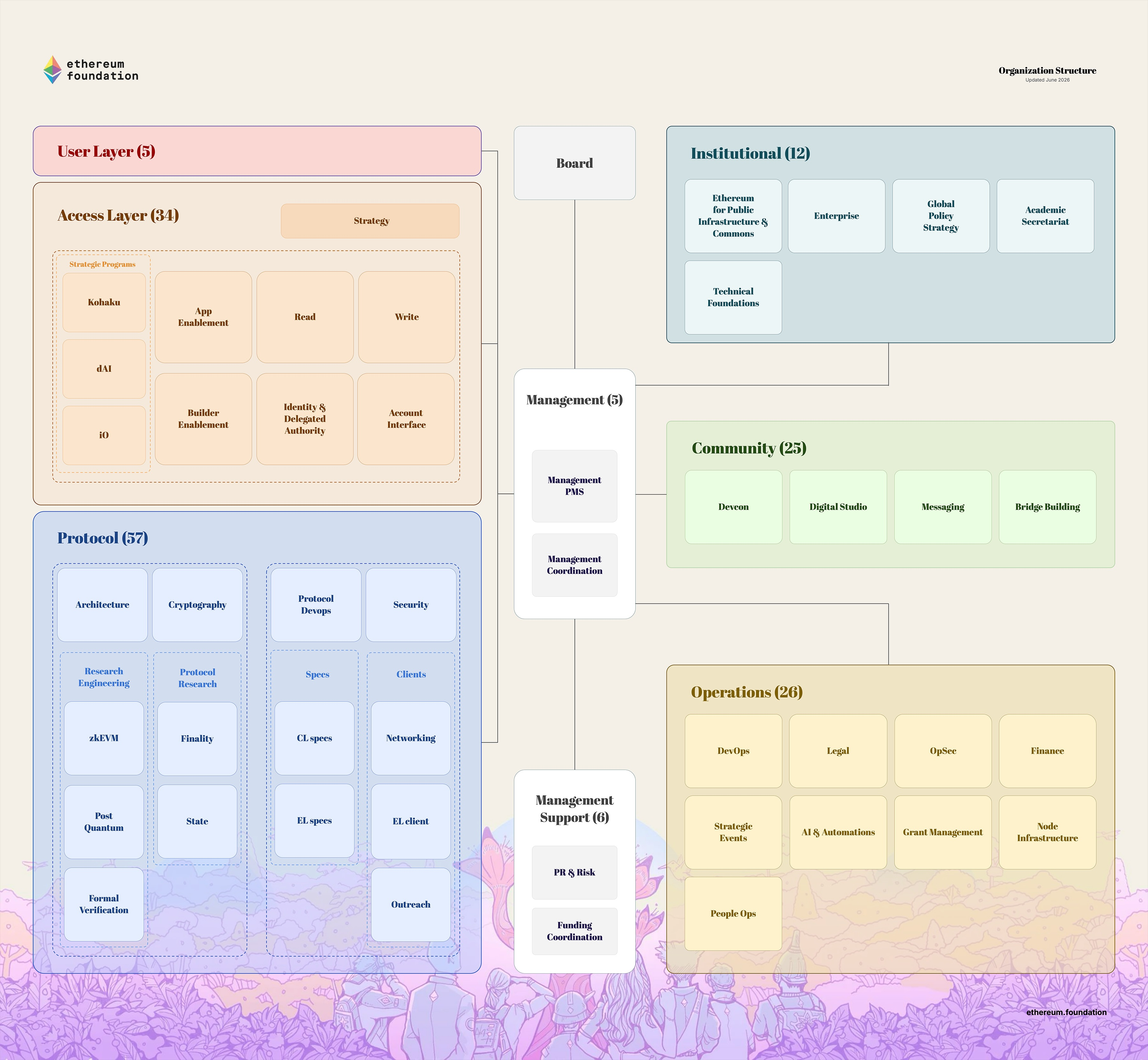


This ranking itself is telling: after the EF's contraction, resources have not been evenly diluted but are instead being concentrated towards the Protocol and Access layers once more. In other words, the Foundation is focusing more energy back on the most foundational and hardest-to-outsource parts of Ethereum: protocol evolution, security, privacy, clients, specifications, and the entry points through which users and institutions actually interact with the chain.


First, let's look at the Protocol layer. The official definition is to continue maintaining Ethereum's most defensible attributes: censorship resistance, capture resistance, open-source nature, privacy, and security. The EF blog states it bluntly: the protocol team's work is not to make Ethereum easier to market, nor to transform it into a financially controlled rail by intermediaries, but to ensure it remains dependable when counterparties fail, platforms censor, governments overreach, or intermediaries extract rent.


In the detailed breakdown chart of the Protocol layer provided by EF researcher Justin Drake, what stands out most is not each individual name, but several technical lines that have been explicitly elevated in priority.


Most prominent is the Architecture Group: led by Justin Drake, with Vitalik Buterin also listed. Justin Drake has frequently pushed discussions on strawmap, post-quantum security, zkEVM, issuance policy, etc., over the past year, while Vitalik represents one of the highest weights in Ethereum's long-term roadmap. Their simultaneous presence in the Architecture Group indicates that the EF is not simply compressing teams, but is reassigning higher priority to the long-term evolution of the protocol.


Several more specific long-term technical topics are also individually highlighted: Thomas Coratger is responsible for post-quantum security (a team newly established in January 2026), Ignacio Hagopian for zkEVM, and Alex Hicks for formal verification. These names may not all be publicly active, but the directions they represent are critical: post-quantum security relates to whether Ethereum can complete its cryptographic migration ahead of schedule, zkEVM relates to the long-term form of the execution layer and proof systems, and formal verification is a new tool the EF hopes to use to reduce protocol complexity and client maintenance costs.
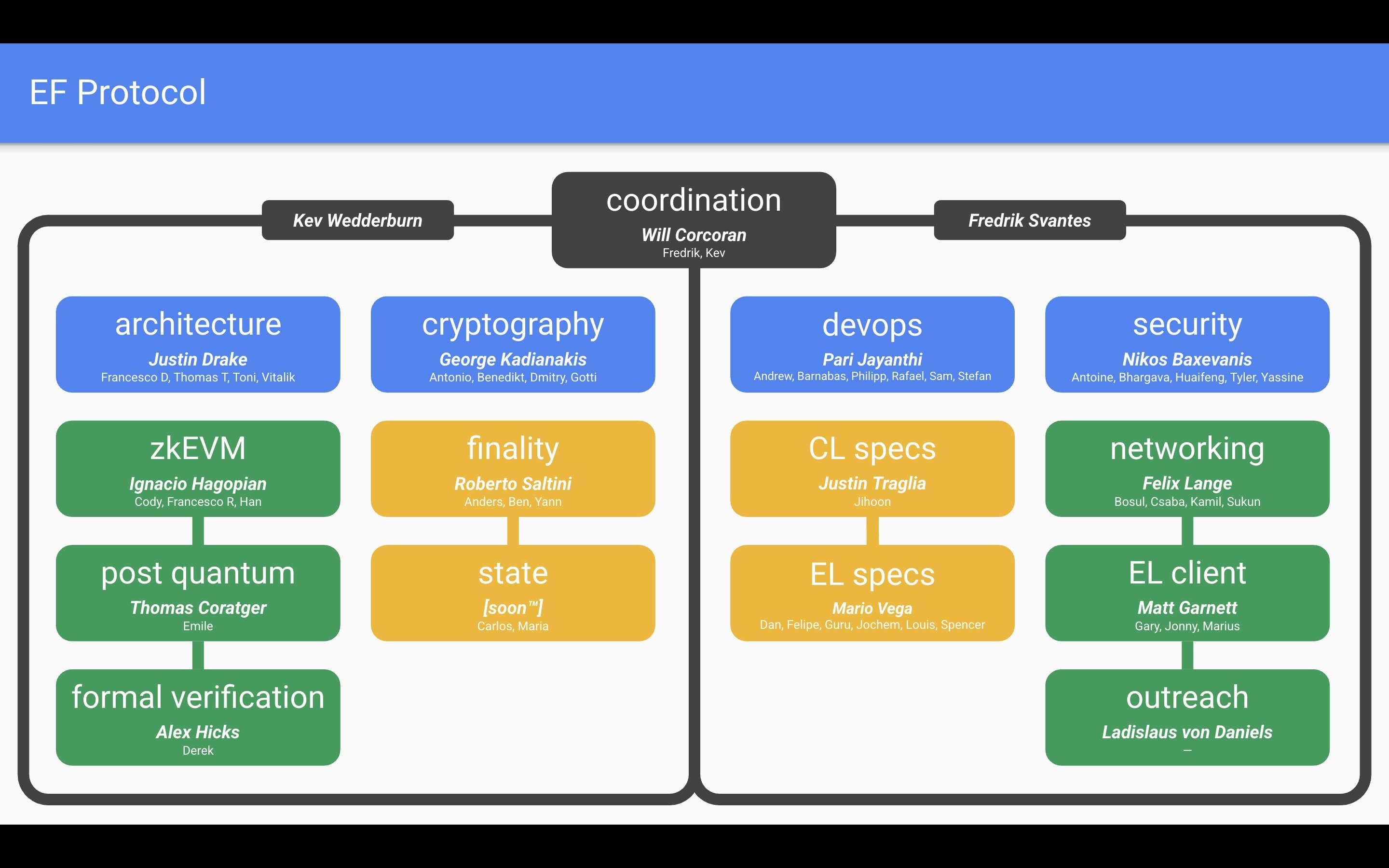


Additionally, cryptography is overseen by George Kadianakis. He has long been involved in research related to privacy networks and anonymous communication, including security research for the Tor anonymous communication network; the Security direction is led by Nikos Baxevanis; and Protocol DevOps is led by Pari Jayanthi.


The signal from these two charts is strong: The EF is not turning the Protocol layer into a generic "Research Department"; instead, it's breaking down post-quantum security, zkEVM, formal verification, finality, clients, specifications, and security engineering into accountable sub-units. Ethereum's next challenge is not a single scalability problem, but a set of interconnected hard problems: a faster L1, stronger privacy, lower complexity, fewer trusted dependencies, and a cryptographic migration before quantum computing risks materialize.


Justin Drake's update made the Protocol layer's direction even more specific. He stated the EF Protocol cluster shrank from about 100 to about 60 people, that EF subsidies for consensus and execution layer clients will end in 2027, and that annual expenditure, including grants, is dropping to around $30 million. He also mentioned that timelines for strategic upgrades like post-quantum security and zkEVM are shortening, and that AI-assisted formal verification and automated research are changing protocol R&D methods.


Vitalik also noted that Ethereum's ongoing Strawmap is a "Phase 3"-style overhaul involving consensus, proofs, privacy, account models, state, and more. He further judged that the multi-client model might shift from a past emphasis on "redundant security" towards more "specialization," with some security responsibilities shouldered by AI-assisted formal verification.


This touches a sensitive point in Ethereum's culture. In the past, multiple clients were seen as a hallmark of Ethereum's security philosophy: as long as no single client exceeds a critical threshold, the chain won't halt due to one bug. But if protocol complexity continues to rise, the cost of all clients fully replicating the same capabilities will become increasingly high. The EF's new direction seems to be betting on another security philosophy: reduce unnecessary complexity, and combine provable correctness, formal verification, AI-assisted research, and specialized clients.


This path carries risks. Formal verification is not magic, and AI cannot replace engineering responsibility. Yet it points to the deep waters of Ethereum's next round of competition: future chains won't just compete on TPS, but also on who can establish new safe production methods before complexity spirals out of control. If Ethereum wants privacy, scaling, MEV resistance, post-quantum security, and better user access simultaneously, the bottleneck is no longer just human scale, but R&D methodology, engineering coordination, and roadmap trade-offs.


20% Layoff, ~40% Budget Cut: The EF is Learning to Live Long-term


Vitalik's explanation of this reorganization gets closer to the financial and strategic underpinnings. He stated that the EF's budget this year is decreasing by approximately 40%, with the goal of shifting from consuming an average of about 15% of remaining funds annually pre-2026, to becoming a long-term endowment-style organization with a roughly 5% annual spend rate post-2030.


This passage is important because it explains the EF's real dilemma: a foundation operating on an ETH treasury cannot spend forever as if in a bull market. The more Ethereum aspires to be "world-class infrastructure," the less the EF can operate like a perpetually expanding tech company. Tech companies justify expenses with growth; foundations constrain expenses with mission. When these two logics are mixed, you get the state repeatedly criticized by outsiders in recent years: the Foundation is expected to fund public goods, support applications, branding, conferences, institutional adoption, ecosystem relations—everything finds a justification, and everything can dilute the main line.


Comments from Tomasz K. Stańczak, former co-Executive Director of the Ethereum Foundation, provide another perspective. He acknowledged the direction of cutting large events, client funding, institutional teams, and non-core large projects, but also expressed concern that the new organizational chart still appears complex.


He also mentioned that the EF needs more professional, transparent treasury management, and should not miss significant ETH opportunities in staking and capital allocation due to insufficient financial capabilities.


The Ethereum Ecosystem Needs to Grow More Nodes


Another subtle change during the reorganization is the EF pushing some work outside to the broader ecosystem.


The emergence of EthLabs fits perfectly within this context. The organization describes itself as a non-profit R&D lab for Ethereum and ETH, aiming to make Ethereum the settlement layer for the global economy, and emphasizes its role in translating real needs between users, applications, wallets, L2s, infrastructure, institutions, ETH holders, core developers, and researchers into protocol work, standards, infrastructure, and products.


EthLabs resembles a prototype for the EF's "multi-node future." It takes on some work that the EF is no longer suited to handle directly but remains crucial for Ethereum: closer to adoption, more ETH-focused, and closer to product and market feedback. If the EF is the constitutional layer, organizations like EthLabs are more like policy labs and engineering translators. Their value lies not in speaking for the EF, but in ensuring Ethereum doesn't have to place all public goods, research, adoption, and narrative on the same foundation.


Recommended reading: "Ethlabs Established, Treasury Companies Pay for Ethereum After EF"


In a thread on June 22nd, the EF mentioned that realizing Ethereum's potential requires a set of organizations collaborating around a shared vision, and that over the past year, multiple organizations have emerged, enhancing the ecosystem's resilience and capacity. It named EthLabs, Ethereum Apps Guild (EAG, promoting adoption of native Ethereum apps), Ethereum Economic Zone (EEZ, a framework for synchronizing composable Rollups), and Argot (maintaining Solidity and open-source compiler tools relied upon by the Ethereum ecosystem), and concluded by emphasizing: "The privilege of stewarding Ethereum should not be hoarded, but shared thoughtfully with others committed to building self-sovereign infrastructure."


Viewed against the backdrop of the EF's reorganization, these organizations collectively illustrate one thing: Ethereum is no longer suited to place all public goods, adoption, research, standards, and narrative on a single central foundation. The EF needs to concentrate resources on the hardest-to-replace work: protocol, security, privacy, and access layers; while application adoption, developer tools, ecosystem coordination, institutional communication, ETH narrative, and productization advancement need more external nodes to fill the gaps.


The real test lies here. A multi-node structure can increase resilience, but may also create new coordination costs. Whether third-party organizations can form complementary roles rather than pushing their own separate agendas; whether they can reduce the ecosystem's dependency on the EF rather than creating new centers of discourse; and whether they can transform funding, talent, and research outcomes into actual products and protocol progress—these factors will determine if the EF's step back is a healthy devolution of power or a more complex coordination experiment.


The EF's New Role: Contracting Boundaries, Betting on Hard Problems


The true signal released by this reorganization runs deeper: the Ethereum Foundation is abandoning the safety of being "big and complete," turning towards a narrower, harder, more long-term role.


The EF's reorganization points not to contraction itself, but to redefining the boundaries of the Foundation's responsibilities. Doing less doesn't mean ambition has shrunk; it's more like a discipline: concentrating limited funds and talent on the hardest-to-replace areas. Making things harder also doesn't equate to technical romanticism; it requires the EF to deliver executable roadmaps for post-quantum security, formal verification, zkEVM, privacy, and access layers, while simultaneously enabling new nodes outside the Foundation to genuinely grow.


Vitalik mentioned that Ethereum must be worthy of occupying a place in the era of quantum computing, Mars rockets, powerful biotechnology, and artificial intelligence, and be capable of confronting the challenges brought by this era.


This path won't please everyone. Developers will worry about reduced funding, institutions about narrower interfaces, the market will think it doesn't tell a good enough story, and the community will continue questioning the EF's transparency. As Tomasz expressed concern: if the org chart gets smaller but decisions remain opaque, the reorganization is just a more expensive typesetting exercise.

Criptos en tendencia

Preguntas relacionadas

QAccording to the article, what are the primary areas of focus for the Ethereum Foundation (EF) following its restructuring?

AFollowing its restructuring, the Ethereum Foundation is primarily focusing its resources and efforts on the protocol layer and the access layer. These include core areas like protocol evolution, security, privacy, client development, specifications, and the entry points where users and institutions interact with the chain.

QWhat are some of the key long-term technical initiatives highlighted within the EF's protocol layer after the reorganization?

AKey long-term technical initiatives within the reorganized EF protocol layer include post-quantum security (led by Thomas Coratger), zkEVM development (led by Ignacio Hagopian), and formal verification (led by Alex Hicks). An architecture group led by Justin Drake and including Vitalik Buterin is also established to oversee long-term protocol evolution.

QWhat financial and operational goals did Vitalik Buterin outline for the Ethereum Foundation in the context of this restructuring?

AVitalik Buterin stated that the EF's budget for the year has been reduced by approximately 40%. The goal is to transition from an average annual spending rate of about 15% of its remaining funds pre-2026 to a long-term endowment-like model of about 5% annual spending after 2030.

QHow is the role of external organizations like EthLabs described in relation to the EF's new structure?

AExternal organizations like EthLabs are described as complementary nodes that will take on work the EF is stepping back from, such as driving adoption, product development, and market-facing initiatives. They act as policy labs and engineering translators, helping to distribute the responsibility for Ethereum's public goods beyond a single central foundation.

QWhat potential shift in Ethereum's security philosophy is suggested by the article's discussion on client models and new tools?

AThe article suggests a potential shift from a security philosophy heavily reliant on the 'redundant security' of multiple full clients, towards a model that combines specialization among clients with new tools like formal verification and AI-assisted research. This aims to manage rising protocol complexity while maintaining security.

Lecturas Relacionadas

SemiAnalysis Deep Dive into CXMT: $50 Billion Revenue, An IPO Amidst a Supercycle

SemiAnalysis' in-depth report on ChangXin Memory Technologies (CXMT) details its rapid rise as China's largest upcoming semiconductor IPO. Founded in 2016 by Zhu Yiming, CXMT built its DRAM foundation on acquired patents and talent from the bankrupt German firm Qimonda. It achieved its first annual profit in 2025 after nearly a decade of significant capital support, primarily from patient Hefei municipal investors who fostered a local supply chain. The company is now capitalizing on a strong DRAM supercycle. Its revenue soared from ~$3.3B in 2024 to ~$8.6B in 2025, with Q1 2026 alone reaching ~$7.3B. SemiAnalysis projects full-year 2026 revenue could exceed $50B, driven by soaring ASPs rather than massive market share gains. While CXMT is closing the capacity gap with Micron, its product mix remains heavily focused on commodity DDR/LPDDR, which currently offers higher margins than its nascent HBM business. CXMT faces significant challenges in HBM, struggling with yield and stability for HBM3 8-Hi stacks while lagging behind the big three (Samsung, SK Hynix, Micron) in advanced nodes. However, strategic national priorities for AI self-sufficiency may push it to accelerate HBM capacity. Its complex IPO structure reveals heavy state-backed ownership and voting control over its fabs, with Alibaba appearing as both a key cloud customer and a minority shareholder. The IPO aims to raise ~$4.1B, primarily to strengthen its core DRAM manufacturing base.

marsbitHace 9 min(s)

SemiAnalysis Deep Dive into CXMT: $50 Billion Revenue, An IPO Amidst a Supercycle

marsbitHace 9 min(s)

From Corning to Ciena: The 10x Opportunity in the AI Optical Communication Chain

The transition from copper to optical communication in AI data centers is creating significant investment opportunities beyond just chipmakers. The entire photonics supply chain, from glass and fiber to connectors and test equipment, is critical. Corning, a key fiber supplier, has locked in multi-billion dollar, multi-year contracts with major cloud providers (Meta, Amazon, Google, Microsoft, OpenAI, NVIDIA), demonstrating pricing power and scale. Its profit growth is outpacing revenue growth. In the interconnect layer, Amphenol benefits from high growth in AI data centers, driven by strategic acquisitions and operational efficiency, while Credo Technology acts as a bridge between copper and optical solutions, though with high customer concentration risk. At the systems level, Ciena enables higher data capacity on existing fiber lines, with a strong backlog and cloud customer adoption. Further upstream, AXT is a bottleneck supplier of key indium phosphide wafers for lasers but faces geopolitical supply chain risks. VEO Solutions provides essential testing equipment for the entire photonics industry. A new pure-play photonics ETF (FOTO) offers a consolidated investment approach. The core thesis is that the physical limits of copper are driving an inevitable shift to optical technologies, with wealth flowing to essential, often overlooked, suppliers across the photonics value chain.

marsbitHace 21 min(s)

From Corning to Ciena: The 10x Opportunity in the AI Optical Communication Chain

marsbitHace 21 min(s)

Collector Crypt's DAU Is Only 800, Yet It's Already One of Crypto's Most Profitable Projects?

"Collector Crypt: A Highly Profitable Crypto Project with Only 800 Daily Active Users?" Collector Crypt (CARDS) is a crypto project tokenizing physical graded trading cards (primarily Pokémon) on Solana, achieving significant real-world profitability and growth. According to a Maelstrom Fund analysis, it generated approximately $53M in annualized profit in May, with a June run-rate nearing $109M, against a $550M FDV. Its core revenue driver is a digital pack-opening 'Gacha' system. The platform bulk-buys cards at a 5-15% discount. Users can open digital packs and choose to keep cards or sell them back to the platform at a 7-15% discount to market price. Most users sell back common cards, creating an efficient model: users get packs with a ~2% positive expected value, while Collector Crypt captures ~4.5% profit. The project aims to disrupt the inefficient $22.2B GMV (Q1 2026) eBay trading card market, which charges sellers 16-20% in total fees. Collector Crypt offers 2% fees, instant settlement, insured custody, and one-click trading. Beyond Gacha, future revenue streams include secondary market trading fees, infrastructure partnerships, and an eBay "snipe" tool. It holds ~$23M in card inventory and ~$10M in cash, and has already begun token buybacks. With a total supply of 2B tokens, effective circulation post-2027 unlocks is estimated at ~1.3B. Trading primarily on DEXs has so far limited large institutional entry. The project is expanding into sports cards and attracting Web2 users. Maelstrom Fund's price target is $4 by summer's end, positioning Collector Crypt at the forefront of migrating collectibles on-chain.

Foresight NewsHace 33 min(s)

Collector Crypt's DAU Is Only 800, Yet It's Already One of Crypto's Most Profitable Projects?

Foresight NewsHace 33 min(s)

Trading

Spot
Futuros

Artículos destacados

Qué es ETH 2.0

ETH 2.0: Una Nueva Era para Ethereum Introducción ETH 2.0, conocido ampliamente como Ethereum 2.0, marca una actualización monumental para la blockchain de Ethereum. Esta transición no es solo una mejora superficial; busca mejorar fundamentalmente la escalabilidad, seguridad y sostenibilidad de la red. Con un cambio del mecanismo de consenso intensivo en energía Prueba de Trabajo (PoW) a una Prueba de Participación (PoS) más eficiente, ETH 2.0 promete un enfoque transformador para el ecosistema blockchain. ¿Qué es ETH 2.0? ETH 2.0 es un conjunto de actualizaciones interconectadas y distintivas centradas en optimizar las capacidades y el rendimiento de Ethereum. La reestructuración está diseñada para abordar desafíos críticos que el mecanismo actual de Ethereum ha enfrentado, particularmente en lo que respecta a la velocidad de transacción y la congestión de la red. Objetivos de ETH 2.0 Los objetivos principales de ETH 2.0 giran en torno a mejorar tres aspectos clave: Escalabilidad: Con el objetivo de aumentar significativamente el número de transacciones que la red puede manejar por segundo, ETH 2.0 busca superar la limitación actual de aproximadamente 15 transacciones por segundo, potencialmente alcanzando miles. Seguridad: Las medidas de seguridad mejoradas son fundamentales para ETH 2.0, particularmente a través de una mejor resistencia contra ciberataques y la preservación del ethos descentralizado de Ethereum. Sostenibilidad: El nuevo mecanismo PoS está diseñado no solo para mejorar la eficiencia, sino también para reducir drásticamente el consumo de energía, alineando el marco operativo de Ethereum con consideraciones ambientales. ¿Quién es el Creador de ETH 2.0? La creación de ETH 2.0 se puede atribuir a la Fundación Ethereum. Esta organización sin fines de lucro, que desempeña un papel crucial en el apoyo al desarrollo de Ethereum, es liderada por el notable cofundador Vitalik Buterin. Su visión de un Ethereum más escalable y sostenible ha sido la fuerza motriz detrás de esta actualización, involucrando contribuciones de una comunidad global de desarrolladores y entusiastas dedicados a mejorar el protocolo. ¿Quiénes son los Inversores de ETH 2.0? Si bien los detalles sobre los inversores de ETH 2.0 no se han hecho públicos, se sabe que la Fundación Ethereum recibe apoyo de varias organizaciones e individuos en el ámbito de blockchain y tecnología. Estos socios incluyen firmas de capital de riesgo, compañías tecnológicas y organizaciones filantrópicas que comparten un interés mutuo en apoyar el desarrollo de tecnologías descentralizadas e infraestructura blockchain. ¿Cómo Funciona ETH 2.0? ETH 2.0 se distingue por introducir una serie de características clave que lo diferencian de su predecesor. Prueba de Participación (PoS) La transición a un mecanismo de consenso PoS es uno de los cambios más destacados de ETH 2.0. A diferencia de PoW, que se basa en la minería intensiva en energía para la verificación de transacciones, PoS permite a los usuarios validar transacciones y crear nuevos bloques de acuerdo con la cantidad de ETH que apuestan en la red. Esto conduce a una mayor eficiencia energética, reduciendo el consumo en aproximadamente un 99.95%, convirtiendo a Ethereum 2.0 en una alternativa considerablemente más verde. Cadenas Shard Las cadenas shard son otra innovación crítica de ETH 2.0. Estas cadenas más pequeñas operan en paralelo con la cadena principal de Ethereum, lo que permite que múltiples transacciones sean procesadas simultáneamente. Este enfoque mejora la capacidad general de la red, abordando las preocupaciones de escalabilidad que han afectado a Ethereum. Cadena Beacon En el núcleo de ETH 2.0 se encuentra la Cadena Beacon, que coordina la red y gestiona el protocolo PoS. Funciona como un organizador de cierta manera: supervisa a los validadores, asegura que los shards permanezcan conectados a la red y monitorea la salud general del ecosistema blockchain. Cronología de ETH 2.0 El viaje de ETH 2.0 ha estado marcado por varios hitos clave que trazan la evolución de esta importante actualización: Diciembre 2020: El lanzamiento de la Cadena Beacon marcó la introducción de PoS, preparándose para la migración hacia ETH 2.0. Septiembre 2022: La finalización de “La Fusión” representa un momento crucial en el que la red Ethereum se trasladó exitosamente de un marco PoW a uno PoS, anunciando una nueva era para Ethereum. 2023: El lanzamiento esperado de cadenas shard tiene como objetivo mejorar aún más la escalabilidad de la red Ethereum, consolidando a ETH 2.0 como una plataforma robusta para aplicaciones y servicios descentralizados. Características Clave y Beneficios Escalabilidad Mejorada Una de las ventajas más significativas de ETH 2.0 es su escalabilidad mejorada. La combinación de PoS y cadenas shard permite que la red expanda su capacidad, permitiendo acomodar un volumen mucho mayor de transacciones en comparación con el sistema heredado. Eficiencia Energética La implementación de PoS representa un gran paso hacia la eficiencia energética en la tecnología blockchain. Al reducir drásticamente el consumo de energía, ETH 2.0 no solo disminuye los costos operativos, sino que también se alinea más estrechamente con los objetivos de sostenibilidad global. Seguridad Mejorada Los mecanismos actualizados de ETH 2.0 contribuyen a mejorar la seguridad en toda la red. El despliegue de PoS, junto con las medidas de control innovadoras establecidas a través de cadenas shard y la Cadena Beacon, asegura un mayor grado de protección contra posibles amenazas. Costos Más Bajos para los Usuarios A medida que la escalabilidad mejora, los efectos sobre los costos de transacción también serán evidentes. Se espera que una mayor capacidad y una menor congestión se traduzcan en tarifas más bajas para los usuarios, haciendo que Ethereum sea más accesible para transacciones cotidianas. Conclusión ETH 2.0 marca una evolución significativa en el ecosistema blockchain de Ethereum. A medida que aborda problemas fundamentales como la escalabilidad, el consumo de energía, la eficiencia en las transacciones y la seguridad general, la importancia de esta actualización no puede ser subestimada. La transición a la Prueba de Participación, la introducción de cadenas shard y el trabajo fundamental de la Cadena Beacon son indicativos de un futuro donde Ethereum puede satisfacer las crecientes demandas del mercado descentralizado. En una industria impulsada por la innovación y el progreso, ETH 2.0 se erige como un testimonio de las capacidades de la tecnología blockchain para allanar el camino hacia una economía digital más sostenible y eficiente.

173 Vistas totalesPublicado en 2024.04.04Actualizado en 2024.12.03

Qué es ETH 2.0

Qué es ETH 3.0

ETH3.0 y $eth 3.0: Un Examen Profundo del Futuro de Ethereum Introducción En el paisaje en rápida evolución de las criptomonedas y la tecnología blockchain, ETH3.0, a menudo denotado como $eth 3.0, ha surgido como un tema de considerable interés y especulación. El término abarca dos conceptos principales que merecen aclaración: Ethereum 3.0: Esto representa una posible actualización futura destinada a aumentar las capacidades de la blockchain existente de Ethereum, enfocándose particularmente en mejorar la escalabilidad y el rendimiento. ETH3.0 Meme Token: Este proyecto de criptomoneda distinto busca aprovechar la blockchain de Ethereum para crear un ecosistema centrado en memes, promoviendo la participación dentro de la comunidad de criptomonedas. Comprender estos aspectos de ETH3.0 es esencial no solo para los entusiastas de las criptomonedas, sino también para aquellos que observan tendencias tecnológicas más amplias en el espacio digital. ¿Qué es ETH3.0? Ethereum 3.0 Ethereum 3.0 se presenta como una actualización propuesta para la red de Ethereum ya establecida, que ha sido la columna vertebral de muchas aplicaciones descentralizadas (dApps) y contratos inteligentes desde su inicio. Las mejoras previstas se concentran principalmente en la escalabilidad, integrando tecnologías avanzadas como sharding y pruebas de conocimiento cero (zk-proofs). Estas innovaciones tecnológicas tienen como objetivo facilitar un número sin precedentes de transacciones por segundo (TPS), potencialmente alcanzando millones, abordando así una de las limitaciones más significativas que enfrenta la tecnología blockchain actual. La mejora no es meramente técnica, sino también estratégica; está destinada a preparar la red de Ethereum para su adopción generalizada y utilidad en un futuro marcado por una mayor demanda de soluciones descentralizadas. ETH3.0 Meme Token En contraste con Ethereum 3.0, el ETH3.0 Meme Token se aventura en un ámbito más ligero y juguetón al combinar la cultura de memes de internet con la dinámica de las criptomonedas. Este proyecto permite a los usuarios comprar, vender e intercambiar memes en la blockchain de Ethereum, proporcionando una plataforma que fomenta la participación comunitaria a través de la creatividad y los intereses compartidos. El ETH3.0 Meme Token tiene como objetivo demostrar cómo la tecnología blockchain puede intersectarse con la cultura digital, creando casos de uso que son tanto entretenidos como financieramente viables. ¿Quién es el Creador de ETH3.0? Ethereum 3.0 La iniciativa hacia Ethereum 3.0 es impulsada principalmente por un consorcio de desarrolladores e investigadores dentro de la comunidad de Ethereum, incluyendo notablemente a Justin Drake. Conocido por sus ideas y contribuciones a la evolución de Ethereum, Drake ha sido una figura prominente en las discusiones sobre la transición de Ethereum a una nueva capa de consenso, denominada “Beam Chain.” Este enfoque colaborativo para el desarrollo significa que Ethereum 3.0 no es el producto de un creador singular, sino más bien una manifestación de ingenio colectivo centrado en avanzar la tecnología blockchain. ETH3.0 Meme Token Los detalles sobre el creador del ETH3.0 Meme Token son actualmente inidentificables. La naturaleza de los tokens de memes a menudo conduce a una estructura más descentralizada y dirigida por la comunidad, lo que podría explicar la falta de atribución específica. Esto se alinea con la ética de la comunidad cripto más amplia, donde la innovación a menudo surge de esfuerzos colaborativos en lugar de individuales. ¿Quiénes son los Inversores de ETH3.0? Ethereum 3.0 El apoyo a Ethereum 3.0 proviene principalmente de la Fundación Ethereum junto con una entusiasta comunidad de desarrolladores e inversores. Esta asociación fundamental proporciona un grado significativo de legitimidad y mejora la perspectiva de una implementación exitosa, ya que aprovecha la confianza y credibilidad construidas a lo largo de años de operaciones en la red. En el clima cambiando rápidamente de las criptomonedas, el apoyo de la comunidad juega un papel crucial en impulsar el desarrollo y la adopción, posicionando a Ethereum 3.0 como un contendiente serio para futuros avances en blockchain. ETH3.0 Meme Token Si bien las fuentes actualmente disponibles no proporcionan información explícita sobre las fundaciones o organizaciones de inversión que respaldan el ETH3.0 Meme Token, es indicativo del modelo de financiamiento típico para tokens de memes, que a menudo depende del apoyo de base y la participación comunitaria. Los inversores en tales proyectos suelen consistir en individuos motivados por el potencial de innovación impulsada por la comunidad y el espíritu de cooperación que se encuentra dentro de la comunidad cripto. ¿Cómo Funciona ETH3.0? Ethereum 3.0 Las características distintivas de Ethereum 3.0 radican en su implementación propuesta de sharding y tecnología zk-proof. Sharding es un método de particionamiento de la blockchain en piezas más pequeñas y manejables o “shards,” que pueden procesar transacciones de manera concurrente en lugar de secuencial. Esta descentralización del procesamiento ayuda a prevenir la congestión y asegura que la red permanezca receptiva incluso bajo una carga pesada. La tecnología de prueba de conocimiento cero (zk-proof) contribuye con otra capa de sofisticación al permitir la validación de transacciones sin revelar los datos subyacentes involucrados. Este aspecto no solo mejora la privacidad, sino que también aumenta la eficiencia general de la red. También se habla de incorporar una Máquina Virtual de Ethereum de conocimiento cero (zkEVM) en esta actualización, amplificando aún más las capacidades y utilidad de la red. ETH3.0 Meme Token El ETH3.0 Meme Token se distingue al capitalizar la popularidad de la cultura de memes. Establece un mercado para que los usuarios participen en el comercio de memes, no solo por entretenimiento sino también por el posible beneficio económico. Al integrar características como staking, provisión de liquidez y mecanismos de gobernanza, el proyecto fomenta un entorno que incentiva la interacción y participación de la comunidad. Al ofrecer una mezcla única de entretenimiento y oportunidad económica, el ETH3.0 Meme Token tiene como objetivo atraer a una audiencia diversa, que abarca desde entusiastas de las criptomonedas hasta conocedores casuales de memes. Línea de Tiempo de ETH3.0 Ethereum 3.0 11 de noviembre de 2024: Justin Drake insinúa la próxima actualización de ETH 3.0, centrada en mejoras de escalabilidad. Este anuncio significa el comienzo de las discusiones formales sobre la futura arquitectura de Ethereum. 12 de noviembre de 2024: Se espera que la propuesta anticipada para Ethereum 3.0 se desvele en Devcon en Bangkok, preparando el escenario para una mayor retroalimentación de la comunidad y posibles próximos pasos en el desarrollo. ETH3.0 Meme Token 21 de marzo de 2024: El ETH3.0 Meme Token se lista oficialmente en CoinMarketCap, marcando su incursión en el dominio público de las criptomonedas y mejorando la visibilidad de su ecosistema basado en memes. Puntos Clave En conclusión, Ethereum 3.0 representa una evolución significativa dentro de la red de Ethereum, enfocándose en superar las limitaciones en términos de escalabilidad y rendimiento a través de tecnologías avanzadas. Sus actualizaciones propuestas reflejan un enfoque proactivo hacia las demandas y la usabilidad futura. Por otro lado, el ETH3.0 Meme Token encapsula la esencia de la cultura impulsada por la comunidad en el espacio de las criptomonedas, aprovechando la cultura de memes para crear plataformas atractivas que fomentan la creatividad y participación del usuario. Comprender los distintos propósitos y funcionalidades de ETH3.0 y $eth 3.0 es fundamental para cualquiera interesado en los desarrollos en curso dentro del espacio cripto. Con ambas iniciativas abriendo caminos únicos, subrayan colectivamente la naturaleza dinámica y multifacética de la innovación en blockchain.

193 Vistas totalesPublicado en 2024.04.04Actualizado en 2024.12.03

Qué es ETH 3.0

Cómo comprar ETH

¡Bienvenido a HTX.com! Hemos hecho que comprar Ethereum (ETH) sea simple y conveniente. Sigue nuestra guía paso a paso para iniciar tu viaje de criptos.Paso 1: crea tu cuenta HTXUtiliza tu correo electrónico o número de teléfono para registrarte y obtener una cuenta gratuita en HTX. Experimenta un proceso de registro sin complicaciones y desbloquea todas las funciones.Obtener mi cuentaPaso 2: ve a Comprar cripto y elige tu método de pagoTarjeta de crédito/débito: usa tu Visa o Mastercard para comprar Ethereum (ETH) al instante.Saldo: utiliza fondos del saldo de tu cuenta HTX para tradear sin problemas.Terceros: hemos agregado métodos de pago populares como Google Pay y Apple Pay para mejorar la comodidad.P2P: tradear directamente con otros usuarios en HTX.Over-the-Counter (OTC): ofrecemos servicios personalizados y tipos de cambio competitivos para los traders.Paso 3: guarda tu Ethereum (ETH)Después de comprar tu Ethereum (ETH), guárdalo en tu cuenta HTX. Alternativamente, puedes enviarlo a otro lugar mediante transferencia blockchain o utilizarlo para tradear otras criptomonedas.Paso 4: tradear Ethereum (ETH)Tradear fácilmente con Ethereum (ETH) en HTX's mercado spot. Simplemente accede a tu cuenta, selecciona tu par de trading, ejecuta tus trades y monitorea en tiempo real. Ofrecemos una experiencia fácil de usar tanto para principiantes como para traders experimentados.

4.2k Vistas totalesPublicado en 2024.12.10Actualizado en 2026.06.02

Cómo comprar ETH

Discusiones

Bienvenido a la comunidad de HTX. Aquí puedes mantenerte informado sobre los últimos desarrollos de la plataforma y acceder a análisis profesionales del mercado. A continuación se presentan las opiniones de los usuarios sobre el precio de ETH (ETH).

活动图片