Xinjiang's Computing Power Resurges, Then Gets Cleared Out Within 48 Hours: What Exactly Happened to the Bitcoin Network This Time?

marsbitPublicado a 2025-12-16Actualizado a 2025-12-16

Resumen

On December 16, Bitcoin network hashrate dropped sharply within 48 hours, widely attributed to the concentrated shutdown and clearance of mining facilities in Xinjiang. Estimates suggest between 200,000 to 400,000 mining machines went offline, causing a hashrate decline of nearly 30%, from around 1200 EH/s to approximately 836 EH/s at its lowest. The resurgence of mining in Xinjiang was driven by three factors: surplus energy capacity and low electricity prices, underutilized data center infrastructure seeking revenue, and shorter ROI periods for miners amid rising Bitcoin prices. Despite China’s clear policy against cryptocurrency mining—classifying it as an obsolete industry—mining resurfaced periodically due to economic pressures and infrastructure availability. The recent crackdown was swift and severe, following a multi-department regulatory meeting emphasizing continued strict oversight of crypto-related activities, including anti-money laundering and cross-border capital risks. The concentrated nature of mining operations in specific regions meant that regulatory actions led to large-scale, simultaneous shutdowns. Short-term impacts include disrupted cash flows for miners and potential market volatility due to heightened policy sensitivity. In the medium term, the Bitcoin network will adjust mining difficulty, and hashrate is likely to migrate to other regions. The event underscores that mining in China remains a high-risk, grey-area activity driven by economic ince...

On December 16th, Beijing time, the Bitcoin network suddenly slammed on the brakes. The hashrate curve showed a significant drop within two days, and the mining community's explanation was highly consistent: concentrated shutdowns occurred at multiple mining farms in Xinjiang, with some equipment being confiscated or cleared out, leading to a sudden "chunk" of the total network hashrate being pulled away. The market's debate wasn't about whether the shutdowns happened, but about the actual scale—rumored figures ranged from over 200,000 to 400,000 units.
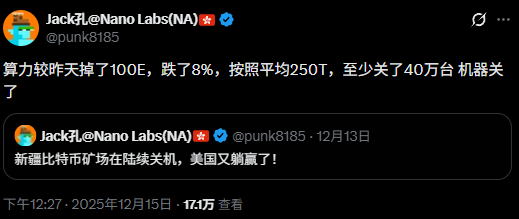
The most commonly cited estimate comes from an engineer's algorithm in the mining circle: roughly calculated based on contemporary mainstay machines at about 250 TH/s each, if 400,000 units were successively powered down, the corresponding hashrate gap would be enough to cause a drop on the order of hundreds of EH/s for the entire network. Some put the more aggressive hashrate point more bluntly: the total hashrate once dropped from nearly 1200 EH/s to around 836.75 EH/s, a decline of nearly 30%. Different platforms and different calibers don't completely agree on the "lowest point," but one fact is hard to ignore: this isn't the fluctuation of a few mining farms "turning off a few rows of cabinets," but a widespread concentrated shutdown.

What's truly worth追问 is the two halves of this story: Why did mining in Xinjiang resurge under the ban? And why did the clearance come so quickly and so fiercely?


Why Did Mining in Xinjiang Come Back?

The underlying driving force behind the "resurgence" of Xinjiang's computing power wasn't a sudden policy shift, but three real-world pressures being squeezed into the same outlet.

The first pressure comes from the energy structure. Xinjiang has large-scale power supply and industrial power distribution systems. During certain periods and in some regions, the marginal value of power consumption is not very high. For transmission channels, dispatch, and demand-side承接 capacity, this is a long-term tug-of-war: electricity can be generated, but it can't always be sold in an "ideal way." For asset owners, the most painful thing isn't low electricity prices, but electricity that can't be sold; for miners, this恰恰 constitutes an energy洼地—as long as they can get electricity, they can directly convert it into cash flow.

The second pressure comes from data center facilities and infrastructure. The rapid expansion of data centers across various regions in recent years has left a large amount of存量 capacity where "power is already connected, and facilities are already built." The AI narrative is hot, but AI isn't a case of having a data center就能赚钱: it requires compute cards, big clients, and long-term stable load. The reality is, some data centers haven't secured enough AI orders nor enough compute card resources; equipment sitting idle for a day means real losses from depreciation. Thus, some asset owners see "filling load" as a rigid demand—in the gray area, mining happens to be the easiest application to deploy for filling capacity: it doesn't挑剔 clients or business models, it runs as long as there's power, cooling, and an internet connection.

The third pressure comes from the temptation of ROI and the supply chain. When Bitcoin's price rises, the payback period for miners is significantly compressed; faced with the诱惑 of "breaking even in about six months," many people treat the risks in the gray area as a cost rather than a red line. More crucially, the miner supply chain hasn't disappeared: machines can be bought, transported, and installed, giving the gray area resurgence the physical conditions.

The result of these three pressures converging is a shadow resurgence: local assets (power + facilities) need cash flow, miners need low-cost electricity, the supply chain can deliver the equipment, so Xinjiang once again becomes a magnet for computing power. It's not a gathering place for miner sentiment, but a place where an energy洼地 and an infrastructure洼地 overlap.

This also explains a seemingly contradictory phenomenon: the ban never disappeared, but mining still periodically surfaces. It's not because the red line loosened, but because the constraints of real-world assets never stop: electricity, facilities, power distribution, depreciation, cash flow—all force participants to repeatedly test the boundaries.


Is Mining Illegal in China: An Eliminated Item Doesn't Equal a Criminal Crime, But the Red Line Persists

In China, the policy positioning of mining is not an encouraged industry, but an item that must be rectified and pushed for exit. The relevant authorities' rectification documents core requirements are to strictly prohibit new additions, properly handle existing stock, promote orderly exit, and explicitly list virtual currency mining as an eliminated industry, while also emphasizing precise identification through methods like abnormal electricity consumption monitoring and park inspections, and prohibiting mining under the name of data centers.

Looking at real-world governance methods, it's more like a combination of administrative and energy-side measures: differentiated electricity prices or punitive fees, cancellation of preferential policies, cessation of fiscal and financial support, restrictions on power connection and participation in the electricity market, etc. Therefore, the direct consequences for many mining farms when handled are often power cuts, clearance, back payment of electricity fees, and cancellation of policy benefits—this is not the same as legal operation, but it also doesn't equate to "mining itself必然触犯刑法" (necessarily violating criminal law).

What truly escalates the risk are usually actions附带 to mining: electricity theft, illegal power supply, fraudulently claiming subsidies, obtaining support funds under the guise of supercomputing centers or data centers, illegal fundraising, money laundering channels, etc. Once these issues are triggered, it quickly moves from industrial rectification into the realm of public security or criminal law.

At the same time, financial regulation has maintained a tougher stance on virtual currency-related businesses, continuously emphasizing the crackdown on illegal activities related to virtual currency and focusing on anti-money laundering and cross-border capital risks. Putting these two lines together, one can understand why such clearance actions happen repeatedly: mining has long been within the red line of rectification, and once the enforcement end tightens its口径, the power switch is faster than any announcement.


Why Did This Clearance Come So Fiercely

The speed and force of the clearance often depend on two things: whether the signals are unified, and whether the leverage points are clear.
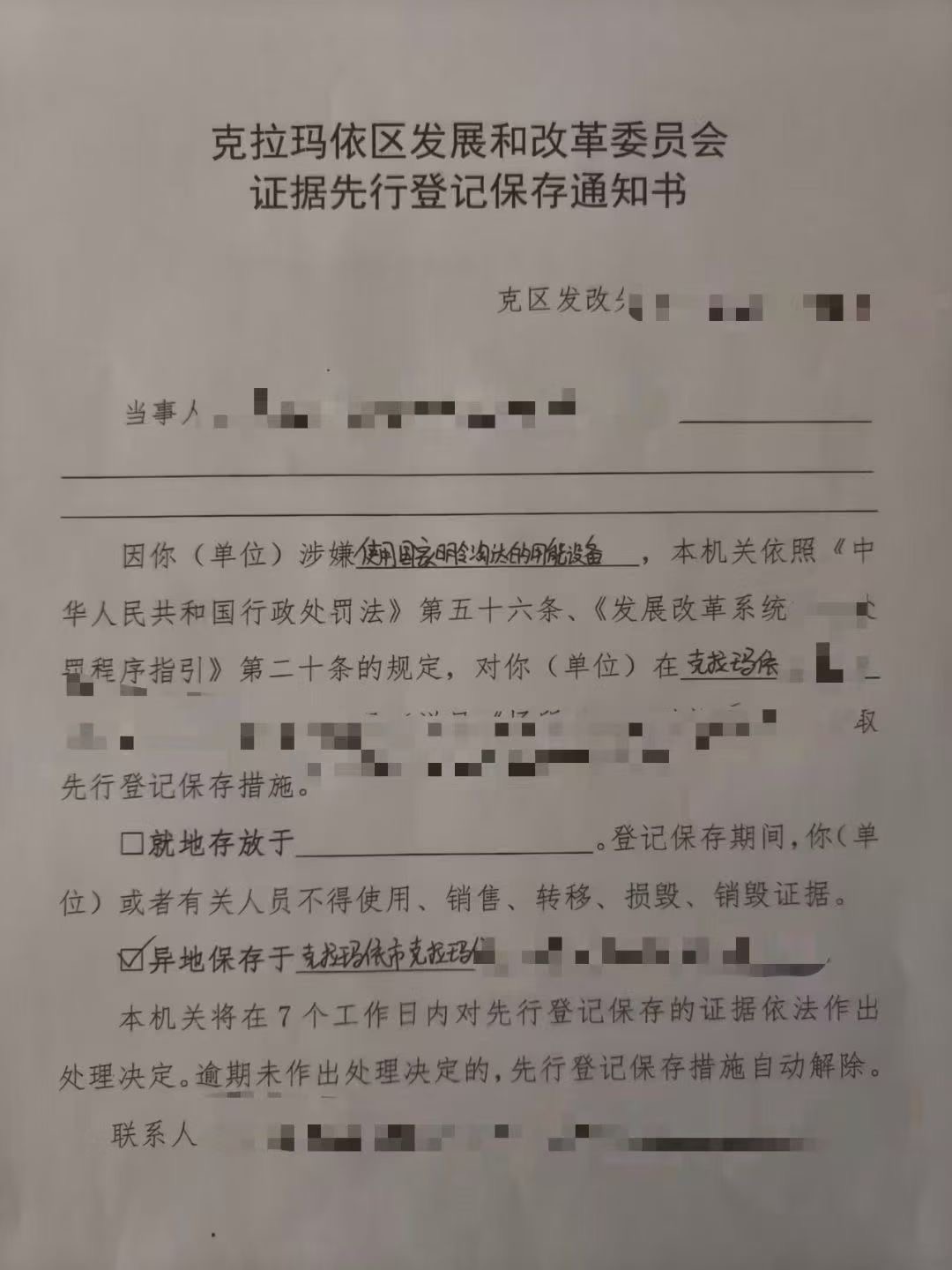
A coordination mechanism meeting led by the central bank with participation from multiple departments in late November was seen as an important node by the mining circle. It released not emotion, but a unification of enforcement port口径: continue to maintain high pressure on virtual currency-related activities, strengthen the narrative on anti-money laundering and cross-border capital risks, and bring issues like stablecoins into a more stringent regulatory view. For gray area industries, this meant "the scope of being watched expanded," and more importantly, local systems knew what to check next, how to check it, who would lead, and who would cooperate.

At the same time, mining in China has long been handled within an industrial policy framework, not just a financial regulatory framework. It is classified as an eliminated industry, with common governance methods including differentiated electricity prices, punitive fees, park inspections, abnormal electricity consumption monitoring, etc. A more realistic risk point is: simply running hashrate might be treated as an eliminated industry, but once it involves electricity theft, fraudulently claiming subsidies, or obtaining support funds under the name of other projects, the nature quickly turns from gray to accountable black.

Therefore, when systems like development and reform, energy, power, and parks start to联动, the clearance often presents a "sudden" feeling: it was running yesterday, but today there's a collective shutdown. To the outside world, this is news; to miners, it's the power switch, and the power switch never needs an advance announcement.


Why Did the Hashrate Drop So Dramatically: Concentrated Power Cuts Get "Amplified" on the Curve

The dramatic drop in hashrate isn't核心ly about "number jitter," but about "concentrated power cuts." After entering the ZH era, the total network hashrate fluctuates daily, but most fluctuations are like ocean waves: rising and falling, looking back it's just noise. This time was more like pulling out a beam—a阶梯式 (stepped) plunge occurring in a short time, combined with highly consistent on-the-ground information from the mining circle pointing to concentrated shutdowns in Xinjiang. This combination is what made the market treat it as a hard event, not normal jitter.
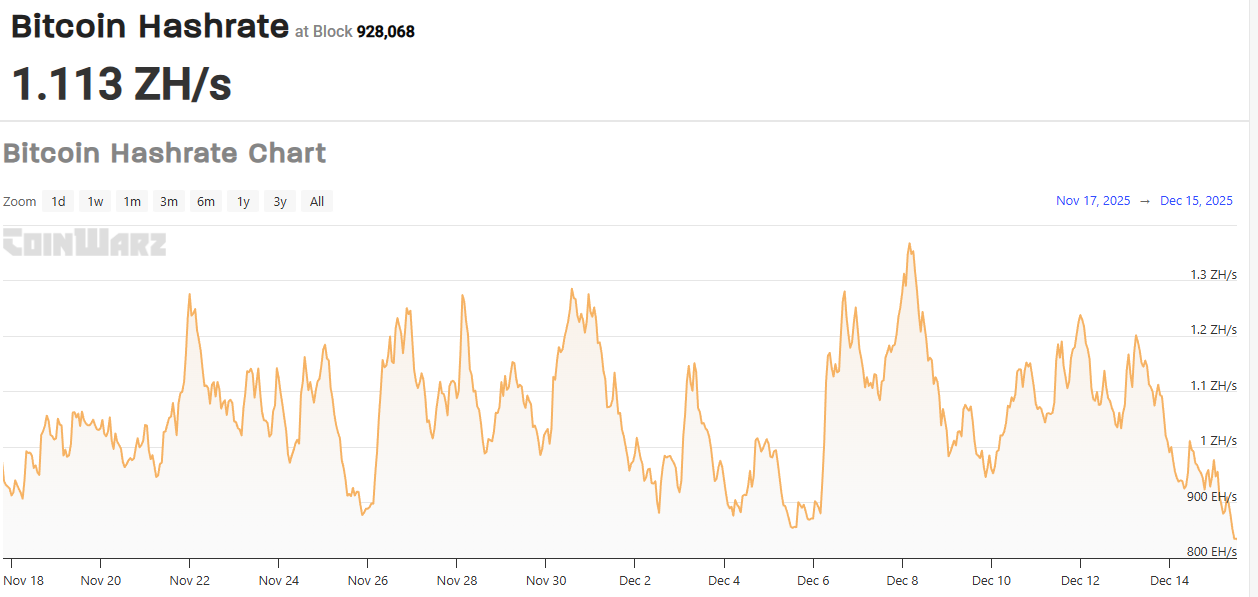
More crucial is the structure. When the resurgence happens in a concentrated form of "few regions + few parks + few data centers," its advantage is fast expansion, its disadvantage is fragility: once the switch is pulled, what drops isn't sporadic mining farms, but an entire chunk of hashrate coming loose together. In other words, the market isn't debating whether the hashrate is an estimate, but reading one thing: what was cut off this time was likely a highly concentrated hashrate pool.

There's another layer of perceptual amplification. Hashrate is estimated based on block production speed: when large-scale shutdowns happen in a short period, the block interval first becomes unstable, and short-term estimates are more prone to exaggerated spikes and deep pits; once the difficulty completes its self-healing in subsequent adjustment cycles, the curve will slowly smooth out. Therefore, this "seemingly scary" plunge is essentially the immediate projection of a regional concentrated shutdown on the network level—it's not a false alarm, but an amplification effect brought by concentration.


What Happens After the Clearance: Miners Hurt Most, Market Most Sensitive, Hashrate Will Continue Migrating

The short-term impact will first land on miner cash flow. Machines being confiscated or shut down means the payback period is instantly interrupted; hosting providers and the power side will become more cautious, and the costs of relocation, restarting, and finding new sockets will increase sharply. These costs will ultimately manifest in two ways: some miners are forced to exit, while other miners raise their risk premium, only willing to restart under higher profit expectations.

At the market level, the most common说法 is that miners will sell coins. This conclusion doesn't always hold directly: whether it's a集中处置 (concentrated disposal), what the disposal path is, whether it enters the secondary market, how long it drags on—all depend on the specific execution method. But the clearance will form a clear signal in sentiment: the policy risk premium is back. Especially in a phase already marked by increased volatility, any news带有 (carrying) the color of concentrated clearance will be amplified, becoming an amplifier for price fluctuations.

In the medium term, the Bitcoin network will use difficulty adjustment to self-heal: after the hashrate declines, block production slows, then the difficulty下调 (drops), short-term收益 (profits) improve for the remaining miners, and hashrate will regrow elsewhere. The protocol doesn't care about Xinjiang or Texas, it only cares about producing a block on average every ten minutes. But for Chinese miners, this means the next migration will be more dispersed, more hidden, more socket-based.

The significance of this clearance in Xinjiang isn't whether the lowest point was exactly 836.75 or some other number, but that it laid bare the true structure of the shadow resurgence: this wasn't an above-board industrial recovery, but a gray area arbitrage driven by electricity, facilities, depreciation, and cash flow. Arbitrage is fast, of course, but when the switch falls, it's equally fast.


Preguntas relacionadas

QWhat caused the sudden drop in Bitcoin's network hashrate in mid-December?

AThe sudden drop in Bitcoin's network hashrate was caused by the concentrated shutdown of mining operations in Xinjiang, with reports of between 200,000 to 400,000 mining machines being powered down or seized within 48 hours.

QWhat were the three main pressures that led to the resurgence of mining in Xinjiang despite the ban?

AThe three main pressures were: 1) The region's energy structure, where excess electricity created a low-cost 'energy洼地' (energy洼地); 2) Underutilized data center infrastructure seeking any revenue-generating load; and 3) The tempting return-on-investment cycle for miners when Bitcoin's price rises, making the risk seem worth the cost.

QIs cryptocurrency mining illegal in China according to the article?

ACryptocurrency mining is not classified as a criminal offense per se, but it is explicitly listed as an industry that must be eliminated and phased out. The primary enforcement measures are administrative and energy-based, such as punitive electricity pricing, power cuts, and revoking policy benefits, rather than direct criminal charges, unless it involves ancillary illegal acts like electricity theft or fraud.

QWhy did the crackdown and shutdown of mines happen so quickly and forcefully?

AThe crackdown was swift and forceful due to a unified signal from a high-level multi-departmental coordination meeting led by the central bank, which mandated continued high-pressure scrutiny on virtual currency activities. This provided clear guidance for local authorities in energy, development, and industrial parks to act in concert, leading to coordinated power cuts without prior warning.

QWhat is the expected medium-term impact on the Bitcoin network after this crackdown?

AThe medium-term impact is that the Bitcoin network will self-correct through a difficulty adjustment, making mining more profitable for remaining miners and causing the hashrate to regrow in other regions. For Chinese miners, this will lead to more dispersed, hidden, and 'socketized' mining operations in the future.

Lecturas Relacionadas

In-Depth Report on the On-Chain Lending Market: When Off-Chain Credit Meets On-Chain Liquidation

The on-chain lending market has evolved from a peripheral DeFi niche into core financial infrastructure. As of early 2026, total value locked (TVL) in on-chain lending protocols has reached $64.3 billion, accounting for 53.54% of total DeFi TVL, making it the largest and most mature vertical within decentralized finance. Aave dominates the sector with approximately $32.9 billion in TVL, commanding nearly half of the market—a leadership position that is unlikely to be challenged in the foreseeable future. However, the path of on-chain lending forward is not without risk. Liquidation cascades, credit defaults, and cross-chain vulnerabilities remain systemic threats hanging over the industry. At the same time, a deeper structural transformation is underway: on-chain lending is shifting from a “leverage tool for crypto-native users” to a “compliant gateway for institutional capital”. The scale of RWA (Real World Asset) lending has surpassed $18.5 billion, with U.S. Treasuries and government securities increasingly serving as core collateral. Institutional capital inflows are reshaping both the user base and risk appetite of the sector. This report systematically analyzes the evolution of on-chain lending definitions, competitive dynamics, core risks, and future trends, providing a comprehensive industry outlook for investors and trade practitioners. Key findings suggest that the “one dominant player with several strong challengers” structure will persist in the short term, while fixed-rate lending, compliant collateral, and institutional credit underwriting will define the next phase of competition. For investors focused on DeFi infrastructure, three key opportunity tracks stand out, namely, the Aave ecosystem (Morpho, Spark), RWA lending protocols (Ondo, Maple) and fixed-rate innovation (Notional, Pendle).

HTX LearnHace 36 min(s)

In-Depth Report on the On-Chain Lending Market: When Off-Chain Credit Meets On-Chain Liquidation

HTX LearnHace 36 min(s)

Fu Peng's First Public Speech in 2026: What Exactly Are Crypto Assets? Why Did I Join the Crypto Asset Industry?

Fu Peng, a renowned macroeconomist and now Chief Economist at New火 Group, delivered his first public speech of 2026 at the Hong Kong Web3 Festival. He explained his perspective on crypto assets and why he joined the industry, framing it within the context of macroeconomic trends and financial evolution. Fu emphasized that crypto assets are transitioning from an early, belief-driven phase to a mature, institutionally integrated asset class. He drew parallels to the 1970s-80s, when technological advances (like computing) revolutionized traditional finance, leading to the rise of FICC (Fixed Income, Currencies, and Commodities). Similarly, current advancements in AI, data, and blockchain are reshaping finance, with crypto assets becoming part of a new "FICC + C" (C for Crypto) framework. He noted that institutional capital, including traditional hedge funds, avoided early crypto due to its speculative nature but are now engaging as regulatory clarity emerges (e.g., stablecoin laws, CFTC classifying crypto as a commodity). Fu predicted that 2025-2026 marks a turning point where crypto becomes a standardized, financially viable asset for diversified portfolios, akin to commodities or derivatives in traditional finance. Fu defined Bitcoin not as "digital gold" in a simplistic sense but as a value-preserving, financially tradable asset. He highlighted that crypto's future lies in regulated, institutional adoption, moving away from retail-dominated trading. His entry into crypto signals this maturation, where traditional finance integrates crypto into mainstream asset management.

marsbitHace 1 hora(s)

Fu Peng's First Public Speech in 2026: What Exactly Are Crypto Assets? Why Did I Join the Crypto Asset Industry?

marsbitHace 1 hora(s)

Justin Sun Sues Trump Family: What $75 Million Bought Was Only a Blacklist

Justin Sun, founder of Tron, has filed a lawsuit in federal court against World Liberty Financial (WLF), alleging he was made the "primary target of a fraudulent scheme" after investing $75 million. Sun claims the investment secured him an advisor title and WLFI tokens, which were later frozen by WLF, causing "hundreds of millions in losses." The dispute began in late 2024 when Sun's investment helped revive WLF's struggling token sale, which ultimately raised $550 million. Shortly after, the SEC dropped its lawsuit against Sun following Donald Trump's inauguration. However, relations soured when Sun refused WLF's demands for additional funding. In August 2025, WLF added a "blacklist" function to its smart contract, allowing it to unilaterally freeze tokens. Sun's holdings, worth approximately $107 million, were frozen, and he was threatened with token destruction. The lawsuit highlights WLF's structure, which directs 75% of token sale profits to the Trump family, who had earned $1 billion by December 2025. WLF's CEO is Zach Witkoff, son of U.S. Middle East envoy Steve Witkoff. The project faces scrutiny for opaque operations, including a controversial loan arrangement on the Dolomite platform, co-founded by a WLF advisor. Despite Sun's history with the SEC, the case underscores centralization risks within DeFi, as WLF controls governance and holds powers to freeze assets arbitrarily. Sun's tokens remain frozen as legal proceedings begin.

marsbitHace 1 hora(s)

Justin Sun Sues Trump Family: What $75 Million Bought Was Only a Blacklist

marsbitHace 1 hora(s)

Trading

Spot
Futuros

Artículos destacados

Qué es $S$

Entendiendo SPERO: Una Visión General Completa Introducción a SPERO A medida que el panorama de la innovación continúa evolucionando, la aparición de tecnologías web3 y proyectos de criptomonedas juega un papel fundamental en la configuración del futuro digital. Un proyecto que ha atraído la atención en este campo dinámico es SPERO, denotado como SPERO,$$s$. Este artículo tiene como objetivo reunir y presentar información detallada sobre SPERO, para ayudar a entusiastas e inversores a comprender sus fundamentos, objetivos e innovaciones dentro de los dominios web3 y cripto. ¿Qué es SPERO,$$s$? SPERO,$$s$ es un proyecto único dentro del espacio cripto que busca aprovechar los principios de descentralización y tecnología blockchain para crear un ecosistema que promueva la participación, la utilidad y la inclusión financiera. El proyecto está diseñado para facilitar interacciones de igual a igual de nuevas maneras, proporcionando a los usuarios soluciones y servicios financieros innovadores. En su esencia, SPERO,$$s$ tiene como objetivo empoderar a los individuos al proporcionar herramientas y plataformas que mejoren la experiencia del usuario en el espacio de las criptomonedas. Esto incluye habilitar métodos de transacción más flexibles, fomentar iniciativas impulsadas por la comunidad y crear caminos para oportunidades financieras a través de aplicaciones descentralizadas (dApps). La visión subyacente de SPERO,$$s$ gira en torno a la inclusividad, buscando cerrar brechas dentro de las finanzas tradicionales mientras aprovecha los beneficios de la tecnología blockchain. ¿Quién es el Creador de SPERO,$$s$? La identidad del creador de SPERO,$$s$ sigue siendo algo oscura, ya que hay recursos públicos limitados que proporcionan información de fondo detallada sobre su(s) fundador(es). Esta falta de transparencia puede derivarse del compromiso del proyecto con la descentralización, una ética que muchos proyectos web3 comparten, priorizando las contribuciones colectivas sobre el reconocimiento individual. Al centrar las discusiones en torno a la comunidad y sus objetivos colectivos, SPERO,$$s$ encarna la esencia del empoderamiento sin señalar a individuos específicos. Como tal, comprender la ética y la misión de SPERO sigue siendo más importante que identificar a un creador singular. ¿Quiénes son los Inversores de SPERO,$$s$? SPERO,$$s$ cuenta con el apoyo de una diversa gama de inversores que van desde capitalistas de riesgo hasta inversores ángeles dedicados a fomentar la innovación en el sector cripto. El enfoque de estos inversores generalmente se alinea con la misión de SPERO, priorizando proyectos que prometen avances tecnológicos sociales, inclusión financiera y gobernanza descentralizada. Estas fundaciones de inversores suelen estar interesadas en proyectos que no solo ofrecen productos innovadores, sino que también contribuyen positivamente a la comunidad blockchain y sus ecosistemas. El respaldo de estos inversores refuerza a SPERO,$$s$ como un contendiente notable en el dominio de proyectos cripto que evoluciona rápidamente. ¿Cómo Funciona SPERO,$$s$? SPERO,$$s$ emplea un marco multifacético que lo distingue de los proyectos de criptomonedas convencionales. Aquí hay algunas de las características clave que subrayan su singularidad e innovación: Gobernanza Descentralizada: SPERO,$$s$ integra modelos de gobernanza descentralizada, empoderando a los usuarios para participar activamente en los procesos de toma de decisiones sobre el futuro del proyecto. Este enfoque fomenta un sentido de propiedad y responsabilidad entre los miembros de la comunidad. Utilidad del Token: SPERO,$$s$ utiliza su propio token de criptomoneda, diseñado para servir diversas funciones dentro del ecosistema. Estos tokens permiten transacciones, recompensas y la facilitación de servicios ofrecidos en la plataforma, mejorando la participación y la utilidad general. Arquitectura en Capas: La arquitectura técnica de SPERO,$$s$ apoya la modularidad y escalabilidad, permitiendo la integración fluida de características y aplicaciones adicionales a medida que el proyecto evoluciona. Esta adaptabilidad es fundamental para mantener la relevancia en el cambiante paisaje cripto. Participación de la Comunidad: El proyecto enfatiza iniciativas impulsadas por la comunidad, empleando mecanismos que incentivan la colaboración y la retroalimentación. Al nutrir una comunidad sólida, SPERO,$$s$ puede abordar mejor las necesidades de los usuarios y adaptarse a las tendencias del mercado. Enfoque en la Inclusión: Al ofrecer tarifas de transacción bajas e interfaces amigables para el usuario, SPERO,$$s$ busca atraer a una base de usuarios diversa, incluyendo a individuos que anteriormente pueden no haber participado en el espacio cripto. Este compromiso con la inclusión se alinea con su misión general de empoderamiento a través de la accesibilidad. Cronología de SPERO,$$s$ Entender la historia de un proyecto proporciona información crucial sobre su trayectoria de desarrollo y hitos. A continuación se presenta una cronología sugerida que mapea eventos significativos en la evolución de SPERO,$$s$: Fase de Conceptualización e Ideación: Las ideas iniciales que forman la base de SPERO,$$s$ fueron concebidas, alineándose estrechamente con los principios de descentralización y enfoque comunitario dentro de la industria blockchain. Lanzamiento del Whitepaper del Proyecto: Tras la fase conceptual, se lanzó un whitepaper completo que detalla la visión, los objetivos y la infraestructura tecnológica de SPERO,$$s$ para generar interés y retroalimentación de la comunidad. Construcción de Comunidad y Primeras Interacciones: Se realizaron esfuerzos de divulgación activa para construir una comunidad de primeros adoptantes y posibles inversores, facilitando discusiones en torno a los objetivos del proyecto y obteniendo apoyo. Evento de Generación de Tokens: SPERO,$$s$ llevó a cabo un evento de generación de tokens (TGE) para distribuir sus tokens nativos a los primeros seguidores y establecer liquidez inicial dentro del ecosistema. Lanzamiento de la dApp Inicial: La primera aplicación descentralizada (dApp) asociada con SPERO,$$s$ se puso en marcha, permitiendo a los usuarios interactuar con las funcionalidades centrales de la plataforma. Desarrollo Continuo y Alianzas: Actualizaciones y mejoras continuas a las ofertas del proyecto, incluyendo alianzas estratégicas con otros actores en el espacio blockchain, han moldeado a SPERO,$$s$ en un jugador competitivo y en evolución en el mercado cripto. Conclusión SPERO,$$s$ se erige como un testimonio del potencial de web3 y las criptomonedas para revolucionar los sistemas financieros y empoderar a los individuos. Con un compromiso con la gobernanza descentralizada, la participación comunitaria y funcionalidades diseñadas de manera innovadora, allana el camino hacia un paisaje financiero más inclusivo. Como con cualquier inversión en el espacio cripto que evoluciona rápidamente, se anima a los posibles inversores y usuarios a investigar a fondo y participar de manera reflexiva con los desarrollos en curso dentro de SPERO,$$s$. El proyecto muestra el espíritu innovador de la industria cripto, invitando a una mayor exploración de sus innumerables posibilidades. Mientras el viaje de SPERO,$$s$ aún se desarrolla, sus principios fundamentales pueden, de hecho, influir en el futuro de cómo interactuamos con la tecnología, las finanzas y entre nosotros en ecosistemas digitales interconectados.

72 Vistas totalesPublicado en 2024.12.17Actualizado en 2024.12.17

Qué es $S$

Qué es AGENT S

Agent S: El Futuro de la Interacción Autónoma en Web3 Introducción En el paisaje en constante evolución de Web3 y las criptomonedas, las innovaciones están redefiniendo constantemente cómo los individuos interactúan con las plataformas digitales. Uno de estos proyectos pioneros, Agent S, promete revolucionar la interacción humano-computadora a través de su marco agente abierto. Al allanar el camino para interacciones autónomas, Agent S busca simplificar tareas complejas, ofreciendo aplicaciones transformadoras en inteligencia artificial (IA). Esta exploración detallada profundizará en las complejidades del proyecto, sus características únicas y las implicaciones para el dominio de las criptomonedas. ¿Qué es Agent S? Agent S se presenta como un marco agente abierto innovador, diseñado específicamente para abordar tres desafíos fundamentales en la automatización de tareas informáticas: Adquisición de Conocimiento Específico del Dominio: El marco aprende inteligentemente de diversas fuentes de conocimiento externas y experiencias internas. Este enfoque dual le permite construir un rico repositorio de conocimiento específico del dominio, mejorando su rendimiento en la ejecución de tareas. Planificación a Largo Plazo de Tareas: Agent S emplea planificación jerárquica aumentada por la experiencia, un enfoque estratégico que facilita la descomposición y ejecución eficiente de tareas complejas. Esta característica mejora significativamente su capacidad para gestionar múltiples subtareas de manera eficiente y efectiva. Manejo de Interfaces Dinámicas y No Uniformes: El proyecto introduce la Interfaz Agente-Computadora (ACI), una solución innovadora que mejora la interacción entre agentes y usuarios. Utilizando Modelos de Lenguaje Multimodal de Gran Escala (MLLMs), Agent S puede navegar y manipular diversas interfaces gráficas de usuario sin problemas. A través de estas características pioneras, Agent S proporciona un marco robusto que aborda las complejidades involucradas en la automatización de la interacción humana con las máquinas, preparando el terreno para una multitud de aplicaciones en IA y más allá. ¿Quién es el Creador de Agent S? Si bien el concepto de Agent S es fundamentalmente innovador, la información específica sobre su creador sigue siendo elusiva. El creador es actualmente desconocido, lo que resalta ya sea la etapa incipiente del proyecto o la elección estratégica de mantener a los miembros fundadores en el anonimato. Independientemente de la anonimidad, el enfoque sigue siendo en las capacidades y el potencial del marco. ¿Quiénes son los Inversores de Agent S? Dado que Agent S es relativamente nuevo en el ecosistema criptográfico, la información detallada sobre sus inversores y patrocinadores financieros no está documentada explícitamente. La falta de información disponible públicamente sobre las bases de inversión u organizaciones que apoyan el proyecto plantea preguntas sobre su estructura de financiamiento y hoja de ruta de desarrollo. Comprender el respaldo es crucial para evaluar la sostenibilidad del proyecto y su posible impacto en el mercado. ¿Cómo Funciona Agent S? En el núcleo de Agent S se encuentra una tecnología de vanguardia que le permite funcionar de manera efectiva en diversos entornos. Su modelo operativo se basa en varias características clave: Interacción Humano-Computadora Similar a la Humana: El marco ofrece planificación avanzada de IA, esforzándose por hacer que las interacciones con las computadoras sean más intuitivas. Al imitar el comportamiento humano en la ejecución de tareas, promete elevar las experiencias de los usuarios. Memoria Narrativa: Empleada para aprovechar experiencias de alto nivel, Agent S utiliza memoria narrativa para hacer un seguimiento de las historias de tareas, mejorando así sus procesos de toma de decisiones. Memoria Episódica: Esta característica proporciona a los usuarios una guía paso a paso, permitiendo que el marco ofrezca apoyo contextual a medida que se desarrollan las tareas. Soporte para OpenACI: Con la capacidad de ejecutarse localmente, Agent S permite a los usuarios mantener el control sobre sus interacciones y flujos de trabajo, alineándose con la ética descentralizada de Web3. Fácil Integración con APIs Externas: Su versatilidad y compatibilidad con varias plataformas de IA aseguran que Agent S pueda encajar sin problemas en ecosistemas tecnológicos existentes, convirtiéndolo en una opción atractiva para desarrolladores y organizaciones. Estas funcionalidades contribuyen colectivamente a la posición única de Agent S dentro del espacio cripto, ya que automatiza tareas complejas y de múltiples pasos con una intervención humana mínima. A medida que el proyecto evoluciona, sus posibles aplicaciones en Web3 podrían redefinir cómo se desarrollan las interacciones digitales. Cronología de Agent S El desarrollo y los hitos de Agent S pueden encapsularse en una cronología que resalta sus eventos significativos: 27 de septiembre de 2024: El concepto de Agent S fue lanzado en un documento de investigación integral titulado “Un Marco Agente Abierto que Usa Computadoras Como un Humano”, mostrando las bases del proyecto. 10 de octubre de 2024: El documento de investigación fue puesto a disposición del público en arXiv, ofreciendo una exploración profunda del marco y su evaluación de rendimiento basada en el benchmark OSWorld. 12 de octubre de 2024: Se lanzó una presentación en video, proporcionando una visión visual de las capacidades y características de Agent S, involucrando aún más a posibles usuarios e inversores. Estos marcadores en la cronología no solo ilustran el progreso de Agent S, sino que también indican su compromiso con la transparencia y la participación comunitaria. Puntos Clave Sobre Agent S A medida que el marco Agent S continúa evolucionando, varios atributos clave destacan, subrayando su naturaleza innovadora y potencial: Marco Innovador: Diseñado para proporcionar un uso intuitivo de las computadoras similar a la interacción humana, Agent S aporta un enfoque novedoso a la automatización de tareas. Interacción Autónoma: La capacidad de interactuar de manera autónoma con las computadoras a través de GUI significa un salto hacia soluciones informáticas más inteligentes y eficientes. Automatización de Tareas Complejas: Con su metodología robusta, puede automatizar tareas complejas y de múltiples pasos, haciendo que los procesos sean más rápidos y menos propensos a errores. Mejora Continua: Los mecanismos de aprendizaje permiten a Agent S mejorar a partir de experiencias pasadas, mejorando continuamente su rendimiento y eficacia. Versatilidad: Su adaptabilidad en diferentes entornos operativos como OSWorld y WindowsAgentArena asegura que pueda servir a una amplia gama de aplicaciones. A medida que Agent S se posiciona en el paisaje de Web3 y criptomonedas, su potencial para mejorar las capacidades de interacción y automatizar procesos significa un avance significativo en las tecnologías de IA. A través de su marco innovador, Agent S ejemplifica el futuro de las interacciones digitales, prometiendo una experiencia más fluida y eficiente para los usuarios en diversas industrias. Conclusión Agent S representa un audaz avance en la unión de la IA y Web3, con la capacidad de redefinir cómo interactuamos con la tecnología. Aunque aún se encuentra en sus primeras etapas, las posibilidades para su aplicación son vastas y atractivas. A través de su marco integral que aborda desafíos críticos, Agent S busca llevar las interacciones autónomas al primer plano de la experiencia digital. A medida que nos adentramos más en los reinos de las criptomonedas y la descentralización, proyectos como Agent S sin duda desempeñarán un papel crucial en la configuración del futuro de la tecnología y la colaboración humano-computadora.

337 Vistas totalesPublicado en 2025.01.14Actualizado en 2025.01.14

Qué es AGENT S

Cómo comprar S

¡Bienvenido a HTX.com! Hemos hecho que comprar Sonic (S) sea simple y conveniente. Sigue nuestra guía paso a paso para iniciar tu viaje de criptos.Paso 1: crea tu cuenta HTXUtiliza tu correo electrónico o número de teléfono para registrarte y obtener una cuenta gratuita en HTX. Experimenta un proceso de registro sin complicaciones y desbloquea todas las funciones.Obtener mi cuentaPaso 2: ve a Comprar cripto y elige tu método de pagoTarjeta de crédito/débito: usa tu Visa o Mastercard para comprar Sonic (S) al instante.Saldo: utiliza fondos del saldo de tu cuenta HTX para tradear sin problemas.Terceros: hemos agregado métodos de pago populares como Google Pay y Apple Pay para mejorar la comodidad.P2P: tradear directamente con otros usuarios en HTX.Over-the-Counter (OTC): ofrecemos servicios personalizados y tipos de cambio competitivos para los traders.Paso 3: guarda tu Sonic (S)Después de comprar tu Sonic (S), guárdalo en tu cuenta HTX. Alternativamente, puedes enviarlo a otro lugar mediante transferencia blockchain o utilizarlo para tradear otras criptomonedas.Paso 4: tradear Sonic (S)Tradear fácilmente con Sonic (S) en HTX's mercado spot. Simplemente accede a tu cuenta, selecciona tu par de trading, ejecuta tus trades y monitorea en tiempo real. Ofrecemos una experiencia fácil de usar tanto para principiantes como para traders experimentados.

712 Vistas totalesPublicado en 2025.01.15Actualizado en 2025.03.21

Cómo comprar S

Discusiones

Bienvenido a la comunidad de HTX. Aquí puedes mantenerte informado sobre los últimos desarrollos de la plataforma y acceder a análisis profesionales del mercado. A continuación se presentan las opiniones de los usuarios sobre el precio de S (S).

活动图片